


Most American companies searching for growth face a surprising reality: nearly 60 percent of global firms now consider nearshoring as a top strategy for achieving operational efficiency. The pressure to maintain agility and tap into specialized talent pools makes smart outsourcing more critical than ever. This article clears up common myths about nearshoring, explains how it differs from offshoring, and highlights the overlooked benefits that can give American businesses a true competitive advantage.
Table of Contents
- Defining Nearshoring And Debunking Common Myths
- Major Types Of Nearshoring Models In Europe
- Key Benefits: Scalability, Cost Savings, And Talent Access
- How Nearshoring Optimizes Operational Efficiency
- Comparing Nearshoring To Offshoring And Onshoring
Key Takeaways
| Point | Details |
|---|---|
| Nearshoring Offers More Than Cost Savings | While financial benefits are significant, nearshoring provides access to specialized talent, operational agility, and strategic partnerships. |
| Diverse Nearshoring Models Exist | European nearshoring strategies include dedicated teams, managed services, and hybrid models, each optimizing operational capabilities based on business needs. |
| Key Benefits Include Scalability and Talent Access | Nearshoring facilitates quick workforce expansion and access to specialized skills, allowing businesses to meet dynamic market demands efficiently. |
| Nearshoring Balances Cost and Efficiency | Compared to offshoring and onshoring, nearshoring provides a middle ground, enhancing operational control while minimizing communication barriers. |
Defining Nearshoring and Debunking Common Myths
Nearshoring represents a strategic approach to outsourcing business processes to geographically proximate countries, offering more than just cost reduction. By leveraging regional advantages in talent and efficiency, companies can unlock significant operational benefits that extend far beyond traditional outsourcing models.
At its core, nearshoring involves strategically relocating business operations to neighboring countries with shared cultural, economic, and temporal characteristics. Unlike offshoring, which might involve distant global locations, nearshoring focuses on minimizing communication barriers, reducing travel costs, and maintaining closer collaboration. This approach enables businesses to access skilled talent pools, optimize operational expenses, and maintain higher quality control standards.
Contrary to popular misconceptions, nearshoring is not exclusively about reducing costs. While financial benefits are significant, the true value lies in accessing specialized talent, improving operational agility, and creating strategic partnerships. Organizations that view nearshoring as a holistic strategy rather than a mere cost-cutting technique often experience enhanced productivity, faster time-to-market, and more flexible workforce management.
Key myths about nearshoring that need debunking include:
- Myth 1: Nearshoring only saves money
- Myth 2: Local teams are less skilled than domestic workers
- Myth 3: Communication challenges are inevitable
These misconceptions overlook the nuanced advantages that strategic nearshoring provides to forward-thinking enterprises seeking competitive advantages in the global marketplace. By understanding these subtleties, businesses can transform nearshoring from a simple operational tactic into a robust growth strategy.
Major Types of Nearshoring Models in Europe
Nearshoring models in Europe represent diverse strategic approaches that enable businesses to optimize their operational capabilities while maintaining proximity and cultural alignment. European nearshoring strategies have evolved to offer flexible solutions that cater to different organizational needs and technological requirements.
The primary nearshoring models prevalent in the European market include:
- Dedicated Team Model: A comprehensive approach where companies build full-time teams in nearby countries
- Managed Services Model: Organizations outsource specific business processes to specialized service providers
- Hybrid Engagement Model: Combining elements of dedicated teams and project-based collaboration
Each model presents unique advantages tailored to specific business objectives. The Dedicated Team Model, for instance, provides maximum control and integration, allowing companies to establish permanent teams that function as direct extensions of their existing workforce. These teams operate with deep alignment to the company’s culture, processes, and strategic goals.
The Managed Services Model offers a more flexible approach, enabling businesses to leverage specialized expertise without maintaining full-time infrastructure. Companies can quickly scale operations, access niche skill sets, and reduce operational overhead. Nearshoring strategies for European expansion demonstrate that this model is particularly effective for organizations seeking targeted, cost-efficient solutions without long-term commitments.
The Hybrid Engagement Model represents the most adaptable approach, allowing businesses to create customized nearshoring solutions that blend dedicated resources with project-specific teams. This model provides unprecedented flexibility, enabling companies to rapidly adjust their operational strategies in response to changing market dynamics and technological advancements.
Key Benefits: Scalability, Cost Savings, and Talent Access
Nearshoring offers a strategic approach for businesses seeking transformative operational advantages. Optimizing business process scalability enables organizations to rapidly adapt their workforce and capabilities in response to dynamic market demands, creating unprecedented flexibility and competitive potential.
The three primary benefits of nearshoring include:
- Scalability: Quick workforce expansion without long-term infrastructure investments
- Cost Savings: Significant reduction in operational and labor expenses
- Talent Access: Immediate entry to specialized professional talent pools
Scalability stands as a critical advantage, allowing companies to dynamically adjust their team size and capabilities. Businesses can rapidly scale operations up or down without the substantial overhead associated with traditional hiring models. This flexibility proves particularly valuable in industries experiencing rapid technological changes or seasonal fluctuations in workload.

Cost savings represent another compelling dimension of nearshoring. By strategically optimizing outsourcing expenses, organizations can dramatically reduce labor and operational costs while maintaining high-quality output. The economic model of nearshoring enables access to skilled professionals at significantly lower rates compared to domestic hiring, creating substantial financial advantages for forward-thinking enterprises.
Talent access emerges as the most transformative benefit, providing companies with immediate connections to specialized professional networks. Nearshoring breaks traditional geographical constraints, enabling businesses to recruit top-tier talent with specific skill sets that might be scarce or expensive in their home markets. This approach not only fills critical skill gaps but also introduces diverse perspectives and innovative thinking into organizational structures.
How Nearshoring Optimizes Operational Efficiency
Operational efficiency represents the cornerstone of successful business strategies, and modern IT outsourcing practices are revolutionizing how companies approach productivity and performance. Nearshoring emerges as a powerful mechanism for streamlining complex business processes, enabling organizations to achieve unprecedented levels of operational optimization.
Key strategies for optimizing operational efficiency through nearshoring include:
- Implementing robust communication frameworks
- Leveraging agile methodological approaches
- Creating seamless cross-cultural collaboration environments
- Establishing clear performance measurement systems
Communication stands as the fundamental pillar of operational efficiency in nearshoring. By minimizing temporal and cultural barriers, companies can create integrated teams that function with remarkable synchronicity. This approach allows for real-time collaboration, faster decision-making processes, and more responsive organizational structures that can quickly adapt to changing market demands.
The technological infrastructure supporting nearshoring plays a critical role in operational optimization. Best practices for outsourcing demonstrate that strategic alignment of communication tools, project management platforms, and collaborative technologies can dramatically enhance team performance. Advanced digital platforms enable seamless knowledge transfer, reduce communication latency, and create transparent workflows that transcend traditional geographical limitations.
Ultimately, nearshoring represents more than a cost-saving strategy – it is a sophisticated approach to building dynamic, flexible, and highly efficient organizational capabilities. By reimagining traditional workforce models, businesses can create adaptive ecosystems that respond rapidly to technological changes, market shifts, and emerging competitive landscapes.
Comparing Nearshoring to Offshoring and Onshoring
Strategic outsourcing models represent critical decisions for modern businesses seeking operational optimization. Exploring outsourcing options in Europe reveals the nuanced differences between nearshoring, offshoring, and onshoring, each offering unique advantages and challenges for organizations.
Key comparative characteristics include:
- Geographic Proximity: Nearshore (neighboring countries), Offshore (distant countries), Onshore (same country)
- Cost Structures: Varying labor and operational expenses
- Cultural Alignment: Communication and collaboration effectiveness
- Operational Complexity: Integration and management challenges
Nearshoring distinguishes itself through strategic geographical advantages. Unlike offshoring, which typically involves relocating processes to distant countries with significantly lower labor costs, nearshoring focuses on proximity, cultural similarity, and reduced communication barriers. This model enables businesses to maintain closer operational control while still benefiting from cost-effective talent pools within reasonable traveling distance.
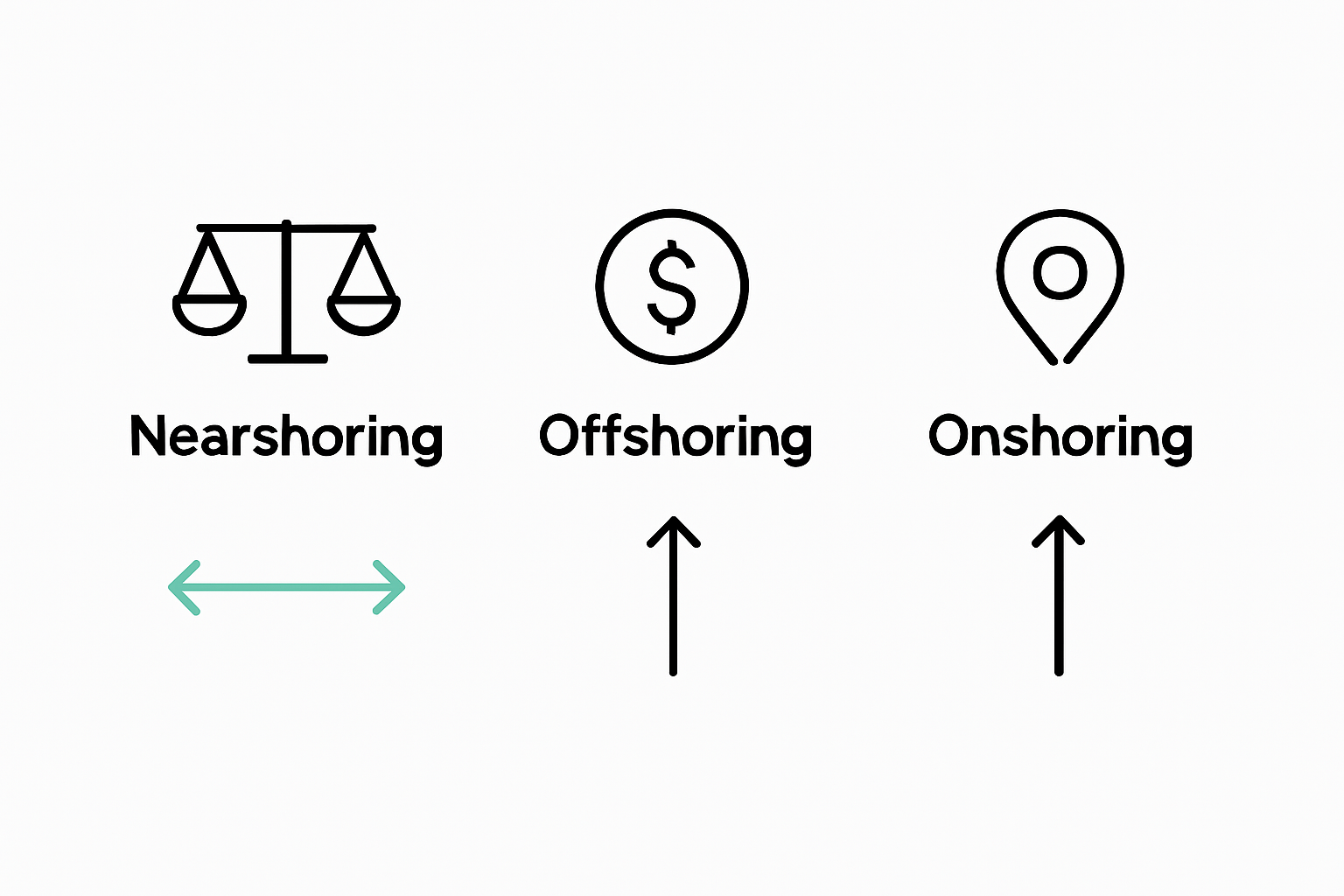
Offshoring traditionally emphasizes maximizing cost reduction by leveraging extremely low-wage markets, often sacrificing communication quality and cultural synchronization. Onshoring, conversely, keeps operations within national boundaries, prioritizing complete cultural alignment but potentially incurring substantially higher operational expenses. Nearshoring emerges as a balanced approach, offering a compelling middle ground that combines cost efficiency with operational excellence.
The strategic selection between these models depends on specific organizational requirements, including budget constraints, project complexity, required skill sets, and desired level of operational integration. Successful companies increasingly recognize nearshoring as a sophisticated solution that delivers optimal value through strategic talent acquisition, reduced logistical challenges, and enhanced collaborative potential.
Unlock Scalable Growth and Cost Efficiency with Expert Nearshoring Solutions
The article highlights critical challenges companies face around scalability and cost savings when expanding operations. If you want to leverage the substantial benefits of nearshoring such as quick workforce expansion, access to specialized talent, and meaningful operational cost reductions, then finding a trusted partner is essential. Concepts like optimizing business process scalability and strategic cost savings need hands-on expertise to transform theory into real competitive advantages.
At StorsenDigital, we specialize in delivering tailored nearshoring and managed BPO services across Europe that align perfectly with your growth objectives. Our dedicated team and hybrid engagement models empower your company to scale efficiently while controlling expenses. We understand the value of seamless communication and cultural alignment emphasized in the article, ensuring smooth collaboration with your extended teams. Discover how our strategic consulting and talent recruitment services can secure your operational success in today’s dynamic market.

Ready to accelerate your business transformation through nearshoring advantages discussed in this article Explore our comprehensive outsourcing solutions by contacting us today. Don’t wait to optimize costs and boost workforce agility Visit Contact StorsenDigital now and take the first step toward scalable growth and enhanced operational efficiency.
Frequently Asked Questions
What are the main advantages of nearshoring?
The primary advantages of nearshoring include scalability, cost savings, and immediate access to specialized talent pools. Businesses can quickly expand their workforce without the overhead costs typical of traditional hiring models.
How does nearshoring improve operational efficiency?
Nearshoring enhances operational efficiency through robust communication frameworks, agile methodologies, and cross-cultural collaboration. These factors allow for real-time collaboration and quicker decision-making processes.
Is nearshoring only about reducing costs?
No, while nearshoring can lead to significant cost reductions, it also provides access to specialized talent, improves operational agility, and fosters strategic partnerships, making it a holistic business strategy.
What types of nearshoring models are available?
The major nearshoring models include the Dedicated Team Model, Managed Services Model, and Hybrid Engagement Model. Each offers unique advantages depending on specific business needs and objectives.


