


Pressure mounts when your company expects you to deliver measurable cost savings while keeping operations smooth. For many European operations managers, outsourcing through Business Process Outsourcing feels promising, yet the risk of misalignment and project confusion is high without a strong foundation. By focusing first on clear objectives and precise BPO scope, you set the groundwork for a controlled outsourcing process that aligns with your business priorities and teams.
Table of Contents
- Step 1: Define Objectives And Select BPO Scope
- Step 2: Assess Current Processes And Gather Requirements
- Step 3: Identify And Onboard The Right BPO Partners
- Step 4: Set Up Operational Frameworks And Communication
- Step 5: Monitor Performance And Verify Outcomes
Quick Summary
| Key Point | Explanation |
|---|---|
| 1. Define clear objectives | Understand what you want to achieve before outsourcing to align team expectations and minimize confusion. |
| 2. Document detailed requirements | Create a comprehensive requirements document to guide the vendor’s work and eliminate gaps in understanding. |
| 3. Choose the right vendor | Evaluate potential partners based on criteria like capabilities, experience, and cultural fit to ensure alignment with your goals. |
| 4. Establish strong governance | Define oversight structures and communication protocols to manage the partnership effectively and resolve issues quickly. |
| 5. Continuously monitor performance | Regularly track metrics related to quality, speed, and cost to ensure the vendor meets expectations and adjust strategies as needed. |
Step 1: Define objectives and select BPO scope
This is where your entire BPO initiative takes shape. Before you engage vendors, allocate budgets, or restructure teams, you need absolute clarity on what you’re outsourcing and why. Getting this step right dramatically increases your chances of success, while skipping it or rushing through it creates the kind of chaos that derails projects months in.
Start by asking yourself the hard questions about what you’re actually trying to accomplish. Are you outsourcing to reduce headcount costs, access specialized skills, improve service quality, or free up internal teams to focus on strategic work? Most likely, it’s a combination. The challenge is that these objectives can pull in different directions, so you need to rank them. Defining clear engagement objectives aligned with your business goals ensures your entire team understands what success looks like. This prevents the situation where your finance team thinks you’re cutting costs, while your operations team expects better service delivery.
Once you’ve clarified your primary objectives, get specific about scope. Scope answers the practical question: what exactly is being outsourced and what stays in-house? Here’s where precision matters. Too broad a scope becomes uncontrollable and impossible to measure. Too narrow and you don’t realize the full value. Most operations managers find it helpful to map out your current processes first. Which functions take the most resources? Which have the highest error rates? Which are repetitive and rule-based versus requiring constant judgment? Your BPO scope should target processes that are standardizable, repeatable, and clearly defined.
Break your scope definition into these categories:
- Core processes: The main activities you’re considering for outsourcing (payroll, accounts payable, customer support, etc.)
- Specific tasks within those processes: Not entire departments, but defined workflows (invoice processing, ticket resolution, data entry)
- Volume and complexity: How many transactions, what exception rates, what skill levels required?
- Technology dependencies: What systems must connect to the outsourced operation
- Quality metrics: What does success actually look like in measurable terms
Clear scope prevents scope creep. Without explicit boundaries, vendors will gradually expand what they’re handling, and you’ll gradually expect more than you’re paying for.
Another critical piece: identify what stays internal. Sometimes what you keep in-house is as important as what you outsource. Many European tech firms outsource routine customer support but maintain in-house technical support for complex issues. They offshore invoice processing but keep high-value supplier negotiations internal. This hybrid approach lets you reduce costs while protecting strategic capabilities.
Here is a comparison of what to keep in-house versus what to outsource in a typical BPO initiative:
| Work Type | Best Kept In-House | Ideal for Outsourcing |
|---|---|---|
| Strategic decision making | Core business strategy, innovation | Transactional processing, data entry |
| High-value negotiations | Major supplier partnerships | Routine contract administration |
| Complex issue resolution | Technical customer support | Standard support, FAQ handling |
| Regulatory compliance | Internal controls, audits | Routine compliance reporting |
| Process improvement | Business transformation | Process documentation and monitoring |
At StorsenDigital, we’ve seen operations managers succeed when they treat this definition phase as a collaboration between finance, operations, and the business units affected by outsourcing. Each perspective reveals different risks and opportunities. When you’re ready to move into vendor selection with these foundations solid, you’ll make faster decisions and negotiate better terms. Check out the managed BPO implementation guide for scalable operations to understand how strategic scope definition connects to sustainable scaling. This foundational clarity also makes it easier for partners like StorsenDigital to build dedicated teams that actually meet your needs, delivering the cost advantages and operational efficiency you’re after.
Document everything you’ve decided at this stage. Put it in writing. Circulate it internally. Get sign-off from key stakeholders. This document becomes your reference point throughout the entire implementation process, and it’s what you’ll use to evaluate vendor proposals. You’ll return to it constantly to resolve ambiguities and prevent mission creep.
Pro tip: Create a one-page scope summary with your top 3 objectives, the specific processes you’re outsourcing, and the measurable success metrics you’ll track. Keep this visible throughout vendor selection and implementation, and you’ll avoid the scope expansion that derails most BPO projects.
Step 2: Assess current processes and gather requirements
Now that you know what you’re outsourcing, you need to understand exactly how it currently works. This step separates successful BPO implementations from the ones that stumble. You’re not just documenting what happens today, you’re capturing the detailed requirements that will define what your vendor needs to deliver. Think of it as creating a complete blueprint of your operation before handing it over.

Start by mapping your current state. Walk through each process you’ve identified for outsourcing. How many steps does it take from start to finish? Who touches it at each stage? What systems are involved? Where do errors typically occur? What takes the most time? You’ll want to talk to the people actually doing the work, not just their managers. The accounts payable specialist knows the quirks and exceptions that the finance director might not mention. The customer support team knows which types of requests cause friction. Engaging diverse stakeholders through interviews and workshops gives you the complete picture you need, not just the sanitized version.
As you gather information, document these specific requirements across multiple dimensions. Business requirements answer the “why” and “what” questions about your outsourcing goals and expected outcomes. Stakeholder requirements capture what different teams and roles need from the outsourced process. Solution requirements detail how the work should actually be performed, including specific steps, systems, and quality standards. Transition requirements address how you’ll move from your current operation to the vendor’s operation without disrupting your business. Each category matters because gaps in any one of them create problems down the line.
Here’s what you should be capturing during this assessment phase:
- Process volumes and timing: How many transactions per day, week, or month? When do peaks occur? What are turnaround time expectations?
- Quality standards: What error rates are acceptable? What constitutes rework? What are your SLA requirements?
- System connections: What platforms must integrate with the outsourced process? What data flows in and out? What are the technical requirements?
- Exception handling: What percentage of work requires human judgment or escalation? How should these be handled?
- Compliance and security: What regulations apply? What data classifications are involved? What audit trails are required?
- Current pain points: What doesn’t work well today? What would you like to improve? What creates bottlenecks?
Incomplete requirements gathering is the silent killer of BPO projects. You’ll discover missing requirements when implementation is underway, and by then fixing them is expensive and disruptive.
Take time to analyze what you’ve gathered. Requirements gathering reduces misunderstandings by ensuring that your vendor solution is well-defined and truly targets your business goals. Look for patterns. Are there 10 common exception scenarios or 100? Is the process relatively straightforward or genuinely complex? Do you need specialized skills or is it routine work? These insights directly influence which vendors can succeed with your work and how much you should expect to pay.
Create a requirements document that’s detailed enough for a vendor to price and execute your work, but not so overwhelming that it becomes unwieldy. Many operations managers find success with a tiered approach: a high-level overview that explains context and business drivers, followed by detailed process maps and specific requirement tables. Include examples of actual transactions or scenarios. If you outsource invoice processing, show three representative invoices and walk through how each should be handled. Real examples clarify what “routine” and “complex” actually mean.
Before you move forward, validate your requirements with your stakeholders. Does this match how things actually work? Did you miss anything important? Are there details that conflict? Getting alignment here prevents the vendor from delivering something that technically meets requirements but misses what you actually needed. StorsenDigital builds dedicated teams based on detailed requirements like these, and we’ve learned that the clearest requirements lead to the smoothest implementations and strongest outcomes. The more precisely you define what success looks like in this phase, the faster your vendor can get productive and the better your cost savings will materialize.
Pro tip: Create a requirements validation checklist with your key stakeholders and walk through it before finalizing your requirements document. Have them sign off on it. This simple step prevents the “but I thought you meant” conversations that derail implementations months in.
Step 3: Identify and onboard the right BPO partners
You’ve defined your scope and documented your requirements. Now comes the decision that will shape your entire BPO experience: choosing the right partner. This isn’t just about finding someone who can handle the work. It’s about finding someone whose capabilities, culture, and commitment align with your goals. A mediocre vendor executing excellent requirements will still deliver mediocre results. A great vendor aligned with your expectations and equipped with the right governance structure will transform your operation.
Start by identifying potential vendors against concrete criteria. Don’t just rely on vendor websites and sales pitches. Create an evaluation matrix that weighs factors like technical capability, domain experience, financial stability, security certifications, cultural fit, and geographic location. For European operations managers, proximity and time zone alignment matter. You want a partner you can work with in real time, not one where communication happens through time zone gaps. Assess whether vendors have specific experience with your industry or process type. A vendor who has handled invoice processing for tech companies will ramp faster than one doing it for the first time. Look at their team composition. Do they have dedicated teams or do they rotate resources? How stable is their workforce? Check references thoroughly. Talk to current clients about actual experience, not just what vendors want you to hear.
Once you’ve narrowed your list, governance aligned with process interdependence and strategic importance becomes critical. Different processes require different oversight models. A routine, straightforward process might need lighter governance. A complex, strategically important process needs robust contract definition, relationship management structures, and clear escalation paths. Discuss with potential vendors how they’ll structure their governance with you. Will you have a dedicated account manager? How often will you review performance? What’s the escalation process when issues arise? How will you handle process improvements over time? These conversations reveal whether vendors think like partners or like vendors.
Evaluation typically involves multiple stages:
- Request for Information (RFI): Get basic company and capability information from multiple vendors to narrow your list
- Request for Proposal (RFP): Present your requirements to shortlisted vendors and ask them to propose how they’ll execute your work, their pricing, and their implementation timeline
- Vendor presentations: Have your top candidates present their approach and answer detailed questions from your team
- Site visits or reference calls: Meet the team that will actually execute your work, not just the salespeople
- Final negotiation: Work with your top choice to finalize contract terms, service levels, and implementation approach
A vendor who pushes back on your requirements and asks clarifying questions is often better than one who says yes to everything. They’re thinking like partners, not just trying to make a sale.
Onboarding is where many partnerships falter. The vendor you selected now needs to understand your business deeply, meet your team, and transition the work smoothly. Effective onboarding involves structured collaboration, clear communication about expectations, and adaptation to your specific operational needs. Don’t treat onboarding as a quick handoff. Build in time for knowledge transfer. Have your current team work with the vendor’s team for an overlap period. Document workarounds and undocumented processes. Show them the exceptions that don’t appear in any manual. Introduce them to your stakeholders. Help them understand why things matter, not just how to do them.
Create an onboarding timeline with clear milestones. When will the vendor achieve basic competency? When will they handle high-volume work independently? When will you scale to full volumes? What’s the quality expectation during ramp up? Most vendors need 4 to 12 weeks to reach full productivity, depending on complexity. Don’t expect perfection immediately, but do expect improvement week over week. StorsenDigital’s approach to BPO onboarding for European enterprises emphasizes dedicated teams that understand your business context and maintain stability throughout the relationship. This focus on genuine partnership, rather than transactional outsourcing, creates the foundation for long-term success and measurable business value. The right partner becomes an extension of your team, delivering the cost advantages and operational improvements you’re seeking.
Measure your vendor’s performance from day one. Track quality, speed, and cost against your agreed service levels. When something doesn’t meet expectations, address it quickly. Most issues are easier to fix in the first month than in the twelfth month. Build a regular cadence of reviews where you discuss performance, identify improvement opportunities, and plan for growth or process changes. The vendors who thrive are ones who actively pursue improvement, not ones who just maintain status quo.
Pro tip: Request a detailed onboarding plan from each vendor during your RFP process. The quality of their plan reveals how seriously they take the transition. Vendors with thorough, realistic onboarding plans typically deliver better outcomes than those with vague timelines.
Step 4: Set up operational frameworks and communication
You’ve selected your partner and started onboarding. Now you need to create the operational structures and communication rhythms that will keep your partnership functioning smoothly. Think of this as building the skeleton that holds everything together. Without clear frameworks, even the best vendors will struggle, and even simple processes become complicated. With solid frameworks, your partnership scales efficiently and problems get resolved quickly.
Start by defining your governance structure. This is your oversight and decision-making system. Who owns what? If the vendor encounters a problem, who escalates it and to whom? How often do you review performance? What meetings are non-negotiable? Most successful partnerships have multiple governance layers. Weekly tactical meetings focus on immediate operational issues like quality problems or volume spikes. Monthly business reviews examine performance against service levels and discuss optimization opportunities. Quarterly strategic reviews look at the bigger picture: are we hitting our objectives? Should we adjust scope or approach? Establishing control over outsourced processes requires clear responsibilities, monitoring, and performance criteria that integrate the vendor into your quality management system. Document your governance model in writing so there’s no ambiguity about who does what and when.
Designate clear roles and responsibilities. Appoint an internal BPO program owner who has authority to make decisions about the outsourced process. This person is the vendor’s main point of contact and owns the relationship on your side. On the vendor side, ensure you have a dedicated account manager who is empowered to make decisions without constantly waiting for approval from their company. Create a steering committee with representatives from finance, operations, and any affected business units. This group meets quarterly to discuss strategic direction and resolve issues that operational teams can’t handle. Establish an operational task force of people actually doing or managing the work. This group meets weekly to solve day to day problems.
Communication cadence is critical. Effective communication evolves during the outsourcing lifecycle and requires consistent engagement beyond just transactional exchanges. Here’s a typical rhythm for tech firms outsourcing established processes:
- Daily: Vendor sends you a brief status update on volumes processed, quality metrics, and any blockers
- Weekly: Your task force meets with the vendor to discuss issues, resolve problems, and plan the week ahead
- Bi-weekly: Review detailed performance data against service levels and discuss trends
- Monthly: Business review meeting where leadership from both sides discusses performance, improvements, and strategic direction
- Quarterly: Steering committee meeting focused on bigger picture topics like process improvements, scope adjustments, or cost optimization
- Annual: Comprehensive partnership review covering everything from relationship health to contract renewal discussions
Over-communication is almost impossible in outsourcing. Under-communication creates misunderstandings that fester into serious problems. Build in more communication than feels necessary.
Define your performance metrics and dashboards before you need them. What will you actually measure? Most outsourced processes track quality (error rates, rework), speed (turnaround time, throughput), and cost (cost per transaction). Create a simple dashboard your vendor updates daily or weekly. You should be able to glance at it and know immediately whether things are on track. When metrics slip, there should be a documented process for how you address it. Is there an automatic escalation if quality drops below a certain threshold? What triggers a problem resolution meeting? Clear processes prevent the situation where you complain but nothing changes.
Establish your escalation paths before problems arise. What happens if the vendor misses a deadline? What if quality drops? What if they lose key staff? Who decides whether to issue a warning, impose penalties, or terminate the relationship? Put this in writing. It removes emotion from difficult conversations and gives your vendor clear understanding of expectations.
Set up your communication protocols. How will you communicate? Email, Slack, project management software, or a combination? When should the vendor call you versus email? What about urgent issues that need response outside normal business hours? Clarify what each communication channel is for. Email for documentation, Slack for quick questions, scheduled calls for complex discussions. This prevents the situation where something urgent gets lost in email because everyone thought someone else saw it.
Finally, create a documentation system where you capture decisions, agreements, and changes. When you agree to modify a process, document it. When you change a service level, update it in writing. When you make an exception to your normal procedures, record it. This documentation becomes invaluable when disputes arise or new team members join. StorsenDigital’s operational framework emphasizes these structured communication protocols and clear accountability, ensuring that your partnership operates with transparency and consistency. Visit www.storsendigital.com to explore how established operational frameworks support successful long-term partnerships and drive measurable business outcomes. The frameworks you build now prevent 90 percent of the problems that derail outsourcing partnerships.
Pro tip: Establish one “no surprises” rule: the vendor calls you immediately if something happens that could impact your business, even if they don’t yet have a solution. This early warning system gives you time to prepare contingencies instead of discovering problems when they explode.
Step 5: Monitor performance and verify outcomes
Your BPO partnership is now operational. The vendor is processing work, and your frameworks are in place. But this isn’t the time to step back and hope everything works. This is the time to monitor closely, measure rigorously, and verify that you’re actually getting the results you expected. Performance monitoring isn’t punitive. It’s how you ensure your partnership stays healthy and catches problems early before they become crises.
Start by collecting your baseline metrics. Before the vendor took over, what was your actual performance? How many invoices did you process daily? What was your error rate? How long did things take? How much did it cost? You need these numbers so you can measure whether the vendor is actually improving your operation or just maintaining the status quo at a lower cost. Many operations managers skip this step and later can’t prove whether their BPO is delivering value. Track these baseline metrics carefully during the first month of vendor operation. This becomes your reference point for everything that follows.
Monitor key performance indicators across three critical dimensions. Quality metrics tell you whether the work is being done correctly. Error rates, rework percentages, and customer complaint rates all matter here. A vendor might process invoices quickly but make so many mistakes that your accounting team spends all day fixing them. That’s not a win. Speed metrics measure how fast the vendor is working. Turnaround time, throughput, and meeting deadlines all fall here. Processing 1,000 invoices slowly might be worse than processing 500 invoices quickly if your cash flow depends on speed. Cost metrics track whether you’re actually saving money. Cost per transaction, total monthly cost, and cost trends over time. The vendor might maintain quality and speed but quietly add headcount that drives costs up. These three dimensions must be balanced. A vendor optimizing for only one dimension while ignoring the others will create problems.
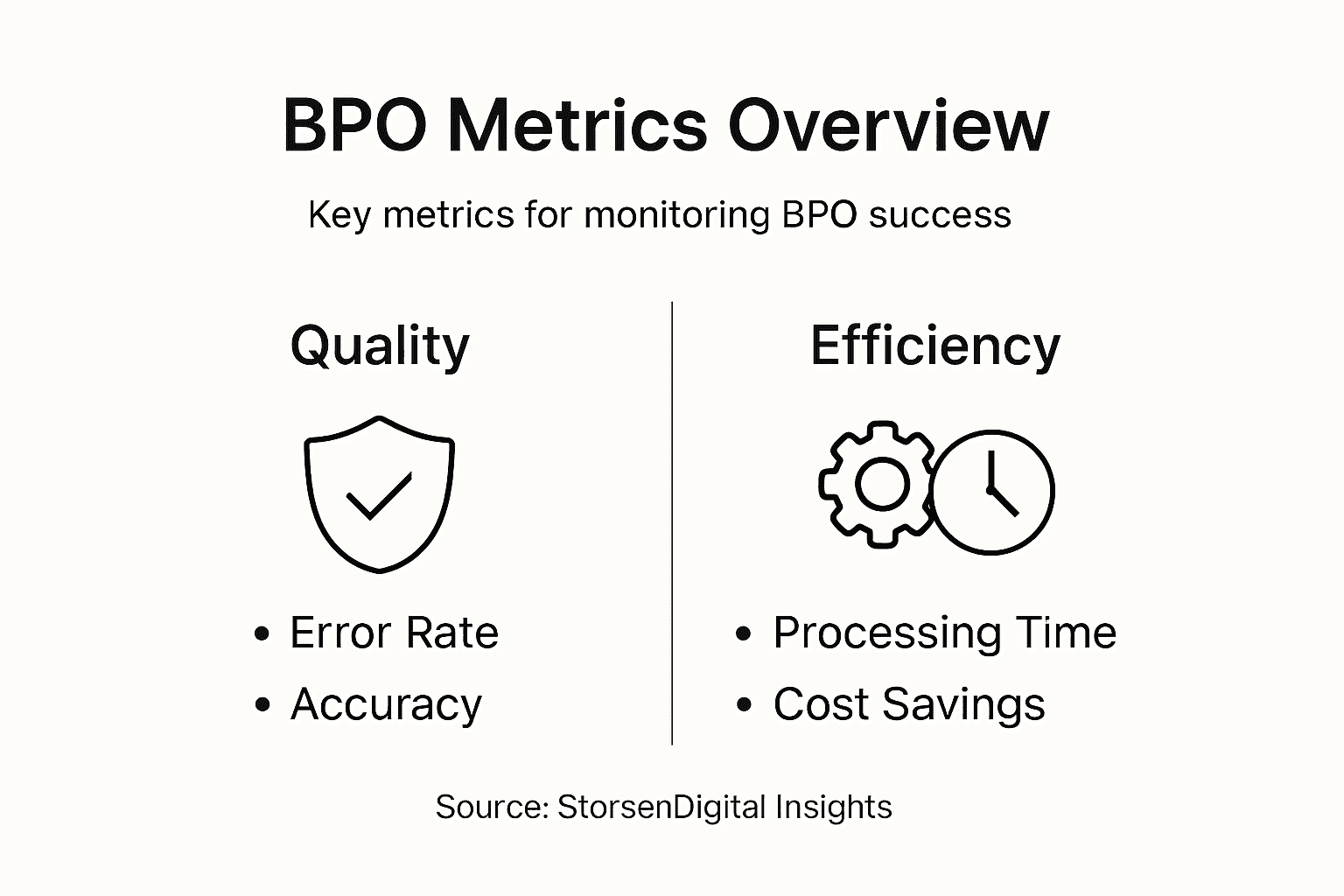
Set up your performance dashboard to track these metrics daily or weekly. Your vendor should provide this data automatically. You shouldn’t have to ask for it. Most vendors use simple spreadsheets or specialized BPO management software that shows real time metrics. You want to see at a glance whether you’re on track or slipping. When metrics slip, you need a clear trigger for action. Many successful partnerships define specific thresholds. If quality drops below 98 percent, you automatically escalate. If turnaround time extends beyond two days, you schedule a problem solving meeting. Transparent performance evaluation frameworks promote fairness and help identify training needs while supporting accountability. This objectivity removes emotion from performance discussions and gives your vendor clear targets to hit.
To help you monitor your BPO vendor effectively, here is a summary of essential performance metrics and what each reveals:
| Metric Type | What It Measures | Business Relevance |
|---|---|---|
| Quality | Error or defect rates | Ensures deliverables meet expectations |
| Speed | Turnaround time | Impacts responsiveness and cash flow |
| Cost | Expense per unit | Validates savings from outsourcing |
| Improvement | Trend over time | Highlights process optimization gains |
Conduct regular performance reviews at multiple levels. Weekly operational reviews focus on immediate issues. Did the vendor meet last week’s targets? What’s causing any shortfalls? What’s the plan to fix it? Monthly business reviews dig deeper. Are we trending in the right direction? Are there patterns we should address? Do we need process adjustments? Quarterly strategic reviews examine the bigger picture. Are we hitting our overall objectives? Should we expand or modify scope? What improvements should we prioritize? Annual reviews reset expectations and plan for the year ahead.
Implement a continuous feedback loop. Implementation evaluations assess compliance and promote learning by monitoring whether the BPO delivers as planned and identifying barriers to success. When something isn’t working, address it immediately. Don’t wait for your monthly meeting. Tell your vendor the same day you notice a problem. Give them time to investigate and respond, but don’t let issues fester. Most vendor problems are easier to fix when caught early. A quality issue in week one is a training problem. A quality issue in month four is a culture or system problem.
Verify that you’re actually achieving your original objectives. Go back to why you outsourced this work. Were you trying to reduce costs? Measure your actual savings compared to your baseline. Were you trying to improve quality? Compare error rates before and after. Were you trying to free up internal staff? Track how your team is actually using the time saved. If you’re not seeing the benefits you expected, you need to understand why and fix it. Sometimes the issue is with the vendor. Sometimes it’s with your internal processes. Sometimes it’s that your original assumptions were wrong. Either way, knowing the difference matters.
Create a corrective action process for when metrics don’t meet expectations. When the vendor misses a target, what happens? First, you investigate. Is it a training issue? A process issue? A resource issue? Once you understand the root cause, you work together on a solution. You might need to provide additional training, adjust the process, or add resources. Document the issue, the root cause, and the solution. Track whether the solution actually works. If metrics don’t improve after 30 days, you escalate. Maybe you adjust the vendor’s pricing or service levels. Maybe you consider finding a different vendor. The key is having this conversation from a place of data, not frustration.
Beyond the metrics, stay connected to the actual work. Visit your vendor occasionally if they’re located nearby. See how your team is integrated. Meet the people doing your work. Understand their challenges. This human connection strengthens the partnership and gives you insight that numbers alone can’t provide. Ask your vendor what they think could improve. They’re often closer to the work than you are and see opportunities you might miss. When vendors feel like true partners rather than just vendors, they put more effort into your account.
Remember that BPO implementations mature over time. First month performance is rarely representative of steady state performance. Expect the vendor to get progressively better. Quality should improve as they understand exceptions. Speed should improve as they build efficiency. Cost might improve as they optimize staffing. Set realistic improvement targets. You won’t see all your benefits on day one, but you should see steady progress. StorsenDigital’s approach emphasizes continuous performance monitoring and partner collaboration, ensuring that your partnership delivers consistent value and adapts to your evolving needs. Visit www.storsendigital.com to learn how dedicated teams and robust performance frameworks drive measurable outcomes for European tech firms. Performance monitoring keeps your partnership healthy and ensures your BPO continues delivering the cost advantages and operational improvements you’re seeking.
Pro tip: Create a “monthly metrics pack” that shows your three most important metrics in simple visual format. Review this with your vendor monthly. When everyone is looking at the same data, conversations shift from blame to problem solving.
Achieve Seamless BPO Success with Tailored European Solutions
Navigating the complexities of BPO implementation demands clear objectives, precise scope definition, thorough requirements gathering, and strong operational frameworks. If you feel overwhelmed by managing vendor selection or worry about maintaining consistent quality and cost control, you are not alone. Many operations managers share these challenges when striving to optimize outsourced processes like finance, HR, or customer support while preserving strategic control.
At StorsenDigital, we specialize in crafting managed BPO solutions designed specifically for European enterprises seeking scalable, reliable, and cost-effective nearshoring partnerships. Our expertise covers every stage highlighted in the article whether you need help defining scope, assessing detailed requirements, identifying qualified partners, or setting up governance frameworks that prevent scope creep and performance pitfalls. We build dedicated teams that integrate smoothly with your operations to deliver measurable improvements in quality, speed, and cost.

Explore how our comprehensive BPO services can transform your outsourcing journey. Connect with us today through our contact page to start a conversation tailored to your objectives. Learn more about our managed BPO implementation guide for scalable operations and discover how expert onboarding and performance monitoring can safeguard your investment. Take the next step toward seamless outsourcing success by partnering with a trusted provider who understands your European market needs.
Frequently Asked Questions
What are the first steps in a BPO implementation process?
Begin by defining your objectives and selecting the scope of your BPO initiative. Clarify what you want to achieve and identify which processes will be outsourced to ensure everyone is aligned on success.
How do I assess my current processes before outsourcing?
To assess your current processes, map out the existing workflows, identify key stakeholders, and gather detailed information on performance metrics. Engage those involved in the processes to pinpoint pain points and areas for improvement.
What criteria should I use to select the right BPO partner?
Evaluate potential BPO vendors based on their technical capabilities, domain experience, financial stability, and cultural fit. Create a detailed evaluation matrix to rank vendors objectively and ensure they can meet your specific needs.
How can I effectively monitor the performance of a BPO vendor?
Set clear performance metrics and dashboards to track quality, speed, and cost. Collect data regularly and perform performance reviews to quickly identify issues, ensuring that your BPO partnership remains healthy and effective.
What should I include in the communication framework with my BPO partner?
Establish a governance structure that outlines roles, responsibilities, and communication protocols. Define a regular meeting cadence to review performance, resolve issues, and ensure alignment on objectives.
How do I document requirements for the BPO vendor?
Create a detailed requirements document that specifies business needs, stakeholder expectations, and solution parameters. Include examples and be sure to validate this document with key stakeholders before sharing it with potential vendors.


