


Over 60 percent of European tech firms now adopt american-style BPO onboarding practices to fill talent gaps and boost scalability. For C-suite executives and procurement leaders, the onboarding process sets the pace for rapid operational growth and effective team integration. This guide brings precision and clarity to each step, so you can confidently design workflows that drive measurable efficiency and secure cross-border talent alignment.
Table of Contents
- Step 1: Assess Onboarding Requirements And Set Objectives
- Step 2: Develop Tailored Onboarding Documentation And Tools
- Step 3: Coordinate Internal And External Process Stakeholders
- Step 4: Implement Workflow Training For BPO Teams
- Step 5: Validate Onboarding Success With Performance Checks
Quick Summary
| Key Point | Explanation |
|---|---|
| 1. Assess onboarding requirements and set objectives | Conduct an internal audit to identify operational gaps and future needs; use SMART criteria for setting measurable goals. |
| 2. Develop tailored onboarding documentation and tools | Create customized onboarding resources for clarity and knowledge transfer, including role-specific manuals and compliance guidelines. |
| 3. Coordinate internal and external process stakeholders | Establish a communication framework to ensure alignment among all stakeholders, both internal departments and external team members. |
| 4. Implement workflow training for BPO teams | Design a structured training program using e-learning and interactive techniques that focus on both technical skills and cultural alignment. |
| 5. Validate onboarding success with performance checks | Use KPIs and continuous feedback mechanisms to measure training effectiveness and team performance, ensuring ongoing improvement. |
Step 1: Assess onboarding requirements and set objectives
Navigating the BPO onboarding workflow for European enterprises requires a strategic approach to understanding your specific organizational needs and establishing clear performance benchmarks. This initial assessment phase determines the foundation for successful talent integration and operational alignment.
Start by conducting a comprehensive internal audit of your current operational gaps and future scalability requirements. Engage key stakeholders from departments like Human Resources, IT, Finance, and Operations to gather holistic insights. Your goal is to create a detailed profile of the exact skills, technical capabilities, and cultural competencies needed for your dedicated nearshore team. Consider factors such as language proficiency, technical expertise, industry experience, and adaptability to your specific work processes.

Document your objectives with precision using the SMART framework (Specific, Measurable, Achievable, Relevant, Time-bound). This approach transforms vague aspirations into concrete milestones that can be tracked and evaluated. For instance, instead of stating “improve customer support,” define a specific target like “reduce customer response times by 40% within six months by leveraging StorsenDigital’s specialized talent pool”
Pro tip: Conduct a pre-onboarding skills gap analysis to identify exact training requirements and create tailored integration strategies that minimize transition friction.
Step 2: Develop tailored onboarding documentation and tools
Creating comprehensive and customized onboarding documentation is a critical step in establishing a smooth integration process for your nearshore team. Your goal is to develop a robust set of resources that not only communicate your organizational expectations but also facilitate seamless knowledge transfer and cultural alignment.
Begin by leveraging comprehensive document templates and collaboration tools that enable precise customization across different roles and regional requirements. Focus on developing modular documentation that can be easily adapted to specific team member responsibilities. This includes creating role-specific process manuals, compliance guidelines, communication protocols, and performance expectation documents. Reference the essential onboarding documentation framework to ensure you cover all critical aspects such as legal requirements, cultural integration guidelines, technical process descriptions, and role-specific training materials.
Implement a digital document management system that allows for version control, secure access, and real-time updates. This approach ensures that all team members have access to the most current information while maintaining a centralized repository of organizational knowledge. Prioritize creating documents that are clear, concise, and visually engaging to enhance comprehension and retention.
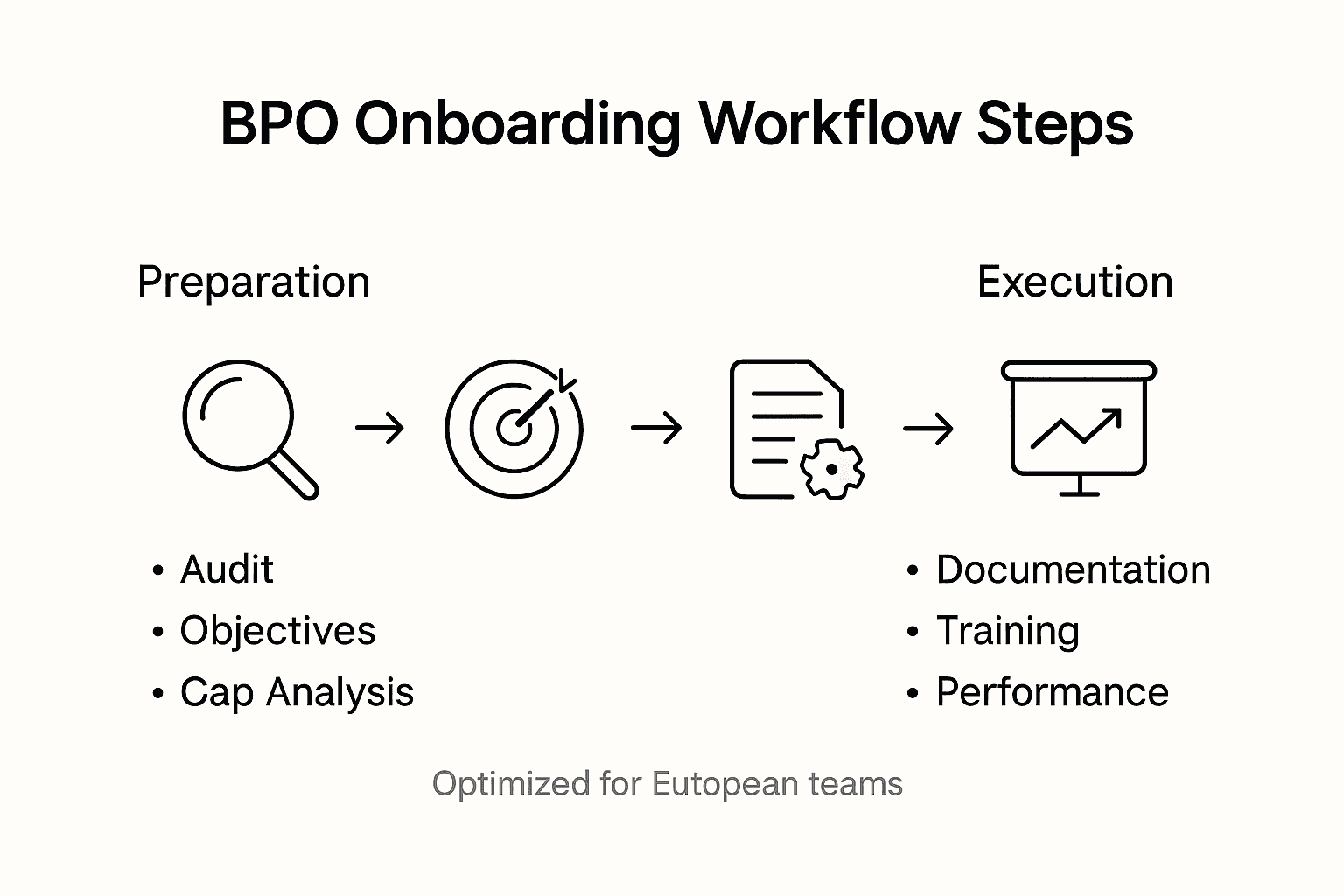
Here’s how onboarding documentation elements support successful integration:
| Documentation Type | Key Purpose | Business Impact |
|---|---|---|
| Role-specific Manuals | Clarify duties and workflows | Faster team ramp-up |
| Compliance Guidelines | Ensure regulatory alignment | Reduced legal risk |
| Communication Protocols | Standardize interactions | Stronger team collaboration |
| Performance Expectation Docs | Define benchmarks | Improved accountability |
Pro tip: Design your onboarding documentation with a modular approach that allows for quick updates and easy translation across different language requirements.
Step 3: Coordinate internal and external process stakeholders
Successfully managing stakeholder coordination is a critical component of a seamless BPO onboarding workflow, requiring strategic communication and alignment across multiple organizational layers. This step focuses on creating a collaborative ecosystem that bridges internal departments and external team members to ensure smooth integration and operational efficiency.
Begin by developing a comprehensive stakeholder coordination framework that facilitates collaborative innovation across different organizational boundaries. Identify key internal stakeholders from departments like Human Resources, IT, Finance, and Operations who will play crucial roles in the onboarding process. Simultaneously, map out external stakeholders including your nearshore team leaders, potential vendor representatives, and regional compliance experts. Establish clear communication protocols that define roles, responsibilities, expectations, and channels for ongoing dialogue.
Implement a structured communication strategy that emphasizes transparent and frequent interactions. Utilize agile onboarding approaches that promote cross-functional collaboration and trust-building between internal and external team members. Schedule regular check-ins, create shared digital workspaces, and develop standardized reporting mechanisms that keep all stakeholders informed and engaged throughout the onboarding journey.
Pro tip: Create a centralized digital dashboard that provides real-time visibility into onboarding progress for all stakeholders, reducing communication gaps and enhancing overall coordination efficiency.
Step 4: Implement workflow training for BPO teams
Designing an effective workflow training program is crucial for transforming your nearshore team into a high-performance operational unit. This step focuses on creating a comprehensive learning strategy that accelerates skill development and ensures consistent performance across your BPO team.
Develop a centralized training approach that leverages e-learning platforms and AI-powered guidance tools to standardize workflow competency. Create modular training modules that break down complex processes into digestible segments, allowing team members to progressively build their skills. Incorporate interactive elements like simulation exercises, real-world scenario practices, and knowledge assessment checkpoints to reinforce learning and validate comprehension. Focus on creating training content that not only teaches technical skills but also emphasizes cultural alignment and communication protocols specific to your organizational ecosystem.
Establish a continuous learning framework that goes beyond initial onboarding. Implement regular skills refresher courses, peer-to-peer knowledge sharing sessions, and performance-based learning paths that adapt to individual team member development needs. Utilize analytics and feedback mechanisms to continuously refine your training approach, ensuring that your BPO team remains agile and responsive to evolving business requirements.
Pro tip: Integrate microlearning techniques that deliver bite-sized, just-in-time training content directly within your team’s workflow tools, enabling continuous skill enhancement without disrupting operational productivity.
Step 5: Validate onboarding success with performance checks
Validating the effectiveness of your BPO onboarding process is crucial for ensuring long-term team performance and continuous organizational improvement. This step focuses on establishing a robust framework for measuring and analyzing your new team members performance and integration success.
Implement a comprehensive performance evaluation system that tracks multiple dimensions of new hire productivity and engagement. Develop a structured set of key performance indicators (KPIs) that go beyond traditional metrics. These should include quantitative measures like task completion rates and quality scores, alongside qualitative assessments such as cultural alignment, communication effectiveness, and team collaboration. Create performance dashboards that provide real-time insights into ramp-up speed and compliance with service level agreements, enabling rapid identification of potential skill gaps or training needs.
Establish a continuous feedback loop that transforms performance data into actionable insights. Schedule regular review sessions with team leaders and new hires to discuss individual progress, challenges, and opportunities for growth. Use multi-source feedback mechanisms that incorporate perspectives from peers, managers, and self-assessment to create a holistic view of each team member performance. Design adaptive learning paths that can be dynamically adjusted based on these ongoing performance evaluations, ensuring your onboarding process remains responsive and targeted.
Here’s a summary of BPO onboarding performance evaluation metrics:
| Metric | Measurement Focus | Example Application |
|---|---|---|
| Task Completion Rate | Productivity | Tracks daily deliverables |
| Quality Scores | Service accuracy | Monitors error rates |
| Cultural Alignment | Integration effectiveness | Surveys and peer feedback |
| Communication Effectiveness | Team interaction quality | Reviews meetings and emails |
| Collaboration | Cross-team cooperation | Assesses group tasks |
Pro tip: Implement a 90-day comprehensive performance assessment that combines quantitative metrics with qualitative feedback to provide a nuanced understanding of new team member integration and potential.
Streamline Your BPO Onboarding with StorsenDigital’s Nearshore Expertise
Effectively managing the BPO onboarding workflow is crucial for European enterprises aiming to build high-performing dedicated teams without costly delays or misalignment. If you are facing challenges like skill gaps, complex stakeholder coordination, or ensuring cultural integration, our tailored nearshore solutions at StorsenDigital can directly address these pain points. We specialize in creating customized onboarding documentation, comprehensive workflow training, and continuous performance validation to accelerate your team ramp-up and operational success.

Discover how partnering with StorsenDigital lets you leverage European talent while optimizing costs and maintaining precise control over your BPO operations. Ready to turn onboarding challenges into competitive advantages Start your journey with us now by contacting our team at StorsenDigital Contact. Learn more about how our nearshoring services and managed BPO solutions can transform your enterprise’s outsourcing performance.
Frequently Asked Questions
What are the initial steps in a BPO onboarding workflow for European enterprises?
To start a BPO onboarding workflow, conduct a comprehensive internal audit to assess operational gaps and scalability needs. Engage stakeholders from key departments like Human Resources, IT, and Finance to create a profile of required skills and objectives using the SMART framework.
How can I create effective onboarding documentation for my nearshore team?
Develop tailored onboarding documentation by using modular templates that cover role-specific responsibilities, compliance guidelines, and performance expectations. Ensure the documentation is clear and visually engaging to facilitate knowledge transfer and cultural alignment within the team.
What strategies can I use to improve communication among internal and external stakeholders during onboarding?
Implement a comprehensive stakeholder coordination framework that identifies roles and establishes clear communication protocols. Schedule regular check-ins and utilize shared digital workspaces to maintain transparency and engagement throughout the onboarding process.
How can I ensure my BPO team is trained effectively?
Design a workflow training program that incorporates e-learning and interactive modules to build skills progressively. Focus on continuous learning through refresher courses and peer-to-peer sessions to ensure your BPO team remains agile and responsive to business needs.
What metrics should I use to validate the success of my BPO onboarding process?
Implement a performance evaluation system that tracks tasks completion rates, quality scores, and cultural alignment. Use these metrics to conduct a comprehensive assessment of new hires’ integration and performance within the first 90 days for continuous improvement.


