


Nearly 60 percent of European companies report operational inefficiencies when processes lack clear mapping. For C-suite leaders and procurement VPs searching for cost-effective solutions, applying the structure of American process mapping can deliver measurable gains in HR and IT workflows. This guide uncovers proven steps to define scope, gather detailed information, and create visual maps—empowering executives to increase productivity and drive smarter nearshoring strategies for sustainable growth.
Table of Contents
- Step 1: Define Scope And Identify Key Processes
- Step 2: Gather Detailed Process Information
- Step 3: Create Visual Process Maps Efficiently
- Step 4: Analyze Workflows And Identify Improvements
- Step 5: Validate Maps With Stakeholders
Quick Summary
| Key Insight | Explanation |
|---|---|
| 1. Define Scope Clearly | Establish clear boundaries and objectives for business process mapping initiatives for effective improvements. |
| 2. Engage Stakeholders | Conduct interviews and gather insights from key personnel to accurately document current workflows. |
| 3. Create Visual Maps | Translate process information into clear visual diagrams that highlight inefficiencies and workflow connections. |
| 4. Analyze for Improvements | Examine workflows systematically to identify bottlenecks and areas where enhancements can be made. |
| 5. Validate with Stakeholders | Review process maps collaboratively with stakeholders to ensure accuracy and gather valuable feedback. |
Step 1: Define scope and identify key processes
Defining the scope and identifying key processes are foundational steps in business process mapping that help organizations streamline their operations. In this phase, you will create a comprehensive overview of your organization’s critical workflows while establishing clear boundaries for your improvement initiative.
Start by leveraging process classification frameworks that provide structured approaches to mapping organizational processes. These frameworks offer hierarchical lists of business processes that can serve as a strategic roadmap. Begin by conducting stakeholder interviews to understand current workflows and gather insights about existing operational patterns. Document each process with clear inputs, outputs, and responsible team members. Pay special attention to processes that directly impact customer experience, revenue generation, and operational efficiency.
Map out your processes using visual tools like flowcharts or specialized process mapping software. Focus on capturing the current state of workflows before designing potential improvements. Break down complex processes into manageable steps and identify interdependencies between different organizational functions. Scope management techniques recommend defining objectives in terms of outputs and outcomes without predetermining specific solutions.
Professional Tip: Create a process inventory spreadsheet that tracks each workflow’s complexity, frequency, and strategic importance to prioritize your mapping efforts effectively.
Here’s a summary table to help prioritize which business processes to map first:
| Criteria | Examples | Impact on Mapping Priority |
|---|---|---|
| Frequency | Daily, weekly processes | Higher frequency, higher priority |
| Strategic Importance | Customer touchpoints | Critical to business success |
| Complexity | Multi-step, cross-team | Complex processes often need mapping |
| Performance Issues | Bottlenecks, delays | Existing problems accelerate mapping |
Step 2: Gather detailed process information
Gathering detailed process information forms the critical foundation for effective business process mapping. This step requires a systematic approach to collecting comprehensive insights about how work actually gets done within your organization.
Business process mapping involves carefully documenting each step of your organizational workflows. Begin by scheduling interviews with key personnel across different departments who perform the processes you are investigating. During these interviews, ask specific questions about workflow sequences, time requirements, responsibilities, potential bottlenecks, and existing challenges. Use structured interview guides to ensure consistent and thorough information gathering. Request employees to walk you through their typical work processes, demonstrating actual steps and decision points.

Support your interviews with direct observation and documentation techniques. Capture end-to-end process details that illustrate how activities connect across different organizational functions. Utilize process mapping tools and software to record inputs, outputs, interdependencies, and performance metrics. Pay special attention to understanding variations in process execution and identifying potential improvement opportunities. Consider creating swimlane diagrams that clearly show responsibilities and interactions between different roles and departments.
Professional Tip: Create a standardized documentation template that captures consistent information across different processes to ensure comprehensive and comparable data collection.
Step 3: Create visual process maps efficiently
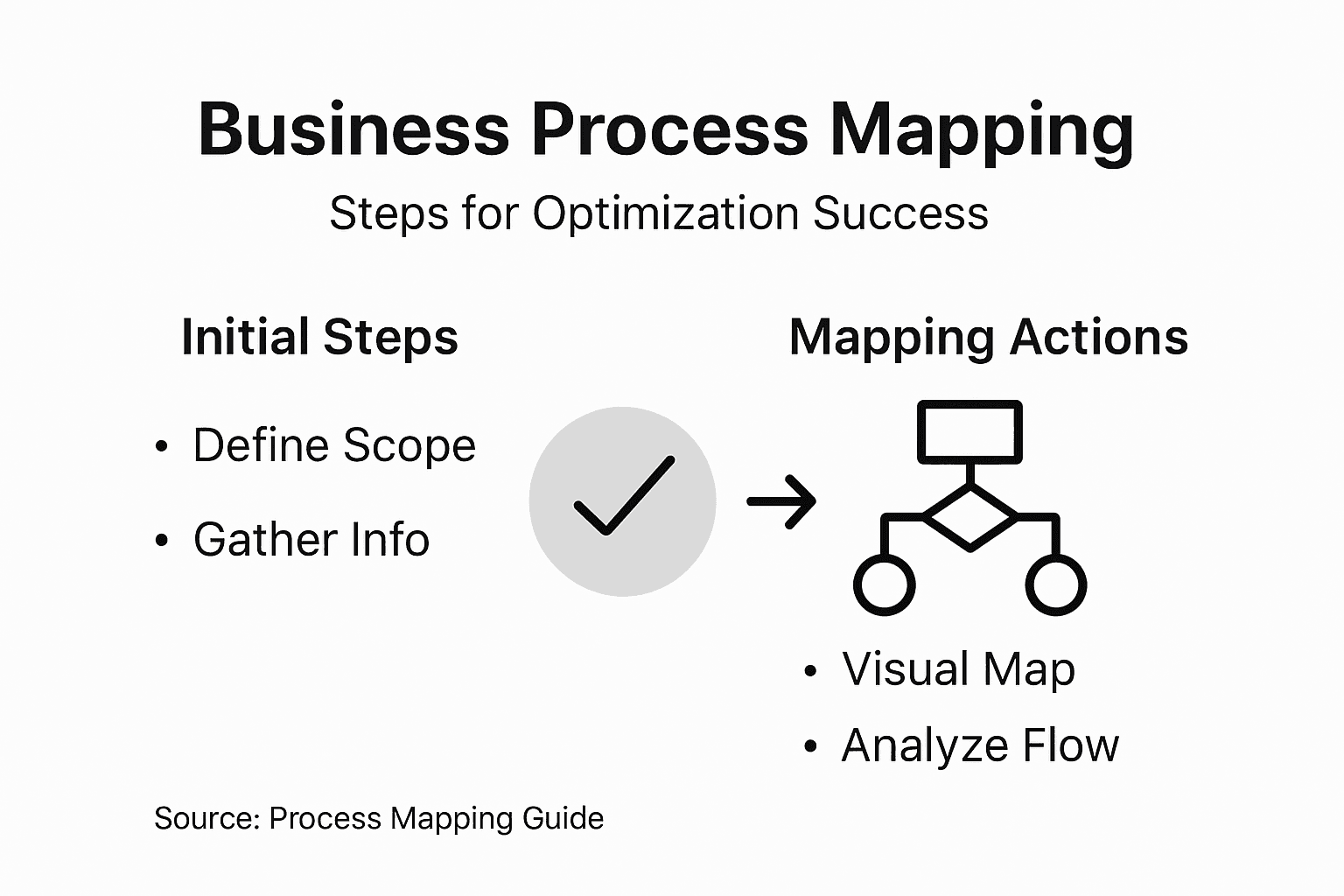
Creating visual process maps transforms complex workflows into clear, understandable diagrams that help organizations identify inefficiencies and improve operational performance. In this step, you will learn how to translate your gathered process information into meaningful visual representations that stakeholders can easily comprehend.
Business process mapping requires selecting the right visualization technique for your specific workflow. Start by choosing appropriate diagramming tools or software that support different mapping styles like flowcharts, swimlane diagrams, or Business Process Model and Notation (BPMN) standards. Begin with a clear process trigger and systematically document each step using standardized symbols that represent activities, decision points, inputs, and outputs. Pay attention to logical sequence and ensure that your map clearly shows how different elements interact and connect.
Utilize standard flowchart techniques to create precise and comprehensible process maps. Use consistent color coding, maintain clean and uncluttered layouts, and include clear legends that explain the meaning of each symbol. Validate your process map with key stakeholders who perform the actual work to ensure accuracy and completeness. Incorporate feedback and iterate on your visual representation to capture the nuanced realities of your organizational workflows.
Professional Tip: Use digital process mapping tools that offer collaboration features, allowing multiple team members to review and annotate the map in real time.
Here’s a quick reference table outlining popular process mapping diagram types and their best uses:
| Diagram Type | Typical Usage | Strengths |
|---|---|---|
| Flowchart | Basic workflow visualization | Easy to create, widely understood |
| Swimlane Diagram | Role-based process mapping | Clarifies responsibilities |
| BPMN | Complex process modeling | Industry standard, detailed |
| Value Stream Map | Lean improvement | Highlights waste, process steps |
Step 4: Analyze workflows and identify improvements
Analyzing workflows and identifying potential improvements is a critical phase in business process mapping that transforms your visual maps into strategic optimization opportunities. This step involves a systematic and comprehensive examination of your existing processes to uncover inefficiencies, bottlenecks, and potential areas for enhancement.
Workflow analysis techniques require a methodical approach to evaluating each step of your process. Begin by examining your visual process map and conducting a detailed assessment of resource flow, time requirements, and potential redundancies. Look for specific indicators of inefficiency such as unnecessary steps, manual interventions that could be automated, repeated tasks, or points where work gets delayed or stuck. Quantify the current performance by tracking metrics like processing time, error rates, and resource utilization to establish a baseline for improvement.
Utilize clinical workflow analysis principles to triangulate your findings through multiple perspectives. Engage stakeholders who perform the actual work to gain qualitative insights about pain points and challenges. Cross reference their feedback with quantitative data to develop a comprehensive understanding of process limitations. Create a detailed report that not only highlights problems but also proposes specific recommendations for streamlining workflows, reducing waste, and improving overall operational efficiency.
Professional Tip: Develop a standardized scoring system for evaluating process efficiency to ensure objective and consistent analysis across different workflows.
Step 5: Validate maps with stakeholders
Validating process maps with stakeholders is a critical step that transforms your initial documentation into a precise and actionable representation of organizational workflows. This collaborative verification ensures that your process mapping accurately reflects real world operations and builds crucial organizational alignment.
Business process mapping validation requires a structured and inclusive approach to reviewing your documented processes. Schedule individual and group review sessions with key stakeholders from different departments who directly perform or manage the workflows you have mapped. Present your visual process maps and walk through each step, inviting detailed feedback and encouraging stakeholders to highlight any discrepancies between the documented process and actual practice. Be prepared to listen actively and take detailed notes about variations, exceptions, and potential improvements suggested by those with direct operational experience.
Stakeholder mapping techniques recommend categorizing participants based on their influence and interest in the process. Prioritize feedback from front line workers who execute the tasks daily, while also considering input from managers and strategic leaders who understand broader organizational goals. Create a systematic method for documenting and incorporating stakeholder feedback, such as a validation tracking sheet that records each suggested change, its potential impact, and the rationale behind accepting or rejecting the recommendation.
Professional Tip: Create a collaborative digital workspace where stakeholders can provide asynchronous feedback and track changes to process maps in real time.
Unlock Business Efficiency with Expert Outsourcing Support
Mapping and analyzing your business processes is key to discovering inefficiencies and creating meaningful improvements. If your goal is to optimize workflows while overcoming challenges like bottlenecks and complex interdepartmental tasks, partnering with a trusted outsourcing provider can accelerate your success. StorsenDigital.com offers tailored outsourcing, nearshoring, and Business Process Outsourcing solutions designed to streamline operations and enhance talent acquisition across Europe.

Take control of your process optimization journey today by leveraging our managed BPO services in HR, finance, IT, and customer support. Our strategic consulting expertise complements your process mapping efforts, helping you transform insights into actionable improvements while scaling your operations efficiently. Contact us now to get personalized support and unlock the full potential of your workflows at StorsenDigital Contact. Learn how our proven methods connect seamlessly with your business process mapping goals at Business Process Mapping Guide for Effective Optimization. Start building smarter, cost-effective operations with StorsenDigital and move from process mapping to performance excellence.
Frequently Asked Questions
What is business process mapping?
Business process mapping is a technique used to visualize and document the steps involved in a workflow. This helps organizations identify inefficiencies and areas for improvement. Start by outlining the key processes in your organization to create a clear representation of how work flows.
How do I gather detailed process information for mapping?
To gather detailed process information, schedule interviews with key team members and observe their workflows. Use structured questions to collect comprehensive insights about each step, including potential bottlenecks. Document each process step in detail to ensure you have a complete picture for mapping.
What visualization techniques should I use for process maps?
You should choose visualization techniques that best suit your processes, such as flowcharts or swimlane diagrams. Each method offers different strengths for clarity and role-based mapping. Start by creating a flowchart for simple processes and consider swimlane diagrams for more complex interactions between teams.
How can I analyze workflows to identify improvements?
Analyze workflows by evaluating each step in your visual process maps to pinpoint inefficiencies and redundancies. Look for manual tasks that could be automated or bottlenecks causing delays. Document your findings and propose specific recommendations for optimization to improve overall efficiency.
Why is validating process maps with stakeholders important?
Validating process maps with stakeholders ensures that the maps accurately reflect actual workflows and operations. Involve key team members to provide feedback and highlight discrepancies. This collaborative approach helps build alignment and support for any proposed changes or improvements.
How often should I review and update my business process maps?
You should review and update your business process maps regularly, ideally at least once every six months or whenever significant changes occur in your workflows. Schedule these reviews as part of your continuous improvement process to ensure your maps remain relevant and effective.


