


Chasing greater efficiency often means questioning long-standing cost structures at every level of the organization. For European tech companies, rising operational demands require precise cost assessments and bold strategies to stay competitive. This article guides C-suite leaders through proven methods of evaluating enterprise expenses, uncovering outsourcing and nearshoring opportunities, and driving sustainable savings for lasting scalability.
Table of Contents
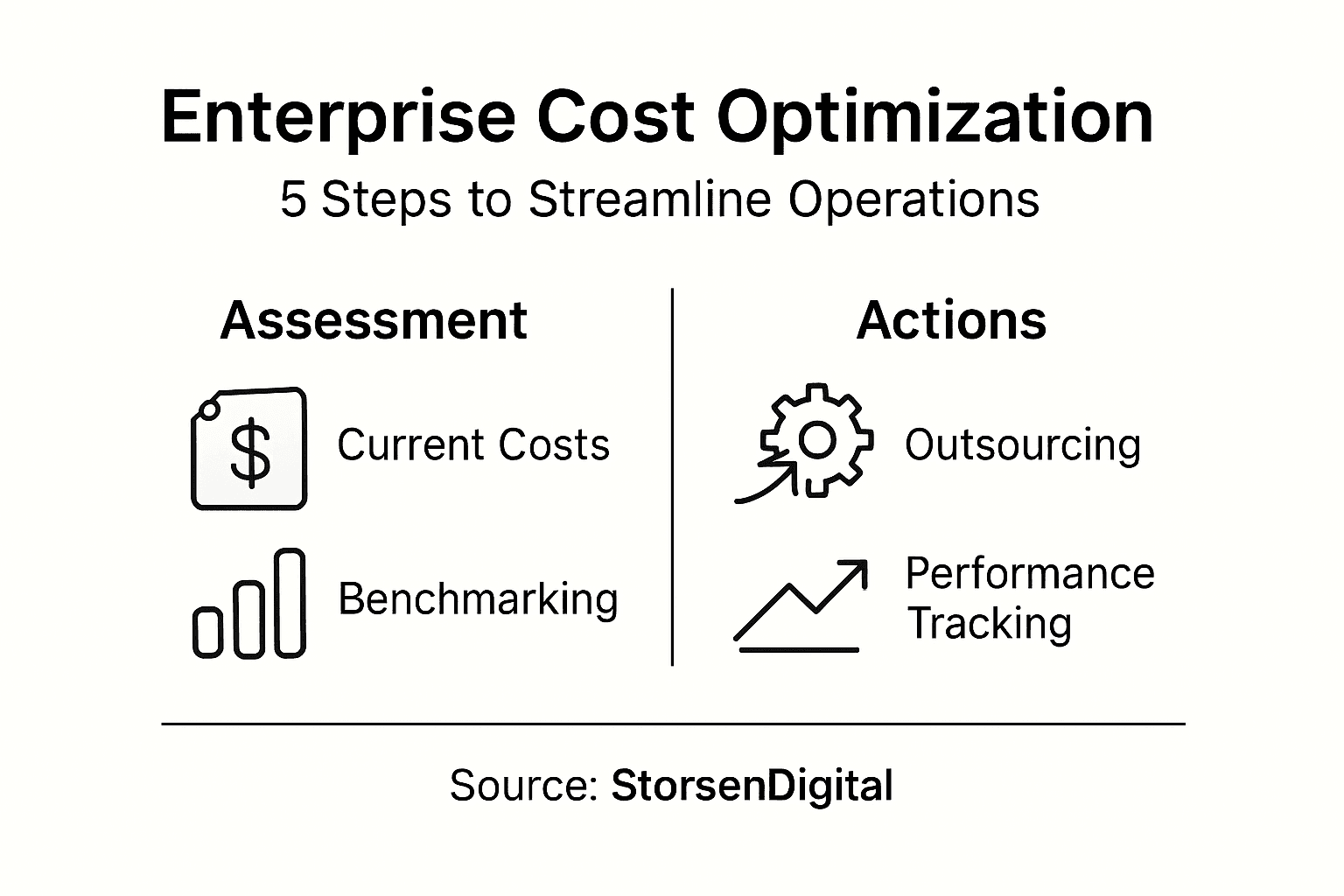
- Step 1: Assess Current Cost Structures
- Step 2: Identify Outsourcing and Nearshoring Opportunities
- Step 3: Implement Tailored Cost-Saving Solutions
- Step 4: Monitor Performance and Adjust Strategies
- Step 5: Verify Long-Term Savings and Scalability
Quick Summary
| Key Message | Explanation |
|---|---|
| 1. Assess Cost Structures Thoroughly | Break down expense categories to uncover savings opportunities and validate data accuracy through multiple financial records. |
| 2. Identify Strategic Outsourcing Options | Evaluate which functions can be outsourced for cost efficiency, prioritizing repetitive tasks or tech support roles. |
| 3. Implement Targeted Cost Solutions | Develop specific initiatives that enhance efficiency, involving cross-departmental collaboration and performance tracking. |
| 4. Monitor Performance Regularly | Establish a feedback loop with key metrics to adjust strategies in real-time, enhancing organizational agility. |
| 5. Verify Long-Term Savings and Scalability | Conduct retrospective analyses to ensure ongoing savings and assess potential for organizational growth and efficiency. |
Step 1: Assess Current Cost Structures
Understanding your enterprise’s cost landscape is the critical first move toward meaningful financial optimization. In this step, you’ll systematically break down and analyze your organization’s existing expense structures to identify potential savings and efficiency opportunities.
Begin by gathering comprehensive financial documentation from every department. This includes detailed expense reports, budget allocations, operational costs, and historical spending records. The cost estimating guidance recommends a systematic approach that considers both direct and indirect expenses.
Your assessment should focus on several key areas:
- Direct Labor Costs: Salary expenses, contractor rates, benefits
- Operational Expenses: Utilities, equipment, facility maintenance
- Technology Infrastructure: Software licenses, hardware investments, cloud services
- Administrative Overhead: Management salaries, support staff, administrative systems
To ensure comprehensive analysis, break down each category into granular components. Use spreadsheet tools to create detailed cost mapping that reveals hidden spending patterns. Cross-reference multiple financial records to validate data accuracy and identify potential discrepancies.
Precision in cost assessment determines the effectiveness of future optimization strategies.
Utilize benchmarking techniques by comparing your current cost structures against industry standards. This helps identify areas where your organization might be overspending or could potentially streamline operations.
Here’s a summary of major cost categories and their typical business impact:
| Cost Category | Example Expenses | Potential Issues | Business Impact |
|---|---|---|---|
| Direct Labor Costs | Salaries, contractor benefits | Overtime, turnover costs | Affects morale and stability |
| Operational Expenses | Utilities, maintenance | Inefficiency, overspending | Drives day-to-day operations |
| Technology Infrastructure | Software, cloud, hardware | Legacy systems, upgrades | Enables innovation |
| Administrative Overhead | Management, support staff | Excess staff, slow process | Impacts agility |
Pro tip: Create a standardized cost tracking template that allows consistent, repeatable financial analysis across all departments and reporting periods.
Step 2: Identify Outsourcing and Nearshoring Opportunities
Identifying strategic outsourcing and nearshoring opportunities is crucial for enterprise cost optimization and operational efficiency. In this step, you’ll systematically analyze your current business processes to determine which functions are prime candidates for external talent and geographic optimization.
Start by conducting a comprehensive internal capability assessment. Nearshoring research demonstrates that successful enterprises carefully evaluate which operations can be effectively managed through external partnerships. Focus on functions that meet specific outsourcing criteria:
- Repetitive administrative tasks
- Technology support functions
- Customer service operations
- Back-office financial processing
- Software development and IT services
Consider key evaluation metrics when assessing potential outsourcing opportunities:
- Cost differential between current in-house operations and external solutions
- Complexity of the specific business function
- Required skill levels and talent availability
- Potential productivity improvements
- Risk management considerations
Strategic nearshoring transforms operational challenges into competitive advantages.
Utilize a structured decision matrix to score and rank potential outsourcing candidates. This approach ensures objective, data-driven decision-making that minimizes emotional or biased assessments.

Below is a reference table comparing outsourcing and nearshoring for enterprise efficiency:
| Approach | Cost Efficiency | Talent Access | Typical Risks |
|---|---|---|---|
| Outsourcing | High potential | Global talent | Time zones, quality control |
| Nearshoring | Moderate gain | Regional talent | Cultural alignment, pricing |
| In-house | Variable | Internal team | Skill gaps, higher overhead |
Pro tip: Create a weighted scoring system that objectively evaluates each potential outsourcing function across multiple performance and financial dimensions.
Step 3: Implement Tailored Cost-Saving Solutions
Implementing targeted cost-saving solutions requires a strategic and methodical approach that goes beyond simple budget cutting. Your goal is to develop nuanced, impactful interventions that optimize operational efficiency while maintaining high-quality performance.
Crowdsourced innovation strategies demonstrate that engaging employees across different organizational levels can unlock significant savings potential. Begin by establishing a comprehensive cost optimization framework that includes these critical components:
- Cross-departmental collaboration
- Systematic performance tracking
- Continuous improvement mechanisms
- Technology-enabled efficiency solutions
- Data-driven decision making
Apply a structured approach to implementing your cost-saving initiatives:
- Prioritize initiatives with highest potential impact
- Develop clear implementation timelines
- Assign specific accountability metrics
- Create pilot testing protocols
- Establish robust monitoring systems
Precision in execution determines the success of cost optimization strategies.
Ensure each cost-saving solution includes quantifiable performance indicators that allow for real-time assessment and rapid adjustment. This approach transforms cost-cutting from a reactive measure into a proactive strategic advantage.
Pro tip: Develop a flexible cost optimization dashboard that provides real-time visibility into savings performance and allows immediate strategic recalibration.
Step 4: Monitor Performance and Adjust Strategies
Continuous performance monitoring is the critical engine that transforms cost optimization from a one-time initiative into a sustainable organizational capability. Your objective in this phase is to establish a dynamic feedback loop that enables real-time strategic refinement and proactive financial management.
Cost optimization insights highlight the importance of developing a disciplined, data-driven approach to tracking and adjusting your cost-saving strategies. Key focus areas for comprehensive performance monitoring include:
- Quantitative financial metrics
- Operational efficiency indicators
- Team productivity measurements
- Technology utilization rates
- Comparative benchmarking analysis
Implement a structured monitoring framework with these essential steps:
- Define clear, measurable performance indicators
- Establish baseline measurements
- Create regular reporting intervals
- Design responsive adjustment protocols
- Communicate findings across organizational levels
Strategic agility separates high-performing organizations from average performers.
Ensure your performance tracking system provides granular insights that enable swift, intelligent course corrections. This approach transforms cost management from a reactive process to a strategic competitive advantage.
Pro tip: Develop automated dashboards with real-time alerts that flag potential performance deviations before they become significant financial challenges.
Step 5: Verify Long-Term Savings and Scalability
Verifying long-term savings and scalability represents the culmination of your cost optimization journey. Your primary objective is to transform initial cost reduction strategies into sustainable, strategic financial advantages that support ongoing organizational growth.
IT cost optimization frameworks emphasize the importance of comprehensive, forward-looking verification processes. Your verification strategy should encompass multiple critical dimensions:
- Financial performance tracking
- Operational efficiency metrics
- Technology investment returns
- Scalability potential assessment
- Competitive positioning analysis
Implement a rigorous verification methodology through these strategic steps:
- Conduct comprehensive financial retrospective analysis
- Compare actual savings against initial projections
- Assess structural cost changes
- Evaluate technological and human capital investments
- Project future scalability potential
Sustainable cost optimization transforms financial constraints into strategic opportunities.
Performance validation requires a holistic approach that goes beyond simple numerical comparisons. Look for systemic improvements in organizational agility, technology utilization, and strategic resource allocation.
Pro tip: Create a dynamic verification dashboard that provides real-time insights into long-term savings trajectories and emerging scalability indicators.
Unlock Lasting Enterprise Cost Optimization Through Expert Outsourcing Solutions
Managing complex cost structures and identifying the right outsourcing opportunities can feel overwhelming for medium to large enterprises focused on streamlining operations. This article highlights critical pain points such as assessing detailed expenses, evaluating outsourcing and nearshoring potential, and implementing targeted cost-saving initiatives—all essential steps to transform financial challenges into strategic advantages. If you want to leverage European talent and scalable managed services to turn these principles into action, you need a trusted partner who understands your operational goals and can deliver tailored solutions.
At StorsenDigital, we specialize in providing comprehensive outsourcing, nearshoring, and Business Process Outsourcing (BPO) services that align perfectly with the cost optimization strategies outlined. From recruiting top talent and establishing regional offices to managing your HR, finance, IT, and software development needs, our proven framework helps reduce direct labor costs, improve operational efficiency, and ensure sustainable savings.
Take the next step in transforming your enterprise operations with confidence. Explore how our specialized services can support your cost optimization journey with real-time performance insights and scalable solutions today.

Discover tailored outsourcing solutions by contacting our experts now. Visit StorsenDigital Contact and start your path to smarter cost management and enhanced operational agility.
Frequently Asked Questions
What are the first steps to assess current cost structures in my company?
Start by gathering comprehensive financial documentation from every department, including expense reports and budget allocations. Organize this information to analyze direct labor costs, operational expenses, technology infrastructure, and administrative overhead within 30 days.
How can I identify outsourcing opportunities for cost optimization?
Evaluate your current business processes to find tasks that can be effectively outsourced, such as customer service or technology support functions. Create a scoring matrix to rank these opportunities based on cost savings and complexity.
What are the key components of implementing tailored cost-saving solutions?
Develop a comprehensive cost optimization framework that includes cross-departmental collaboration and performance tracking. Focus on initiatives with the highest impact and establish accountability metrics within the first quarter of implementation.
How can I effectively monitor the performance of my cost optimization strategies?
Establish a structured monitoring framework that includes measurable performance indicators and regular reporting intervals. Implement this system to analyze financial metrics and operational efficiency at least quarterly to ensure proactive adjustments.
What steps should I take to verify long-term savings and scalability?
Conduct a comprehensive financial retrospective analysis to compare actual savings against initial projections. Utilize a dynamic verification dashboard to track long-term savings trajectories and scalability indicators on an ongoing basis.


