


Over 60 percent of operational leaders at large European technology firms now benchmark their spending against American business models. Reducing costs while scaling rapidly has become more complex in a market where global competition for resources is fierce. This article reveals how a clear-eyed assessment of current expenses unlocks the potential for smarter Business Process Outsourcing, offering practical steps for executives aiming to balance strategic growth with measurable savings.
Table of Contents
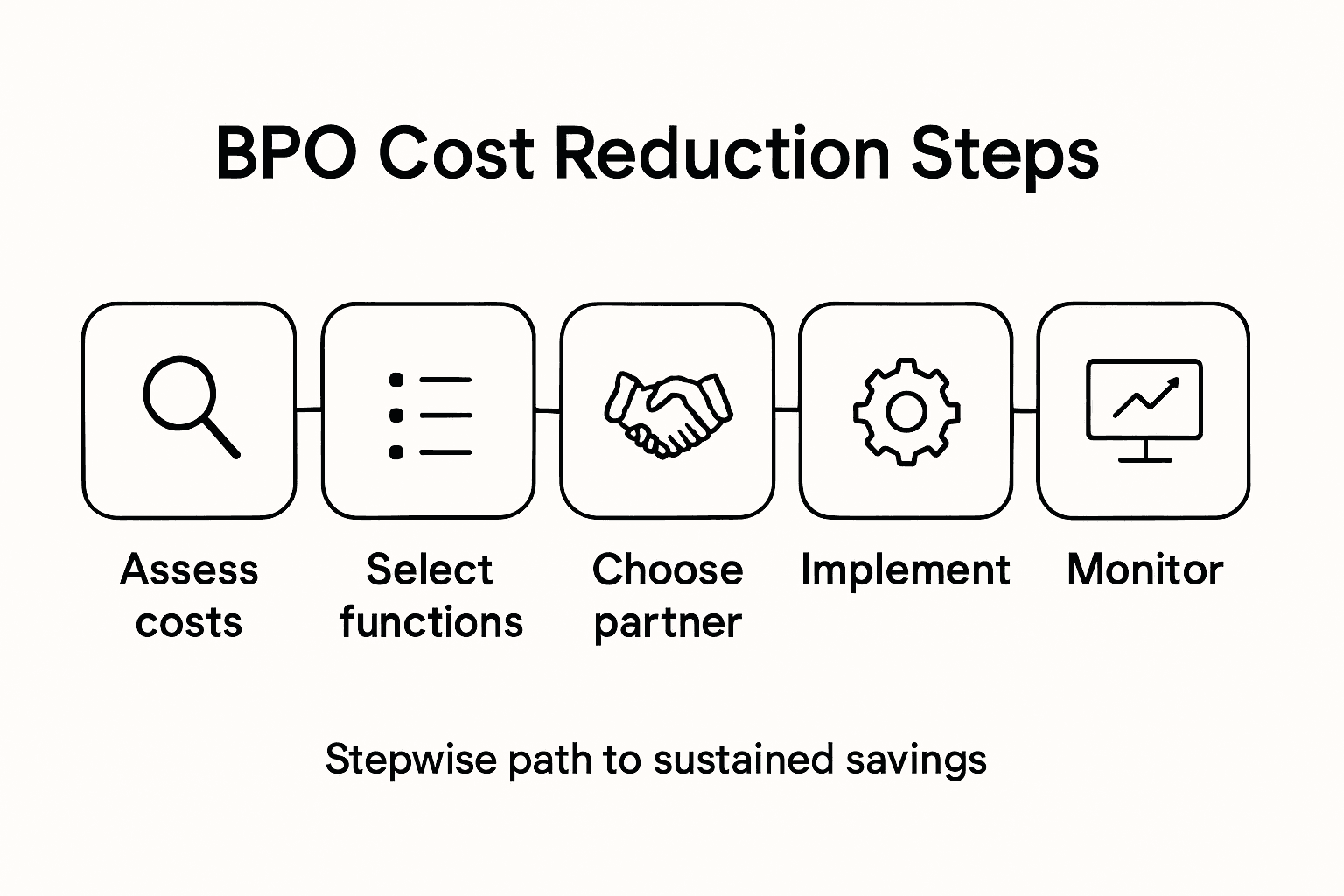
- Step 1: Assess Current Cost Structure For BPO Potential
- Step 2: Identify Suitable BPO Functions And Priorities
- Step 3: Select The Right BPO Partner Strategically
- Step 4: Implement Cost-Saving BPO Solutions Effectively
- Step 5: Monitor And Optimize For Sustainable Savings
Quick Summary
| Key Insight | Explanation |
|---|---|
| 1. Assess Current Costs First | Evaluate operational expenses to identify outsourcing opportunities. Map labor, technology, and overhead costs carefully. |
| 2. Identify Suitable BPO Functions | Focus on standardized, repetitive processes that don’t impact core strategy. Examples include customer support and payroll. |
| 3. Choose the Right Partner | Select a BPO partner based on technological capabilities and cultural compatibility. Prioritize long-term relationships. |
| 4. Implement Gradually | Start with less critical operations and develop a comprehensive roadmap for transition. Ensure clarity in performance metrics. |
| 5. Monitor for Continuous Savings | Establish KPIs and a feedback loop to optimize BPO outcomes over time, ensuring sustained value and efficiency. |
Step 1: Assess current cost structure for BPO potential
Uncovering your organization’s potential for Business Process Outsourcing (BPO) begins with a comprehensive evaluation of your existing cost structure. This critical first step allows you to identify opportunities for optimization and potential financial gains through strategic outsourcing.
To conduct a thorough assessment, start by meticulously mapping out all operational expenses across different departments. This includes labor costs, technology infrastructure, software licenses, overhead expenses, and indirect operational spending. Detailed analysis of process readiness is essential in determining which business processes are most suitable for outsourcing.
Break down your evaluation into key categories: direct labor costs, technology expenses, administrative overhead, and support function expenditures. Look for processes that are repetitive, standardized, and not core to your strategic differentiation. Pay special attention to areas with high operational complexity or those consuming significant resources without delivering unique competitive advantages.
Pro tip: Create a comprehensive spreadsheet that categorizes expenses by department, process type, and potential outsourcing viability. This systematic approach will provide clear visibility into where BPO might deliver the most significant cost reduction and operational efficiency.
Step 2: Identify suitable BPO functions and priorities
After assessing your current cost structure, the next critical phase is identifying which business functions are most appropriate for Business Process Outsourcing (BPO). This strategic selection process will determine the potential success and efficiency gains of your outsourcing initiative.

Strategic decision making frameworks reveal that not all business functions are equally suitable for outsourcing. Focus on processes that are standardized, repetitive, and do not directly contribute to your core competitive advantage. Typical candidates include customer support, human resources administrative tasks, accounting and payroll processing, IT support, and data entry operations.
When evaluating potential BPO functions, consider multiple dimensions such as complexity, strategic importance, potential cost savings, and scalability. Prioritize functions that have well-documented processes, clear performance metrics, and minimal dependencies on specialized internal knowledge. Look for tasks that can be easily transferred without disrupting your organization’s fundamental operational capabilities.
Here is a summary of common business functions typically considered for BPO and their potential benefits:
| Function Type | Example Activities | Potential Benefit |
|---|---|---|
| Customer Support | Call center services | Improved responsiveness |
| Human Resources Admin | Payroll, benefits admin | Lower labor costs |
| Accounting Processing | Invoicing, bookkeeping | Increased accuracy |
| IT Support | Help desk, troubleshooting | Access to latest technology |
| Data Entry Operations | Database management | Faster data processing |
Pro tip: Create a comprehensive scoring matrix that ranks potential BPO functions across key criteria including cost reduction potential, process complexity, strategic impact, and ease of transition. This systematic approach will help you objectively prioritize and select the most promising candidates for outsourcing.
Step 3: Select the right BPO partner strategically
Selecting the ideal Business Process Outsourcing (BPO) partner requires a methodical and strategic approach. Your goal in this critical phase is to identify a partner that not only meets your operational requirements but also aligns with your organization’s long term vision and cultural dynamics.
Strategic innovation frameworks for outsourcing partnerships emphasize the importance of comprehensive evaluation beyond simple cost considerations. Look for potential partners who demonstrate robust technological capabilities, proven track records in your specific industry, and a transparent approach to communication and performance management. Key evaluation criteria should include the partner’s technological infrastructure, quality assurance processes, scalability potential, data security protocols, and their ability to integrate seamlessly with your existing operational workflows.
During the selection process, conduct thorough due diligence by requesting detailed case studies, conducting site visits, speaking with reference clients, and performing comprehensive background checks. Pay close attention to the potential partner’s cultural compatibility, understanding of your business context, and their commitment to continuous improvement. Evaluate their talent pool, training programs, and ability to adapt to your specific operational requirements.
Pro tip: Develop a comprehensive scoring matrix that weights different evaluation criteria based on your organization’s unique priorities. This structured approach will help you objectively compare potential BPO partners and make a data driven selection that goes beyond surface level considerations.
Step 4: Implement cost-saving BPO solutions effectively
Successfully implementing cost-saving Business Process Outsourcing (BPO) solutions requires a strategic and methodical approach. Your primary objective is to translate your carefully planned outsourcing strategy into tangible operational improvements that deliver measurable financial benefits.
Digital platform adoption and performance monitoring techniques are critical for ensuring successful BPO implementation. Begin by establishing clear performance metrics, defining precise service level agreements, and creating robust communication channels with your chosen BPO partner. Leverage advanced technologies such as cloud computing, automation tools, and data analytics platforms to streamline processes and enhance operational transparency.
Careful implementation involves gradual transition strategies, starting with less critical functions and progressively expanding outsourced processes. Continuous monitoring, regular performance reviews, and agile adjustment mechanisms will help you optimize cost savings and maintain high quality standards. Focus on knowledge transfer, comprehensive training programs, and developing strong collaborative frameworks that enable seamless integration between your internal teams and the BPO partner.
Pro tip: Create a detailed implementation roadmap with specific milestones, performance indicators, and contingency plans. This structured approach will help you mitigate risks, manage expectations, and ensure a smooth transition towards more efficient and cost-effective business operations.
Step 5: Monitor and optimize for sustainable savings
Sustaining cost savings through Business Process Outsourcing (BPO) requires continuous monitoring, strategic optimization, and proactive performance management. Your goal in this phase is to transform initial cost reductions into long-term, scalable operational efficiencies that consistently deliver value to your organization.
Sustainability metrics and tracking methodologies are crucial for maintaining and improving BPO performance. Implement a comprehensive monitoring framework that includes regular performance reviews, data-driven analytics, and key performance indicators (KPIs) that measure both financial and operational outcomes. Develop a dynamic dashboard that provides real-time insights into productivity, cost efficiency, quality metrics, and process improvements.
The following table highlights key focus areas for monitoring and optimizing BPO outcomes over time:
| Focus Area | Sample Metric | Optimization Rationale |
|---|---|---|
| Cost Efficiency | Cost per transaction | Track and reduce expenses |
| Quality Metrics | Error rate, defect count | Maintain high service standards |
| Productivity | Tasks completed per hour | Identify process improvements |
| Flexibility | Response to changes | Adapt to evolving requirements |
Establish a collaborative feedback mechanism that enables continuous dialogue between your internal teams and the BPO partner. This approach allows for rapid identification of potential optimization opportunities, process bottlenecks, and areas requiring strategic intervention. Regularly benchmark performance against industry standards, conduct periodic audits, and maintain flexibility to adjust strategies based on evolving business needs and technological advancements.
Pro tip: Create a quarterly optimization review process that systematically evaluates BPO performance, identifies efficiency gains, and develops targeted improvement strategies. This proactive approach ensures that your outsourcing partnership remains aligned with your organization’s strategic objectives and continues to deliver tangible value.
Unlock Lasting Savings with Strategic BPO Solutions from StorsenDigital
The stepwise approach outlined in “Cost Reduction Through BPO” highlights the challenges organizations face in identifying cost-saving opportunities, selecting suitable outsourcing functions, and partnering wisely to implement effective BPO solutions. You understand the importance of assessing your cost structure carefully, prioritizing scalable processes, and monitoring performance for sustainable savings. Yet translating this strategy into real operational improvements can be complex without the right expertise.
StorsenDigital specializes in bridging this gap. We provide comprehensive managed BPO services across HR, finance, IT, customer support, and software development designed to streamline your operations while maximizing cost efficiency. Whether you need support with talent acquisition, office establishment, or strategic consulting, our tailored European nearshoring solutions help you leverage top-tier digital infrastructure and skilled professionals. Gain confidence from our proven track record and transparent partnership approach that aligns with your long-term business goals.
Ready to unlock measurable cost reductions and elevate your outsourcing results? Discover how to transform your BPO strategy into actionable success today.
Explore our outsourcing expertise to get started.

Connect with our team now by visiting Contact StorsenDigital for a personalized consultation and begin your journey toward optimized costs and operational excellence.
Learn more about how strategic outsourcing can empower your business on our Contact page.
Frequently Asked Questions
What is the first step in assessing BPO potential for cost reduction?
To uncover your organization’s BPO potential, start by evaluating your current cost structure. Map out operational expenses, including labor, technology, and overhead, to find areas where outsourcing may save costs. This could lead to potential reductions of around 15-30% in those identified areas.
How do I identify which functions are suitable for outsourcing?
Begin by focusing on processes that are standardized, repetitive, and not core to your competitive advantage. Prioritize functions like customer support or payroll that have minimal dependencies on specialized knowledge, which can help streamline your operations drastically.
What criteria should I use when selecting a BPO partner?
When choosing a BPO partner, evaluate their technological capabilities, industry experience, and communication style. Prioritize partners with strong quality assurance processes and data security protocols to ensure a successful collaboration and potentially reduce operational risks by about 10%.
How can I effectively implement BPO solutions to achieve cost savings?
Implement BPO solutions by setting clear performance metrics and establishing robust communication channels with your partner. Gradually transition less critical functions first, ensuring that you can monitor costs and efficiencies closely for improvements over time.
What metrics should I monitor to ensure sustainable BPO savings?
Establish a monitoring framework to track cost per transaction, error rates, and productivity. Regularly review these metrics to identify areas for optimization, which can lead to further savings and efficiency improvements in your operations.


