


Creating an effective outsourcing Request for Proposal can feel overwhelming when you’re balancing operational demands with the need to identify the right vendor partner. Many procurement managers struggle to structure RFPs that attract qualified responses while protecting their organization’s interests. A well-crafted RFP streamlines vendor selection, reduces contract costs by up to 35%, and sets clear expectations from day one. This guide walks you through practical steps to build outsourcing RFPs that deliver measurable results, from defining evaluation criteria to finalizing vendor agreements that support your operational goals.
Table of Contents
- Understanding The Essentials: What Your Outsourcing RFP Must Include
- Preparing Your RFP Strategy: Setting Evaluation Criteria And Timelines For Success
- Executing The RFP: Managing The Process, Engaging Vendors, And Mitigating Risks
- Evaluating Proposals And Selecting The Best Outsourcing Partner
- Learn More With StorsenDigital’s Outsourcing Guides
- Frequently Asked Questions
Key takeaways
| Point | Details |
|---|---|
| Essential RFP sections | Include submission details, specifications, evaluation criteria, timelines, and selection process to ensure complete vendor responses. |
| Cost reduction potential | Competitive RFP processes save 15-35% on outsourcing contracts through structured evaluation. |
| Weighted scoring advantage | Clear must-have requirements and weighted criteria improve vendor selection accuracy and reduce evaluation time. |
| Timeline expectations | Average RFP processes take 3.5 months, with response leaders winning 58% versus 50% for slower competitors. |
| Strategic approach matters | Traditional RFPs work for commoditized services, while strategic outsourcing may require collaborative methods. |
Understanding the essentials: What your outsourcing RFP must include
Every successful outsourcing RFP starts with a clear structure that guides vendors through your requirements while giving your team the information needed for objective evaluation. Key sections include submission details, business background, detailed specifications, evaluation criteria, timelines, and selection process that work together to create a complete picture of your needs.
Your RFP must distinguish between mandatory requirements and optional preferences. Use “must” or “shall” for non-negotiable elements like security certifications or compliance standards. Reserve “may” or “can” for nice-to-have features that could differentiate vendors but aren’t dealbreakers. This clarity prevents wasted time reviewing proposals that don’t meet baseline requirements.
Submission instructions should specify format requirements, deadline details, and contact information for questions. Your business background section provides context about your organization, current challenges, and strategic goals that help vendors tailor their approach. The specifications section details exactly what you need, from service levels to technology requirements to geographic considerations.
| RFP Section | Purpose | Key Elements |
|---|---|---|
| Submission Instructions | Guide vendor response format | Deadline, format, contact info, Q&A process |
| Business Background | Provide organizational context | Company overview, current state, strategic goals |
| Detailed Specifications | Define service requirements | Scope, technical specs, volume, locations |
| Evaluation Criteria | Establish selection framework | Weighted factors, scoring method, must-haves |
| Timeline & Milestones | Set process expectations | Key dates, decision timeline, implementation start |
| Selection Process | Outline next steps | Shortlist approach, presentations, negotiation phase |
Evaluation criteria deserve special attention because they directly impact how you’ll compare proposals. List the factors you’ll assess, assign weights to each category, and explain your scoring methodology. Include your timeline with specific dates for proposal submission, evaluation completion, vendor presentations, and final selection. For hr outsourcing step by step global enterprises, this structure becomes even more critical when coordinating across multiple regions.
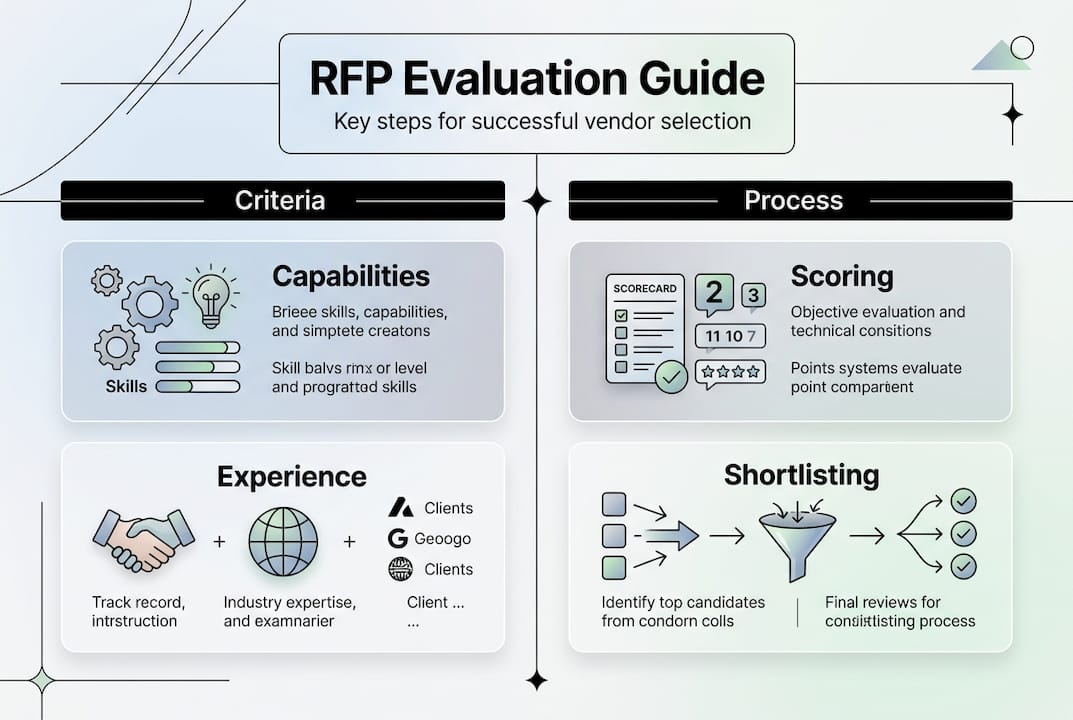
Pro Tip: Leverage industry-standard templates from e-sourcing platforms or software rfp template resources to save time and ensure you don’t miss critical sections. Adapt these templates to your specific outsourcing needs rather than starting from scratch. Following 7-step outsourcing best practices checklist helps maintain consistency across multiple RFP projects.
Preparing your RFP strategy: Setting evaluation criteria and timelines for success
Weighted scoring models transform subjective vendor evaluation into objective decision-making. Assign percentage weights to each evaluation category based on what matters most to your organization. Typical weights include 15-25% for implementation approach, similar percentages for cost and total cost of ownership, and varying amounts for innovation, cultural fit, and vendor stability.
Your evaluation categories should reflect both quantitative and qualitative factors. Cost analysis goes beyond initial pricing to include total cost of ownership, hidden fees, and long-term value. Implementation capability examines the vendor’s methodology, timeline realism, and change management approach. Technical qualifications assess relevant experience, team expertise, and technology infrastructure. Cultural alignment evaluates communication style, values match, and partnership potential.
- Technical capability and relevant industry experience
- Financial stability and business continuity planning
- Innovation potential and continuous improvement approach
- Security measures and compliance certifications
- Scalability to support future growth
- Geographic presence and service delivery model
Realistic timelines keep your RFP process moving without rushing critical decisions. RFP processes average 3.5 months from launch to vendor selection, though complexity and organizational size influence duration. Break this timeline into clear phases with specific milestones that create accountability and momentum.
- Define your evaluation process by identifying key stakeholders including procurement, operations, finance, IT, and C-level executives who will participate in vendor assessment.
- Establish weighted criteria with input from each stakeholder group to ensure evaluation factors reflect cross-functional priorities and strategic objectives.
- Create a scoring rubric that assigns point ranges to each criterion, making it easy for evaluators to rate proposals consistently and objectively.
- Schedule evaluation meetings in advance, blocking time for initial review, shortlist discussions, vendor presentations, and final selection deliberations.
- Document your decision framework including how you’ll handle ties, what triggers automatic disqualification, and your process for requesting clarifications from vendors.
Pro Tip: Consider outsourcing RFP management if you lack dedicated procurement resources. Organizations without procurement teams achieve 15-25% savings by leveraging specialized RFP consultants who bring process expertise and vendor market knowledge. This approach works especially well when you’re evaluating outsourcing vendors successfully across multiple service categories or need to improve business process outsourcing efficiency quickly.
Executing the RFP: Managing the process, engaging vendors, and mitigating risks
Efficient RFP distribution sets the tone for vendor engagement. Use e-sourcing platforms to manage document sharing, track vendor questions, and maintain version control. Establish a structured Q&A process where vendors submit questions by a specific deadline, and you publish answers to all participants simultaneously. This transparency ensures fair competition and reduces your administrative burden.
For complex outsourcing initiatives, consider multi-phase approaches that start with a Request for Information before issuing the full RFP. The RFI helps you understand market capabilities and refine requirements before asking vendors to invest significant proposal effort. This phased strategy works particularly well for strategic partnerships where you need to assess vendor innovation and collaborative potential beyond standard service delivery.
- Distribute RFPs through secure platforms that track vendor access and download confirmation
- Set clear Q&A deadlines at least two weeks before proposal submission to allow vendors time to incorporate answers
- Publish all questions and answers to maintain fairness and prevent selective information sharing
- Schedule optional vendor conferences for complex RFPs where visual walkthroughs add value
- Send reminder notifications at key milestones to keep vendors on track
Critical contract elements deserve attention during RFP development to avoid negotiation surprises later. Include service level agreements, total cost of ownership models, and exit clauses in your RFP requirements so vendors address these terms upfront. SLAs should specify measurable performance metrics, reporting frequency, and remedies for non-compliance. TCO models must account for transition costs, ongoing management overhead, and potential hidden fees.
| Contract Element | Benefit | Risk if Omitted |
|---|---|---|
| Service Level Agreements | Clear performance expectations and accountability | Disputes over service quality and response times |
| Total Cost of Ownership Model | Accurate budget planning and cost comparison | Hidden fees and budget overruns |
| Exit Clauses | Flexibility to change vendors if needed | Vendor lock-in and expensive termination costs |
| Intellectual Property Rights | Protection of proprietary information and work product | Loss of control over custom developments |
| Data Security Requirements | Compliance and risk mitigation | Data breaches and regulatory violations |
Intellectual property risks increase with offshore outsourcing where legal protections vary by jurisdiction. Your RFP should require vendors to specify IP ownership terms, confidentiality measures, and compliance with relevant data protection regulations. Address these concerns early through clear contractual language rather than discovering gaps during implementation.
- Require vendors to detail their data security protocols including encryption, access controls, and incident response procedures in their proposals.
- Specify compliance requirements relevant to your industry such as GDPR, HIPAA, or SOC 2 certification and request proof of current compliance.
- Include provisions for regular security audits and the right to conduct on-site assessments of vendor facilities and systems.
- Establish clear protocols for handling confidential information during the RFP process itself, requiring non-disclosure agreements before sharing sensitive data.
- Define communication escalation paths for issues that arise during contract performance, including executive sponsor involvement for critical situations.
Maintaining consistent communication throughout the RFP process builds vendor relationships while keeping your team aligned. Share timeline updates proactively, acknowledge proposal receipt promptly, and provide feedback to shortlisted vendors even if they aren’t selected. These practices enhance your reputation and make future sourcing efforts more successful. Resources on business process optimization tips and how to assess BPO performance provide additional context for ongoing vendor management.
Evaluating proposals and selecting the best outsourcing partner
Objective proposal evaluation starts with applying your predetermined weighted scoring system consistently across all vendor responses. Assign evaluation team members to specific sections based on their expertise, then consolidate scores using your weighting formula. This methodical approach removes bias and creates defensible selection decisions that stakeholders can understand and support.

Your scoring framework should translate qualitative assessments into quantitative ratings. Define what constitutes excellent, good, acceptable, and poor performance for each criterion. For example, implementation approach scores might range from 1 to 5 points, with 5 representing a detailed methodology with proven success in similar projects and 1 indicating a vague or unrealistic plan.
| Evaluation Criteria | Weight | Scoring Range | Key Assessment Factors |
| — | — | — |
| Technical Capability | 25% | 0 to 25 points | Relevant experience, team qualifications, methodology |
| Cost and TCO | 20% | 0 to 20 points | Pricing competitiveness, fee transparency, value |
| Implementation Approach | 20% | 0 to 20 points | Timeline realism, change management, risk mitigation |
| Innovation and Improvement | 15% | 0 to 15 points | Process optimization ideas, technology leverage |
| Cultural Fit | 10% | 0 to 10 points | Communication style, values alignment, partnership approach |
| Vendor Stability | 10% | 0 to 10 points | Financial health, client retention, market reputation |
Beyond numerical scores, analyze qualitative factors that indicate long-term partnership potential. Review case studies for relevance to your situation, not just impressive client names. Assess how vendors addressed your specific pain points rather than providing generic solutions. Look for proactive suggestions that demonstrate deep understanding of your industry challenges.
- Evaluate vendor responsiveness during the RFP process as a preview of future service quality and communication patterns
- Review proposed team credentials and stability, not just company capabilities, since individuals deliver the actual service
- Assess innovation beyond buzzwords by examining specific examples of process improvements vendors implemented for similar clients
- Consider geographic and cultural alignment factors that impact collaboration effectiveness and time zone coordination
- Verify references thoroughly by asking specific questions about vendor performance during challenges, not just routine operations
Pro Tip: Conduct multiple review rounds with different stakeholder groups to surface diverse perspectives before making final decisions. Initial technical reviews should focus on capability and compliance, while executive reviews emphasize strategic fit and risk assessment. This layered approach catches issues that single-pass evaluations might miss and builds broader organizational buy-in for your vendor selection.
Competitive RFP processes yield 15-35% cost reductions compared to sole-source negotiations, with ROI often reaching 3 to 7 times the initial investment in the first year. These savings come from both lower contract pricing and improved service quality that reduces rework and management overhead. Response leaders who submit proposals quickly win at 58% rates versus 50% for slower competitors, highlighting the importance of vendor engagement and responsiveness.
Shortlist three to five vendors for deeper evaluation through presentations, site visits, or proof of concept projects. These interactions reveal capabilities that written proposals can’t fully convey, from team chemistry to problem-solving approaches. Use consistent questions across vendor meetings to maintain fair comparison while allowing flexibility for vendors to showcase their unique strengths. When you’re ready to choose outsourcing partner effectively, reference frameworks for business process outsourcing steps to validate your selection against proven success criteria.
Learn more with StorsenDigital’s outsourcing guides
You’ve now built a solid foundation for creating outsourcing RFPs that drive real procurement success. Taking the next step means diving deeper into specific outsourcing strategies and operational frameworks that complement your RFP process. StorsenDigital offers comprehensive resources designed specifically for procurement managers navigating complex vendor selection and partnership management.

Our detailed outsourcing process guide business success walks you through end-to-end outsourcing implementation, from initial strategy through ongoing optimization. When you’re ready to move beyond RFP creation, explore our practical advice on how to choose outsourcing partner that aligns with your operational goals and company culture. For teams managing day-to-day outsourcing relationships, our operations outsourcing workflow guide provides frameworks for maintaining service quality and continuous improvement. These resources build on the RFP foundation you’ve established here, helping you maximize the value of your vendor partnerships.
Frequently asked questions
What are the key sections to include in an outsourcing RFP?
Every outsourcing RFP should include submission instructions, business background, detailed specifications, evaluation criteria, timeline, and selection process. These sections ensure vendors understand your requirements and provide responses you can evaluate objectively. Clear must-have requirements marked with “must” or “shall” language prevent wasted time reviewing non-compliant proposals.
How long does the typical outsourcing RFP process take?
The average RFP process takes approximately 3.5 months from launch to vendor selection. This timeline includes RFP development, vendor response period, proposal evaluation, shortlist presentations, and final negotiations. Complex outsourcing initiatives or multi-phase approaches with initial RFIs may extend this timeframe.
What savings can companies expect from a well-executed outsourcing RFP?
Competitive outsourcing RFPs typically generate 15 to 35% cost reductions compared to sole-source negotiations. Return on investment often reaches 3 to 7 times the initial procurement investment within the first year. Savings vary by outsourcing type and complexity, with some offshore development projects achieving up to 70% cost reductions while maintaining quality standards.
Should I use weighted scoring for vendor evaluation?
Weighted scoring provides objective, defensible vendor selection by assigning importance percentages to different evaluation criteria. This approach removes bias, creates transparency for stakeholders, and ensures your selection aligns with strategic priorities. Typical weights allocate 15 to 25% each for implementation approach and total cost of ownership, with remaining percentages distributed across technical capability, innovation, and cultural fit.


