


Over 60 percent of American businesses now use customer support BPO to deliver better experiences while managing costs. As consumer expectations soar, responding quickly and efficiently is no longer optional for companies competing in global markets. This guide explains how customer support BPO works, why it matters, and the powerful ways it can help American organizations create seamless support systems that build lasting customer loyalty.
Table of Contents
- Customer Support BPO Basics And Key Concepts
- Main Types Of Customer Support BPO Services
- How Customer Support BPO Operates In Practice
- Cost Drivers And Common Pricing Models
- Risks, Security, And Compliance Factors
Key Takeaways
| Point | Details |
|---|---|
| Customer Support BPO Enhances Engagement | Outsourcing customer support allows businesses to utilize specialized expertise, improving customer satisfaction and operational efficiency. |
| Diverse Service Offerings | BPO services range from multi-channel support to technical assistance, helping organizations streamline interactions and drive revenue. |
| Important Pricing Models | Understand various pricing models like hourly, per-interaction, and performance-based to select what aligns best with business needs. |
| Security and Compliance are Crucial | Evaluate BPO partners based on their security measures and compliance with regulations to protect sensitive customer information. |
Customer Support BPO Basics and Key Concepts
Customer Support Business Process Outsourcing (BPO) represents a strategic approach where enterprises delegate their customer interaction functions to specialized external service providers. Customer service in specialized BPO environments involves comprehensive management of customer interactions across multiple communication channels, including phone, email, chat, and social media platforms.
At its core, customer support BPO enables organizations to leverage external expertise for handling critical customer engagement processes. These specialized providers offer end-to-end support functions such as problem resolution, product information dissemination, order processing, technical assistance, and customer feedback collection. By partnering with experienced BPO firms, enterprises can transform their customer support from a cost center into a strategic asset that drives customer satisfaction and operational efficiency.
The fundamental principles of customer support BPO are rooted in business process orientation, which emphasizes reducing organizational conflicts and improving interconnectedness. This approach allows companies to create more agile, responsive customer support ecosystems that can scale rapidly in response to changing market demands. Key benefits include reduced operational costs, access to specialized talent, 24/7 support capabilities, and the ability to maintain consistent service quality across global markets.
Pro Tip – Strategic Outsourcing: When selecting a customer support BPO partner, prioritize providers with demonstrable expertise in your industry, robust technological infrastructure, and a proven track record of maintaining high customer satisfaction metrics.
Main Types of Customer Support BPO Services
Customer support BPO services encompass a comprehensive range of specialized interaction and service management functions designed to meet diverse enterprise needs. Customer service in BPO environments typically includes multiple critical service categories that help organizations maintain seamless customer communication and support strategies.
The primary types of customer support BPO services can be categorized into several key areas. Multi-channel support represents the foundational service, enabling businesses to manage customer interactions across phone, email, chat, social media, and messaging platforms. Technical support services provide specialized assistance for product troubleshooting, software implementations, and complex problem resolution. Additional service types include order processing, which manages customer transactions and inventory tracking, and customer feedback collection, a critical function for continuous improvement and strategic insights.
Enterprises can also leverage specialized BPO services like upselling and product information dissemination, which go beyond traditional support functions. These advanced services help companies not just resolve customer issues but actively drive revenue and enhance customer engagement. By partnering with experienced BPO providers, organizations can transform customer support from a reactive cost center into a strategic asset that contributes directly to business growth and customer satisfaction.
Here’s a summary of common customer support BPO service types and their business impact:
| Service Type | Key Function | Business Impact |
|---|---|---|
| Multi-channel Support | Manages all communication platforms | Ensures consistent customer outreach |
| Technical Support | Handles troubleshooting and product help | Reduces downtime and errors |
| Order Processing | Processes sales and tracks inventory | Increases accuracy, speeds delivery |
| Feedback Collection | Gathers and analyzes customer input | Informs product and service upgrades |
| Upselling & Cross-Selling | Offers additional products or services | Drives revenue and retention |
Pro Tip – Service Selection: When evaluating customer support BPO services, assess providers based on their technological capabilities, industry expertise, multilingual support options, and proven performance metrics to ensure alignment with your specific business requirements.
How Customer Support BPO Operates in Practice
Customer support BPO operates through a sophisticated ecosystem of technological infrastructure, human expertise, and strategic process management designed to deliver seamless customer interactions. Advanced AI-driven customer support mechanisms enable organizations to create highly responsive and efficient support environments that can adapt rapidly to changing customer needs and technological landscapes.
The operational framework of customer support BPO typically involves several interconnected components. Technological integration plays a crucial role, with sophisticated customer relationship management (CRM) systems, automated routing algorithms, and intelligent ticketing platforms serving as the backbone of support operations. These systems enable real-time tracking of customer interactions, prioritize support requests, and ensure that each inquiry is directed to the most appropriate agent with the right skill set and expertise.

Modern customer support BPO goes beyond traditional call center models by implementing comprehensive omnichannel strategies. This approach allows businesses to manage customer interactions across multiple platforms seamlessly, including phone, email, chat, social media, and emerging communication channels. Specialized BPO providers leverage advanced analytics and machine learning algorithms to continuously improve response times, enhance service quality, and provide actionable insights that help businesses refine their customer engagement strategies.
Pro Tip – Operational Excellence: Regularly audit and optimize your BPO partnership by establishing clear performance metrics, implementing continuous training programs, and maintaining open communication channels to ensure alignment with your organization’s evolving customer support objectives.
Cost Drivers and Common Pricing Models
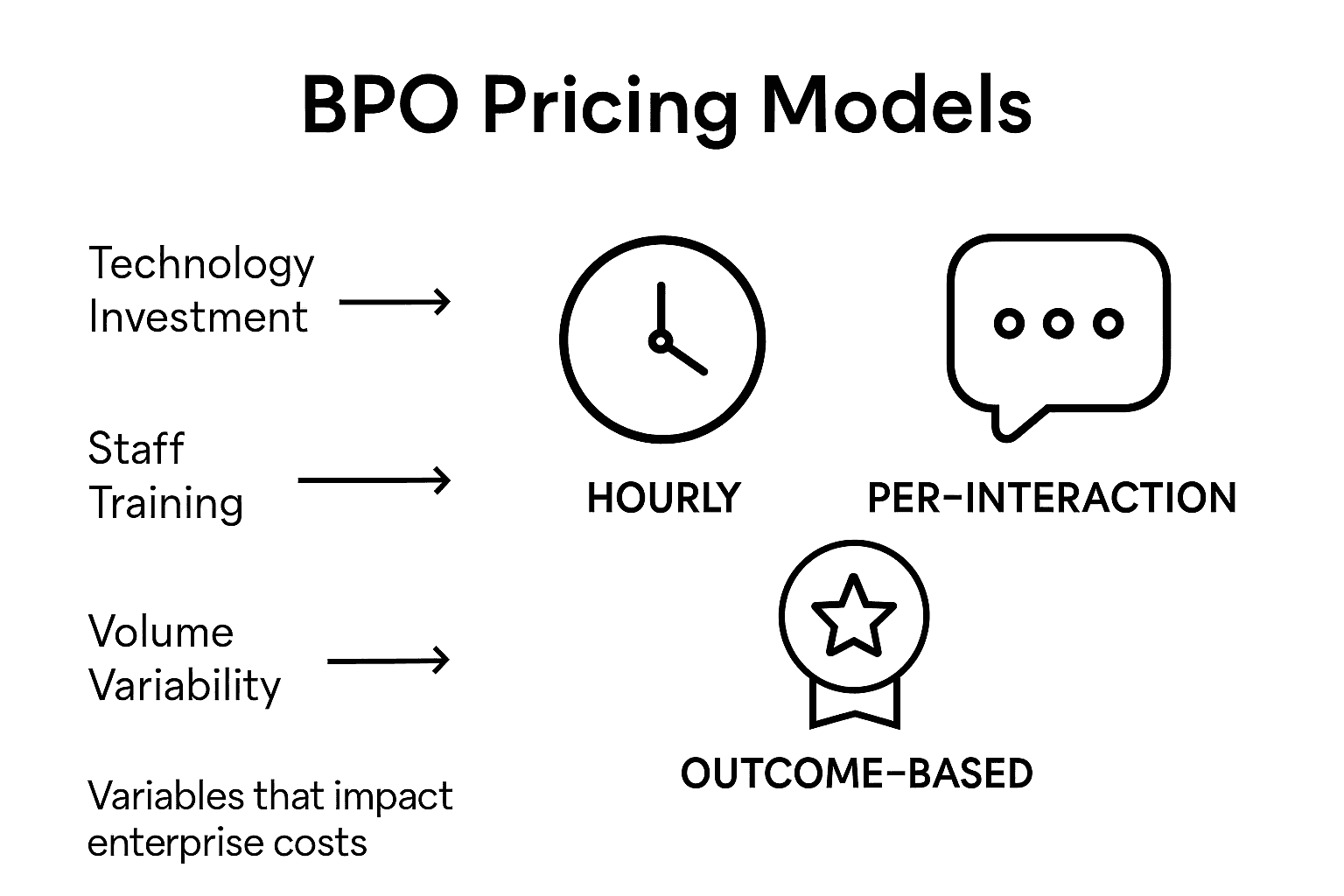
Customer support BPO pricing models are complex strategic frameworks that directly impact an organization’s operational expenses and financial planning. BPO pricing strategies encompass multiple approaches designed to provide flexibility and alignment with diverse business requirements, each offering unique advantages and potential challenges for enterprises seeking outsourced support solutions.
The primary pricing models in customer support BPO include hourly-based pricing, per-minute/per-interaction pricing, and performance-based pricing. Hourly-based pricing provides predictable costs with a fixed rate regardless of volume, making it suitable for organizations with consistent support needs. Per-minute or per-interaction models offer more granular cost control, charging clients based on actual usage and allowing for more dynamic scaling. Performance-based pricing represents the most innovative approach, directly linking costs to specific business outcomes and creating a more collaborative partnership between the BPO provider and the client.
This comparison explains major BPO pricing models and when to use them:
| Pricing Model | How It Works | Best For |
|---|---|---|
| Hourly-Based | Fixed hourly agent rate | Predictable support needs |
| Per-Minute/Interaction | Pay per contact/handled minute | Fluctuating or unpredictable volume |
| Performance-Based | Fees tied to business outcomes | Strategic, results-driven partnerships |
Key cost drivers in customer support BPO extend beyond simple pricing structures and include factors such as technological infrastructure, agent skill levels, language capabilities, and geographic location. Enterprises must consider these nuanced elements when evaluating potential BPO partnerships, as they significantly influence overall service quality and long-term cost-effectiveness. Advanced BPO providers often offer hybrid pricing models that combine elements from different approaches, enabling more tailored and flexible financial arrangements that can adapt to changing business requirements.
Pro Tip – Financial Optimization: Conduct a comprehensive total cost of ownership analysis that goes beyond headline pricing, evaluating indirect costs, potential efficiency gains, and long-term strategic value when selecting a customer support BPO partner.
Risks, Security, and Compliance Factors
Customer support BPO introduces complex security and compliance challenges that require comprehensive strategic management. Customer support BPO security protocols demand rigorous approaches to protect sensitive organizational and customer information across multiple operational dimensions.
The primary security risks in customer support BPO encompass data privacy breaches, regulatory non-compliance, and potential unauthorized information access. Comprehensive risk mitigation strategies must address technological vulnerabilities, human factor risks, and systemic organizational challenges. This includes implementing robust encryption technologies, establishing strict access control protocols, conducting regular security audits, and developing comprehensive employee training programs that emphasize data protection and confidentiality awareness.
Enterprises must carefully evaluate potential BPO partners through detailed compliance assessments that examine their adherence to international standards such as GDPR, HIPAA, and industry-specific regulatory frameworks. Critical evaluation criteria should include the provider’s data handling procedures, incident response capabilities, technological infrastructure security, employee background verification processes, and demonstrated track record of maintaining stringent security standards. Advanced BPO providers often integrate multi-layered security approaches, combining technological solutions, legal safeguards, and continuous monitoring mechanisms to create comprehensive protection ecosystems.
Pro Tip – Security Diligence: Develop a comprehensive security assessment framework that includes mandatory third-party security certifications, regular penetration testing, and detailed contractual agreements specifying exact data protection responsibilities and potential liability scenarios.
Unlock Your Enterprise Potential with Expert Customer Support BPO Solutions
The article highlights key challenges enterprises face when managing customer support functions such as maintaining multi-channel interactions, ensuring high-quality technical assistance, and managing costs through strategic pricing models. If you are seeking to reduce operational complexity while enhancing customer satisfaction and scalability, it is essential to partner with a provider who understands these pain points and offers tailored solutions in managed customer support BPO.
StorsenDigital.com specializes in delivering comprehensive outsourcing and nearshoring services across Europe that align perfectly with these needs. Our expertise in talent acquisition, technology integration, and process optimization allows your business to benefit from 24/7 support capabilities, industry-focused service excellence, and secure compliance management. Let us help transform your customer support operations into a strategic asset that drives growth and efficiency.
Explore how our approach addresses critical factors like multi-channel management, cost-effective pricing models, and robust security protocols by contacting our team today.

Take the next step toward seamless, scalable customer support outsourcing. Reach out now to partner with StorsenDigital.com and position your enterprise for competitive advantage with trusted nearshoring and BPO solutions. Visit our contact page to get started.
Frequently Asked Questions
What is Customer Support BPO?
Customer Support BPO (Business Process Outsourcing) is a strategic approach where businesses delegate their customer interaction functions, such as support and engagement, to specialized external service providers.
What are the main types of services offered by Customer Support BPO?
Customer Support BPO services include multi-channel support, technical support, order processing, feedback collection, and upselling. Each type plays a critical role in enhancing customer interactions and driving business growth.
How does Customer Support BPO operate in practice?
Customer Support BPO operates through a blend of technological infrastructure, human expertise, and strategic process management. This includes integrating CRM systems, utilizing automated ticketing, and ensuring omnichannel communication for seamless customer support experiences.
What are the common pricing models used in Customer Support BPO?
Common pricing models include hourly-based pricing, per-minute or per-interaction pricing, and performance-based pricing. Each model provides different benefits depending on the organization’s support needs and financial strategy.


