


Over 60 percent of American companies now outsource at least part of their customer support operations. As rising customer expectations put more pressure on internal teams, businesses are searching for solutions that increase efficiency without sacrificing quality. Clearly understanding the key functions and models of customer support outsourcing helps organizations streamline service, save money, and provide faster help to their customers.
Table of Contents
- Defining Customer Support Outsourcing Functions
- Key Models: Offshoring, Nearshoring, and Onshoring
- How Outsourcing Enhances Scalability and Efficiency
- Cost Benefits and Financial Implications for Enterprises
- Comparing Outsourcing to In-House Support Operations
Key Takeaways
| Point | Details |
|---|---|
| Customer Support Outsourcing Enhances Efficiency | Outsourcing customer support allows businesses to focus on core activities while leveraging external expertise and technology for improved service delivery. |
| Geographical Models Offer Strategic Options | Companies can choose between offshoring, nearshoring, and onshoring based on cost, cultural alignment, and operational needs to optimize their support operations. |
| Scalability and Flexibility are Key Benefits | Outsourcing provides the ability to quickly scale support services up or down based on demand, without the overhead of maintaining a large in-house team. |
| Cost Structure and Financial Benefits | Transitioning to an outsourced model can convert fixed costs to variable ones, improving cash flow and enabling more strategic financial planning. |
Defining Customer Support Outsourcing Functions
Customer support outsourcing represents a strategic approach where businesses delegate their customer interaction and service responsibilities to specialized external partners. This practice enables organizations to enhance operational efficiency while maintaining high-quality customer experiences.
At its core, customer support outsourcing involves transferring customer communication channels like phone, email, chat, and social media management to a third-party service provider. Companies leverage these specialized teams to handle various interactions, ranging from technical support and product inquiries to complaint resolution and post-purchase assistance. The Customer Support Conversation framework highlights the critical importance of structured and empathetic communication in these interactions, emphasizing five distinct conversational stages that guide high-quality customer service.
Effective customer support outsourcing functions typically encompass several key operational domains:
- Multichannel Support: Managing customer interactions across phone, email, live chat, social media, and messaging platforms
- Technical Troubleshooting: Providing specialized technical assistance and product guidance
- Billing and Account Management: Handling payment inquiries, account modifications, and financial support
- Complaint Resolution: Systematically addressing and resolving customer concerns with efficiency and empathy
- Product Information Dissemination: Offering comprehensive details about product features, usage, and specifications
By partnering with experienced outsourcing providers like StorsenDigital, businesses can transform customer support from a cost center into a strategic asset. These specialized teams bring deep expertise, advanced technological infrastructure, and a commitment to maintaining exceptional service standards across diverse customer interaction scenarios.
Key Models: Offshoring, Nearshoring, and Onshoring
Customer support outsourcing encompasses three primary geographical models that businesses can leverage to optimize their service delivery: offshoring, nearshoring, and onshoring. Each model presents unique advantages and challenges, enabling organizations to strategically align their customer support operations with specific business objectives.

Comprehensive research on outsourcing models reveals distinct characteristics that differentiate these approaches. Offshoring involves establishing customer support teams in geographically distant countries, typically with significant cost advantages but potential communication and cultural challenges. Conversely, nearshoring focuses on partnering with service providers in neighboring or geographically close countries, offering a balanced approach that combines cost efficiency with cultural and linguistic proximity.
Onshoring, the third model, represents a domestic outsourcing strategy where companies engage support teams within their home country. This approach minimizes language barriers and cultural differences but often comes with higher operational costs. Detailed comparative analysis highlights the nuanced trade-offs between these models:
Offshoring:
- Lowest cost per agent
- Potential significant time zone differences
- Higher risk of communication challenges
Nearshoring:
- Moderate cost advantages
- Similar time zones
- Cultural and linguistic alignment
- Reduced communication friction
Onshoring:
- Highest operational costs
- Perfect cultural and linguistic match
- Immediate accessibility
- Strong local market understanding
Companies like StorsenDigital specialize in helping organizations navigate these models, providing tailored solutions that balance cost-effectiveness, operational efficiency, and service quality. The optimal model depends on specific business requirements, budget constraints, and strategic long-term objectives.
How Outsourcing Enhances Scalability and Efficiency
Customer support outsourcing represents a strategic approach that enables businesses to dramatically enhance their operational scalability and efficiency. By leveraging external expertise, companies can rapidly adapt to changing market demands without the substantial overhead associated with building and maintaining internal infrastructure.
Advanced outsourcing strategies demonstrate how organizations can quickly scale operations in response to fluctuating customer service requirements. This flexibility allows businesses to ramp up support capabilities during peak periods and scale down during slower seasons, eliminating the financial burden of maintaining a consistently large in-house team. The ability to access specialized expertise and cutting-edge technology without significant capital investments provides a compelling competitive advantage.
Companies can achieve remarkable operational efficiency through outsourcing by implementing several key strategies:
Rapid Resource Allocation:
- Instantly deploy trained support professionals
- Eliminate lengthy recruitment and training processes
- Quickly adjust team size based on business needs
Technology Integration:
- Access advanced CRM and communication tools
- Implement multilingual and omnichannel support platforms
- Leverage state-of-the-art customer interaction technologies
Cost Optimization:
- Reduce fixed operational expenses
- Convert fixed costs to variable, performance-based models
- Minimize infrastructure and technology investment requirements
By implementing strategic business process outsourcing, organizations can transform their customer support from a cost center into a dynamic, responsive service engine. The key lies in selecting partners who understand your specific operational requirements and can provide tailored, scalable solutions that align with your business objectives.
Cost Benefits and Financial Implications for Enterprises
Customer support outsourcing introduces a transformative financial model that enables enterprises to convert fixed operational expenses into flexible, scalable investments. By strategically reimagining customer support as a variable cost structure, organizations can achieve significant economic advantages that extend far beyond traditional cost-cutting approaches.
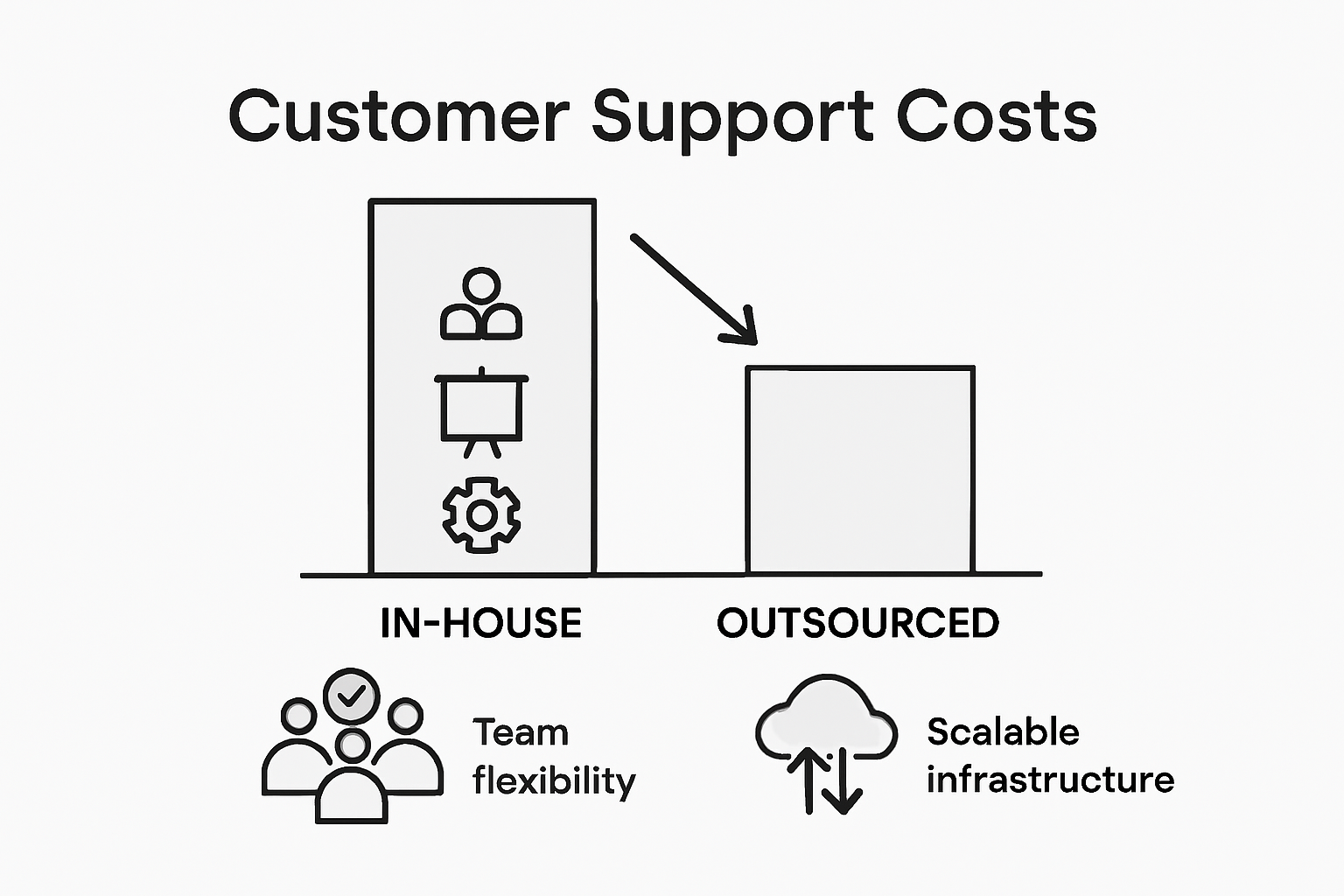
Financial optimization through outsourcing goes beyond simple expense reduction. Advanced automated support systems demonstrate how technological integration can simultaneously reduce operational costs and maintain high-quality customer interactions. These sophisticated approaches can decrease issue resolution time by up to 10% while preserving customer satisfaction levels, presenting a compelling economic argument for strategic outsourcing.
The financial implications of customer support outsourcing can be categorized into several critical dimensions:
Direct Cost Reduction:
- Eliminate recruitment and training expenses
- Reduce infrastructure and technology investment requirements
- Lower per-agent operational costs
Indirect Financial Benefits:
- Minimize overhead and administrative expenses
- Convert fixed labor costs to variable, performance-based models
- Reduce long-term financial commitments
Strategic Financial Advantages:
- Improve cash flow predictability
- Enable faster scaling without substantial capital expenditure
- Redirect resources toward core business growth initiatives
By leveraging strategic outsourcing partnerships, enterprises can transform their customer support from a cost center into a strategic financial asset. The key lies in selecting partners who understand the nuanced financial dynamics of modern business operations and can deliver measurable economic value.
Comparing Outsourcing to In-House Support Operations
Customer support operations represent a critical strategic decision where businesses must carefully evaluate the trade-offs between maintaining internal teams and leveraging external expertise. The choice between in-house support and outsourcing is no longer a simple cost calculation but a complex strategic consideration that impacts overall organizational performance and customer experience.
Contemporary outsourcing strategies reveal significant differences between in-house and outsourced support models across multiple performance dimensions. While in-house teams offer direct control and potential cultural alignment, outsourced providers bring specialized expertise, advanced technological infrastructure, and the ability to rapidly scale operations without substantial internal investment.
Key comparative dimensions between in-house and outsourced support operations include:
Cost Structure:
- In-House: Fixed overhead, consistent expenses
- Outsourced: Variable costs, flexible scaling
- Potential 30-50% cost reduction with outsourcing
Technological Capabilities:
- In-House: Limited by internal budget constraints
- Outsourced: Access to cutting-edge support technologies
- Immediate implementation of advanced CRM systems
Talent Acquisition:
- In-House: Lengthy recruitment, training investments
- Outsourced: Instant access to specialized professionals
- Reduced time-to-productivity
Operational Flexibility:
- In-House: Slower adaptation to market changes
- Outsourced: Rapid team size and skill adjustments
- Enhanced responsiveness to business dynamics
By exploring comprehensive business process outsourcing strategies, organizations can develop nuanced approaches that transcend traditional operational models. The most successful enterprises recognize that outsourcing is not about replacing internal capabilities, but about strategically augmenting and optimizing their customer support ecosystem.
Unlock Scalability and Savings with Expert Customer Support Outsourcing
Many companies face the challenge of balancing cost efficiency with high-quality customer service as they grow. This article highlights key pain points such as managing operational costs, scaling support teams during peak demand, and selecting the right outsourcing model whether offshoring, nearshoring, or onshoring. If you want to convert your customer support from a fixed cost burden into a scalable business advantage while benefiting from specialized expertise and advanced technology, tailored outsourcing solutions are crucial.
At StorsenDigital, we specialize in providing flexible, strategic Business Process Outsourcing services across Europe designed to meet your exact needs. Whether you aim to enhance technical support, optimize multichannel communication, or improve complaint resolution efficiency, our nearshoring and outsourcing services empower you to gain a competitive edge, reduce operational expenses, and accelerate growth.
Take control of your support operations now with StorsenDigital’s custom talent recruitment, managed BPO services, and strategic consulting. Discover how we make scaling seamless and cost-effective by connecting with our experts.

Ready to transform your customer support and drive savings today Start a conversation with us at StorsenDigital Contact Page to explore tailored outsourcing solutions. Learn more about our Business Process Outsourcing services and experience how nearshoring can boost your operational efficiency without sacrificing quality.
Frequently Asked Questions
What is customer support outsourcing?
Customer support outsourcing is a strategic approach where businesses delegate customer interaction and service responsibilities to specialized external partners, enhancing operational efficiency and customer experiences.
What are the primary models of customer support outsourcing?
The three primary models of customer support outsourcing are offshoring, nearshoring, and onshoring, each with unique cost advantages and challenges related to communication and cultural alignment.
How does outsourcing customer support enhance scalability?
Customer support outsourcing enhances scalability by allowing businesses to rapidly adjust their support capabilities in response to fluctuating demand without the overhead of maintaining a large in-house team.
What are the financial benefits of outsourcing customer support?
Outsourcing customer support can lead to direct cost reduction, indirect financial benefits like minimized overhead, and strategic advantages such as improved cash flow predictability and resource allocation towards core business initiatives.


