


More than 60 percent of american businesses now outsource some aspect of their customer support. This shift reflects the growing need for flexible, specialized service that can keep up with customer expectations around the clock. With so many options to choose from, understanding how customer support outsourcing works and what it offers can help companies make smart decisions that support growth and deliver reliable service.
Table of Contents
- Defining Customer Support Outsourcing
- Key Types: Onshore, Offshore, Nearshore Models
- How Customer Support Outsourcing Works
- Benefits and Challenges for Enterprises
- Cost Considerations and Risk Management
Key Takeaways
| Point | Details |
|---|---|
| Customer Support Outsourcing | Companies enhance productivity by outsourcing customer support to specialized providers, allowing them to focus on core competencies. |
| Outsourcing Models | Onshore, offshore, and nearshore models each have unique benefits and challenges that should align with business strategies and budget. |
| Technological Integration | Effective outsourcing hinges on leveraging advanced technology and strong training programs to optimize customer interaction. |
| Balance of Benefits and Risks | Enterprises must assess cost savings against risks like communication barriers and service quality to ensure effective outsourcing success. |
Defining Customer Support Outsourcing
Customer support outsourcing represents a strategic business practice where companies contract external specialized organizations to manage their customer interaction and service functions. Wikipedia defines outsourcing as a business approach where companies leverage external providers to handle processes traditionally managed internally, which perfectly captures the essence of customer support outsourcing.
At its core, customer support outsourcing involves transferring customer service responsibilities to professional third-party service providers who are equipped with specialized tools, technologies, and trained personnel. According to Wikipedia, customer support encompasses a comprehensive range of services designed to assist customers, including planning, installation, training, troubleshooting, maintenance, upgrading, and product disposal.
The strategic decision to outsource customer support enables businesses to focus on their core competencies while ensuring high-quality customer interactions. By partnering with experienced BPO service providers, companies can access specialized expertise, reduce operational costs, and maintain consistent customer service quality across various communication channels. These external teams are typically trained to handle diverse customer inquiries, technical support requests, and complex service scenarios with professional efficiency.
Key characteristics of effective customer support outsourcing include:
- Scalable service models
- Multilingual support capabilities
- 24/7 customer interaction management
- Advanced technological infrastructure
- Specialized training programs
- Performance-driven quality assurance mechanisms
Ultimately, customer support outsourcing is not just about delegating tasks but creating a seamless, responsive customer experience that aligns with the company’s brand standards and service expectations.
Key Types: Onshore, Offshore, Nearshore Models
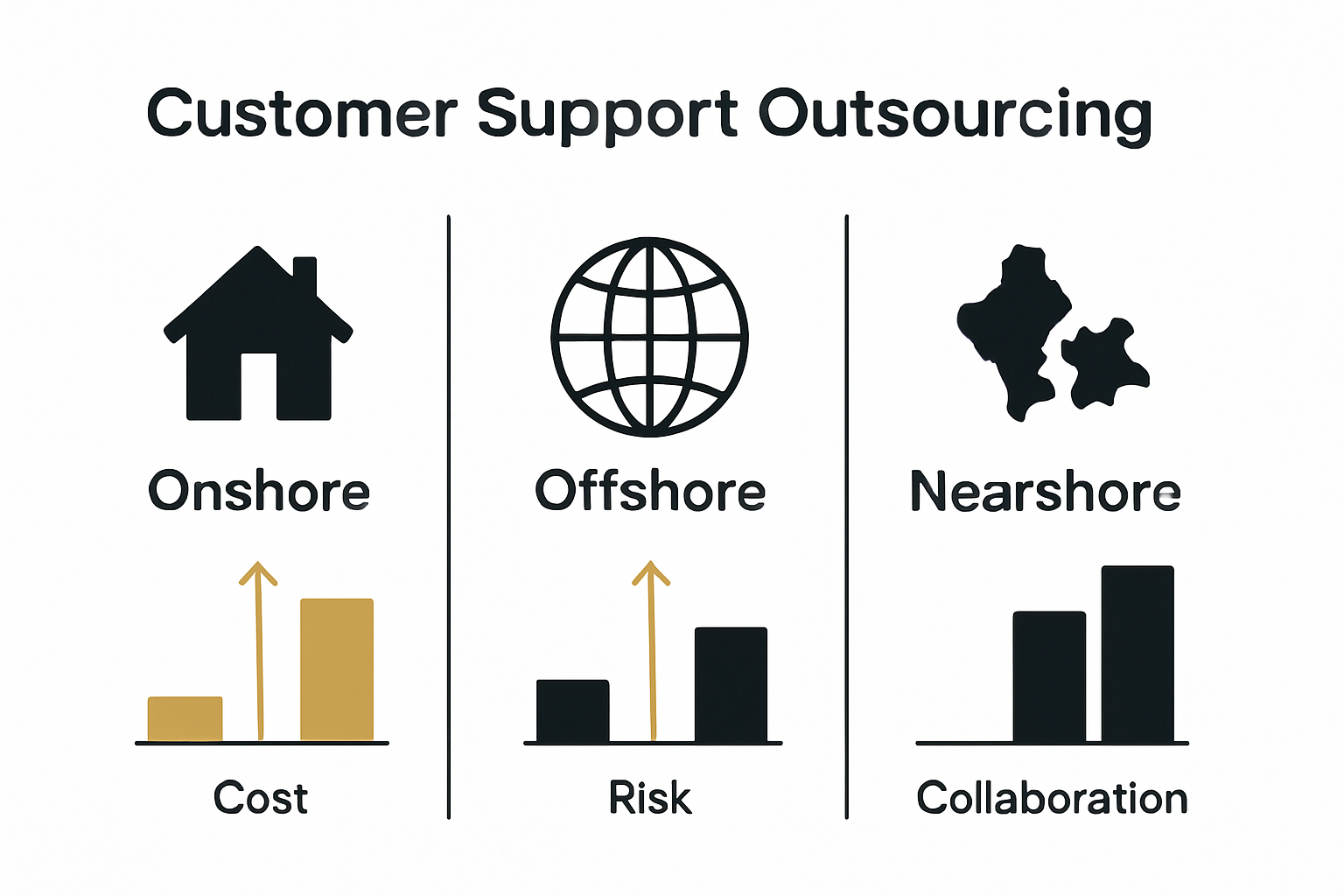
Customer support outsourcing encompasses three primary geographic models, each with unique strategic advantages and considerations. ScienceDirect defines these models as onshore (within the same country), offshore (in a distant country), and nearshore (in a neighboring country), each offering distinct approaches to managing customer support operations.
Onshore Outsourcing represents the model where companies contract customer support services within their home country. According to AgileEngine, this approach offers high cultural alignment and real-time collaboration, making it ideal for businesses prioritizing immediate communication and deep understanding of local customer nuances. However, onshore outsourcing typically comes with higher operational costs compared to other models.
Offshore Outsourcing involves contracting customer support services to a geographically distant country, often driven by significant cost reduction opportunities. While this model provides substantial financial benefits, it can present challenges related to time zone differences, potential language barriers, and cultural misalignments. Companies choosing offshore models must invest in robust communication infrastructure and comprehensive training programs to ensure service quality.
Nearshore Outsourcing emerges as a strategic middle ground, offering a balanced approach that combines cost efficiency with geographical and cultural proximity. By selecting service providers in neighboring or culturally similar countries, businesses can achieve moderate cost savings while maintaining easier communication and reduced logistical complexities.
Key comparative factors across outsourcing models include:
- Cost structure
- Communication efficiency
- Cultural alignment
- Time zone compatibility
- Talent pool accessibility
- Technological infrastructure
The optimal outsourcing model depends on specific business requirements, budget constraints, and strategic priorities. Successful implementation demands careful evaluation of each model’s strengths and potential limitations.

How Customer Support Outsourcing Works
Customer support outsourcing operates through a sophisticated process of strategic planning, technological integration, and specialized talent management. Managed BPO Services play a crucial role in establishing comprehensive frameworks that enable seamless customer interaction and support delivery across multiple channels and platforms.
The process typically begins with detailed requirement analysis, where the outsourcing partner conducts an in-depth assessment of the client’s specific customer support needs, communication protocols, and service level expectations. Research from ArXiv highlights the emerging trend of integrating intelligent systems like the ICS-Assist framework, which can recommend suitable solutions for service staff in real-time, significantly enhancing operational efficiency and customer satisfaction.
Technological infrastructure forms the backbone of effective customer support outsourcing. ArXiv demonstrates how advanced machine learning and natural language processing techniques can be implemented to improve issue resolution speed and accuracy. Modern outsourcing providers leverage sophisticated customer relationship management (CRM) systems, multichannel communication platforms, and advanced analytics tools to deliver comprehensive support solutions.
Key operational components of customer support outsourcing include:
- Comprehensive talent recruitment and training
- Advanced technological infrastructure
- Multilingual support capabilities
- Performance monitoring and quality assurance
- Scalable service delivery models
- Continuous improvement mechanisms
Successful customer support outsourcing requires a dynamic partnership that goes beyond mere task delegation, focusing on creating exceptional customer experiences through strategic collaboration, technological innovation, and specialized expertise.
Benefits and Challenges for Enterprises
Customer support outsourcing presents a complex landscape of strategic advantages and potential obstacles for enterprises seeking to optimize their customer interaction capabilities. Advantages of BPO Services illuminate the multifaceted benefits that drive organizations toward these innovative service models.
Research from ArXiv emphasizes that the success of outsourcing initiatives is critically dependent on human factors, particularly effective knowledge transfer and cultural alignment. This insight underscores that while technological solutions are important, the human element remains paramount in customer support outsourcing. Enterprises must carefully navigate potential challenges such as communication barriers, cultural differences, and maintaining consistent service quality across distributed teams.
According to ScienceDirect, different outsourcing models present unique trade-offs. Onshore models offer high control and cultural alignment but at premium costs, offshore models provide significant cost savings with potential communication challenges, while nearshore options represent a balanced approach combining cost efficiency with geographic and cultural proximity.
Key benefits for enterprises include:
- Significant cost reduction
- Access to global talent pools
- Scalable service capabilities
- 24/7 customer support operations
- Advanced technological infrastructure
- Increased operational flexibility
Corresponding challenges enterprises must address:
- Maintaining service quality consistency
- Managing cultural and communication differences
- Ensuring data security and privacy
- Protecting brand reputation
- Managing complex vendor relationships
- Integrating external teams with internal processes
Successful customer support outsourcing requires a strategic, nuanced approach that balances technological innovation, human expertise, and comprehensive risk management.
Cost Considerations and Risk Management
Customer support outsourcing requires a comprehensive financial and strategic approach that balances potential savings with robust risk mitigation strategies. Step-by-Step Guide to BPO Outsourcing provides critical insights into navigating the complex financial landscape of outsourcing decisions.
Research from ArXiv emphasizes that the success of outsourcing initiatives is fundamentally tied to human factors, including effective knowledge transfer and cultural alignment, which directly impact cost structures and risk management. These considerations extend beyond simple financial calculations, demanding a nuanced approach that accounts for both tangible and intangible expenses associated with customer support outsourcing.
ScienceDirect highlights the critical trade-offs between different outsourcing models, demonstrating that cost considerations are not uniformly applicable. Onshore models typically present higher direct costs but lower potential risks, offshore models offer significant cost savings with increased potential for communication and quality challenges, while nearshore options provide a balanced approach combining cost efficiency with reduced operational risks.
Key cost considerations include:
- Initial transition and setup expenses
- Ongoing operational costs
- Technology infrastructure investments
- Training and knowledge transfer expenses
- Potential productivity adjustment periods
- Compliance and data security investments
Critical risk management strategies:
- Comprehensive vendor due diligence
- Robust contractual frameworks
- Continuous performance monitoring
- Scalable service level agreements
- Data protection and confidentiality protocols
- Contingency and exit strategy planning
Successful customer support outsourcing demands a holistic approach that strategically balances financial optimization with comprehensive risk mitigation, recognizing that the lowest-cost solution is not always the most effective long-term strategy.
Transform Your Customer Support with Expert Outsourcing Solutions
Many businesses face the challenge of delivering high-quality, scalable customer support while managing costs and maintaining service consistency. This article highlights critical pain points such as balancing cultural alignment, ensuring 24/7 service, and integrating advanced technology without sacrificing quality. Terms like nearshore, offshore, and managed BPO reveal that finding the right outsourcing model is central to overcoming these hurdles.
At StorsenDigital, we specialize in tailored customer support outsourcing that addresses these exact concerns. Our experienced teams provide multilingual support with seamless integration into your operations, supported by cutting-edge technology. When you partner with us, you gain a strategic advantage by reducing operational risk and unlocking scalable service capabilities designed to elevate your customer experience.
Discover the difference our managed BPO services can make for your company today.

Ready to optimize your customer interactions through strategic outsourcing? Visit StorsenDigital now and explore how our nearshoring and business process outsourcing solutions deliver reliable, cost-effective customer support tailored for your enterprise needs. Take the first step toward smarter service and lasting growth.
Frequently Asked Questions
What is customer support outsourcing?
Customer support outsourcing is a business practice where companies contract external specialized organizations to handle their customer service functions, allowing businesses to focus on their core competencies while ensuring quality customer interactions.
What are the main types of customer support outsourcing models?
The primary models include onshore outsourcing (services provided within the same country), offshore outsourcing (services provided in a distant country), and nearshore outsourcing (services provided in a neighboring country), each with its own strategic advantages and considerations.
What are the benefits of customer support outsourcing?
Benefits include significant cost reductions, access to global talent, scalable service capabilities, round-the-clock customer support, advanced technology infrastructure, and increased operational flexibility.
What challenges should companies consider when outsourcing customer support?
Companies may face challenges such as maintaining service quality consistency, managing cultural and communication differences, ensuring data security and privacy, and integrating external teams with internal processes.


