


Under mounting pressure to control costs while scaling service quality, many leaders across European tech enterprises are reevaluating how customer support fits into their growth plans. Outsourcing offers a pathway to greater efficiency, but finding the right balance between external partnerships and in-house priorities demands more than a quick decision. This guide lays out a practical, step-by-step approach to customer support outsourcing that aligns operational improvements with your strategic objectives.
Table of Contents
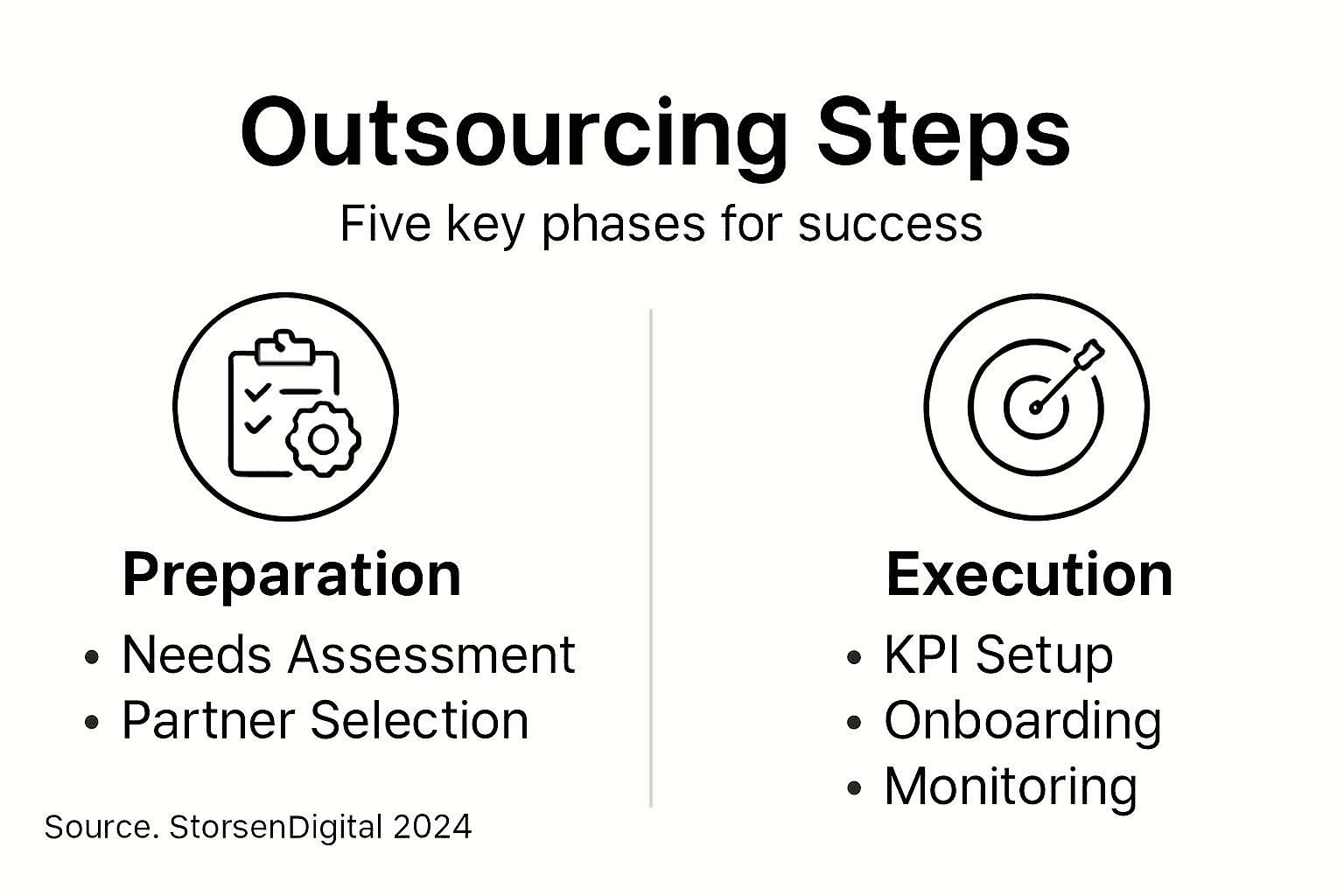
- Step 1: Assess Internal Needs And Outsourcing Goals
- Step 2: Select The Right Customer Support Partner
- Step 3: Define Kpis And Integration Workflows
- Step 4: Implement Transition And Onboarding Plan
- Step 5: Monitor Performance And Optimize Continuously
Quick Summary
| Key Message | Explanation |
|---|---|
| 1. Conduct Internal Assessment | Evaluate your current customer support to identify outsourcing opportunities and needs. |
| 2. Select the Right Partner | Choose a customer support partner who aligns with your business culture and needs. |
| 3. Define Clear KPIs | Establish measurable KPIs to assess the performance and integration of your outsourcing partner. |
| 4. Implement Comprehensive Onboarding | Develop detailed onboarding plans to ensure smooth integration of external teams. |
| 5. Focus on Continuous Monitoring | Regularly evaluate performance to optimize and improve customer support outsourcing results. |
Step 1: Assess Internal Needs and Outsourcing Goals
Assessing your organization’s customer support outsourcing requirements begins with a comprehensive internal evaluation. Your goal is to understand precisely which functions are prime candidates for external management and how outsourcing can strategically enhance your operational capabilities.
To initiate this assessment, start by conducting a detailed internal needs assessment. This involves mapping out your current customer support infrastructure and identifying potential gaps or inefficiencies. Consider the following critical evaluation points:
- Current support team performance: Analyze response times, resolution rates, and customer satisfaction metrics
- Resource allocation: Evaluate existing staff workload and operational costs
- Technology infrastructure: Review current support tools, software, and communication platforms
- Scalability challenges: Determine if your existing setup can handle potential business growth
The strategic evaluation should focus on matching outsourcing goals with core business objectives. This means understanding not just where external support can help, but how it aligns with your broader organizational mission. Organizations that systematically evaluate outsourcing processes tend to achieve more successful outcomes.
Strategic outsourcing is not about replacing internal capabilities, but augmenting them with specialized external expertise.
Key metrics to consider during this assessment include cost-per-interaction, average handling time, customer retention rates, and potential long-term savings. By thoroughly understanding your internal landscape, you can design a targeted outsourcing strategy that delivers measurable improvements.
The following table summarizes how outsourcing can impact key business functions:
| Function Area | Outsourcing Impact | Strategic Benefit |
|---|---|---|
| Customer Response | Improved consistency | Higher satisfaction rates |
| Technology Management | Access to new tools | Enhanced efficiency |
| Resource Allocation | Flexible staffing | Reduced operational costs |
| Scalability | Rapid expansion | Supports business growth |
Pro tip: Create a detailed scorecard that objectively ranks potential outsourcing functions based on complexity, strategic importance, and potential cost savings.
Step 2: Select the Right Customer Support Partner
Selecting the ideal customer support partner is a critical decision that can dramatically impact your organization’s service quality and operational efficiency. Your goal is to identify a partner who not only meets your technical requirements but also aligns with your company’s culture and strategic objectives.
When evaluating potential outsourcing partners, focus on customer support partner qualities that go beyond basic technical capabilities. Consider the following comprehensive selection criteria:
- Communication skills: Ability to understand and represent your brand voice
- Technical expertise: Proficiency in relevant support technologies and platforms
- Language capabilities: Multilingual support matching your customer demographics
- Cultural alignment: Understanding of your industry and customer expectations
- Proven track record: Demonstrated success in similar outsourcing environments
The right customer support partner becomes an extension of your internal team, not just an external service provider.
During your evaluation, request detailed case studies, conduct thorough interviews, and consider running pilot programs to assess potential partners. Performance metrics like first-call resolution rates, average response times, and customer satisfaction scores should be carefully analyzed.

Additionally, explore customer support BPO frameworks that can provide structured approaches to partner selection. Look for partners who offer transparent reporting, flexible scaling options, and a commitment to continuous improvement.
Pro tip: Create a weighted scoring matrix that objectively ranks potential outsourcing partners across multiple dimensions, ensuring a comprehensive and data-driven selection process.
Step 3: Define KPIs and Integration Workflows
Successfully integrating your customer support outsourcing partner requires establishing clear key performance indicators (KPIs) and creating seamless integration workflows. This crucial step ensures that your external support team operates as a cohesive extension of your organization, maintaining consistent quality and strategic alignment.
Begin by defining precise outsourcing metrics that directly reflect your business objectives. These KPIs should encompass multiple dimensions of performance:
- Customer satisfaction scores: Measure overall customer experience
- Response and resolution times: Track efficiency of support interactions
- First-call resolution rate: Evaluate problem-solving effectiveness
- Cost per interaction: Monitor operational efficiency
- Quality assurance metrics: Assess accuracy and compliance
Effective KPIs transform outsourcing from a transactional service into a strategic partnership.
To create robust integration workflows, map critical business processes that connect your internal teams with the external support partner. This involves establishing standardized communication channels, harmonizing technology systems, and creating clear escalation protocols.
Implement regular performance review meetings, develop shared dashboards, and create real-time reporting mechanisms that provide transparent insights into support operations. This approach ensures continuous improvement and keeps both internal and external teams aligned with organizational goals.
Here’s a quick comparison of common KPI types and their business value in customer support outsourcing:
| KPI Type | Measurement Focus | Business Value |
|---|---|---|
| Customer Satisfaction | Overall support experience | Drives loyalty and retention |
| Response Time | Speed of agent replies | Boosts customer confidence |
| Resolution Rate | Issues solved first contact | Reduces follow-up workload |
| Cost Efficiency | Cost per session/interaction | Maximizes budget utilization |
Pro tip: Develop a dynamic KPI framework that can adapt and evolve as your business needs change, allowing for periodic recalibration of performance expectations.
Step 4: Implement Transition and Onboarding Plan
Successfully implementing a customer support outsourcing strategy hinges on executing a comprehensive transition and onboarding plan. This critical phase determines how smoothly your external team integrates with existing operations and begins delivering high-quality customer support.
Begin by developing a detailed outsourcing transition strategy that addresses multiple critical dimensions:
- Knowledge transfer: Comprehensive documentation of existing processes
- Training programs: Detailed skill development for external support agents
- Technology integration: Seamless connection of communication and support platforms
- Cultural alignment: Workshops to understand company values and customer interaction standards
- Gradual rollout: Phased approach to minimize operational disruptions
A well-executed transition plan transforms potential risks into strategic opportunities for service enhancement.
Structure the onboarding process into three distinct phases: pre-transition preparation, active transition, and post-transition stabilization. During the pre-transition phase, focus on comprehensive knowledge sharing, including customer interaction guidelines, product details, and company-specific communication protocols.
Implement overlapping support models where internal and external teams work simultaneously, allowing for real-time learning and immediate performance calibration. Establish clear communication channels, regular performance review meetings, and continuous feedback mechanisms to ensure smooth collaboration and rapid issue resolution.
Pro tip: Create a dedicated transition team with representatives from both internal and external organizations to facilitate seamless communication and address potential challenges proactively.
Step 5: Monitor Performance and Optimize Continuously
Continuous performance monitoring and optimization are critical to maintaining the effectiveness and value of your customer support outsourcing partnership. This step transforms your outsourcing relationship from a static contract into a dynamic, evolving collaboration that adapts to changing business needs.
Implement strategic performance management frameworks that go beyond traditional service level agreements. Your monitoring approach should encompass multiple performance dimensions:
- Quantitative metrics: Response times, resolution rates, customer satisfaction scores
- Qualitative assessments: Communication quality, problem-solving effectiveness
- Strategic alignment: Contribution to broader business objectives
- Continuous improvement: Identification of optimization opportunities
- Risk management: Proactive detection of potential service disruptions
Performance monitoring is not about fault-finding, but about collaborative enhancement and mutual growth.
Develop comprehensive outsourcing performance evaluation processes that include regular review meetings, detailed analytics dashboards, and transparent reporting mechanisms. These tools will help you track progress, identify trends, and make data-driven decisions about your outsourcing strategy.
Establish a feedback loop that encourages open communication between your internal team and the outsourcing partner. This collaborative approach allows for rapid adjustments, skill development, and continuous refinement of support processes.
Pro tip: Schedule quarterly strategic review sessions that not only assess performance but also explore innovative ways to enhance collaboration and drive mutual value.
Elevate Your Customer Support Outsourcing for Lasting Success
Mastering the customer support outsourcing process requires more than just finding an external partner. It demands a strategic approach that addresses key challenges such as seamless integration, performance monitoring, and maintaining brand consistency. If you are aiming to enhance scalability, reduce operational costs, and achieve measurable improvements in customer satisfaction, you need a partner who understands these complexities and complements your business goals.
StorsenDigital offers comprehensive managed BPO services designed to help medium to large enterprises unlock the full potential of outsourcing across Europe. From thorough onboarding and smooth technology integration to continuous performance optimization, our expertise ensures your customer support functions as a seamless extension of your internal teams. Take advantage of our tailored solutions for talent recruitment, strategic consulting, and scalable operations built on proven frameworks mentioned in the article.
Ready to transform your customer support outsourcing journey?

Discover how StorsenDigital can customize an outsourcing strategy aligned with your unique needs. Connect with our experts today and begin driving operational excellence and customer loyalty. Visit Contact Us to get started now.
Frequently Asked Questions
What should I assess before outsourcing customer support?
To successfully outsource customer support, start by conducting a detailed internal needs assessment. Identify your current support team performance, resource allocation, technology infrastructure, and scalability challenges. This will help you determine which functions are best suited for external management.
How can I select the right customer support outsourcing partner?
Choosing the right partner involves evaluating their communication skills, technical expertise, and cultural alignment with your organization. Request case studies and conduct thorough interviews to ensure they meet your specific needs and can effectively represent your brand voice.
What key performance indicators (KPIs) should I define for outsourced support?
Focus on KPIs that reflect your business objectives, such as customer satisfaction scores, response times, and first-call resolution rates. Establishing these metrics allows you to track performance and ensure that the outsourcing partnership aligns with your organization’s goals.
How do I implement an effective onboarding plan for an outsourcing partner?
Develop a detailed onboarding plan that includes knowledge transfer, training programs, and technology integration. A phased rollout will help minimize disruptions and ensure that both internal teams and external support staff can collaborate effectively from the start.
What steps should I take to monitor and optimize outsourced customer support performance?
Continuously monitor performance by establishing regular review meetings and detailed analytics dashboards. Encourage open communication between internal and external teams to facilitate quick adjustments and identify opportunities for process refinement.
How can I ensure cultural alignment with my outsourcing partner?
Cultural alignment can be achieved by conducting workshops that inform your partner about your company values and customer interaction standards. This shared understanding is crucial for maintaining a consistent customer experience throughout the outsourcing relationship.


