


Digital transformation is no longer optional for European enterprises, yet 70% of initiatives fail due to poor planning and execution. The difference between success and costly failure often comes down to following a clear, structured approach that addresses technology, processes, people, and culture simultaneously. This guide provides a practical framework for medium to large enterprises navigating digital transformation in Europe, with insights on leveraging outsourcing and nearshoring to reduce risks, control costs, and accelerate results. You’ll discover how to assess readiness, execute strategically, and sustain gains through continuous improvement.
Table of Contents
- Key takeaways
- Understanding the digital transformation challenge in European enterprises
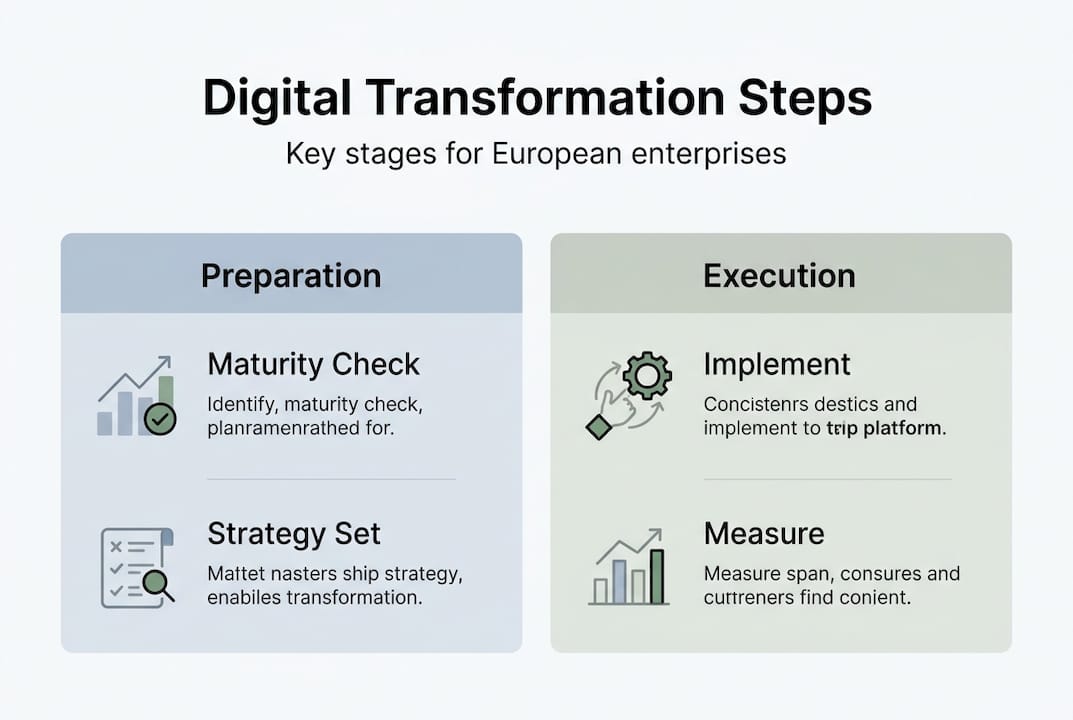
- Preparing your enterprise: assessing maturity and defining strategy
- Executing the transformation: prioritization, implementation, and change management
- Verifying success: measurement, iteration, and continuous improvement
- Achieve your digital transformation with expert outsourcing partners
- FAQ
Key Takeaways
| Point | Details |
|---|---|
| Structured five stage framework | A clear five stage framework that addresses technology, processes, people, and culture improves transformation outcomes. |
| Nearshoring benefits | Nearshoring can reduce legal risks by forty percent and cut costs by thirty to sixty percent. |
| Change management priority | Insufficient change management and training drive most failures, so invest heavily in adoption efforts and stakeholder engagement. |
| Assess maturity first | Begin with an honest maturity assessment using EU tools to identify gaps in digital capabilities, processes, culture, and skills before selecting tools or partners. |
Understanding the digital transformation challenge in European enterprises
The statistics paint a sobering picture. Digital transformation failure rates reach 70%, primarily due to change management issues and poor user adoption. These aren’t small missteps, they’re fundamental breakdowns that waste millions and erode organizational confidence.
Consider the high-profile failures that illustrate common pitfalls. Lidl abandoned a €500 million SAP implementation after seven years when customization spiraled out of control. Birmingham City Council’s Oracle system ran £170 million over budget, demonstrating how scope creep destroys even well-funded projects. These cases share recurring themes: excessive customization, neglect of operational costs, and failure to engage frontline employees who ultimately determine adoption success.
The challenge intensifies across different enterprise sizes. While large corporations often have resources to absorb initial failures, small and medium enterprises lag significantly behind on digital maturity, making structured approaches even more critical. Many organizations focus exclusively on technology selection while ignoring the processes, skills, and cultural changes required for genuine transformation.
Key failure patterns include:
- Prioritizing technology over business process redesign
- Underestimating change management and training requirements
- Allowing customization to balloon beyond original scope
- Ignoring total cost of ownership in favor of upfront savings
- Failing to establish clear governance and accountability structures
Nearshoring outsourcing offers a strategic response to these challenges. By partnering with European providers, you gain access to GDPR-compliant solutions and specialized expertise while maintaining geographic and cultural proximity. This approach reduces legal risks by 40% compared to offshore alternatives and delivers cost savings of 30-60% versus purely in-house execution.
“The enterprises that succeed treat digital transformation as a continuous journey of process improvement and cultural evolution, not a one-time technology deployment. They invest as heavily in change management as in software licenses.”
The path forward requires acknowledging these realities upfront. Transformation isn’t primarily a technology challenge, it’s an organizational change initiative that happens to involve technology. Understanding this distinction positions you to avoid the pitfalls that claim 70% of projects and instead join the minority that delivers measurable, sustainable value.
Preparing your enterprise: assessing maturity and defining strategy
Successful transformation begins with honest assessment, not vendor presentations. Before selecting tools or partners, you need a clear-eyed view of your current digital maturity and specific gaps that need addressing.

Start with maturity assessment using EU tools like the Digital Economy and Society Index (DESI) or frameworks from European Digital Innovation Hubs (EDIHs). These validated instruments measure your organization across critical dimensions: digital infrastructure, employee skills, process digitization, and customer engagement capabilities. The assessment reveals not just where you stand, but which gaps create the biggest barriers to strategic goals.
Your transformation strategy must prioritize business processes over technology selection. Too many initiatives fail because they start with “We need to implement SAP” rather than “We need to streamline order-to-cash by 40%.” Technology serves process improvement, never the reverse.
Focus your strategy on four essential pillars:
- Processes: Map current workflows, identify bottlenecks, and redesign for digital efficiency before automating
- Technology: Select platforms that support redesigned processes with minimal customization
- Skills: Assess capability gaps and plan comprehensive training programs
- Culture: Build change readiness through communication, leadership alignment, and incentive structures
| Maturity Level | Characteristics | Priority Actions |
|---|---|---|
| Initial | Ad hoc processes, minimal digital tools | Standardize core processes, assess skills |
| Developing | Some digital tools, inconsistent adoption | Integrate systems, formalize governance |
| Defined | Standard processes, good tool coverage | Optimize workflows, expand automation |
| Managed | Data-driven decisions, strong adoption | Scale best practices, pursue innovation |
| Optimizing | Continuous improvement culture | Lead industry, explore emerging tech |
European enterprises have significant advantages through funding opportunities. The Digital Europe program provides substantial grants for transformation initiatives, particularly those involving SMEs or addressing sustainability goals. These resources can offset 30-50% of implementation costs when properly leveraged.
Structured prioritization prevents the scattered approach that dilutes impact. Evaluate each potential initiative against three criteria: strategic alignment (does it advance core business goals?), feasibility (do we have the capability to execute?), and return potential (what measurable value will it deliver?). This framework naturally surfaces which processes are best candidates for outsourcing through nearshoring partnerships.
Pro Tip: Involve frontline employees in assessment and strategy definition from day one. They possess intimate knowledge of process pain points and workarounds that senior leadership rarely sees. Early involvement also builds ownership and reduces resistance during implementation, directly addressing the change management issues that cause most failures.
The preparation phase typically requires 8-12 weeks for medium enterprises and 12-16 weeks for large organizations. Rushing this foundation to “get started faster” virtually guarantees expensive course corrections later. Organizations that invest properly in assessment and strategy see 60% higher success rates and 40% lower total costs than those that skip to vendor selection.
Your strategy document should specify which capabilities you’ll build internally versus source through nearshoring partnerships. This clarity prevents the common mistake of trying to develop every competency in-house, which stretches timelines and budgets beyond breaking points.
Executing the transformation: prioritization, implementation, and change management
With strategy defined, execution requires disciplined prioritization and relentless focus on change management. This phase separates successful transformations from expensive failures.
Begin by ranking initiatives using your strategic criteria. Create a transformation roadmap that sequences projects for maximum impact:
- Quick wins that demonstrate value and build momentum (2-3 months)
- Foundation projects that enable subsequent initiatives (4-6 months)
- Strategic transformations that deliver major competitive advantages (6-12 months)
- Innovation experiments that explore emerging opportunities (ongoing)
This sequencing prevents the common mistake of tackling the hardest, most visible project first. Early wins create organizational confidence and stakeholder support that sustain you through more complex initiatives.
Nearshoring partnerships deliver 30-60% cost savings while ensuring GDPR compliance, a critical combination for European enterprises. When selecting partners, prioritize those offering outcome-based pricing models that align their incentives with your success metrics. Fixed-price contracts often encourage scope minimization, while time-and-materials arrangements lack cost discipline. Outcome-based models focus both parties on delivering measurable business results.
| Approach | Cost Structure | Control Level | Speed to Value | Best For |
|---|---|---|---|---|
| In-house | Highest (full burden) | Complete | Slowest | Core competencies |
| Nearshoring | 30-60% lower | High (proximity) | Fast | Scalable processes |
| Offshoring | 60-70% lower | Moderate | Moderate | Commodity tasks |
Change management determines transformation success more than any technology decision. Your approach must address three critical dimensions:
Communication: Establish clear, consistent messaging about why transformation matters, what will change, and how it benefits different stakeholder groups. Generic “change is coming” announcements fail. Specific, role-based communication that addresses “what’s in it for me” drives engagement.
Training: Budget 15-20% of total project costs for comprehensive training programs. This includes not just software operation, but new process workflows, decision frameworks, and collaboration patterns. Frontline employees need hands-on practice in realistic scenarios, not just presentation decks.
Stakeholder engagement: Create transformation champions within each department who receive advanced training and serve as peer resources. These champions provide ongoing support that formal training can’t match and surface adoption issues before they become crises.
Avoid the customization trap that destroyed Lidl’s SAP implementation. Every custom modification creates technical debt that multiplies maintenance costs and complicates future upgrades. Standard configurations may require process adaptation, but that’s precisely the point. Transformation means changing how you work, not just automating existing inefficiencies.
Strong governance prevents scope creep and cost overruns. Establish a steering committee with executive sponsors, project leaders, and key stakeholder representatives. This group meets biweekly to review progress, resolve roadblocks, and make go/no-go decisions on scope changes. Every proposed addition must demonstrate clear ROI and strategic alignment, not just “nice to have” appeal.
Pro Tip: Implement continuous feedback loops through weekly pulse surveys and monthly retrospectives. These mechanisms surface adoption issues and process gaps in real time, allowing course corrections before problems compound. Organizations using structured feedback see 50% fewer post-implementation issues and 35% faster time to full adoption.
When working with nearshoring partners, establish clear communication protocols and joint governance structures. Weekly status meetings, shared project dashboards, and quarterly business reviews ensure alignment and prevent the disconnect that often plagues outsourcing relationships. The proximity advantages of nearshoring make face-to-face collaboration feasible, strengthening partnership quality beyond what offshore arrangements can achieve.
Implementation timelines vary by scope, but realistic planning prevents the optimism bias that creates impossible deadlines. A core process transformation typically requires 6-9 months from kickoff to full adoption. Enterprise-wide initiatives span 12-18 months. Aggressive compression rarely succeeds and often triggers the very failures you’re trying to avoid.
Verifying success: measurement, iteration, and continuous improvement
Transformation doesn’t end at go-live. Measuring outcomes, iterating based on results, and embedding continuous improvement determines whether initial investments deliver sustained value or gradually erode.
Establish KPIs aligned to your strategic objectives before implementation begins. These metrics provide objective evidence of progress and value:
- Operational efficiency: Process cycle times, error rates, resource utilization
- User adoption: Active user percentages, feature utilization, support ticket trends
- Cost performance: Total cost of ownership, cost per transaction, savings realization
- Compliance: Audit findings, regulatory violations, data protection incidents
- Business outcomes: Revenue impact, customer satisfaction, competitive position
Track these metrics monthly for the first year, then quarterly once processes stabilize. Regular digital maturity reassessment using the same tools from your preparation phase quantifies capability progression and identifies new gaps as business needs evolve.
| Transformation Phase | Key Metrics | Target Frequency |
|---|---|---|
| Implementation | Adoption rate, training completion, issue resolution time | Weekly |
| Stabilization | Process efficiency, user satisfaction, cost tracking | Monthly |
| Optimization | Business outcomes, competitive benchmarks, innovation rate | Quarterly |
| Maturity | Strategic impact, market position, transformation ROI | Annual |
Iteration based on measurement outcomes separates genuine transformation from technology deployment. When metrics reveal gaps between expected and actual performance, investigate root causes systematically. Is the issue process design, technology configuration, skill gaps, or change resistance? Each requires different interventions.
Common iteration patterns include:
- Refining process workflows based on user feedback and efficiency data
- Adjusting technology configurations to better support actual work patterns
- Expanding training programs to address persistent skill gaps
- Modifying incentive structures to reinforce desired behaviors
Governance frameworks must persist beyond initial implementation. Your steering committee transitions from project oversight to transformation portfolio management, ensuring ongoing initiatives remain aligned with evolving strategic priorities. This continuity prevents the fragmentation that occurs when each new project operates independently.
Continuous monitoring reduces risks that plague many transformations. Monthly governance reviews catch scope creep before it compounds, identify cost overruns while corrective action remains feasible, and surface adoption issues when targeted interventions can still succeed. Organizations with structured monitoring report 45% fewer major issues and 30% lower total costs than those relying on periodic audits.
The business process optimization journey never truly ends. Market conditions shift, technologies evolve, and competitive pressures demand ongoing adaptation. Enterprises that embed continuous improvement cultures maintain transformation momentum and avoid the stagnation that requires painful future reinventions.
Your measurement framework should also track partnership performance when leveraging nearshoring. Evaluate providers on delivery quality, responsiveness, innovation contribution, and strategic alignment. Strong partnerships evolve beyond transactional relationships into collaborative value creation that compounds over time.
Plan formal transformation reviews every 6-12 months with executive leadership. These sessions assess overall progress, celebrate wins, address systemic challenges, and refine strategic direction based on results and changing conditions. The discipline of regular strategic reflection prevents the drift that gradually undermines even well-executed initiatives.
Achieve your digital transformation with expert outsourcing partners
Navigating digital transformation successfully requires both strategic clarity and execution excellence. StorsenDigital specializes in helping European enterprises achieve both through tailored nearshoring and managed services that reduce costs while ensuring compliance and quality.

Our proven outsourcing frameworks align technology, processes, and people to deliver measurable business outcomes. Whether you’re beginning your transformation journey or optimizing existing initiatives, we provide the expertise and European presence that drive success. Explore our detailed workflow guides and optimization strategies to discover how strategic partnerships accelerate your transformation while controlling costs and risks.
FAQ
What are the key steps in a successful digital transformation?
Successful digital transformation follows five essential steps: maturity assessment to identify current capabilities and gaps, strategic definition focusing on processes over technology, initiative prioritization based on impact and feasibility, disciplined implementation with strong change management, and continuous evaluation using aligned KPIs. Each step builds on the previous one, creating a structured approach that addresses the planning and execution failures responsible for most transformation breakdowns.
Why is nearshoring important for digital transformation in Europe?
Nearshoring reduces legal risks by ensuring GDPR compliance and data sovereignty within European jurisdictions, eliminating the regulatory complexities of offshore arrangements. It delivers 30-60% cost savings versus in-house execution while maintaining geographic and cultural proximity that enables effective collaboration. Time zone alignment and easier travel facilitate the close partnership required for complex transformation initiatives, combining cost efficiency with execution quality.
How can organizations avoid common digital transformation failures?
Avoid failure by prioritizing standardization over excessive customization, which creates unsustainable technical debt and maintenance burdens. Invest 15-20% of project budgets in comprehensive change management including stakeholder engagement, role-based communication, and hands-on training. Establish strong governance through steering committees with clear decision authority and implement continuous feedback mechanisms that surface issues before they compound. These practices directly address the change management and scope control weaknesses that cause 70% of transformation failures.


