


Outsourcing in Europe promises talent, cost savings, and scalability, yet many enterprises stumble due to legal, cultural, and operational blind spots. Ignoring GDPR requirements or misunderstanding local labor laws can inflate failure rates by more than 40%. This guide walks you through a structured, evidence-based approach to European nearshoring and managed services, helping you navigate compliance, vendor selection, talent acquisition, and continuous monitoring to achieve scalable, risk-reduced success.
Table of Contents
- Prerequisites And Legal Considerations
- Step-By-Step Implementation Process
- Talent Acquisition Strategies
- Managed Services Deployment
- Cost And Timeline Expectations
- Common Mistakes And Troubleshooting
- Expected Results And Success Metrics
- Frequently Asked Questions About European Outsourcing
Key takeaways
| Point | Details |
|---|---|
| Legal compliance and vendor vetting cut key risks by over 40% | Proactive GDPR and labor law adherence prevents costly disruptions |
| Structured stepwise execution ensures smooth outsourcing | Clear vendor selection, contract negotiation, and onboarding milestones reduce downtime |
| Local talent expertise and cultural match drive project success | Leveraging regional recruitment and cultural fit improves retention and performance |
| Managed services boost operational efficiency up to 40% | HR, finance, IT, and customer support deployment scales rapidly with proper KPIs |
| Continuous monitoring tracks ROI and compliance | Dashboards measuring cost savings, efficiency gains, and legal adherence validate investment |
Prerequisites and legal considerations
Before launching any European outsourcing project, you must establish a solid legal and operational foundation. Understanding and complying with GDPR and European labor laws reduces legal risk by over 40%, making early preparation non-negotiable. GDPR demands explicit consent for personal data processing, strict breach notifications, and hefty penalties for non-compliance. If your outsourcing partner will handle customer or employee data, ensure they maintain GDPR-compliant data processing agreements and appoint a Data Protection Officer when required.
European labor laws vary by country but generally mandate minimum wage compliance, statutory leave, and specific termination procedures. When you engage contractors or staff through a vendor, confirm that contracts specify working conditions, benefits, and rights aligned with local regulations. Conduct an internal readiness assessment to evaluate your current processes, technology compatibility, and team capacity to manage outsourced functions. This self-audit highlights gaps in governance, communication protocols, and risk management before vendor engagement begins.
Cross-border data transfers add another layer of complexity. If your vendor operates outside the European Economic Area, verify they use Standard Contractual Clauses or other approved mechanisms for data export. Security measures like encryption, access controls, and regular audits should be mandatory clauses in your service agreements. Engage legal expertise early to interpret evolving legislation and tailor contracts to your industry’s specific requirements, whether finance, healthcare, or technology.
Pro Tip: Partner with a compliance consultant familiar with multiple European jurisdictions to streamline multi-country outsourcing and avoid conflicting local rules.
Key compliance checklist:
- Confirm GDPR data processing agreements with vendors
- Verify local labor law compliance for contractor engagements
- Assess internal readiness via governance and technology audits
- Implement cross-border data transfer safeguards
- Budget for ongoing legal reviews as regulations evolve
For deeper insights into outsourcing legal considerations in Europe, review comprehensive frameworks that address both operational and regulatory challenges.
Step-by-step implementation process
A clear, repeatable workflow transforms outsourcing ambitions into operational reality. Start by defining your business objectives and outsourcing scope. Are you seeking cost reduction, talent access, faster time to market, or all three? Document which functions will be outsourced (HR, IT, customer support, software development) and the expected outcomes, such as 30% cost savings or 50% faster hiring cycles. This clarity guides vendor selection and contract negotiations.
Next, develop a vendor evaluation checklist covering technical capabilities, compliance certifications, financial stability, and cultural alignment. Request case studies demonstrating experience with enterprises similar in size and industry. Evaluate their GDPR audit history, ISO certifications, and references from current clients. Schedule site visits or virtual tours to assess infrastructure, security protocols, and team competencies. Narrow your shortlist to three candidates and conduct proof-of-concept projects to test collaboration and deliverables.
Negotiate contracts with explicit service level agreements, performance metrics, liability clauses, and exit provisions. Include GDPR compliance terms, data breach notification timelines, and intellectual property ownership. Define escalation paths for disputes and change management procedures for scope adjustments. Secure sign-off from legal, procurement, and operational stakeholders before finalizing.

Plan onboarding timelines with integration milestones to reduce downtime. Typical onboarding spans three to six months, depending on complexity. Establish a kickoff meeting to align goals, assign project managers from both sides, and set weekly check-ins. Integrate vendor systems with your existing tools through APIs or data connectors. Conduct training sessions for your internal team on new workflows and communication channels. Monitor initial deliverables closely and provide feedback loops to refine processes.
Pro Tip: Prioritize vendors with proven European market experience to ease cultural integration and regulatory navigation.
| Step | Responsibility | Typical Duration |
|---|---|---|
| Define objectives and scope | Internal leadership | 2 to 4 weeks |
| Vendor evaluation and shortlisting | Procurement and operations | 4 to 6 weeks |
| Contract negotiation and sign-off | Legal and procurement | 3 to 5 weeks |
| Onboarding and system integration | Joint project teams | 8 to 12 weeks |
| Performance review and optimization | Operations and vendor account managers | Ongoing |
For a detailed outsourcing onboarding process and a structured outsourcing process, explore step-by-step guides tailored to enterprise needs.
Talent acquisition strategies
Securing skilled European talent is a cornerstone of successful nearshoring. Leverage local recruitment agencies with deep knowledge of regional labor markets. Agencies in Poland, Romania, Portugal, and Bulgaria specialize in tech, finance, and customer support roles, offering pre-vetted candidates who meet language and skill requirements. They understand local employment contracts, salary benchmarks, and candidate expectations, accelerating time to hire.
Assess talent pool sizes in key hubs. Poland hosts over 400,000 IT professionals, while Romania’s tech workforce exceeds 200,000. Portugal and Bulgaria offer strong English proficiency and competitive wage structures. Evaluate each location’s university output, coding bootcamp ecosystems, and industry clusters to match your needs. For example, Poland excels in fintech and software engineering, whereas Romania shines in cybersecurity and data analytics.
Cultural and language factors matter. While English is widely spoken in nearshoring hubs, nuances in communication style, work ethic, and decision-making can impact collaboration. Conduct cultural training for your internal team and vendor staff to bridge gaps. Prioritize vendors who invest in employee engagement programs, career development, and retention incentives. High turnover disrupts projects and erodes knowledge continuity.
Implement retention strategies from day one. Offer competitive compensation, professional development opportunities, and clear career paths. Establish regular performance reviews and recognize achievements publicly. Successful nearshoring deployments in Poland report 85% employee retention rates when companies invest in training and transparent communication. Monitor attrition metrics quarterly and adjust incentives as needed.
For more on European talent acquisition methods and effective talent acquisition strategies, consult resources that detail local nuances and hiring best practices.
- Partner with specialized local recruitment agencies
- Evaluate talent pool depth in Poland, Romania, Portugal, and Bulgaria
- Conduct cultural training to align communication styles
- Prioritize vendors with strong retention programs
- Monitor quarterly attrition and adjust compensation strategies
Managed services deployment
Deploying managed services such as HR, finance, IT, and customer support within European outsourcing frameworks maximizes operational efficiency. Start by identifying which functions align with your strategic goals. If you need rapid scaling, managed IT and software development offer immediate capacity. If compliance and cost control are priorities, managed HR and finance deliver standardized processes and audit-ready documentation.
Set performance KPIs upfront. For IT services, track uptime, incident response times, and ticket resolution rates. For HR, measure time to hire, employee satisfaction scores, and payroll accuracy. Finance KPIs include invoice processing speed, accounts receivable days, and compliance audit results. Share these metrics with your vendor in quarterly business reviews to drive continuous improvement.
Integration challenges arise when linking vendor systems with your existing ERP, CRM, or HRIS platforms. Plan for API development, data migration, and user training. Test integrations in a sandbox environment before full rollout. Establish data governance protocols to ensure consistency and security across systems. Allocate budget for middleware or integration platforms if legacy systems lack modern connectors.
Showcase efficiency gains. Companies deploying managed HR services report 40% faster onboarding cycles and 25% lower administrative costs. Managed IT services reduce downtime by 35% and accelerate feature releases by 50%. Document these wins internally to justify continued investment and expansion of managed service layers.
Adopt a gradual rollout strategy. Start with a pilot function, such as level-one customer support or accounts payable. Measure results, refine processes, and then scale to additional functions. This phased approach minimizes risk and builds organizational confidence. For insights on managed services deployment tips, explore implementation frameworks tested across diverse industries.
- Identify managed services aligned to strategic goals
- Define clear performance KPIs for IT, HR, finance, and customer support
- Plan system integration with APIs and data governance protocols
- Document efficiency gains to justify expansion
- Rollout services gradually to manage risk and build confidence
Cost and timeline expectations
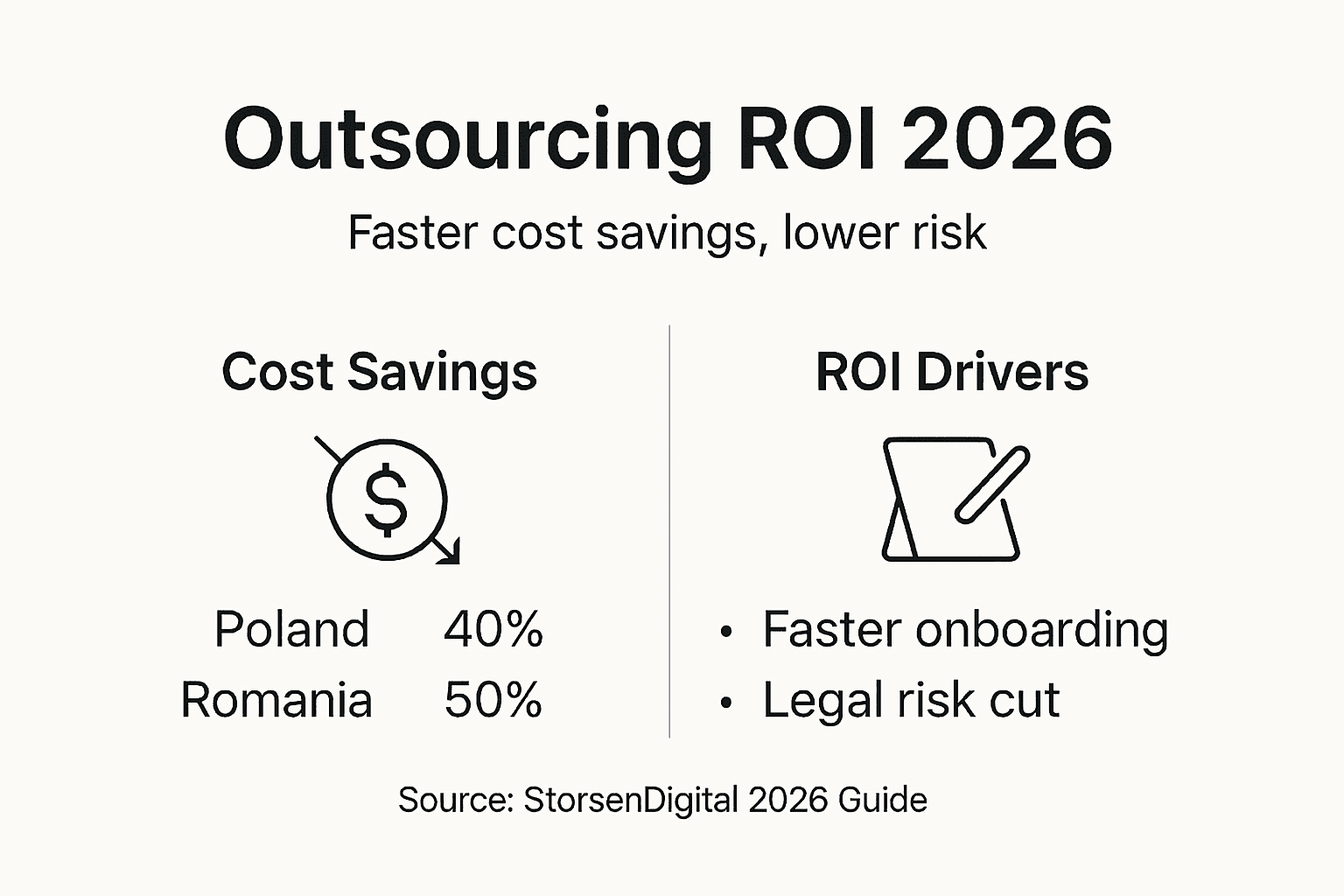
Realistic budgeting and scheduling prevent surprises and align stakeholder expectations. In 2026, nearshoring costs in Poland range from $30 to $50 per hour for software developers, while Romania offers $25 to $45 per hour. Customer support agents cost $12 to $18 per hour in both countries. These rates include employer taxes, benefits, and overhead, delivering 40% to 60% savings compared to Western European or North American equivalents.
Onboarding and ramp-up timelines typically span three to six months. The first month focuses on vendor selection and contract finalization. Months two and three cover recruitment, training, and system integration. By month four, teams reach 70% productivity, climbing to full capacity by month six. Accelerated timelines compress this to two to three months but require higher upfront investment in dedicated project managers and change management support.
ROI timeframes depend on function and scale. Cost savings materialize within six months as operational expenses decline. Efficiency gains, such as faster hiring or improved customer satisfaction, appear within nine to twelve months. Strategic benefits like market expansion or innovation acceleration take twelve to eighteen months to fully realize. Set realistic expectations with leadership to maintain support during the initial ramp-up.
Compare tradeoffs between accelerated and phased onboarding. Accelerated plans reduce time to value but increase risk of integration issues and team burnout. Phased approaches allow iterative learning and adjustment but delay full benefits. Choose based on your risk tolerance, internal capacity, and competitive pressures.
| Factor | Poland Nearshoring | Romania Nearshoring |
|---|---|---|
| Developer hourly rate | $30 to $50 | $25 to $45 |
| Customer support rate | $12 to $18 | $12 to $18 |
| Talent pool size | 400,000+ IT professionals | 200,000+ IT professionals |
| Onboarding timeline | 3 to 6 months | 3 to 6 months |
| English proficiency | High | High |
| Cost savings vs Western Europe | 40% to 60% | 45% to 65% |
For detailed benchmarks on nearshoring cost and timeline expectations and nearshoring timeline expectations, consult guides that break down regional variations and service-specific data.
Common mistakes and troubleshooting
Avoiding frequent pitfalls saves time, money, and reputation. Poor vendor due diligence tops the list. Skipping reference checks, ignoring financial audits, or accepting vague case studies leads to partnership failures. Always verify certifications, conduct background checks, and request client testimonials with verifiable contacts. Visit vendor sites when possible and assess team stability and infrastructure quality.
Ignoring cultural differences erodes collaboration. Assumptions about communication styles, decision-making hierarchies, or work-life balance create friction. Invest in cross-cultural training for both internal and vendor teams. Establish explicit communication protocols, including preferred channels, response time expectations, and escalation procedures. Misaligned expectations cause 30% of outsourcing project delays.
Missing legal compliance is a costly error. Failing to include GDPR clauses, labor law protections, or data breach notification terms exposes you to fines and lawsuits. Engage legal counsel to draft and review every contract. Conduct annual compliance audits with your vendor to ensure ongoing adherence. Regulatory changes happen frequently, so build flexibility into agreements for updates.
Rushed timelines compromise quality. Compressed onboarding skips critical steps like thorough training, system testing, and feedback loops. Teams lack time to build trust and refine workflows. If deadlines are tight, scale back scope rather than rush execution. Deliver one function excellently before expanding.
Pro Tip: Conduct quarterly audits covering vendor performance, compliance adherence, and process optimization to identify and address emerging issues before they escalate.
To avoid common outsourcing mistakes, apply lessons learned from enterprises that navigated these challenges successfully.
- Conduct thorough vendor due diligence with reference checks and site visits
- Invest in cross-cultural training to align communication and work styles
- Include comprehensive GDPR and labor law clauses in contracts
- Avoid rushed timelines by scaling back scope if necessary
- Schedule quarterly audits to catch compliance or performance drift early
Expected results and success metrics
Measuring outcomes validates your outsourcing investment and guides future decisions. Operational efficiency gains up to 40% are achievable through streamlined processes, reduced administrative overhead, and faster turnaround times. Track metrics like cycle time reduction, error rate declines, and resource utilization improvements. For example, managed finance teams cut invoice processing time by 35% on average.
Talent acquisition improvements manifest as shorter time to hire, higher candidate quality scores, and improved retention rates. Nearshoring hubs deliver 50% faster hiring cycles compared to in-house recruitment in high-demand markets. Monitor offer acceptance rates, employee satisfaction surveys, and 90-day retention figures to assess talent strategy success.
Cost savings benchmarks vary by function but typically range from 40% to 60% compared to Western European or North American alternatives. Track total cost of ownership, including vendor fees, integration expenses, and internal management overhead. Compare quarterly against baseline costs to quantify savings and justify continued investment.
GDPR compliance and legal adherence are non-negotiable success factors. Implement regular audits, data protection impact assessments, and breach simulation exercises. Maintain documentation of consent management, data processing activities, and cross-border transfer mechanisms. Zero compliance violations and audit-ready records signal robust governance.
Vendor performance against KPIs reveals partnership health. Establish dashboards tracking SLA adherence, ticket resolution times, project milestone completion, and customer satisfaction scores. Hold monthly reviews with vendor account managers to address gaps and celebrate wins. Poor KPI trends trigger corrective action plans or vendor reevaluation.
Align these metrics with business scalability and risk reduction goals. Efficient, compliant outsourcing frees internal resources for strategic initiatives like product innovation and market expansion. Set a centralized dashboard visible to leadership, consolidating cost, efficiency, compliance, and satisfaction metrics for continuous evaluation.
- Measure operational efficiency gains targeting 40% improvement
- Track talent acquisition speed, quality, and retention improvements
- Quantify cost savings against baseline Western European rates
- Audit GDPR compliance and legal adherence quarterly
- Monitor vendor KPIs via dashboards shared in monthly reviews
Streamline your European outsourcing with StorsenDigital
Ready to put these strategies into action? StorsenDigital specializes in outsourcing, nearshoring, and managed services across Europe, helping medium to large enterprises scale efficiently while staying compliant. We provide tailored solutions for talent acquisition, HR, finance, IT, and customer support, backed by deep regional expertise and proven methodologies.

Whether you need a structured outsourcing process guide, a detailed nearshoring workflow guide for 2026, or practical managed services implementation frameworks, our resources and team empower you to reduce risk, accelerate results, and unlock European talent advantages. Explore our guides, connect with our consultants, and transform your outsourcing ambitions into scalable, compliant success.
Frequently asked questions about European outsourcing
What are the main legal risks in European outsourcing?
GDPR non-compliance, inadequate labor law protections, and missing cross-border data transfer safeguards are the top risks. Engage legal experts early and include comprehensive compliance clauses in all vendor contracts to mitigate exposure.
How long does it take to onboard a nearshoring team in Europe?
Typical onboarding spans three to six months, covering vendor selection, contract negotiation, recruitment, training, and system integration. Accelerated timelines of two to three months are possible with dedicated project management but carry higher risk.
Which European countries offer the best nearshoring value in 2026?
Poland and Romania lead with large talent pools, competitive rates ($25 to $50 per hour for developers), and high English proficiency. Portugal and Bulgaria also deliver strong value with growing tech ecosystems and cultural compatibility.
How do I measure ROI from European outsourcing?
Track cost savings (40% to 60% typical), operational efficiency gains (up to 40%), talent acquisition speed improvements, and compliance audit results. Use dashboards consolidating these metrics and review quarterly to validate investment and guide scaling decisions.
What managed services are most effective for operational efficiency?
Managed HR and finance services streamline administrative processes, cutting costs by 25% to 40%. Managed IT and customer support deliver uptime improvements and faster response times, boosting customer satisfaction and freeing internal resources for strategic projects.


