


Finance outsourcing offers European enterprises a powerful path to reduce costs and improve efficiency, but navigating regulatory complexities and operational risks requires a structured approach. This guide walks you through each critical phase, from assessing your needs and selecting compliant providers to executing smooth transitions and verifying long-term outcomes. You will learn how to leverage nearshoring advantages, manage compliance under GDPR and DORA, and avoid common pitfalls that derail outsourcing projects. Whether you are starting with transactional processes or planning comprehensive finance transformation, this step-by-step framework equips you with actionable strategies to achieve measurable results.
Table of Contents
- Key takeaways
- Understanding finance outsourcing and preparing your strategy
- Selecting and evaluating finance outsourcing providers
- Transitioning and implementing finance outsourcing operations
- Verifying outcomes, ongoing review, and optimizing for long-term success
- How StorsenDigital can support your finance outsourcing journey
- Frequently asked questions
Key Takeaways
| Point | Details |
|---|---|
| Needs assessment | Thoroughly assess current processes and desired outcomes to guide outsourcing decisions. |
| SLA and security | Strong service level agreements paired with security certifications and compliance coverage ensure reliable performance. |
| Pilots and governance | Starting with transactional pilots and a clear governance framework helps monitor progress and enable quick adjustments. |
| Nearshoring benefits | Choosing EU based providers simplifies GDPR compliance and reduces time zone friction for smoother collaboration. |
| Regulatory oversight | Ongoing regulatory risk management and quality control are essential for a compliant and reliable outsourcing program. |
Understanding finance outsourcing and preparing your strategy
Finance outsourcing transfers specific accounting and financial functions to external specialists, enabling your team to focus on strategic activities. Common services include accounts payable, accounts receivable, financial reporting, reconciliations, and tax compliance. You can choose between hybrid models that combine internal staff with external support or full outsourcing where the provider manages entire processes end to end.
European enterprises increasingly favor nearshoring to EU-based providers for regulatory alignment and cultural compatibility. This approach simplifies GDPR compliance, reduces time zone friction, and ensures providers understand local business practices. Nearshoring also mitigates geopolitical risks compared to offshore arrangements in distant regions.
Starting with transactional services minimizes risk while delivering quick wins. Accounts payable and receivable processing involve high volumes of routine tasks that benefit immediately from specialized expertise and technology. These functions carry lower strategic sensitivity than financial planning or treasury, making them ideal pilots. Once you prove the model works, you can expand to more complex areas like management reporting or FP&A support.
Before initiating outsourcing, complete these prerequisites:
- Document current processes with clear workflows and performance baselines
- Identify pain points such as bottlenecks, error rates, or resource constraints
- Define success metrics including cost targets, quality standards, and timeline expectations
- Secure executive sponsorship and budget approval for transition costs
- Assess data security requirements and regulatory obligations specific to your industry
- Map system integration needs for ERP, banking platforms, and reporting tools
Pro Tip: Create a detailed current-state assessment that quantifies processing times, error rates, and full-time equivalent costs. This baseline becomes essential for measuring ROI and negotiating realistic SLAs with providers.
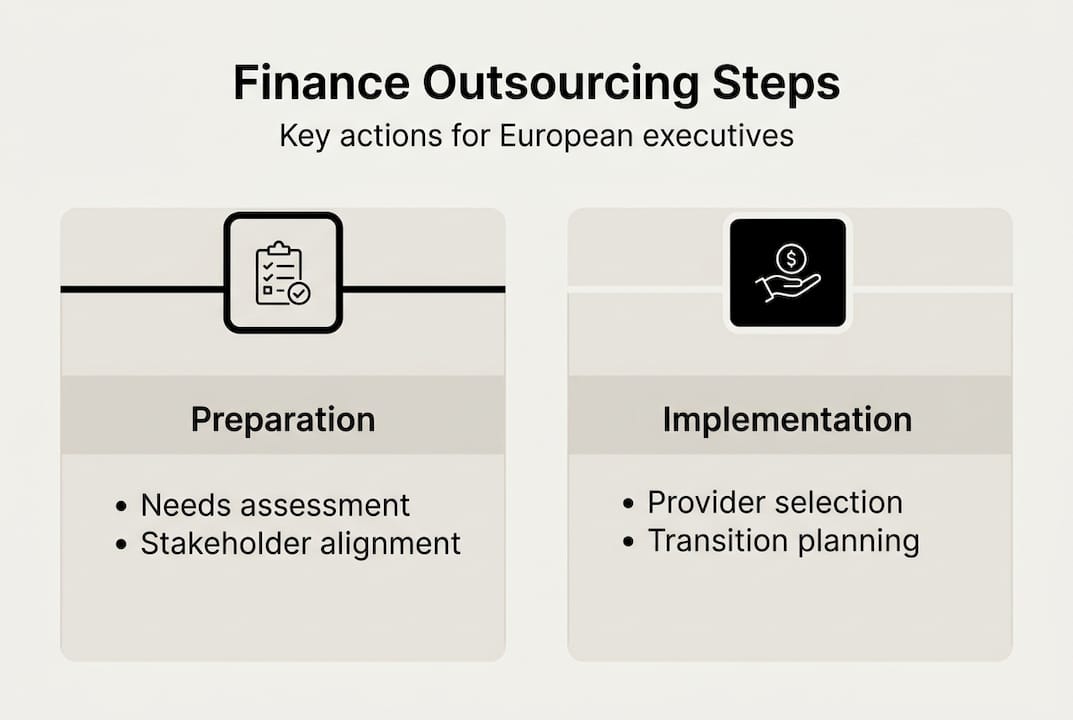
Your preparation phase sets the foundation for successful outsourcing. Clear documentation and stakeholder alignment prevent scope creep and ensure smooth handoffs. Taking time upfront to assess needs thoroughly pays dividends throughout implementation and operations. For comprehensive planning frameworks, explore our finance outsourcing guide that covers strategic considerations in depth.
Selecting and evaluating finance outsourcing providers
Evaluating potential providers requires rigorous focus on service level agreements, security certifications, and compliance capabilities. Strong SLAs specify response times, accuracy thresholds, and escalation procedures with clear penalties for non-performance. Verify that providers hold relevant certifications like SOC 2 Type II or ISO 27001 that demonstrate robust controls over data security and process quality. Insist on audit rights that allow your internal audit team or external auditors to review provider controls and access detailed process documentation.

GDPR and DORA compliance form critical requirements for European financial institutions and enterprises handling sensitive data. DORA (Digital Operational Resilience Act) mandates specific oversight of ICT third-party providers, including finance outsourcers who access your systems. Ensure providers demonstrate clear data residency policies, breach notification procedures, and business continuity plans that meet regulatory standards. Request evidence of previous regulatory audits and compliance track records.
Sub-outsourcing introduces concentration risk and control challenges. When your provider delegates work to additional vendors, you face extended chains of responsibility that complicate oversight and increase vulnerability. Monitor sub-outsourcing arrangements carefully, requiring disclosure of all downstream providers and maintaining veto rights over critical subcontractors. Concentration risk emerges when too many functions depend on a single provider, creating business continuity exposure if that relationship fails.
| Evaluation Factor | What to Verify | Red Flags |
|---|---|---|
| SLA specificity | Detailed metrics for accuracy, timeliness, escalation | Vague commitments, no penalties |
| Security certifications | SOC 2 Type II, ISO 27001, recent audits | Outdated certs, no third-party validation |
| GDPR/DORA readiness | Data residency, breach protocols, regulatory experience | Non-EU data centers, unclear policies |
| Audit rights | Unrestricted access, documentation transparency | Limited visibility, restricted reviews |
| Sub-outsourcing policy | Full disclosure, client approval required | Hidden layers, uncontrolled delegation |
| Financial stability | Audited financials, client references, tenure | Private ownership with no transparency |
Pro Tip: Request a detailed org chart showing which team members will handle your account, their locations, and their credentials. High turnover or offshore teams handling sensitive work may signal quality or security risks.
Flag these risky provider arrangements during evaluation:
- Reluctance to share detailed security policies or allow site visits
- Pricing significantly below market rates that suggests corner-cutting on quality or compliance
- Limited references from clients in similar industries or regulatory environments
- Ownership structures that obscure ultimate control or financial backing
- Technology platforms that lack integration capabilities with your existing systems
- Staff augmentation models without clear governance over individual contractor performance
Thorough provider evaluation protects your organization from compliance failures, security breaches, and operational disruptions. Investing time in due diligence upfront prevents costly mistakes and relationship failures. For deeper guidance on compliance frameworks, review our analysis of regulatory compliance in finance outsourcing.
Transitioning and implementing finance outsourcing operations
Executing the transition carefully prevents disruptions and sets the stage for long-term success. Follow this structured approach to implement finance outsourcing operations:
Launch a pilot program with a single transactional process like accounts payable or expense processing. Select a function with clear inputs, outputs, and success metrics that you can measure objectively. Run the pilot for 60-90 days to identify issues before full-scale rollout.
Execute structured knowledge transfer through documented procedures, recorded training sessions, and shadowing periods where provider staff observe your team. Create detailed process maps that capture exceptions, approval hierarchies, and system-specific quirks. Schedule regular check-ins during the first 30 days to address questions immediately.
Integrate systems by establishing secure data connections between your ERP, banking platforms, and the provider’s technology stack. Test data flows thoroughly in a sandbox environment before processing live transactions. Implement role-based access controls that limit provider permissions to only necessary functions and data.
Establish governance structures with clear escalation paths, regular performance reviews, and executive oversight. Assign an internal relationship manager who serves as the single point of contact and monitors day-to-day operations. Schedule monthly business reviews to assess KPIs, address issues, and plan continuous improvements.
Monitor quality, cost, and compliance KPIs from day one. Track error rates, processing times, cost per transaction, and regulatory adherence against baseline metrics. Use dashboards that provide real-time visibility into operations and flag exceptions automatically.
Implement governance with monitoring KPIs that cover financial performance, operational quality, and risk management. Financial metrics include cost savings versus budget, cost per invoice processed, and total contract spend. Quality indicators track error rates, rework percentages, and customer satisfaction scores from internal stakeholders. Risk metrics monitor security incidents, compliance violations, and SLA breaches.
Avoid these common transition mistakes:
- Rushing implementation without adequate testing or training periods
- Failing to document tribal knowledge that exists only in current staff members’ heads
- Underestimating integration complexity and timeline for system connections
- Neglecting change management for internal teams who fear job loss or role changes
- Setting unrealistic expectations for immediate cost savings during transition periods
- Skipping pilot phases and attempting full-scale launches that amplify risks
Executive oversight ensures accountability and strategic alignment throughout the transition. CFOs and finance directors should participate in monthly governance reviews, approve major process changes, and maintain relationships with provider executives. Regular audits by internal audit or external firms verify that controls remain effective and compliance standards are met consistently.
Pro Tip: Maintain a detailed issues log during transition that tracks every problem, resolution, and owner. This log becomes invaluable for identifying patterns, improving processes, and holding the provider accountable for recurring issues.
Smooth transitions require patience, clear communication, and realistic timelines. Expect 3-6 months before operations stabilize and deliver consistent results. For additional implementation guidance, explore our framework for optimizing finance operations and our comprehensive overview of business process outsourcing steps.
Verifying outcomes, ongoing review, and optimizing for long-term success
Measuring performance continuously ensures your outsourcing arrangement delivers expected benefits and identifies optimization opportunities. Track these critical metrics monthly:
- Cost savings as percentage reduction versus baseline internal costs, including both direct labor and overhead
- Quality improvements measured by error rates, rework percentages, and audit findings
- Compliance adherence through regulatory audit results, security incident counts, and policy violations
- Efficiency gains such as reduced processing times, faster close cycles, and improved cash flow
- Stakeholder satisfaction via surveys of internal customers who interact with outsourced processes
Cost savings range 20-60% depending on function complexity, provider efficiency, and baseline costs. Transactional processes like bookkeeping and accounts payable typically deliver higher savings than specialized functions like tax planning or treasury management. Efficiency improvements often accompany cost reductions as providers leverage specialized technology and process expertise.
| Arrangement Type | Advantages | Disadvantages | Best For |
|---|---|---|---|
| Single integrated provider | Unified governance, seamless processes, clear accountability | Concentration risk, limited flexibility, potential lock-in | Comprehensive outsourcing of related functions |
| Multi-vendor specialists | Best-of-breed expertise, competitive pricing, reduced concentration | Complex coordination, integration challenges, governance overhead | Large enterprises with diverse needs |
| Hybrid internal/external | Retained strategic control, flexibility, gradual transition | Blurred accountability, cultural friction, higher management cost | Organizations building outsourcing capability |
Ongoing governance maintains data security and regulatory fit as your business and regulations evolve. Conduct quarterly security reviews that assess access controls, encryption standards, and incident response readiness. Update compliance requirements proactively when new regulations emerge, ensuring your provider adapts processes and controls accordingly. Perform annual comprehensive audits that evaluate financial controls, operational effectiveness, and strategic alignment.
Optimize your outsourcing arrangement when performance plateaus or business needs shift:
- Renegotiate pricing based on volume changes, technology improvements, or competitive benchmarks
- Expand scope to additional functions once core processes stabilize and deliver results
- Consolidate multiple providers to reduce complexity and improve integration
- Insource strategic functions that require closer business alignment or sensitive decision-making
- Switch providers if performance consistently misses targets despite improvement efforts
Plan exit strategies before you need them. Maintain detailed documentation of all processes, data structures, and integration points that enable smooth transitions to alternative providers or back in-house. Include termination clauses in contracts that specify reasonable notice periods, data return procedures, and knowledge transfer obligations. Test business continuity plans annually to ensure you can maintain operations if the provider relationship ends unexpectedly.
Risk mitigation during ongoing operations requires vigilance:
- Monitor sub-outsourcing arrangements and require approval for new downstream providers
- Review provider financial stability annually through credit reports and financial statement analysis
- Maintain current backups of all data held by providers with tested restoration procedures
- Conduct surprise audits periodically to verify controls operate as documented
- Track provider staff turnover and require notification of key personnel changes
- Benchmark performance against industry standards and alternative providers regularly
Continuous improvement transforms outsourcing from cost reduction to strategic capability. Regular performance reviews identify automation opportunities, process refinements, and service enhancements that compound benefits over time. Strong provider relationships built on transparency and collaboration unlock innovation that rigid contracts cannot achieve. For comprehensive risk management frameworks, explore our guide to outsourcing risk management.
How StorsenDigital can support your finance outsourcing journey
Navigating finance outsourcing complexity requires expertise, proven frameworks, and hands-on support tailored to European regulatory environments. StorsenDigital specializes in helping enterprises design, implement, and optimize outsourcing strategies that deliver measurable results while managing compliance and operational risks.

Our comprehensive resources include detailed planning guides, evaluation checklists, and governance frameworks built from hundreds of successful engagements. Whether you need help selecting providers, structuring contracts, or managing transitions, our team brings practical experience across diverse industries and finance functions. Access our outsourcing process guide and best practices checklist to accelerate your planning. Ready to start your finance outsourcing project? Contact our team for a consultation tailored to your specific needs and objectives.
Frequently asked questions
What are the first finance functions to consider outsourcing?
Start with transactional processes like accounts payable and receivable that involve high volumes of routine tasks. These functions offer quick efficiency gains and lower strategic risk compared to financial planning or treasury. Successful pilots on transactional work build confidence and provide lessons before expanding to more complex areas.
How can European companies ensure compliance when outsourcing finance?
Select providers with demonstrated GDPR and DORA compliance, verified through recent audits and certifications. Ensure contracts include audit rights that allow your team to review controls and access detailed documentation. Maintain robust monitoring and governance structures that track regulatory adherence continuously, not just at contract signing.
What are common risks during finance outsourcing and how to mitigate them?
Key risks include loss of control over critical processes, multiple sub-outsourcing layers that obscure accountability, and data security breaches. Mitigate through strong governance structures with clear KPIs, requiring provider certifications like SOC 2 or ISO 27001, and piloting approaches that test capabilities before full commitment. Regular audits and transparent communication prevent small issues from becoming major failures.
Can finance outsourcing deliver significant cost savings?
Yes, empirical studies show cost reductions of 20-60% on transactional functions like bookkeeping and accounts payable processing. Savings come from labor arbitrage, process efficiency, and technology leverage that specialized providers achieve at scale. Quality and efficiency improvements often accompany cost reductions, creating compounding value beyond direct expense savings.


