


Over 60 percent of american companies turn to business process outsourcing as a way to stay competitive and manage growth. The right strategy can make all the difference between stalled progress and seamless expansion. Whether you want to cut costs, access specialized skills, or prepare for rapid changes, understanding how to approach outsourcing will help you build stronger partnerships and smoother operations from the start.
Table of Contents
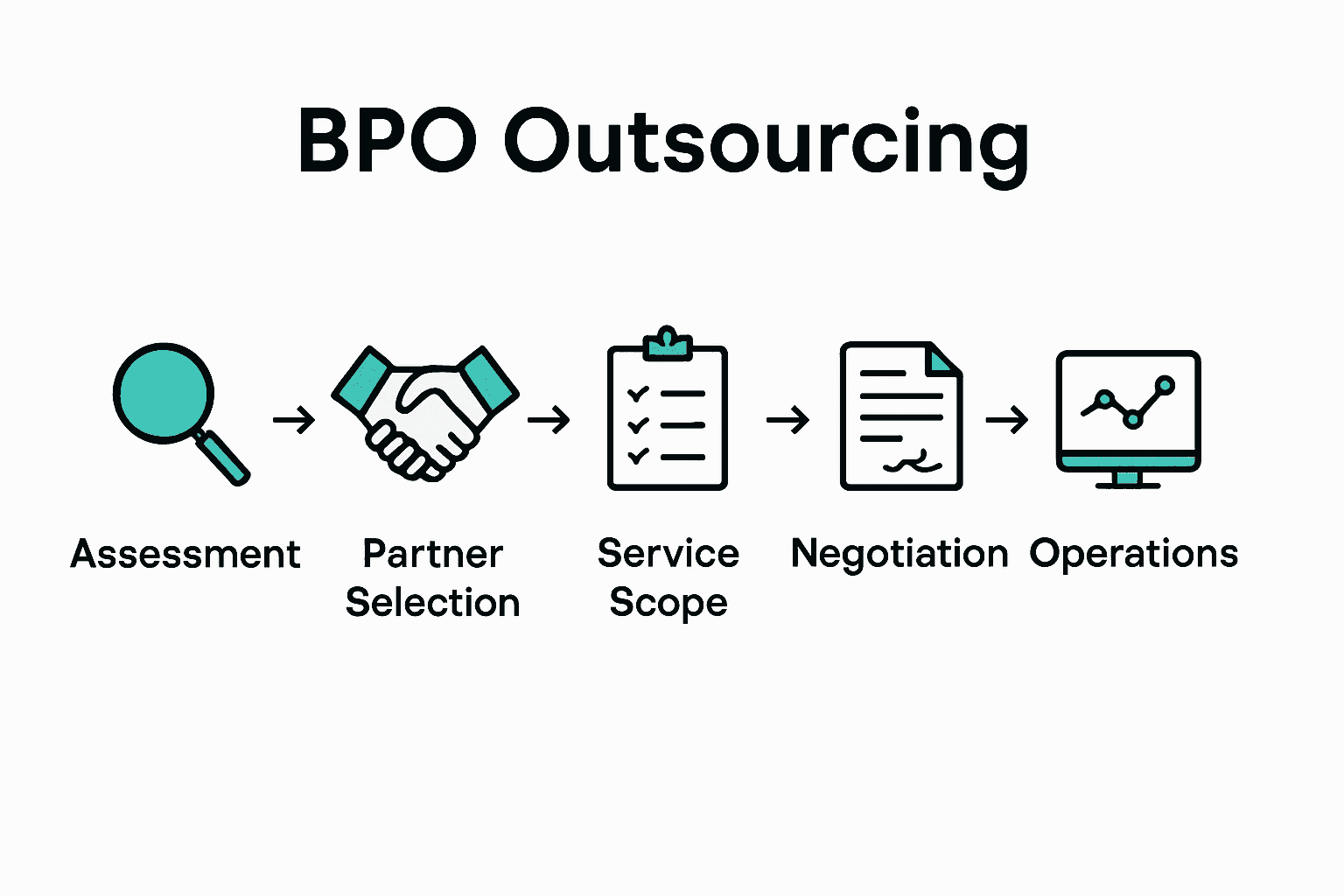
- Step 1: Assess Organizational Needs And Outsourcing Goals
- Step 2: Identify Suitable BPO Partners And Regions
- Step 3: Define Service Scope And Performance Expectations
- Step 4: Negotiate Contracts And Establish Governance
- Step 5: Launch Operations And Monitor Service Delivery
- Step 6: Optimize Processes And Scale BPO Engagement
Quick Summary
| Key Insight | Explanation |
|---|---|
| 1. Assess Organizational Needs | Conduct a detailed audit to identify core competencies and areas that can benefit from outsourcing expertise. |
| 2. Select BPO Partners Methodically | Use a weighted scoring matrix to evaluate potential partners against your criteria, focusing on technical expertise and cultural compatibility. |
| 3. Define Clear Service Scope | Create comprehensive service documentation outlining deliverables, performance standards, and workflow processes to avoid ambiguity. |
| 4. Negotiate Thorough Contracts | Incorporate detailed service descriptions, performance metrics, and risk management in contracts to ensure alignment with organizational goals. |
| 5. Implement Robust Monitoring Systems | Use performance dashboards and regular assessments to track service delivery and foster continuous improvement throughout the partnership. |
Step 1: Assess Organizational Needs and Outsourcing Goals
Successfully navigating business process outsourcing (BPO) begins with a strategic and comprehensive evaluation of your organizational requirements. According to research from arxiv.org, developing a systematic framework for assessing outsourcing potential is crucial for strategic innovation and long term success.
To effectively evaluate your outsourcing goals, start by conducting a detailed internal audit of your current operational processes. This involves identifying core competencies, analyzing performance gaps, and determining which functions could benefit from external expertise. As ir.knust.edu.gh highlights, understanding your strategic objectives is paramount when considering outsourcing decisions. Key areas to examine include:
- Current operational efficiency
- Resource allocation and potential cost savings
- Skills and talent gaps within your existing team
- Technological infrastructure limitations
- Scalability requirements for future growth
The goal is not just to reduce costs but to strategically enhance your organization’s capabilities. Carefully map out which processes are candidates for outsourcing and which should remain in house. This nuanced approach ensures you leverage external talent without compromising your core business functions.
Pro tip: Create a comprehensive scorecard that objectively measures potential outsourcing opportunities against your strategic goals. This will help you make data driven decisions and avoid emotional or reactive choices.
Once you have completed this detailed assessment, you will be well positioned to move forward with identifying potential BPO partners who can help you achieve your organizational objectives.
Step 2: Identify Suitable BPO Partners and Regions
Narrowing down the right BPO partners requires a strategic and methodical approach that goes beyond simple cost considerations. Research from arxiv.org introduces the MAPSS method, which emphasizes a multi-aspect approach to selecting partners that evaluates critical competencies and relationship potential.
To effectively identify suitable BPO partners, you need a comprehensive evaluation framework. Sloan Review recommends developing a rigorous assessment process that examines potential providers across multiple dimensions. Your selection criteria should include:
- Technical expertise and specialized skills
- Track record of successful project implementations
- Cultural compatibility and communication standards
- Technological infrastructure and innovation capabilities
- Scalability and flexibility of services
- Compliance with industry regulations and data security standards
Consider exploring nearshoring options in European regions, which offer strategic advantages such as proximity, similar time zones, and robust technological ecosystems.
 Nearshoring in European Expansion can provide additional insights into selecting optimal geographic locations for your BPO partnerships.
Pro tip: Create a weighted scoring matrix that objectively ranks potential BPO partners based on your specific organizational needs. This data driven approach will help you make more informed decisions and minimize potential risks associated with outsourcing.
Once you have identified and thoroughly vetted potential partners, you will be ready to move forward with detailed discussions and initial engagement strategies.
Step 3: Define Service Scope and Performance Expectations
Crafting a precise and comprehensive service scope is fundamental to successful business process outsourcing. According to research from arxiv.org, transformational outsourcing in project management requires meticulously defining service boundaries and performance expectations to drive strategic growth and innovation.
To establish a robust framework, break down your service requirements into granular, measurable components. MDPI emphasizes the importance of balancing innovation and efficiency through clear, well defined performance metrics. Your service scope documentation should comprehensively address:
- Specific deliverables and expected outputs
- Quality standards and performance benchmarks
- Detailed workflow processes and methodologies
- Communication protocols and reporting mechanisms
- Key performance indicators (KPIs) for measuring success
- Service level agreements (SLAs) with precise expectations
- Mechanisms for performance review and continuous improvement
Ensure that your documentation leaves no room for ambiguity. Each aspect of the service scope should be quantifiable and aligned with your organizational objectives. This clarity prevents potential misunderstandings and sets a solid foundation for a productive partnership.
Pro tip: Develop a collaborative template that allows both your organization and the BPO partner to contribute input, ensuring mutual understanding and agreement on service expectations.
Once you have meticulously defined your service scope, you will be prepared to move into the critical phase of contract negotiation and formal partnership establishment.
Step 4: Negotiate Contracts and Establish Governance
Navigating the contract negotiation process requires a strategic approach that goes beyond standard legal documentation. Research from arxiv.org highlights the GQM+Strategies approach, which emphasizes aligning organizational goals and strategies across multi organizational settings to create robust outsourcing agreements.
When negotiating your BPO contract, focus on creating a comprehensive framework that addresses potential risks and establishes clear performance expectations. SJSAF underscores the critical importance of careful planning and governance in outsourcing strategies. Key elements to include in your contract negotiation process should encompass:
- Detailed scope of services with precise deliverables
- Clear performance metrics and accountability standards
- Comprehensive risk management and mitigation strategies
- Flexible terms for scaling services up or down
- Robust data security and confidentiality provisions
- Mechanisms for dispute resolution
- Exit strategies and contract termination conditions
Establish a governance model that includes regular performance reviews, transparent communication channels, and collaborative problem solving mechanisms. This approach ensures ongoing alignment between your organizational objectives and the BPO partner capabilities.
Pro tip: Include a quarterly strategic review clause that allows both parties to reassess and realign the partnership based on evolving business needs and performance outcomes.
With a well negotiated contract in place, you will be prepared to transition into the implementation and onboarding phase of your BPO partnership.
Step 5: Launch Operations and Monitor Service Delivery
Successfully launching BPO operations requires a systematic approach that transforms organizational processes. Wikipedia emphasizes the critical importance of adopting a comprehensive process view when implementing outsourcing strategies, ensuring seamless integration and performance alignment.
Implement a robust monitoring framework that enables real time tracking of service delivery and performance metrics. Drawing insights from Wikipedia’s Business Process Re-engineering, focus on continuously redesigning and optimizing operational processes. Your monitoring strategy should include:
- Establishing comprehensive performance dashboards
- Implementing automated tracking and reporting mechanisms
- Conducting regular performance assessment meetings
- Creating clear escalation protocols for addressing issues
- Tracking key performance indicators in real time
- Maintaining open communication channels
- Developing continuous improvement mechanisms
Ensure your monitoring approach balances quantitative metrics with qualitative assessments. This holistic perspective allows you to capture nuanced performance insights beyond simple numerical measurements, enabling more strategic decision making and process optimization.
Pro tip: Develop a dynamic feedback loop that allows both your organization and the BPO partner to share insights, identify potential improvements, and collaboratively enhance service delivery.
With a comprehensive monitoring system in place, you will be prepared to optimize your BPO partnership and drive ongoing operational excellence.
Step 6: Optimize Processes and Scale BPO Engagement
Scaling your BPO engagement requires a strategic approach that balances innovation and operational efficiency. MDPI research highlights the critical importance of developing sustainable performance strategies that enable organizations to progressively enhance their outsourcing capabilities.
To effectively optimize and scale your BPO partnership, implement a phased approach that focuses on continuous improvement and strategic expansion. Drawing insights from Springer, consider the following key strategies for scaling your engagement:
- Develop a flexible operational framework
- Create modular service expansion pathways
- Establish clear performance progression metrics
- Build robust knowledge transfer mechanisms
- Invest in cross functional training programs
- Implement adaptive technological infrastructure
- Design scalable communication protocols
Transitioning from initial engagement to a mature partnership requires deliberate and strategic planning. How to Optimize Outsourcing Costs can provide additional insights into maximizing the value of your BPO relationship while maintaining cost effectiveness.
Pro tip: Regularly reassess your BPO partnership through quarterly strategic reviews that evaluate performance, identify potential improvements, and align with evolving organizational objectives.
With a structured approach to optimization and scaling, you will transform your BPO engagement from a transactional service to a strategic business partnership.
Unlock the Full Potential of Your BPO Strategy with StorsenDigital
Navigating the complexities of business process outsourcing requires more than just cutting costs. This article highlights crucial steps like carefully assessing organizational needs, selecting the right partners, and defining clear service scopes that align perfectly with your strategic goals. If you are feeling the pressure of juggling talent gaps, technological limitations, and scalability challenges, you are not alone. Many enterprises struggle to create sustainable outsourcing partnerships that truly drive growth and innovation.
At StorsenDigital, we specialize in empowering businesses to overcome these hurdles with our comprehensive BPO and nearshoring services across Europe. Our expertise in talent recruitment, office establishment, and managed services in HR, finance, IT, and software development ensures your outsourcing journey is seamless and strategically aligned. You will have access to tailored solutions backed by proven success stories and client insights to confidently optimize operations while mitigating risks.

Ready to transform your BPO outsourcing efforts into a powerful competitive advantage? Visit our homepage to explore how our strategic consulting and managed services can help you launch, monitor, and scale with confidence. Take the first step no matter your industry or size. Connect with us now to start building a flexible, scalable partnership that fuels lasting operational excellence.
Frequently Asked Questions
What is the first step to assess my organization’s outsourcing needs?
To assess your organization’s outsourcing needs, start with a detailed internal audit of your current operational processes. Identify key competencies, performance gaps, and functions that could benefit from outsourcing to external experts.
How can I identify suitable BPO partners for my company?
Identify suitable BPO partners by developing a comprehensive evaluation framework that assesses potential providers on technical skills, track records, and cultural compatibility. Create a weighted scoring matrix to rank partners based on your specific organizational needs.
What should be included in the service scope when outsourcing?
The service scope should comprehensively outline specific deliverables, quality standards, and detailed workflow processes. Ensure all performance metrics and service level agreements are clearly defined to avoid ambiguities in expectations.
How do I negotiate contracts with BPO providers effectively?
Negotiate contracts by focusing on creating a comprehensive framework that includes detailed scope, performance metrics, risk management strategies, and clear communication channels. Prioritize establishing flexible terms that allow for scaling services based on your organization’s evolving needs.
What monitoring practices should I adopt after launching BPO operations?
Implement a robust monitoring framework with performance dashboards, automated tracking systems, and regular assessment meetings. Maintain open communication channels to ensure continuous improvement and timely issue resolution.
How can I optimize and scale my BPO engagement over time?
To optimize and scale your BPO engagement, adopt a phased approach that incorporates continuous improvement strategies and clear performance progression metrics. Regularly reassess your partnership and adjust operational frameworks to accommodate growth and change.


