


Industry news
How to assess BPO performance for operational excellence

Measuring BPO performance remains one of the most challenging aspects of outsourcing strategy for enterprise decision-makers. Traditional efficiency metrics like call duration or cost per transaction fail to capture the strategic value BPO partnerships deliver to your business. Without a comprehensive assessment framework that connects outsourcing activities to measurable business outcomes, you risk overlooking critical opportunities for optimization and growth. This guide provides a modern, evidence-based approach to evaluating BPO performance that drives operational excellence, reduces risk, and maximizes return on your outsourcing investment through actionable strategies you can implement immediately.
Table of Contents
- Define Your Objectives And Measurement Purpose
- Select And Track Relevant Performance Metrics
- Conduct Regular Vendor Performance Reviews And Risk Assessments
- Leverage Technology And Continuous Improvement For Operational Excellence
- Optimize Your Outsourcing Strategy With Expert BPO Solutions
- FAQ
Key takeaways
| Point | Details |
|---|---|
| Strategic measurement | Move beyond basic efficiency metrics to evaluate BPO impact on business outcomes and strategic goals |
| Clear objectives | Define measurement purpose explicitly before selecting KPIs to ensure alignment with stakeholder expectations |
| Quality focus | Track parameters like First Call Resolution and customer satisfaction for tangible performance insights |
| Regular reviews | Conduct scheduled vendor assessments to identify risks early and maintain service excellence |
| Technology integration | Leverage AI and continuous improvement methodologies to sustain and scale BPO success |
Define your objectives and measurement purpose
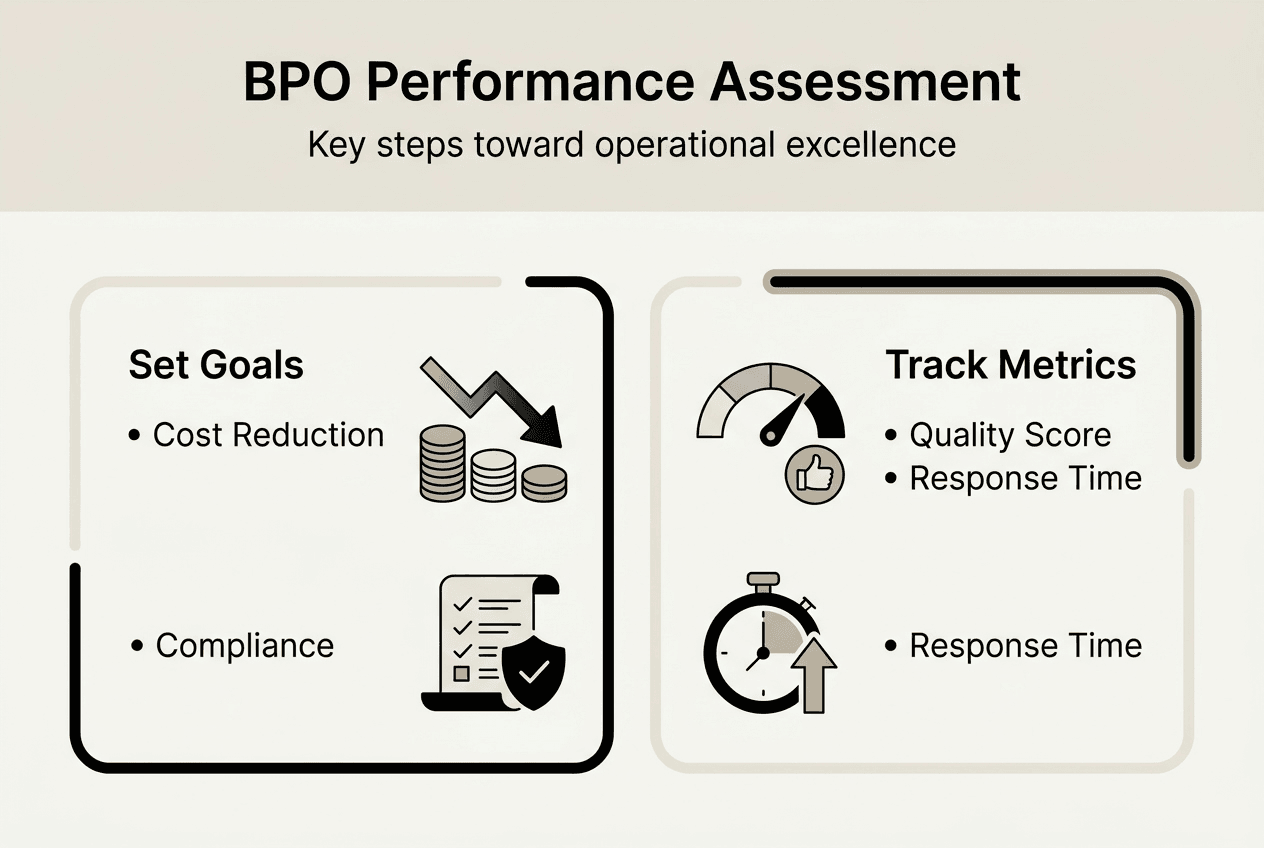
Before selecting metrics or launching assessments, you must explicitly define why you are measuring BPO performance. Measurement purpose definition is critical in developing effective performance strategies. Without clarity on measurement intent, you risk collecting irrelevant data that wastes resources and provides no actionable insights. Your measurement objectives shape which KPIs matter, what data sources you need, and how frequently you should review performance.
Common measurement purposes include cost reduction, customer experience enhancement, regulatory compliance verification, and innovation acceleration. Each purpose demands different evaluation frameworks and success criteria. Cost-focused assessments emphasize efficiency ratios and unit economics, while customer experience objectives prioritize satisfaction scores and resolution quality. Compliance-driven measurement tracks adherence rates and audit findings, whereas innovation goals monitor process improvements and technology adoption.
The metrics you choose must align with strategic business goals rather than just operational convenience. Many organizations default to easily available data like call volume or average handle time because these metrics are simple to track. However, these operational measures rarely connect to the strategic outcomes your leadership team cares about, such as revenue growth, market expansion, or competitive advantage. Effective BPO assessment links outsourcing activities directly to business impact through carefully selected indicators.
Pro Tip: Involve key stakeholders from finance, operations, compliance, and customer experience teams early in defining measurement objectives to ensure comprehensive coverage and secure buy-in for the assessment framework you develop.
When selecting a BPO provider for efficiency, establish measurement criteria upfront as part of your vendor evaluation process. This proactive approach ensures alignment between provider capabilities and your performance expectations from day one. Document your measurement objectives in the service agreement to create shared accountability and prevent misunderstandings about success criteria.
Select and track relevant performance metrics
Once you have defined clear objectives, selecting the right KPIs becomes straightforward. Essential BPO metrics include First Call Resolution, customer satisfaction scores, average turnaround time, agent turnover rates, and compliance adherence percentages. First Call Resolution is vital for BPO success, with industry targets typically ranging from 70% to 85% depending on service complexity. Higher FCR rates correlate directly with improved customer satisfaction and reduced operational costs.
Quality parameters deliver more meaningful insights than volume-based efficiency metrics. While call duration and transaction counts provide operational visibility, they fail to capture the value delivered to customers or your business. Customer satisfaction scores, Net Promoter Scores, and quality assurance ratings reveal how well your BPO partner meets end-user needs. Agent turnover rates indicate workforce stability and training effectiveness, both critical factors in service consistency.
Tracking methods should combine automated reporting dashboards with regular human review. Modern BPO platforms offer real-time performance visibility through integrated analytics tools that aggregate data from multiple sources. However, quantitative data alone misses important context that qualitative feedback provides. Schedule monthly or quarterly reviews where you examine metrics alongside customer feedback, agent observations, and operational challenges to gain balanced insights.

| Metric | Target Range | Business Impact |
|---|---|---|
| First Call Resolution | 70-85% | Reduces repeat contacts and improves customer satisfaction |
| Customer Satisfaction | 80-90% | Drives retention and positive brand perception |
| Agent Turnover | Below 20% annually | Maintains service quality and reduces training costs |
| Average Response Time | Under 2 minutes | Enhances customer experience and operational efficiency |
| Compliance Rate | 95-100% | Minimizes regulatory risk and protects brand reputation |
Pro Tip: Create a balanced scorecard that combines leading indicators like agent training completion with lagging indicators like customer satisfaction to predict performance trends before they impact business results.
Integrating your measurement systems with managed BPO services workflow ensures consistent data collection and reporting. Standardized workflows reduce measurement variability and make performance comparisons more reliable across time periods and service lines. Establish clear data governance protocols that define metric calculations, reporting frequency, and accountability for data accuracy.
Conduct regular vendor performance reviews and risk assessments
Scheduled vendor performance evaluations form the backbone of effective BPO management. These structured reviews should cover security practices, compliance adherence, SLA performance, innovation contributions, and strategic alignment. Regular assessments help identify problems early, before they escalate into service failures or compliance violations that damage your business. Regular vendor performance assessments identify security risks preventing costly breaches.
Data breaches cost organizations an average of $4.45 million per incident, making proactive vendor security assessments a critical risk management investment that delivers measurable ROI through breach prevention.
Your review process should follow a consistent checklist to ensure comprehensive coverage:
- Evaluate security controls and data protection measures against current threat landscape and regulatory requirements
- Review SLA compliance rates and investigate any performance gaps or recurring issues
- Assess quality metrics including customer feedback, error rates, and resolution effectiveness
- Examine innovation contributions and process improvement initiatives the vendor has proposed or implemented
- Verify compliance with industry regulations and internal policy requirements through audit findings
- Analyze financial stability and business continuity preparedness to ensure vendor viability
- Gather stakeholder feedback from internal teams who interact with the BPO provider regularly
Transparent communication of review findings with your BPO provider drives continuous improvement. Share both positive performance highlights and areas requiring attention in a constructive manner that fosters partnership rather than blame. Establish joint improvement plans with clear timelines and accountability when gaps emerge. The best BPO relationships treat performance reviews as collaborative opportunities to optimize outcomes together.
Document all review findings and track improvement commitments over time. This historical record helps you identify persistent issues that require escalation or contract renegotiation. It also provides evidence of due diligence for compliance audits and supports data-driven decisions about contract renewals or vendor changes. Implementing managed BPO services with built-in review cadences ensures this critical governance activity happens consistently.
Leverage technology and continuous improvement for operational excellence
Artificial intelligence is transforming BPO performance management at unprecedented speed. AI adoption in call centers reaches 82%, fundamentally changing service quality and efficiency expectations. AI-powered tools enable real-time performance monitoring, predictive analytics that forecast service issues before they occur, and automated quality assurance that reviews 100% of interactions rather than small samples. These capabilities deliver insights impossible to achieve through manual processes.
| Approach | Performance Monitoring | Quality Assurance | Customer Insights | Cost Efficiency |
|---|---|---|---|---|
| Traditional BPO | Sample-based, delayed reporting | Manual review of 2-5% of interactions | Quarterly surveys and feedback | Moderate optimization potential |
| AI-Powered BPO | Real-time dashboards, predictive alerts | Automated review of 100% interactions | Continuous sentiment analysis | Significant cost reduction through automation |
BPO operational excellence incorporates continuous improvement, technology integration, and client-centric focus as core components. Continuous improvement means treating performance optimization as an ongoing journey rather than a one-time project. Implement regular retrospectives where your team and BPO partner review what worked well, what needs adjustment, and what new opportunities exist. This iterative approach compounds small gains into substantial performance improvements over time.
Practical steps for implementing continuous feedback loops and technology upgrades include:
- Establish weekly or biweekly performance sync meetings to review leading indicators and address emerging issues quickly
- Create feedback channels where frontline agents can report process inefficiencies and suggest improvements directly
- Implement A/B testing for process changes to validate improvements before full deployment across operations
- Develop technology roadmaps that prioritize automation opportunities based on ROI and implementation complexity
- Partner with your BPO provider to pilot emerging technologies in controlled environments before scaling
Pro Tip: Start with small AI pilot projects focused on specific pain points like call routing or quality monitoring, then scale based on demonstrated ROI to avoid common pitfalls of over-investing in unproven technology.
Integrating AI in BPO customer service requires change management that addresses both technical implementation and workforce adaptation. Agents need training to work effectively alongside AI tools, and processes must evolve to capitalize on automation capabilities. The most successful implementations treat AI as augmentation that enhances human capabilities rather than replacement that eliminates jobs. This approach maintains workforce engagement while capturing technology benefits.
Optimize your outsourcing strategy with expert BPO solutions
Implementing comprehensive BPO performance assessment and operational excellence requires expertise, proven frameworks, and ongoing support. StorsenDigital specializes in helping European enterprises optimize their outsourcing strategies through tailored BPO solutions that deliver measurable business impact. Our team brings deep experience in performance measurement, vendor management, and technology integration to ensure your outsourcing investments drive strategic value.

Explore our outsourcing process guide to understand how structured approaches maximize BPO outcomes. Our managed BPO implementation guide provides detailed frameworks for launching and scaling operations effectively. Discover practical strategies to improve BPO scalability as your business grows and requirements evolve. With StorsenDigital’s support, you gain a strategic partner committed to your operational excellence and long-term success.
FAQ
How often should I assess BPO performance to ensure optimal results?
Conduct comprehensive BPO performance assessments quarterly or biannually to identify issues early and support continuous improvement. This cadence provides sufficient data to detect meaningful trends while allowing time for improvement initiatives to demonstrate impact. However, critical risk factors like security controls and compliance adherence should be monitored continuously through automated systems with immediate alerting for any deviations from established standards.
What are the most impactful KPIs for evaluating BPO provider quality?
First Call Resolution, customer satisfaction scores, agent turnover rates, and compliance adherence percentages are the most impactful quality indicators. These metrics directly reflect service effectiveness, customer experience, workforce stability, and risk management. Always align your specific KPI selection to your business goals, as different strategic objectives require different measurement priorities for maximum relevance and actionability.
How can AI improve the assessment and management of BPO performance?
AI enables real-time performance monitoring through automated data collection and analysis that would be impossible manually. Predictive analytics forecast potential service issues before they impact customers, allowing proactive intervention. Process automation reduces manual effort in quality assurance and reporting, freeing resources for strategic analysis. AI-powered sentiment analysis provides continuous customer feedback insights that inform improvement priorities and support data-driven decision making.
What are common mistakes to avoid when measuring BPO performance?
Relying solely on outdated or superficial metrics like call duration fails to capture strategic value and can incentivize counterproductive behaviors. Neglecting to align measurement frameworks with strategic business goals and stakeholder input creates irrelevant data that wastes resources. Ignoring regular vendor reviews and risk assessments allows problems to escalate undetected. Failing to combine quantitative metrics with qualitative feedback misses important context that numbers alone cannot provide.


