


More than 60 percent of European businesses report measurable gains when adopting tailored BPO strategies inspired by American operational frameworks. For C-suite executives facing high labor costs and scattered workflows, defining clear goals and procedures sets the stage for meaningful change. This article breaks down pragmatic steps to build a high-performing BPO team that drives efficiency, cost reduction, and lasting value through well-structured nearshoring decisions.
Table of Contents
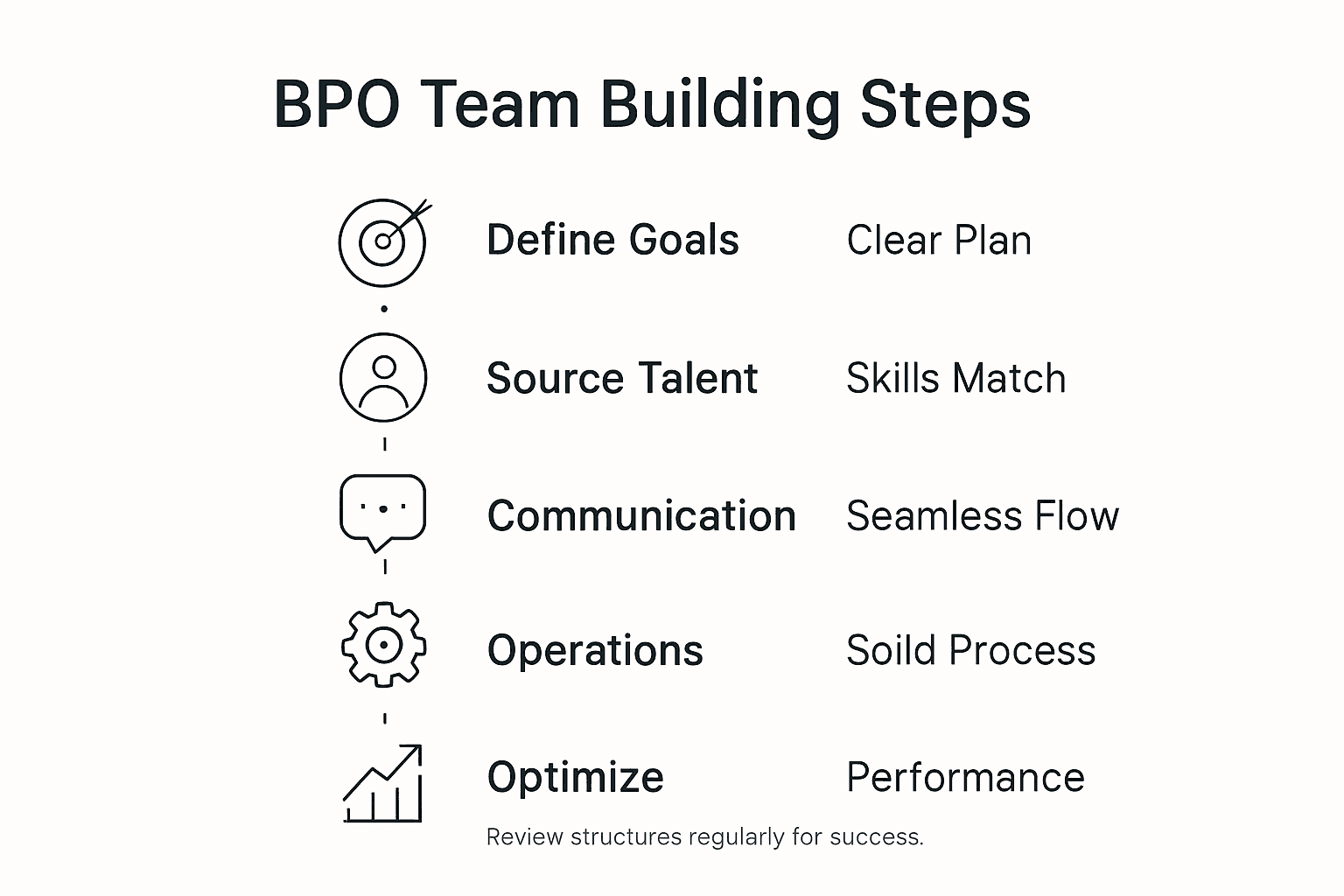
- Step 1: Define Business Goals And Process Requirements
- Step 2: Identify And Source Skilled Talent
- Step 3: Establish Efficient Communication Structures
- Step 4: Implement Robust Operational Frameworks
- Step 5: Verify Team Performance And Optimize Procedures
Quick Summary
| Key Takeaway | Explanation |
|---|---|
| 1. Define Clear Business Goals | Setting precise goals impacts BPO team effectiveness and scalability, aligning activities with overall business objectives. |
| 2. Source Skilled and Adaptable Talent | Attracting candidates who exhibit both technical abilities and adaptability is essential for successful BPO team performance. |
| 3. Establish Efficient Communication Structures | A robust communication infrastructure fosters collaboration and ensures information flows seamlessly across teams and locations. |
| 4. Implement Robust Operational Frameworks | Creating structured operational frameworks leads to consistent performance and facilitates continuous improvement within the team. |
| 5. Optimize Procedures Through Performance Verification | Regularly verify team performance and optimize procedures to drive continuous improvement and enhance overall organizational effectiveness. |
Step 1: Define business goals and process requirements
Building a successful BPO team begins with crystal clear goal setting and precise process requirements. Your ability to define these foundational elements will directly impact the team’s effectiveness and scalability.
Start by conducting a comprehensive organizational assessment that maps your current operational landscape. This means sitting down with key stakeholders from different departments to understand their strategic objectives and pain points. The Process Classification Framework provides an excellent structured approach for breaking down complex business processes into manageable components. Focus on identifying core processes that align with your broader business strategy and require optimization or outsourcing.
When defining your requirements, be extremely specific about expected outcomes, performance metrics, and quality standards. Create detailed documentation that outlines roles, responsibilities, workflow steps, and critical success indicators. Digital transformation emphasizes the importance of precise process governance to ensure alignment between your BPO team and organizational objectives. This means developing clear key performance indicators (KPIs) that can be objectively measured and tracked.
Pro tip: Create a living document that can be iteratively updated as your business needs evolve, ensuring your process requirements remain dynamic and responsive to changing organizational strategies.
Step 2: Identify and source skilled talent
Identifying and sourcing top talent is a critical step in building your BPO team, requiring a strategic approach that goes beyond traditional recruitment methods. Your goal is to attract professionals who not only possess technical skills but also demonstrate the adaptability and communication abilities essential for successful business process outsourcing.
Begin by developing a comprehensive talent acquisition strategy that leverages multiple sourcing channels. This means exploring professional networks, specialized job platforms, and local talent pools in regions known for strong technical education. Talent management requires a holistic approach to attracting and developing skilled professionals that aligns with your organizational objectives. Focus on candidates who show potential for continuous learning and possess strong interpersonal skills alongside their technical expertise.

Once you identify potential candidates, implement a robust training and development program that enhances their capabilities and aligns them with your specific business needs. This involves creating structured onboarding processes, ongoing skill development initiatives, and performance management systems that support employee growth. Consider partnering with local educational institutions or professional training centers to create a pipeline of talent that can be continuously refined and developed.
Pro tip: Develop a flexible talent assessment framework that evaluates candidates not just on their current skills, but on their potential for adaptability, learning agility, and long term organizational fit.
Step 3: Establish efficient communication structures
Building a robust communication infrastructure is crucial for your BPO team’s success, ensuring seamless collaboration and information flow across different departments and geographical locations. Your communication strategy will serve as the backbone of your team’s operational effectiveness and organizational cohesion.
Effective workplace communication strategies require a multifaceted approach that goes beyond traditional communication methods. Implement a comprehensive communication framework that includes digital collaboration tools, regular virtual and in-person meetings, and clear communication protocols. This means selecting the right communication platforms that support real time interactions, document sharing, and transparent project tracking. Pay special attention to creating channels that facilitate both formal reporting and informal team building.
Organizational communication frameworks should prioritize multi directional information flows and establish clear roles for managers and team members. Develop structured communication guidelines that outline expectations for response times, communication etiquette, and preferred communication channels for different types of interactions. This approach ensures that your BPO team maintains high levels of transparency, reduces misunderstandings, and creates a culture of open and efficient information exchange.
Pro tip: Create a communication matrix that maps out preferred communication channels, expected response times, and escalation procedures for different types of interactions and organizational levels.
Step 4: Implement robust operational frameworks
Implementing robust operational frameworks is the critical backbone that transforms your BPO team from a collection of individuals into a high-performing, synchronized unit. Your goal is to create a structured environment that enables consistent performance, predictable outcomes, and continuous improvement across all team functions.
Process frameworks like the APQC Process Classification Framework provide a comprehensive blueprint for organizing and standardizing business operations. Develop a systematic approach that breaks down complex workflows into manageable, repeatable processes. This means creating detailed standard operating procedures (SOPs) that outline step-by-step instructions for each critical business function, ensuring consistency and reducing variability in performance. Focus on developing clear documentation that can be easily understood and implemented by team members at all levels.
Operational excellence requires establishing foundational elements that go beyond mere documentation. Develop a holistic framework that integrates vision, structure, guiding principles, talent management, and technological tools. This involves creating performance metrics, implementing regular review cycles, and building mechanisms for continuous feedback and process refinement. Your operational framework should be flexible enough to adapt to changing business needs while maintaining a core set of standardized practices that drive efficiency and quality.
Pro tip: Design your operational framework with built-in flexibility, allowing for periodic review and adaptation while maintaining a consistent core set of standardized processes and performance expectations.
Step 5: Verify team performance and optimize procedures
Verifying team performance and optimizing procedures represents the critical continuous improvement phase of your BPO team development. Your objective is to transform raw performance data into actionable insights that drive organizational effectiveness and individual growth.
Project management and performance optimization methodologies provide structured approaches to measuring and enhancing team output. Implement a comprehensive performance verification system that integrates quantitative metrics with qualitative assessments. This means establishing clear key performance indicators (KPIs), conducting regular performance reviews, and creating feedback mechanisms that capture both numerical data and nuanced team dynamics. Focus on developing a balanced scorecard that evaluates productivity, quality, efficiency, and individual contributions.
Team development interventions play a crucial role in systematically improving performance. Design a multifaceted approach that includes targeted training programs, leadership development initiatives, structured team building activities, and periodic performance debriefings. Your optimization strategy should be dynamic, allowing for continuous refinement of procedures based on empirical evidence and team feedback. Create an environment that views performance optimization as an ongoing process rather than a periodic event, encouraging proactive problem solving and continuous learning.
Pro tip: Implement a quarterly performance review cycle with granular metrics and create a transparent feedback loop that allows team members to understand their performance context and contribute to process improvement strategies.
The following table highlights business impacts of strong vs. weak BPO team foundations:
| Foundation Element | Strong Practice Impact | Weak Practice Risk |
|---|---|---|
| Clear Process Requirements | Consistent, scalable delivery | Misalignment, inefficiency |
| Skilled Talent | Reliable, flexible performance | High turnover, skill gaps |
| Communication Structure | Seamless teamwork, transparency | Confusion, missed deadlines |
| Robust Frameworks | Predictable outcomes, adaptability | Process failure, rigidity |
| Performance Optimization | Ongoing growth, better results | Stagnation, declining output |
Here’s a summary of key considerations at each stage when building a BPO team:
| Stage | Main Focus | Key Deliverable |
|---|---|---|
| Define Goals | Align objectives & processes | Clear documentation, KPIs |
| Source Talent | Attract skilled, adaptable candidates | Talent pipeline, onboarding plan |
| Build Communication | Create effective channels & protocols | Communication guidelines, platform selection |
| Operational Frameworks | Standardize workflows for consistency | SOPs, review mechanisms |
| Performance & Optimization | Drive continuous improvement | Balanced scorecard, feedback loops |
Unlock Scalable Success with Expert BPO Team Building Support
Building a BPO team that delivers consistent performance and seamless communication requires precise planning and skilled talent management. If you are facing challenges in defining clear process requirements or structuring efficient operational frameworks you are not alone. Many organizations struggle with aligning team goals, sourcing adaptable talent, and establishing robust performance optimization. The good news is that expert guidance can transform these complexities into a powerful growth engine for your business.
At StorsenDigital.com we specialize in tailored Business Process Outsourcing solutions across Europe designed to address exactly the pain points highlighted in this article. From strategic talent acquisition to managed BPO services in HR finance IT and customer support our comprehensive approach guarantees you scalable and reliable operations. Our proven frameworks and communication strategies ensure your team stays transparent and productive while our continuous improvement methodologies drive ongoing success.
Take the first step toward building your scalable BPO team today. Explore how our expert outsourcing and nearshoring services can help you overcome recruitment challenges and operational hurdles.

Contact us now at StorsenDigital.com to schedule a consultation and discover tailored solutions that align with your business goals. Empower your BPO team with StorsenDigital.com and set your path for scalable success.
Frequently Asked Questions
How do I define clear goals and process requirements for my BPO team?
Defining clear goals and process requirements involves conducting an organizational assessment to identify strategic objectives and pain points. Engage with key stakeholders across departments to outline specific expected outcomes, performance metrics, and quality standards.
What skills should I look for when sourcing talent for a BPO team?
Look for candidates with strong technical skills, adaptability, and effective communication abilities. Develop a talent acquisition strategy that includes various sourcing channels to find professionals who demonstrate the potential for continuous learning and organizational fit.
How can I establish efficient communication structures within my BPO team?
To establish efficient communication structures, implement a multi-faceted communication framework that includes digital tools, regular meetings, and clear protocols. Create guidelines that specify preferred communication channels and response times to facilitate seamless collaboration.
What operational frameworks should I implement for a successful BPO team?
Implement operational frameworks by standardizing workflows and creating detailed standard operating procedures (SOPs) for critical functions. Ensure these frameworks are flexible enough to adapt to changing needs while maintaining consistent performance standards.
How can I verify team performance and optimize procedures effectively?
Verify team performance by establishing clear key performance indicators (KPIs) and incorporating regular performance reviews. Use a balanced scorecard approach to track productivity and quality, and create feedback loops to encourage continuous improvement over time.


