


Selecting a nearshoring partner can make or break your operational efficiency. Many European enterprises struggle with choosing providers that align with their strategic goals, leading to costly mismatches and failed partnerships. This guide walks you through a proven framework for preparing, evaluating, executing, and verifying a nearshoring partnership that delivers sustainable business value. You will learn how to set clear criteria, assess providers systematically, implement smooth onboarding, and maintain performance through continuous monitoring.
Table of Contents
- Key takeaways
- Preparing to choose your nearshoring partner
- Evaluating and selecting the right nearshoring partner
- Executing the nearshoring partnership for operational success
- Verifying performance and mitigating risks in your nearshoring partnership
- Explore expert outsourcing guides and support
- Frequently asked questions
Key Takeaways
| Point | Details |
|---|---|
| Define objectives and criteria | Before engaging providers, document clear business objectives and must have capabilities to guide evaluation. |
| Assess capabilities and culture fit | Evaluate technical skills, language, time zone alignment, and cultural compatibility to reduce mismatches. |
| Structured evaluation with scoring | Use a weighted scoring model to compare providers on experience, technology stack, references, and culture. |
| Onboarding and monitoring plan | Implement a clear onboarding process and ongoing performance monitoring to align operations and verify value. |
| Legal and compliance readiness | Identify regulatory requirements early to ensure providers meet data protection, labor laws, and sector standards. |
Preparing to choose your nearshoring partner
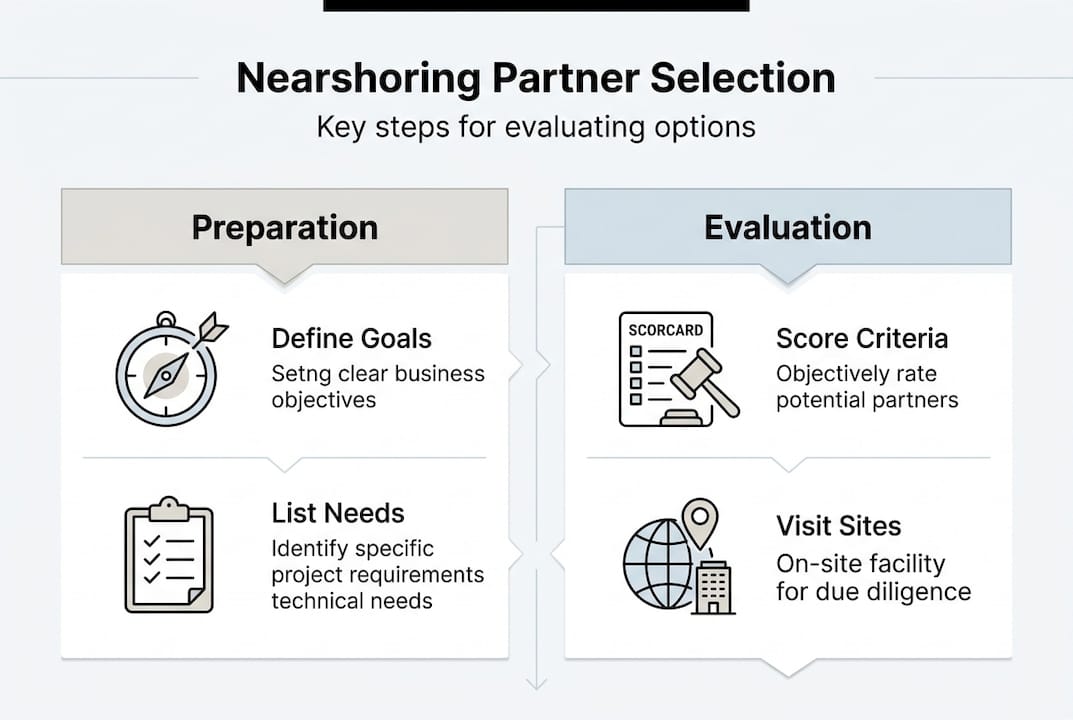
Before you contact any provider, you need a solid foundation. Start by defining your business objectives. Are you looking to reduce costs, access specialized talent, or scale operations quickly? Each goal shapes different partnership requirements.
Next, list your must-have capabilities. Technical skills matter, but so do language proficiency and time zone alignment. If your team works standard European hours, a partner in a similar zone reduces coordination friction. Preparing clear criteria improves decision-making in nearshoring partnerships.
Cultural compatibility often gets overlooked until problems emerge. Communication styles vary significantly across regions. Some cultures favor direct feedback, while others prefer diplomatic approaches. Assess whether a provider’s work culture meshes with your organization’s values and practices.
Compliance and legal requirements cannot be afterthoughts. Depending on your industry, you may face strict data protection regulations, labor laws, or sector-specific standards. Identify these requirements early and ensure any potential partner can meet them.
Cost expectations deserve careful thought. While nearshoring typically offers savings compared to domestic operations, the lowest price rarely delivers the best value. Balance cost considerations against quality, reliability, and long-term partnership potential. A provider offering rock-bottom rates may cut corners on security, training, or talent retention.
Pro Tip: Create a detailed requirements document before reaching out to providers. Include technical specifications, compliance needs, cultural preferences, and budget ranges. This document becomes your baseline for consistent evaluation.
Understanding what nearshoring actually means helps you set realistic expectations. Nearshoring involves partnering with service providers in geographically close countries, typically within the same or adjacent time zones. This proximity offers advantages over traditional offshore models, including easier travel, cultural similarities, and real-time collaboration.
Your preparation checklist should include:
- Documented business objectives with measurable success criteria
- Technical and operational capability requirements
- Compliance and legal framework applicable to your operations
- Cultural fit parameters and communication preferences
- Realistic budget ranges with quality thresholds
This groundwork transforms your partner search from a vague exploration into a targeted evaluation process. You will save time by eliminating mismatched providers early and focusing energy on genuinely viable candidates.
Evaluating and selecting the right nearshoring partner
With your criteria established, you can now assess potential partners systematically. A weighted scoring model brings objectivity to what otherwise feels like a subjective decision. Assign point values to factors like industry experience, technology stack, client references, and cultural alignment based on their importance to your business.
Structured evaluation reduces nearshoring risk and increases partnership success. Conduct thorough due diligence that goes beyond marketing materials. Request detailed case studies from similar clients. Ask for references you can contact directly, not just testimonials on their website.
Site visits provide invaluable insights when feasible. Seeing operations firsthand reveals details no presentation can capture. You observe team dynamics, workspace quality, security measures, and management practices. Even virtual tours offer more transparency than written descriptions alone.

Create a comparison framework to evaluate shortlisted providers side by side:
| Evaluation Factor | Weight | Provider A | Provider B | Provider C |
|---|---|---|---|---|
| Technical expertise | 25% | 8/10 | 9/10 | 7/10 |
| Cultural alignment | 20% | 7/10 | 8/10 | 9/10 |
| Cost competitiveness | 15% | 9/10 | 7/10 | 8/10 |
| Scalability options | 15% | 8/10 | 9/10 | 7/10 |
| Security and compliance | 15% | 9/10 | 8/10 | 8/10 |
| Client references | 10% | 7/10 | 9/10 | 8/10 |
Follow this evaluation sequence:
- Screen initial candidates against your must-have requirements to create a preliminary shortlist
- Request detailed proposals from shortlisted providers with specific responses to your requirements document
- Conduct in-depth interviews focusing on their understanding of your business challenges
- Check references thoroughly, asking about challenges encountered and how they were resolved
- Review contracts carefully for hidden costs, exit clauses, and long-term obligations
- Calculate total cost of ownership including setup, transition, ongoing fees, and potential scaling costs
Flexibility for customization matters more than you might expect. Standard service packages rarely fit unique business needs perfectly. Assess how willing and able each provider is to adapt their offerings. Can they adjust team composition as your needs evolve? Will they accommodate your preferred project management tools and processes?
Pro Tip: During reference calls, ask specifically about how the provider handled unexpected challenges or scope changes. Their crisis response reveals more about partnership quality than their success stories.
Beware of red flags during evaluation. Providers who promise unrealistic timelines or guarantees likely lack experience with complex implementations. Vague answers about security protocols or compliance certifications suggest gaps in their capabilities. Reluctance to provide detailed contract terms upfront indicates potential hidden costs or unfavorable conditions.
Selecting the right nearshore partner requires balancing multiple factors. Technical capabilities get you in the door, but cultural fit and communication quality sustain long-term success. Your weighted scoring model should reflect this balance, not just prioritize the lowest cost or most impressive technology stack.
Executing the nearshoring partnership for operational success
Once you have selected your partner, execution determines whether the relationship delivers promised value. Start by establishing crystal-clear communication channels. Designate primary contacts on both sides and define escalation procedures for different issue types. Will you use Slack for daily coordination, email for formal communications, and video calls for weekly reviews?
Define detailed service level agreements and key performance indicators aligned with your business goals. Effective onboarding and governance are key to long-term nearshoring success. Your SLAs should specify response times, quality standards, availability requirements, and consequences for non-compliance.
Comprehensive onboarding sets the partnership trajectory. Plan knowledge transfer sessions that cover not just technical processes but also your company culture, decision-making norms, and strategic context. The nearshoring team performs better when they understand why certain approaches matter, not just how to execute tasks.
Follow this onboarding sequence:
- Conduct orientation sessions covering company history, values, and strategic objectives
- Provide detailed documentation of processes, systems, and quality standards
- Arrange shadowing opportunities where the nearshore team observes your internal operations
- Start with pilot projects that allow gradual capability building and relationship development
- Schedule regular check-ins during the first 90 days to address questions and adjust approaches
- Gather feedback from both teams to identify friction points early
Project management practices keep operations on track. Implement shared tools that provide visibility into task status, blockers, and progress. Whether you use Jira, Asana, or another platform, ensure both teams have access and training. Consistency in project management reduces miscommunication and keeps everyone aligned.
Maintain frequent progress reviews beyond the onboarding period. Weekly or biweekly meetings allow course correction before small issues become major problems. These reviews should cover completed work, upcoming priorities, resource needs, and any challenges requiring attention.
Pro Tip: Create a shared success metrics dashboard that both teams can access anytime. Transparency around performance builds trust and encourages proactive problem solving.
Adapt operations proactively as you learn what works. Your initial processes may need refinement based on actual collaboration dynamics. Stay flexible and willing to adjust communication frequency, reporting formats, or workflow structures. The best partnerships evolve through continuous improvement.
Key execution elements include:
- Documented communication protocols with designated channels for different purposes
- Comprehensive SLAs covering response times, quality metrics, and availability
- Structured onboarding with knowledge transfer and cultural orientation
- Shared project management tools with consistent usage practices
- Regular progress reviews with action items and accountability
Implementing BPO operations smoothly requires attention to change management within your organization. Your internal teams need preparation for working with nearshore partners. Address concerns about job security, clarify how responsibilities will shift, and emphasize the strategic advantages the partnership enables.
Verifying performance and mitigating risks in your nearshoring partnership
Continuous monitoring ensures your nearshoring partnership delivers expected results. Track KPIs and SLA compliance through dashboard reporting that provides real-time visibility. Automated tracking reduces manual effort while maintaining accountability.
Ongoing risk management in nearshoring minimizes operational disruptions. Identify early warning signs of service or quality issues before they escalate. Missed deadlines, declining quality scores, or increased error rates signal problems requiring immediate attention.
Common risks in nearshoring partnerships include:
- Political or economic instability in the partner’s country affecting operations
- Data security breaches or compliance violations
- High employee turnover disrupting continuity and knowledge retention
- Communication breakdowns leading to misaligned expectations
- Scope creep without proper change management processes
Develop contingency plans for each significant risk. What happens if your primary contact leaves? How will you respond to a data security incident? Where can you find backup capacity if your partner faces unexpected constraints? Having answers ready reduces panic and enables swift response.
Use periodic audits to verify compliance and identify improvement opportunities. Quarterly reviews should examine security practices, quality control processes, and adherence to agreed standards. These audits should feel collaborative, not punitive, focusing on continuous improvement rather than blame.
Client feedback drives meaningful enhancements. Gather input from your internal teams who interact with the nearshore partner regularly. What works well? What causes frustration? Where do they see opportunities for better collaboration? This feedback often reveals issues that metrics alone miss.
Performance verification metrics:
| Metric Category | Key Indicators | Review Frequency |
|---|---|---|
| Quality | Error rates, rework percentage, customer satisfaction | Weekly |
| Efficiency | Task completion time, productivity metrics | Weekly |
| Communication | Response time, issue resolution speed | Daily |
| Compliance | Security audit results, regulatory adherence | Quarterly |
| Financial | Cost per transaction, budget variance | Monthly |
Document lessons learned throughout the partnership. What assumptions proved incorrect? Which processes needed more refinement than expected? How did you successfully overcome challenges? This documentation becomes invaluable for optimizing current operations and informing future nearshoring decisions.
Implement a formal continuous improvement process. Monthly or quarterly sessions dedicated to reviewing what is working and what needs adjustment keep the partnership evolving positively. Bring data to these discussions, but also create space for qualitative observations and creative problem solving.
Balance accountability with partnership mentality. Hold your nearshore partner to agreed standards, but approach challenges collaboratively. The goal is mutual success, not finding fault. When issues arise, focus on root causes and systemic solutions rather than individual blame.
Exploring proven nearshoring workflows helps you benchmark your performance verification practices against industry standards. Learn from others’ experiences to anticipate challenges and adopt best practices proactively.
Explore expert outsourcing guides and support
Navigating nearshoring partnerships becomes simpler with expert guidance. StorsenDigital offers comprehensive resources designed specifically for European enterprises optimizing operations through strategic outsourcing. Whether you are just beginning your nearshoring journey or refining existing partnerships, proven frameworks accelerate your success.

Our outsourcing process guide walks you through every stage of building effective partnerships. You will discover detailed workflows, evaluation templates, and risk mitigation strategies tailored for medium to large enterprises. These resources translate complex decisions into clear action steps.
Looking for scalable cost savings without sacrificing quality? Explore our nearshoring workflow guide to learn how leading companies achieve operational efficiency through strategic European partnerships. The guide includes real implementation examples and measurable outcomes.
Ready for personalized support? Contact StorsenDigital to discuss your specific nearshoring needs. Our team brings extensive experience helping enterprises across Europe build successful outsourcing partnerships that deliver lasting competitive advantages.
Frequently asked questions
What factors most influence successful nearshoring partnerships?
Cultural alignment and communication quality matter more than most executives expect. While technical capabilities and cost get attention during selection, long-term success depends on how well teams collaborate across organizational boundaries. Clear governance structures, shared success metrics, and mutual commitment to continuous improvement also prove critical.
How long does it typically take to onboard a nearshoring partner?
Plan for 60 to 90 days for comprehensive onboarding, though simple arrangements may launch faster. This timeline includes knowledge transfer, process documentation, system access setup, and initial performance calibration. Rushing onboarding to save time usually creates larger problems later through misalignment and knowledge gaps.
What are the top risks in nearshoring and how can I mitigate them?
Data security, employee turnover, and communication breakdowns rank as the most common risks. Mitigate these through rigorous security audits, retention-focused contract terms, and structured communication protocols. Build contingency plans before problems emerge, and maintain regular performance monitoring to catch issues early.
Can nearshoring help improve operational agility for European enterprises?
Absolutely. Nearshoring provides access to specialized talent and scalable capacity without the overhead of building internal teams. This flexibility lets you respond faster to market changes, pilot new initiatives with lower risk, and scale operations up or down based on demand. The key is selecting partners who prioritize adaptability.
How do I measure if my nearshoring partnership is delivering value?
Track both quantitative metrics like cost savings, productivity gains, and quality scores alongside qualitative factors such as collaboration quality and strategic alignment. Compare actual performance against your initial business objectives. Value extends beyond cost reduction to include innovation contributions, risk mitigation, and enhanced competitive positioning. Review your nearshoring strategy workflow regularly to ensure continued alignment with evolving business needs.


