


Nearly 60 percent of European technology firms now consider American outsourcing providers when scaling operations or addressing talent shortages. At the executive level, defining requirements up front can make or break your outsourcing success. Precision in objectives lays the foundation for clear collaboration, risk reduction, and measurable results. This guide outlines the proven steps that turn initial planning into strategic advantage, helping you identify, vet, and onboard partners who truly align with your business goals.
Table of Contents
- Step 1: Define Business Requirements And Objectives
- Step 2: Identify And Shortlist Qualified Outsourcing Partners
- Step 3: Assess Partner Capabilities And Experience
- Step 4: Verify Reliability And Cultural Alignment
- Step 5: Finalize Agreements And Initiate Onboarding
Quick Summary
| Main Insight | Description |
|---|---|
| 1. Clearly Define Requirements | Establish SMART criteria to ensure alignment with business objectives and reduce misalignment risks in outsourcing. |
| 2. Create a Shortlist of Partners | Develop a strategic list of qualified outsourcing candidates based on capabilities, experience, and alignment with organizational goals. |
| 3. Evaluate Partner Capabilities | Assess potential partners by examining their industry experience and technical skills through structured evaluations and portfolio reviews. |
| 4. Verify Reliability and Culture | Ensure cultural alignment and reliability by conducting background checks and multiple interaction sessions with potential partners. |
| 5. Implement Comprehensive Onboarding | Develop a detailed onboarding strategy that includes clear communication, performance metrics, and integration procedures for successful collaboration. |
Step 1: Define business requirements and objectives
Successfully choosing an outsourcing partner begins with crystal clear business requirements and strategic objectives. Your goal in this step is to create a comprehensive roadmap that precisely outlines what you need from your potential outsourcing collaboration.
Start by conducting a deep internal assessment of your current operational challenges and future growth targets. Defining clear scope and objectives is critical for reducing misalignment risks and ensuring your outsourcing strategy supports broader company goals. Map out specific tasks that could benefit from external expertise and identify the key performance indicators that will measure success.
Break down your requirements into distinct categories such as functional needs, technical specifications, budget constraints, and desired outcomes. Consider factors like project complexity, required skill sets, potential scalability, and cultural compatibility. Establishing measurable targets helps you communicate expectations clearly and select a partner who can genuinely meet your strategic objectives.
Each requirement should be specific, measurable, achievable, relevant, and time-bound (SMART). This approach transforms vague aspirations into actionable benchmarks that potential outsourcing partners can understand and deliver against.
Here is a summary of SMART requirements and their business impact:
| SMART Criteria | Purpose | Business Impact |
|---|---|---|
| Specific | Pinpoints exact needs | Minimizes misunderstandings |
| Measurable | Tracks progress quantifiably | Enables objective evaluation |
| Achievable | Ensures realistic goals | Reduces failed initiatives |
| Relevant | Aligns with business priorities | Maximizes strategic value |
| Time-bound | Sets clear deadlines | Supports timely delivery |
Professional Tip: Document your requirements in a structured template that allows easy comparison between potential outsourcing partners, ensuring you can objectively evaluate each proposal against your predefined criteria.
Step 2: Identify and shortlist qualified outsourcing partners
Now that you have clearly defined your business requirements, it is time to methodically research and identify potential outsourcing partners who can meet your specific needs. Your objective in this step is to develop a strategic shortlist of qualified candidates who align with your organizational goals and technical requirements.
Finding and selecting the best outsourcing partners requires a comprehensive evaluation approach. Start by creating a detailed assessment matrix that examines multiple dimensions beyond simple cost considerations. Look for partners with proven expertise in your specific industry, track records of successful project delivery, and demonstrated technical capabilities that match your requirements.

Begin your search by leveraging professional networks, industry recommendations, and targeted online research. Examine potential partners comprehensive portfolios, client testimonials, case studies, and independent reviews. Pay close attention to their technical competencies, cultural compatibility, communication practices, and ability to scale services as your business evolves. Develop a scoring system that weights different evaluation criteria based on your unique business needs.
Consider creating a preliminary shortlist of 5 to 7 potential partners who demonstrate the strongest alignment with your objectives. Prepare a comprehensive request for information (RFI) or request for proposal (RFP) that allows you to gather detailed insights about each potential partner’s capabilities, approach, and potential fit with your organization.
The following table compares key evaluation criteria for shortlisting outsourcing partners:
| Evaluation Dimension | Why Important | What to Look For |
|---|---|---|
| Industry Expertise | Ensures context knowledge | Relevant portfolio examples |
| Technical Capability | Matches project needs | Proven certifications |
| Communication Skills | Improves workflow | Clear, responsive practices |
| Scalability | Supports future growth | Flexibility in service offering |
| Cultural Alignment | Fosters collaboration | Compatible values and mindset |
Professional Tip: Conduct preliminary video interviews or virtual meetings with potential partners to assess communication dynamics and cultural alignment before making a final selection.
Step 3: Assess partner capabilities and experience
With your initial shortlist of potential outsourcing partners in hand, you will now conduct a deep dive into their capabilities and experience to determine their true potential for meeting your business objectives. This critical evaluation phase will help you distinguish between promising candidates and truly exceptional partners.
Evaluating outsourcing partners requires a systematic approach that goes beyond surface level assessments. Examine their industry experience, technical expertise, and ability to deliver tailored solutions that precisely match your unique business requirements. Request comprehensive portfolios that showcase their track record of successful project deliveries, paying special attention to the complexity and relevance of previous work in your specific domain.
Develop a comprehensive evaluation framework that considers multiple dimensions of partner capabilities. Analyze their technical skills, management qualifications, project management methodologies, and adaptability to changing business environments. Review case studies, client testimonials, and independent references to gain insights into their actual performance and problem solving capabilities. Pay particular attention to how potential partners have navigated challenges in previous engagements and their demonstrated capacity to provide innovative solutions.
Consider arranging technical deep dive sessions or capability workshops with your top candidates. These interactions will allow you to assess their technical depth, communication skills, and cultural compatibility firsthand. Create a detailed scorecard that objectively ranks each potential partner across key criteria including technical expertise, industry knowledge, scalability, communication effectiveness, and alignment with your organizational values.
Professional Tip: Request access to a pilot project or limited scope engagement that allows you to evaluate the partner’s actual performance before committing to a long term partnership.
Step 4: Verify reliability and cultural alignment
With your potential outsourcing partners evaluated on technical capabilities, you now enter a critical phase of verifying their reliability and ensuring cultural compatibility. This step goes beyond technical assessments to examine the fundamental interpersonal and operational dynamics that will determine long term partnership success.
Cultural alignment represents a nuanced but crucial element of outsourcing partnerships. Schedule multiple interaction sessions that allow you to observe communication styles, problem solving approaches, and organizational values in action. During these interactions, pay close attention to how potential partners respond to challenging scenarios, demonstrate transparency, and exhibit adaptability. Look for signs of shared professional values, communication rhythm, and mutual understanding that transcend technical competencies.
Develop a comprehensive reliability assessment framework that evaluates multiple dimensions of potential partner performance. This should include examining their financial stability, legal compliance history, workforce retention rates, and track record of meeting contractual obligations. Request detailed documentation including financial statements, client references, and independent third party assessments that can provide objective insights into their operational reliability.
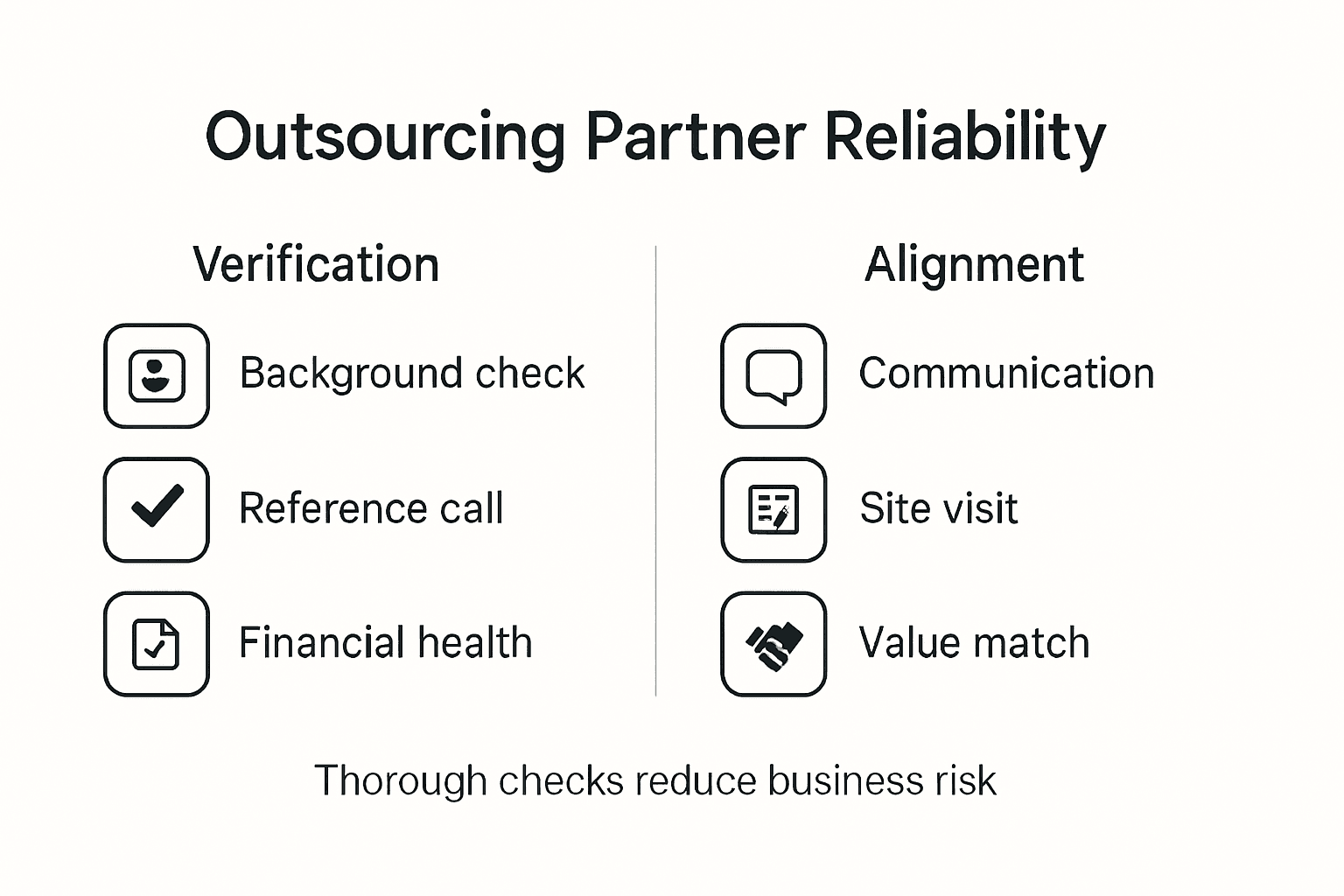
Conduct thorough background checks that extend beyond surface level information. This might involve speaking with previous clients, reviewing independent industry reports, and potentially engaging professional due diligence services to validate the partner’s claims and reputation. Create a structured evaluation matrix that objectively scores potential partners across reliability indicators such as financial health, legal compliance, project delivery consistency, and long term strategic alignment.
Professional Tip: Arrange site visits or virtual facility tours to gain direct insights into the potential partner’s operational environment, workplace culture, and actual working conditions.
Step 5: Finalize agreements and initiate onboarding
With a carefully selected outsourcing partner identified, you are now ready to transform your strategic partnership from potential to operational reality. This critical phase involves crafting comprehensive legal agreements and implementing a structured onboarding process that sets the foundation for successful collaboration.
Partner onboarding represents a structured process that aligns new partners on company goals, expectations, and operational protocols. Begin by developing a detailed service level agreement (SLA) that comprehensively outlines project scope, performance metrics, communication protocols, confidentiality requirements, intellectual property provisions, and dispute resolution mechanisms. Ensure the agreement provides clarity on key deliverables, timelines, quality standards, and financial terms.
Proceed with a systematic onboarding strategy that integrates your new partner seamlessly into your operational ecosystem. Create detailed documentation packages that include company guidelines, project specifications, access credentials, and communication workflows. Schedule comprehensive orientation sessions that introduce your organizational culture, strategic objectives, and specific project expectations. Establish clear communication channels, project management tools, and reporting mechanisms that facilitate transparency and real time collaboration.
Implement a phased onboarding approach that allows gradual integration and performance validation. Begin with initial training sessions, followed by limited scope pilot projects that enable both parties to validate compatibility and refine collaboration processes. Develop a structured feedback mechanism that allows continuous performance assessment and iterative improvements throughout the partnership.
Professional Tip: Designate a dedicated onboarding coordinator who can provide consistent support and facilitate smooth communication during the initial partnership integration phase.
Choose Your Ideal Outsourcing Partner with Confidence
Selecting the right outsourcing partner is a complex journey that demands clear objectives, thorough evaluation, and cultural alignment. If you are facing challenges like defining SMART requirements, shortlisting qualified partners, or ensuring reliability, you are not alone. StorsenDigital understands the stakes and provides tailored solutions that address these essential pain points, empowering your business to scale successfully across Europe.
Our expertise in nearshoring, talent recruitment, and managed Business Process Outsourcing combines deep industry insight with a proven track record of client success. We help you navigate each critical step—from setting measurable goals to onboarding your selected partner efficiently. Partner with us to minimize risks and maximize strategic value.
Unlock the potential of expert outsourcing today.

Ready to find the outsourcing partner perfectly aligned with your business needs Use our consulting to streamline your selection process and accelerate growth. Contact us now at Storsen Digital Contact Page and take the first step toward operational excellence. Explore how our nearshoring services and managed BPO solutions deliver measurable results tailored to your goals.
Frequently Asked Questions
What criteria should I consider when defining business requirements for an outsourcing partner?
Clearly outline specific needs such as functional requirements, technical specifications, budget constraints, and desired outcomes. Start by conducting an internal assessment of operational challenges and growth targets to inform these needs.
How can I effectively shortlist qualified outsourcing partners for my business?
Begin by creating an assessment matrix to evaluate potential partners across multiple dimensions, including industry expertise and communication skills. Aim to narrow your list to 5 to 7 candidates who align best with your objectives for more focused evaluations.
What should I include in a request for information (RFI) to potential outsourcing partners?
An RFI should gather detailed insights on each partner’s capabilities, approach, and fit with your organization. Ensure you ask about their industry experience, technical skills, and proven success in similar projects to make informed comparisons.
How do I assess the reliability of potential outsourcing partners?
Develop a reliability assessment framework that evaluates their financial health, legal compliance, and workforce retention rates. Look into client references and conduct background checks to validate their operational reliability before proceeding.
What steps should I take during the onboarding process of a new outsourcing partner?
Craft a detailed service level agreement (SLA) that outlines project scope and performance metrics. Implement a phased onboarding strategy with initial training and pilot projects to validate compatibility and refine collaboration processes.
How can I ensure cultural alignment with an outsourcing partner?
Schedule multiple interaction sessions to understand potential partners’ communication styles and organizational values. Look for shared professional values and a compatible mindset, as this fosters better collaboration and long-term success.


