


For executives steering growth across European markets, building effective remote teams has become a top priority. Misaligned objectives, inconsistent workflows, and infrastructure gaps create costly setbacks, especially when scaling across multiple countries. Defining clear goals and understanding unique remote team needs is the foundation for future success, as confirmed by recent research. This guide reveals actionable steps to design remote teams that deliver operational efficiency and improved cost-effectiveness for European tech organizations.
Table of Contents
- Step 1: Define Organizational Goals And Remote Team Needs
- Step 2: Select Optimal Remote Infrastructure And Digital Tools
- Step 3: Recruit And Onboard Qualified European Talent
- Step 4: Implement Robust Communication And Workflow Protocols
- Step 5: Monitor Performance And Optimize Remote Processes
Quick Summary
| Key Insight | Explanation |
|---|---|
| 1. Define clear organizational goals | Establish specific objectives to align team efforts with business success and prevent miscommunication. |
| 2. Assess remote team infrastructure needs | Ensure your team has reliable technology and tools for seamless communication and effective work. |
| 3. Recruit talent with regional focus | Target specific European countries to find skilled professionals that meet your operational needs. |
| 4. Implement effective communication protocols | Establish clear guidelines for communication channels and workflows to enhance collaboration and reduce confusion. |
| 5. Monitor performance and gather feedback | Regularly measure key performance metrics and solicit team input to optimize remote work processes. |
Step 1: Define organizational goals and remote team needs
Before you hire a single remote team member, you need absolute clarity on what success looks like for your organization. This step sets the foundation for every decision that follows. When you skip this part or gloss over it, you end up with misaligned teams, wasted resources, and frustrated employees working toward different outcomes. So let’s get specific about what your business actually needs.
Start by identifying your core organizational objectives. What are you trying to achieve in the next 12 to 24 months? Are you scaling customer support across European markets? Building a dedicated software development team? Expanding your finance operations to reduce overhead? Your answer shapes everything else. Then break those objectives down into measurable outcomes. Instead of “improve customer service,” you need “reduce response time from 48 hours to 8 hours” or “increase first-contact resolution rate to 85 percent.” Research shows that clear organizational goals and understanding unique remote team needs serve as the foundation for successful remote work implementation. This clarity becomes your north star when evaluating candidates and structuring workflows.
Next, define exactly what your remote team needs to deliver those outcomes. Map out the specific functions, skill sets, and experience levels required. Do you need senior developers who can architect solutions independently, or mid-level engineers who can execute within defined specifications? Are you looking for native English speakers for client-facing roles, or technical experts whose communication skills can be developed? Consider the volume of work too. One person’s 40-hour week delivering 200 customer support tickets looks different from three people splitting that load. According to best practices for managing remote teams, aligning team roles and workflows with defined organizational objectives ensures effective collaboration across remote work dynamics. Document your requirements honestly, including timezone preferences, reporting structures, and collaboration tools your team will use daily. This prevents the common mistake of hiring talent that technically fits but doesn’t work within your actual operational reality.
Once you have this clarity, connect your organizational goals to remote team capabilities. A customer experience team can only deliver 30-second response times if they have the right tools, training, and staffing. A development team can only ship features on schedule if requirements are clear and technical architecture is sound. At StorsenDigital, we specialize in building dedicated teams aligned with exactly these kinds of strategic objectives. Our approach starts with understanding your specific goals and the operational requirements that make them achievable. We focus on matching your business needs with European talent who can deliver consistent, high-quality results while optimizing your total cost of operations. When you’re ready to move from planning to execution, we can help you build remote teams that actually work.
Here’s a summary of key remote team needs mapped to business objectives:
| Business Objective | Essential Skills Needed | Ideal Team Structure |
|---|---|---|
| Expand customer support | Multilingual communication, conflict resolution | 2-3 support reps per region |
| Accelerate software delivery | Senior development, Agile experience | 1 architect, 2-4 engineers |
| Cut finance overhead | Financial analysis, automation tools | 1 lead, 1-2 accountants |
Pro tip: Write down your three primary business goals for the next year, then list the specific team capabilities and headcount needed to achieve each one. This becomes your hiring specification and helps you avoid the trap of building a team based on what sounds good instead of what actually drives your business forward.
Step 2: Select optimal remote infrastructure and digital tools
You’ve defined what your remote team needs to accomplish. Now comes the practical reality: equipping them with the right infrastructure and tools so they can actually do their jobs. Think of this as building the nervous system of your remote operation. Without solid connectivity, reliable devices, and integrated software, even the best talent will spend half their day fighting technical problems instead of creating value.
Start with infrastructure fundamentals. Your remote team members need fast, dependable internet connectivity, ideally with backup options for when their primary connection fails. A developer waiting 30 seconds for a code repository to load loses focus. A customer service representative dealing with dropped calls frustrates clients. Research emphasizes the critical importance of robust connectivity and digital devices to support effective remote collaboration. Beyond connectivity, assess what hardware your team members need. Are they using company-issued laptops with specific technical specifications, or can they work on their personal devices? If you’re building a development team, you’ll likely need to provide hardware. For customer support roles, the requirements differ. Make sure monitors, keyboards, and peripherals are included in your planning. Quality equipment doesn’t just improve productivity; it signals to your team that you’re invested in their work environment.

Next, evaluate your software stack carefully. Communication tools like Slack or Microsoft Teams form your daily backbone. Project management platforms such as Asana or Monday.com help coordinate work across time zones. You’ll need document collaboration (Google Workspace, Microsoft 365), time tracking, and potentially industry-specific software depending on your team’s function. The mistake most companies make is adopting too many tools. Every tool you add creates friction, confusion, and training overhead. Select a core set that integrates smoothly together. A developer using 12 different applications daily burns mental energy switching between them. Choose tools that talk to each other, reduce manual data entry, and support your actual workflows. Test your stack before hiring to ensure it works across different internet speeds and regions. Your Bosnia and Herzegovina team members shouldn’t struggle with tools designed for Silicon Valley office environments.
Consider data security and compliance alongside functionality. Remote teams handling customer data or financial information need encrypted connections, secure file storage, and proper access controls. Your infrastructure choices affect your ability to meet regulations like GDPR. At StorsenDigital, we help international clients establish remote infrastructure that balances functionality with security and compliance. We understand the specific technical requirements for building teams across European locations, and we ensure your digital ecosystem supports seamless operations while optimizing costs. We’ve guided numerous companies through this exact process, matching them with talent while their infrastructure is ready to go.
This table compares major categories of remote work tools and what they enable for teams:
| Tool Type | Main Example | Key Benefit |
|---|---|---|
| Communication | Slack or Teams | Fast, organized messaging |
| Project Management | Asana or Jira | Task tracking, clarity |
| Collaboration Suite | Google Workspace | Real-time document sharing |
| Security Platform | Okta, VPN | Protects data access |
Pro tip: Run a two-week pilot with your core tools using 2-3 team members from your target region before full rollout. This reveals integration problems, connectivity issues, and user experience friction that spreadsheets never catch, and it costs far less than fixing infrastructure problems after you’ve hired 15 people.
Step 3: Recruit and onboard qualified European talent
Now that your organizational goals are defined and your infrastructure is ready, you need to find the right people. Recruiting European talent requires a different approach than hiring locally. You’re working across multiple countries, visa requirements, employment laws, and cultural contexts. But here’s the advantage: European talent pools are deep, skilled, and increasingly open to remote work arrangements. The key is knowing where to look and how to onboard effectively so your new team members hit the ground running.
Start your recruitment by identifying which European countries align with your needs. Are you targeting Eastern European developers known for technical expertise and cost-effectiveness? Looking for Scandinavian customer experience professionals with strong English proficiency? Searching for German finance specialists? Bosnia and Herzegovina offers exceptional value with highly capable professionals who speak excellent English and understand global business practices. The region has become a hub for nearshoring precisely because talent quality is strong while total employment costs are significantly lower than Western Europe. When you post positions, be explicit about remote work arrangements, salary ranges, and visa support if you can offer it. European talent increasingly expects transparency on these fronts. Create job descriptions that speak to your actual needs, not generic corporate language. A developer wants to know what technology stack they’ll use, what problems they’ll solve, and how their work matters. A customer service professional wants to understand call volumes, client types, and what success looks like.
Onboarding requires intentional effort to succeed. Research on successful EU talent integration frameworks757786_EN.pdf) highlights that streamlined processes and effective cultural integration are critical for remote team success. Before your new hire’s first day, send welcome materials, explain your company culture and values, and introduce them to their team members. Set up clear communication channels so they know who to contact with questions. Plan their first week carefully, with dedicated onboarding sessions rather than expecting them to figure everything out independently. Remote team members can’t lean over to a coworker’s desk for help, so you need structured guidance. Address practical concerns like timezone differences, holiday calendars, and how you handle asynchronous communication. Many European professionals have different expectations around work hours and vacation time than American companies, so clarifying these norms prevents frustration later. At StorsenDigital, we specialize in connecting international clients with qualified European professionals and guiding them through the entire onboarding journey. We understand the cultural nuances, administrative requirements, and operational details that make recruitment and integration successful. We’ve built dedicated teams for companies across industries, and we know what transforms a hired candidate into a productive, engaged team member.
Pro tip: Assign each new remote hire a buddy from your existing team for their first 30 days, someone who’s available to answer questions and provide informal guidance outside formal onboarding sessions. This single step dramatically improves retention and reduces the isolation that new remote employees often feel.
Step 4: Implement robust communication and workflow protocols
You have your team in place. They have the tools. Now you need the operating system that holds everything together. Communication and workflow protocols are what separate high-performing remote teams from chaotic ones where people work in silos, duplicate efforts, or miss critical information. Without clear protocols, your distributed team will struggle with misunderstandings, missed deadlines, and frustration born from uncertainty about how things actually get done.
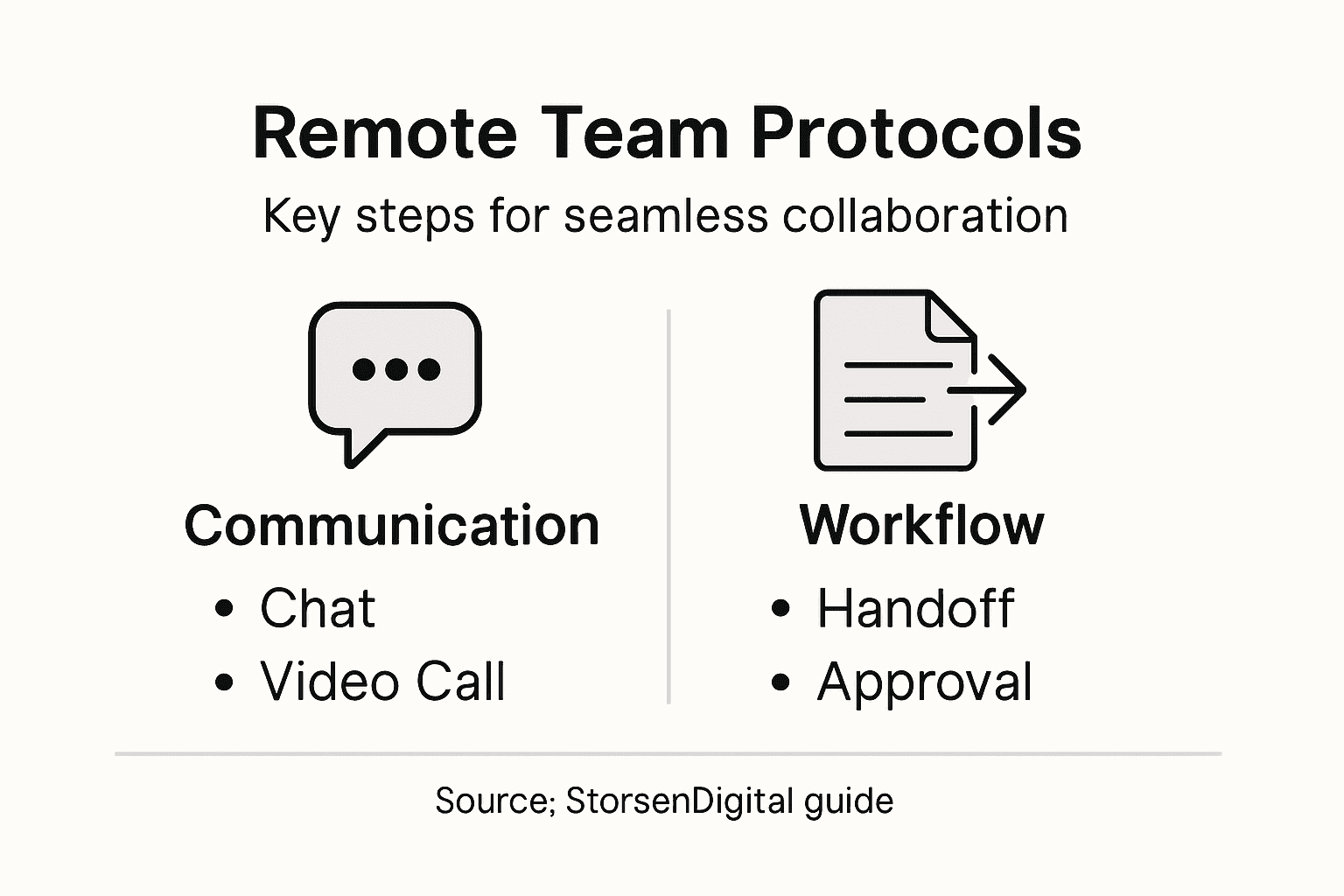
Start by defining your communication framework. Not every conversation deserves the same channel. Quick questions should land in Slack, not email that demands formal responses. Complex technical discussions benefit from video calls where you can share screens and work through problems together. Asynchronous documentation like project summaries belongs in shared documents or wikis where people across time zones can absorb information on their schedule. Establish norms around response times too. Your team shouldn’t expect instant answers to every message, but they should know whether to expect a reply in 30 minutes, 3 hours, or by next business day. This clarity prevents anxiety and allows people to manage their focus. Research on effective virtual team communication strategies emphasizes that clear frameworks address communication obstacles and maintain accountability across dispersed teams. Build protocols around meetings too. Remote meetings can become black holes where people sit silently or multitask invisibly. Set agendas in advance so people can prepare. Clarify who needs to attend and who can catch up on notes. Keep meetings focused on decisions and discussions that actually require synchronous conversation, not status updates that could be email.
Workflow protocols govern how work actually gets completed. Document your approval processes, handoff procedures, and escalation paths. When does a developer consider code ready for review? Who approves customer-facing communications before they go live? What happens if someone discovers a critical issue at 3 AM in a timezone where nobody is awake? Create templates for recurring tasks so people aren’t reinventing processes each time. A support team handling customer escalations needs a clear workflow for triage, investigation, and resolution communication. A development team needs defined standards for code review, testing requirements, and deployment procedures. Clear communication protocols tailored to different team roles prevent miscommunication and reduce unnecessary overhead. Document these protocols in a central location your team can access asynchronously. A new hire should be able to read how things work without having to ask someone in a different timezone. At StorsenDigital, we’ve helped dozens of international clients establish communication and workflow systems that actually work across distributed teams. We understand how to balance structure with flexibility, how to accommodate timezone differences, and how to keep European teams engaged and productive while maintaining clear accountability and quality standards.
Pro tip: Run a monthly retrospective where your team discusses what communication and workflow practices are working and what’s creating friction. Build in a specific process for updating protocols based on feedback. Remote teams often need different systems than you initially predicted, and giving people permission to improve the system prevents resentment from building around ineffective processes.
Step 5: Monitor performance and optimize remote processes
Your remote team is operating. Work is getting done. But you can’t assume everything is running smoothly just because deadlines are met. Remote environments hide problems that are obvious in physical offices. Someone might be struggling for weeks before anyone notices. Performance monitoring and process optimization keep your operation healthy and catch issues before they become crises. This step separates companies that merely maintain remote teams from those that continuously improve them.
Start with clarity on what you’re measuring. Performance metrics should reflect your organizational goals defined in step one. For a customer support team, measure response time, resolution rate, and customer satisfaction scores. For developers, track code quality, deployment frequency, and bug rates. For finance teams, monitor accuracy, processing time, and compliance adherence. Avoid vanity metrics like hours logged or messages sent. Remote work requires trust, and your team needs to know you’re evaluating actual output, not surveillance. Research demonstrates that continuous communication and clear deliverable expectations are essential for effective remote performance management. Set these metrics collaboratively when possible. When your developers help define code quality standards, they own those standards. When your support team helps determine reasonable response times, they commit to meeting them. Regular check-ins matter more in remote environments. Monthly one-on-ones give you visibility into challenges and wins. Does someone need training? Are they overloaded? Struggling with timezone coordination? You’ll only know if you ask. Create psychological safety so people feel comfortable raising problems. A developer who hides that they’re stuck for a week becomes a bottleneck. One who admits it after two days gets support and moves forward.
Optimization happens through structured reflection. Enhanced communication and synchronous collaboration techniques reduce information loss and improve team efficiency in remote settings. Review your processes quarterly. Are meetings still valuable, or do you have meeting bloat? Is your documentation system working, or do people constantly ask the same questions? Are there recurring bottlenecks in your workflows? Collect feedback systematically instead of relying on anecdotes. Survey your team, hold retrospectives, and look for patterns in your data. Maybe response times are slipping because your support team doesn’t have access to needed customer information. Maybe developers spend half their time in code review meetings instead of coding. These are solvable problems if you identify them. At StorsenDigital, we partner with clients to establish performance frameworks that work for remote teams and help them continuously optimize operations. We’ve seen what metrics matter, what questions reveal real problems, and how to balance accountability with autonomy in distributed teams. We bring experience from managing hundreds of remote professionals across European operations, and we can help you build systems that drive both performance and engagement.
Pro tip: Create a simple monthly dashboard showing your three to five key performance metrics for each team. Share it with everyone so there are no surprises during reviews, and update it weekly so you spot problems early. Transparency around metrics builds trust and allows your team to self-correct before performance becomes a serious issue.
Build Your European Remote Team With Confidence and Expert Support
Establishing seamless global operations through remote teams requires clarity in goals, the right infrastructure, and skilled talent aligned with your business needs. If you are facing challenges like managing cross-country recruitment, setting up robust workflows, or ensuring smooth onboarding for your European remote workforce, you are not alone. Many companies struggle to integrate communication protocols and monitor performance effectively across time zones. This article highlights the crucial steps to success and shows why a strategic partner matters.

Unlock the full potential of your remote team with StorsenDigital. We specialize in tailored outsourcing and nearshoring solutions designed for businesses aiming to optimize costs while accessing top-tier European talent. Whether you need help recruiting qualified professionals in Bosnia and Herzegovina or want to establish secure, scalable digital infrastructure, our expert team guides you at every stage. Benefit from proven communication frameworks, compliant operations, and continuous performance monitoring that keep your remote teams productive and engaged.
Ready to transform your global operations with dedicated European expertise? Connect with us today at StorsenDigital contact page and take the first step toward building a remote team that truly delivers.
Frequently Asked Questions
What steps should I follow to define goals for my remote team?
Start by clearly outlining your organization’s objectives for the next 12 to 24 months. Break these objectives into measurable outcomes so you can align your remote team’s capabilities with your overall goals.
How can I choose the right digital tools for my remote team?
Evaluate your team’s needs and select a core set of communication, project management, and collaboration tools that integrate well. Aim for a streamlined software stack that reduces confusion and enhances productivity, testing it within 2-3 team members before full rollout.
What key skills should I look for when recruiting European talent?
Identify the specific functions and skill sets you need that align with your organizational goals. When recruiting, be explicit about remote arrangements and tailor your job descriptions to attract qualified candidates who meet these specific requirements.
How can I effectively onboard new remote employees?
Create a structured onboarding process that includes sending welcome materials and scheduling introductory sessions. Ensure new hires understand your company’s culture, values, and communication channels, allowing them to integrate smoothly into the existing team.
What communication protocols should I implement for remote teams?
Define how different types of communication should occur, such as using instant messaging for quick questions and video calls for complex discussions. Establish clear expectations around response times to facilitate effective collaboration across various time zones.
How do I monitor performance in a remote environment?
Focus on measuring outcomes that align with your organizational goals, such as response times and project completion rates. Conduct monthly check-ins to identify challenges and create a culture of psychological safety, allowing team members to discuss any issues candidly.


