


Choosing the right outsourcing vendor in 2026 demands more than comparing costs. European enterprises face evolving regulatory requirements, geopolitical uncertainties, and the need for AI readiness. This guide provides a structured evaluation framework tailored for medium to large businesses seeking scalable, compliant, and efficient outsourcing partnerships. You’ll gain actionable criteria, avoid common pitfalls, and learn measurable success metrics to drive operational excellence.
Table of Contents
- Prerequisites And Understanding Business Needs
- Step-By-Step Vendor Evaluation Process
- Core Evaluation Criteria: Technology, Operational Capability, And Compliance
- Evaluation Metrics: Reputation, Track Record, And Performance
- Common Mistakes And Troubleshooting Tips
- Alternative Outsourcing Approaches And Tradeoffs
- Expected Results And Success Metrics For Vendor Evaluation
- How StorsenDigital Supports Your Outsourcing Success
- How To Evaluate Outsourcing Vendors: FAQ
Key takeaways
| Point | Details |
|---|---|
| Internal preparation is essential | Define business goals, compliance requirements, and stakeholder roles before contacting vendors. |
| Follow a structured evaluation process | Use a step-by-step framework covering screening, assessment, risk analysis, and selection within 3-6 months. |
| Prioritize core criteria | Assess AI maturity, operational capability, European regulatory compliance, and vendor transparency. |
| Avoid common mistakes | Don’t overemphasize cost, neglect tier-two vendors, or tolerate poor communication channels. |
| Measure success continuously | Track onboarding timelines, procurement efficiency gains, and ongoing compliance performance. |
Prerequisites and understanding business needs
Before you contact a single vendor, clarify what you need internally. 53% of organizations increase outsourcing primarily for scalability, making vendor capacity evaluation critical. Start by defining your project scope precisely. Are you outsourcing customer support, software development, or back-office finance functions? Each requires different technical capabilities and regulatory knowledge.
Next, map your compliance landscape. European enterprises must navigate GDPR, sustainability mandates, and sector-specific regulations. Document your risk tolerance levels for data security, operational disruptions, and geopolitical factors. This clarity prevents mismatched vendor partnerships that derail projects later.
Align your internal stakeholders early. Procurement, compliance, IT, and business unit leaders must agree on priorities and success metrics. Establish which communication tools you’ll use for vendor collaboration and how you’ll collect performance data. This groundwork creates a solid foundation for effective outsourcing risk management throughout the engagement.
Pro Tip: Create a one-page requirements summary that includes your top three business objectives, mandatory compliance standards, and deal-breaker limitations. Share this with every potential vendor to filter mismatches quickly.
Key preparation steps include:
- Defining precise project scope and deliverables
- Identifying mandatory European regulatory requirements
- Establishing risk tolerance for security and operational continuity
- Aligning procurement, compliance, and business unit stakeholders
- Selecting collaboration tools and performance tracking methods
Step-by-step vendor evaluation process
A systematic approach prevents costly mistakes and accelerates decision-making. Plan for 3 to 6 months from initial screening through contract signing and onboarding. This timeline allows thorough due diligence without analysis paralysis.
Follow this sequence:
- Define requirements: Document technical needs, compliance mandates, budget constraints, and timeline expectations based on your prerequisites work.
- Screen candidates: Identify 10 to 15 vendors through industry networks, marketplace platforms, and referrals. Review their service portfolios and geographic presence.
- Assess capabilities: Request proposals from 5 to 7 finalists. Evaluate their AI maturity, process documentation, and relevant industry experience.
- Analyze reputation: Check verified transaction histories, client references, and recent performance reviews rather than generic star ratings.
- Conduct site visits: Tour delivery centers virtually or in person. Observe team interactions, technology infrastructure, and quality control processes.
- Evaluate risks: Assess geopolitical exposure, financial stability, cybersecurity protocols, and business continuity plans.
- Select and negotiate: Choose 2 to 3 top vendors for final negotiations. Clarify SLAs, pricing models, exit terms, and governance structures before signing.
AI readiness matters significantly in 2026. Evaluate whether vendors implement human-in-the-loop frameworks that maintain judgment and escalation capabilities. Purely automated systems create quality and accountability gaps. Ask how vendors balance AI efficiency with human oversight for complex issues.
Consider delivery center diversification to manage geopolitical risks. Vendors operating across multiple European locations provide business continuity if regional disruptions occur. This geographic distribution also supports compliance with data residency requirements in different EU member states.
Pro Tip: Request a pilot project lasting 4 to 8 weeks before full commitment. This trial reveals operational reality beyond polished sales presentations and helps you validate talent outsourcing processes under real conditions.
For comprehensive planning, explore our European outsourcing guide and review this smart outsourcing checklist for additional evaluation steps.
Core evaluation criteria: technology, operational capability, and compliance
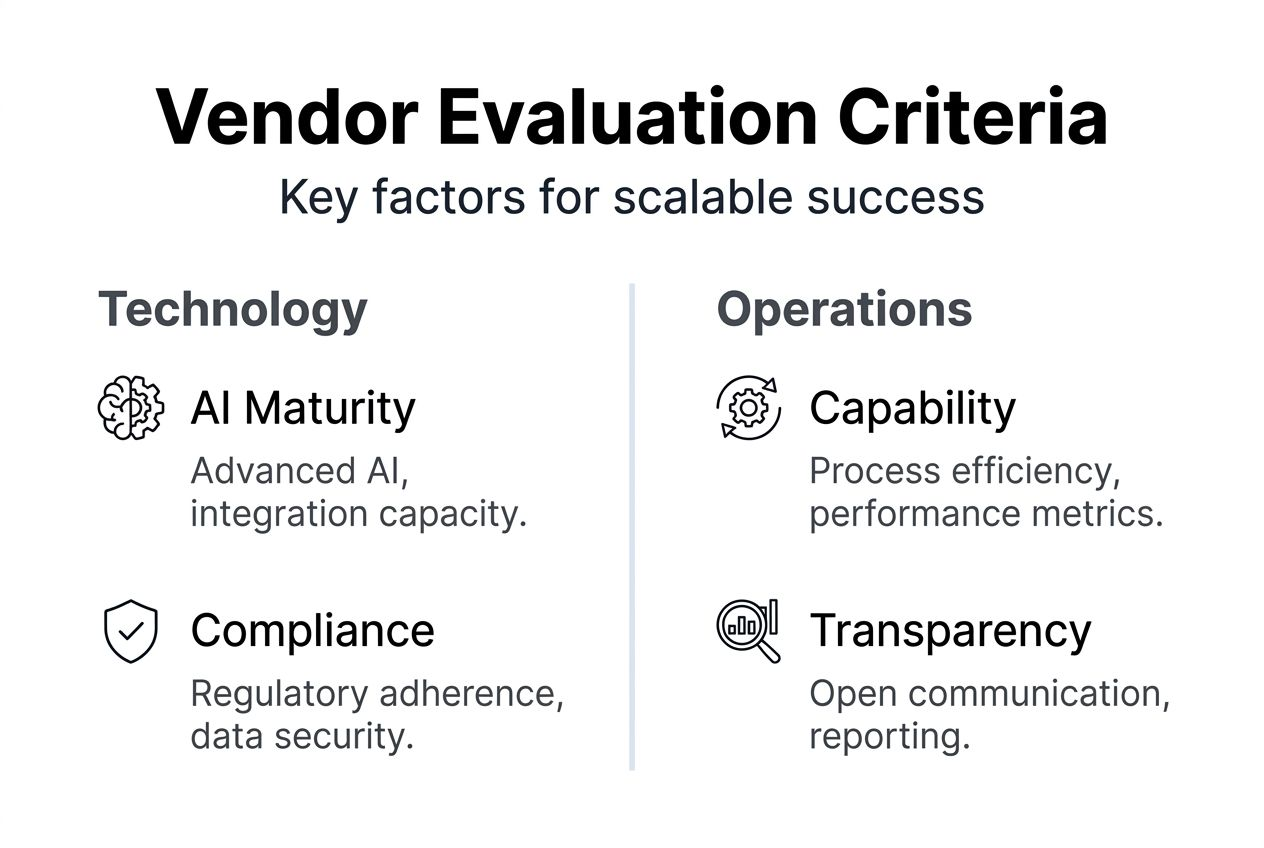
Focus your assessment on four critical dimensions that predict long-term partnership success.
AI maturity and integration: Vendors must demonstrate sophisticated AI capabilities with proper human oversight. Human-in-the-loop AI frameworks are required to maintain judgment and escalation when automated systems encounter edge cases or sensitive situations. Ask vendors to explain their AI quality control processes, error rates, and how they train both algorithms and human supervisors. Vendors lacking AI maturity will struggle to scale efficiently or adapt to your evolving needs.

Operational capability: Examine process maturity through ISO certifications, documented workflows, and digital tool adoption. Request examples of how vendors handle capacity surges, staff turnover, and knowledge transfer. Diversified delivery locations across Europe reduce single-point-of-failure risks while supporting compliance with local labor and data laws. Evaluate their disaster recovery and business continuity plans in detail.
European regulatory compliance: Your vendor must meet GDPR requirements, industry-specific regulations, and emerging sustainability mandates. Request evidence of regular compliance audits, data protection certifications, and staff training programs. Ask how they handle cross-border data transfers and what contractual protections they offer if regulatory requirements change. Non-compliant vendors expose you to fines, reputational damage, and operational shutdowns.
Transparency and reporting: Effective vendors provide real-time dashboards, regular performance reports, and proactive issue escalation. They should offer granular visibility into service metrics, quality indicators, and resource utilization. This transparency enables you to manage performance actively rather than discovering problems during quarterly reviews. Digital monitoring tools support continuous business process outsourcing improvement throughout the partnership.
Pro Tip: Create a scoring matrix that weights these criteria according to your business priorities. Assign numerical scores during vendor presentations to enable objective comparisons later.
Key evaluation factors:
- AI capabilities with human quality controls and escalation protocols
- ISO certifications and documented process maturity
- Multiple European delivery centers for geographic risk distribution
- GDPR compliance certifications and audit trail documentation
- Real-time performance dashboards and proactive reporting systems
- Financial stability and business continuity planning
| Criterion | What to Assess | Red Flags |
|---|---|---|
| AI Maturity | Human-in-the-loop integration, error handling, quality controls | Fully automated systems without human oversight or escalation paths |
| Compliance | GDPR certifications, industry-specific standards, sustainability practices | Inability to provide recent audit reports or compliance documentation |
| Transparency | Real-time dashboards, regular reporting, proactive communication | Delayed or incomplete performance reports, lack of digital monitoring tools |
| Operational Capability | Process documentation, ISO certifications, geographic diversification | Single-location operations, high staff turnover, lack of business continuity plans |
Evaluation metrics: reputation, track record, and performance
Reputation assessment requires looking beyond surface-level ratings. Over 68% of industrial buyers use verified online ratings focusing on transaction history and review authenticity rather than simple star scores. Transaction history reveals how vendors handle projects similar to yours in scope, industry, and complexity.
Prioritize recent reviews over older feedback. A vendor’s performance three years ago may not reflect current capabilities, especially given rapid AI adoption and changing regulatory landscapes. Look for patterns in client feedback regarding communication responsiveness, problem resolution speed, and flexibility during scope changes.
Request detailed case studies with measurable outcomes. Generic success stories lack credibility compared to specific metrics like “reduced customer service response times by 40%” or “achieved 99.7% GDPR compliance across 200,000 monthly transactions.” Contact references directly and ask about challenges encountered, not just successes. How vendors handle difficulties matters more than perfect execution under ideal conditions.
Verify certifications and awards through issuing organizations. Some vendors display outdated credentials or certifications from non-recognized bodies. Cross-check ISO certifications, industry association memberships, and compliance attestations independently.
Once selected, implement continuous digital monitoring. Your outsourcing process guide should include regular performance reviews, quality audits, and stakeholder feedback sessions. This ongoing vigilance ensures vendor performance remains aligned with your evolving business needs.
Reputation evaluation tactics:
- Review verified transaction histories for projects matching your scope and industry
- Prioritize recent client feedback over older reviews to assess current capabilities
- Request case studies with specific, measurable outcomes and contact references directly
- Verify certifications independently through issuing organizations
- Implement continuous monitoring systems post-selection for ongoing performance management
Common mistakes and troubleshooting tips
Even experienced enterprises make predictable evaluation errors that undermine outsourcing success.
Ignoring tier-two vendors: Lack of engagement with tier-two vendors occurs in over 50% of firms, increasing risk across the supply chain. Your primary vendor may subcontract portions of work to smaller suppliers. If you don’t evaluate these tier-two relationships, you create blind spots in compliance, quality control, and business continuity. Require transparency about subcontracting and assess the capabilities of any tier-two vendors involved in your project.
Overemphasizing cost: Choosing the lowest bidder often produces the highest total cost of ownership. Cheap vendors typically cut corners on compliance, quality assurance, or staff expertise. These shortcuts generate rework, regulatory penalties, and reputational damage that dwarf initial savings. Evaluate total value including quality, risk mitigation, and scalability rather than price alone.
Poor communication management: Poor communication causes 45% of outsourcing failures through misaligned expectations, delayed issue resolution, and cultural misunderstandings. Establish explicit communication protocols during contract negotiations. Define response time expectations, escalation procedures, meeting cadences, and documentation standards. Test these protocols during pilot projects before full deployment.
Inadequate governance structures: Without formal vendor management systems, approval processes slow down and transparency suffers. Implement digital platforms that track vendor performance, automate routine approvals, and flag compliance deviations. These systems accelerate procurement cycles while maintaining oversight rigor. Strong outsourcing risk management requires both technology and clear governance policies.
Pro Tip: Schedule monthly governance reviews during the first six months of any new vendor relationship. These frequent touchpoints catch issues early when corrective action is easier and less expensive.
Mistakes to avoid:
- Neglecting to evaluate tier-two vendors and subcontractors
- Selecting vendors primarily based on lowest price without assessing total value
- Failing to establish explicit communication protocols and escalation procedures
- Operating without vendor management systems that provide transparency and oversight
- Skipping pilot projects that reveal operational reality before full commitment
Alternative outsourcing approaches and tradeoffs
Traditional offshore outsourcing isn’t the only option. Consider these alternatives based on your specific operational needs and risk tolerance.
Hybrid outsourcing models: Hybrid outsourcing combines local management with offshore talent pools for 24/7 coverage but requires active governance to mitigate communication risks. You maintain strategic oversight and client-facing roles locally while leveraging cost-effective offshore resources for execution. This approach balances cost savings with quality control and cultural alignment. The tradeoff is increased management complexity since you coordinate across geographic and organizational boundaries.
Nearshoring strategies: Nearshoring places outsourced operations in nearby countries with closer cultural affinity, minimal time zone differences, and similar regulatory frameworks. For European enterprises, Eastern European nearshoring offers significant advantages over Asian offshore locations. You reduce geopolitical risks, simplify travel for oversight visits, and benefit from better language skills and cultural understanding. The cost savings are smaller than offshore alternatives but operational risks decrease substantially.
Both models demand stronger governance than traditional offshore outsourcing. You need clear communication channels, well-defined escalation procedures, and regular performance reviews. Technology investments in collaboration platforms, project management tools, and security infrastructure also increase.
Pro Tip: Start with nearshoring for business-critical functions requiring tight integration, then consider hybrid models for more standardized processes once you’ve built vendor management capabilities.
For detailed implementation guidance, review our nearshoring workflow guide and nearshoring versus offshoring comparison.
| Approach | Primary Benefits | Key Challenges | Best For |
|---|---|---|---|
| Traditional Offshore | Maximum cost savings, large talent pools, 24/7 operations | Time zone gaps, cultural differences, higher communication overhead | Standardized processes with clear documentation |
| Hybrid Model | Balanced cost and quality, local strategic oversight, extended coverage | Management complexity, coordination overhead, governance requirements | Functions requiring both cost efficiency and quality control |
| Nearshoring | Minimal time zone issues, cultural alignment, reduced geopolitical risk | Smaller cost savings, more limited talent pools | Business-critical functions requiring tight integration |
Expected results and success metrics for vendor evaluation
Effective vendor evaluation produces measurable improvements across multiple dimensions. Set clear expectations and track performance rigorously.
Timeline efficiency: Vendor onboarding and evaluation should complete within 3 to 6 months from initial screening through contract execution. Longer timelines indicate analysis paralysis or inadequate internal preparation. Procurement cycle times can be reduced by up to 40% using digital vendor management tools, enabling faster approval and cost control. Track days from RFP issuance to contract signature as a key process metric.
Compliance achievement: Your selected vendor must maintain continuous compliance with GDPR, industry regulations, and sustainability mandates. Request quarterly compliance attestations and annual third-party audits. Non-compliance creates legal exposure and operational disruptions that undermine all other benefits. Build compliance requirements into SLAs with financial penalties for violations.
Operational performance: Successful outsourcing delivers scalability, cost savings, and efficiency gains. Define specific metrics before engagement begins. These might include customer satisfaction scores, transaction processing times, error rates, or cost per unit of output. Compare actual results against baseline internal performance and vendor commitments. Business process outsourcing improvement should be measurable within the first six months.
Financial returns: Calculate total cost of ownership including vendor fees, internal management overhead, technology investments, and transition costs. Compare this to your previous operating model or projected internal costs. Most enterprises target 20% to 40% cost reductions while maintaining or improving quality levels. Track realized savings monthly and adjust engagement scope if returns fall short.
Long-term reliability: Vendor relationships should strengthen over time as they gain institutional knowledge about your business. Monitor staff turnover rates, knowledge transfer effectiveness, and proactive improvement suggestions. Reliable vendors anticipate your needs and propose optimizations rather than passively executing instructions.
Success indicators:
- Complete evaluation and onboarding within 3 to 6 months
- Achieve up to 40% faster procurement cycles through digital automation
- Maintain continuous compliance with all European regulatory requirements
- Deliver measurable operational improvements within first six months
- Generate 20% to 40% cost reductions while maintaining quality standards
- Build strengthening partnerships characterized by proactive vendor engagement
How StorsenDigital supports your outsourcing success
Navigating vendor evaluation complexity requires expertise and proven frameworks. StorsenDigital specializes in helping European enterprises optimize their outsourcing processes through structured evaluation methodologies and ongoing partnership management.
Our nearshoring workflow solutions reduce implementation timelines while ensuring regulatory compliance and operational excellence. We provide tailored guidance on vendor selection criteria, contract negotiation, and performance monitoring systems that accelerate your path to scalable success. Whether you’re launching your first outsourcing engagement or optimizing existing relationships, our team delivers the strategic insights and practical tools you need.

Contact us today to transform your vendor evaluation approach and unlock the full potential of strategic outsourcing partnerships.
How to evaluate outsourcing vendors: FAQ
What are the most critical criteria when evaluating outsourcing vendors in 2026?
Prioritize AI maturity with human-in-the-loop oversight, European regulatory compliance including GDPR, operational capability with geographic diversification, and transparent reporting systems. Vendors must demonstrate these through certifications, case studies, and real-time performance dashboards. ISO certifications and verified transaction histories provide additional credibility for scalable partnerships.
How can enterprises reduce risks related to outsourcing vendor selection?
Engage tier-two vendors and subcontractors during due diligence to eliminate supply chain blind spots. Assess geopolitical risks through delivery center diversification and business continuity planning. Establish explicit communication protocols including response time expectations and escalation procedures. Implement vendor management systems that provide real-time oversight and automate routine approvals for faster issue resolution.
What measurable outcomes indicate a successful vendor evaluation and onboarding?
Complete the process within 3 to 6 months from initial screening through contract execution. Achieve procurement cycle time reductions of up to 40% through digital automation tools. Maintain continuous compliance with European regulations validated through quarterly attestations. Realize 20% to 40% cost reductions while maintaining or improving quality levels within the first six months of operation.
What role does AI play in evaluating outsourcing vendors?
AI maturity determines a vendor’s ability to scale efficiently while maintaining quality standards. Human-in-the-loop frameworks ensure proper judgment on complex issues and timely escalation when automated systems encounter edge cases. Vendors lacking sophisticated AI capabilities with human oversight will struggle to adapt to your evolving needs. Ask vendors to demonstrate their AI error handling processes and quality control mechanisms during evaluation.
Why should enterprises consider nearshoring over traditional offshore outsourcing?
Nearshoring offers closer cultural alignment, minimal time zone differences, and reduced geopolitical risks compared to distant offshore locations. Eastern European nearshoring provides European enterprises with similar regulatory frameworks, easier travel for oversight, and better language capabilities. While cost savings are smaller than offshore alternatives, operational risks and communication challenges decrease substantially. Nearshoring works best for business-critical functions requiring tight integration and frequent collaboration.


