


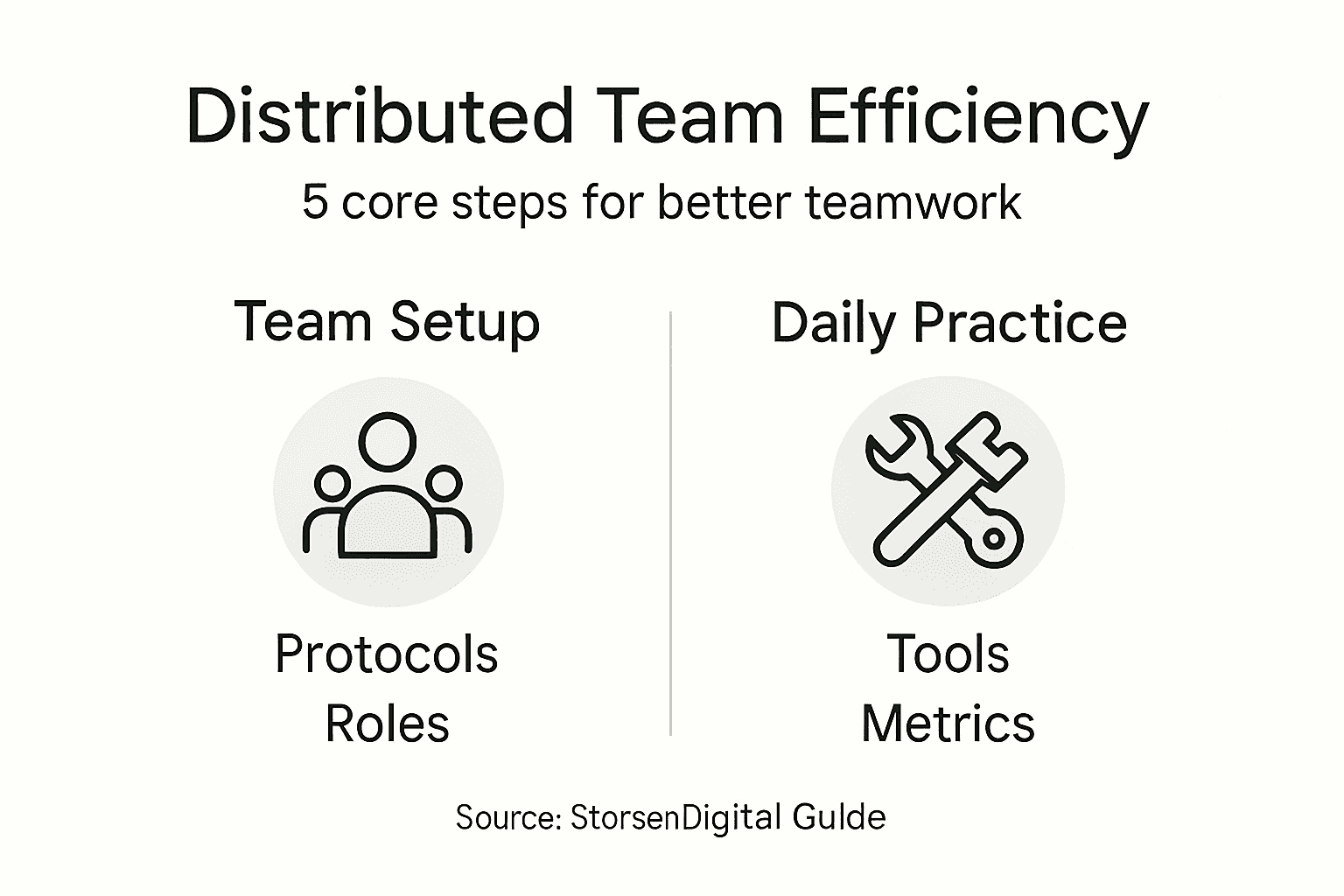
Running distributed teams across multiple European cities can quickly become chaotic without a plan for clarity and alignment. For C-suite leaders, gaps in communication, undefined responsibilities, or outdated collaboration tools risk slowing talent and operational efficiency. This guide delivers actionable steps for establishing remote communication protocols, documenting clear roles, and streamlining collaboration, helping you build a high-performing team that scales with your business.
Table of Contents
- Step 1: Define Remote Communication Protocols
- Step 2: Establish Clear Roles and Responsibilities
- Step 3: Implement Effective Collaboration Tools
- Step 4: Monitor Team Performance Regularly
- Step 5: Optimize Workflows for Continuous Improvement
Quick Summary
| Important Insight | Clear Explanation |
|---|---|
| 1. Establish Remote Communication Protocols | Create structured guidelines for communication channels, response times, and update frequencies to improve team interactions. |
| 2. Define Clear Roles and Responsibilities | Clearly outline each team member’s duties and expectations to minimize confusion and boost productivity. |
| 3. Implement Effective Collaboration Tools | Choose and integrate technology that enhances communication and project management among distributed team members. |
| 4. Monitor Team Performance Regularly | Use a mix of quantitative metrics and qualitative feedback to assess team efficiency and motivate continuous improvement. |
| 5. Optimize Workflows for Continuous Improvement | Foster a culture of regular feedback and incremental changes to enhance team processes and overall performance. |
Step 1: Define Remote Communication Protocols
Establishing clear remote communication protocols transforms distributed team interactions from chaotic to coordinated. You will create a comprehensive framework that ensures every team member understands exactly how, when, and through which channels communication should occur.
To develop robust communication protocols, start by mapping team communication needs across different functions and roles. This involves understanding each team member’s workflow, communication preferences, and primary responsibilities. The goal is creating a flexible yet structured approach that balances synchronous and asynchronous communication methods.
Here are key elements to include in your remote communication protocol:
- Communication Channels: Define primary and secondary communication tools
- Response Time Expectations: Set clear guidelines for reply times
- Update Frequency: Determine how often team members should provide status updates
- Meeting Protocols: Establish rules for video calls, standups, and team meetings
- Documentation Standards: Create templates for consistent reporting and updates
By collectively developing these protocols, you create a shared understanding that reduces misunderstandings and enhances team collaboration. Remote team agreements help document communication rules and provide a reference point for all team interactions.
As you implement these protocols, remember they are living documents. Regularly review and adjust them based on team feedback and changing work dynamics.
Pro tip: Schedule quarterly reviews of your communication protocols to ensure they continue meeting your team’s evolving needs and technological capabilities.
Step 2: Establish Clear Roles and Responsibilities
Building a high-performing distributed team requires crystal-clear role definitions that eliminate confusion and maximize individual and collective productivity. You will create a comprehensive framework that precisely outlines each team member’s responsibilities, accountability, and expected contributions.

Defining roles and responsibilities goes beyond simply listing job titles. It involves creating a detailed map of who owns specific tasks, who needs to be consulted, and who must be informed about project progress. This approach helps overcome geographic barriers and ensures smooth collaboration across different time zones and cultural contexts.
Here are key strategies for establishing clear team roles:
- Job Descriptions: Write detailed, specific role definitions
- Accountability Mapping: Use tools like RACI charts to clarify responsibilities
- Process Documentation: Create step-by-step guides for key workflows
- Interaction Points: Define how team members collaborate and hand off tasks
- Performance Metrics: Establish clear, measurable expectations for each role
Clear role definitions reduce conflicts and enhance team efficiency by eliminating ambiguity about responsibilities.
Roles and responsibilities documentation should be dynamic and adaptable. Regularly review and update these definitions to match evolving team needs and individual skill development.
As your distributed team grows, maintain flexibility while keeping core responsibilities well-defined. This balance prevents role confusion and supports continuous team improvement.
Pro tip: Schedule bi-annual role review sessions where team members can provide input on their current responsibilities and potential skill expansions.
Step 3: Implement Effective Collaboration Tools
Transforming your distributed team’s productivity requires strategic selection and implementation of collaboration technologies that bridge geographic distances and communication barriers. You will create a comprehensive digital ecosystem that enables seamless interaction, task management, and information sharing across your entire team.
Collaboration tools for distributed teams encompass more than just communication platforms. They represent a holistic approach to connecting team members, tracking progress, and maintaining transparency regardless of physical location.
Key collaboration tools to consider include:
- Communication Platforms: Slack, Microsoft Teams for real-time messaging
- Project Management: Trello, Asana for task tracking and workflow visualization
- Video Conferencing: Zoom, Google Meet for face-to-face interactions
- Document Sharing: Google Drive, Dropbox for centralized file access
- Time Zone Coordination: World Time Buddy, Every Time Zone for global scheduling
Successful tool implementation requires consistent usage, team training, and alignment with existing workflows.
Distributed team collaboration strategies demand more than just selecting tools. Ensure each platform integrates smoothly with your team’s unique working style and technological infrastructure.
Remember that tools are most effective when they solve specific communication and productivity challenges. Regularly solicit team feedback to refine and optimize your digital collaboration approach.
Pro tip: Conduct a quarterly review of your collaboration tool stack to identify potential improvements and eliminate redundant or underutilized platforms.
This table highlights key features of common collaboration tools and their strategic value:
| Tool Type | Example Platforms | Unique Strength |
|---|---|---|
| Messaging | Slack, Teams | Real-time updates and chat |
| Project Management | Trello, Asana | Visual task tracking |
| Video Conferencing | Zoom, Meet | Builds face-to-face rapport |
| Document Sharing | Drive, Dropbox | Centralizes files and data |
| Time Zone Scheduling | World Time Buddy | Simplifies global meetings |
Step 4: Monitor Team Performance Regularly
Ensuring your distributed team operates at peak efficiency requires a strategic approach to performance monitoring that balances quantitative metrics with qualitative insights. You will develop a comprehensive performance tracking system that provides transparent, actionable feedback while maintaining team motivation and accountability.
Performance monitoring in distributed teams goes beyond simple productivity tracking. It involves creating a holistic view of team dynamics, individual contributions, and collective outcomes that reflect both measurable results and collaborative effectiveness.
Key strategies for effective performance monitoring include:
- Quantitative Metrics: Track delivery times, project completion rates, and quality benchmarks
- Qualitative Assessment: Gather feedback on teamwork, communication, and individual growth
- Regular Check-ins: Schedule consistent performance review meetings
- Digital Dashboards: Use project management tools for real-time progress tracking
- Peer Feedback: Implement 360-degree review processes
Successful performance monitoring creates a culture of transparency, continuous improvement, and mutual support.
Adaptive performance monitoring strategies recognize that different team structures require unique approaches. Remain flexible and open to adjusting your monitoring methods based on team feedback and evolving organizational needs.
Remember that the goal of performance monitoring is not just measuring output, but fostering a supportive environment that enables each team member to reach their full potential.
Pro tip: Create a standardized yet adaptable performance tracking template that can be easily customized for different team members and projects.
Step 5: Optimize Workflows for Continuous Improvement
Transforming your distributed team’s performance requires a systematic approach to ongoing refinement that turns incremental changes into significant operational advantages. You will create a dynamic workflow optimization strategy that empowers team members to identify, propose, and implement improvements consistently.
Continuous improvement strategies are more than just periodic reviews. They represent a cultural commitment to evolving team processes, reducing inefficiencies, and maintaining high-performance standards across geographic boundaries.
Key methods for workflow optimization include:
- Regular Retrospectives: Schedule structured feedback sessions
- Root Cause Analysis: Investigate performance bottlenecks systematically
- Incremental Changes: Implement small, measurable workflow improvements
- Transparent Tracking: Document and share progress visibly
- Team Engagement: Encourage bottom-up improvement suggestions
Successful workflow optimization transforms challenges into opportunities for collective growth and innovation.
Remote team improvement frameworks like Kaizen democratize the improvement process. By creating dedicated channels for ideas and structured brainstorming, you enable every team member to contribute to organizational evolution.
Remember that continuous improvement is not about perfection, but consistent progress. Embrace a learning mindset that views each challenge as a chance to refine your team’s capabilities.
Pro tip: Create a dedicated digital workspace where team members can anonymously submit and vote on potential workflow improvements.
Here’s a summary of how each step supports distributed team success:
| Step | Primary Focus | Business Impact |
|---|---|---|
| Define Protocols | Structure communication | Reduces confusion, boosts clarity |
| Clear Roles | Set defined responsibilities | Enhances productivity and accountability |
| Collaboration Tools | Integrate technology platforms | Enables seamless remote teamwork |
| Monitor Performance | Track outcomes and feedback | Promotes transparency and improvement |
| Workflow Optimization | Cultivate continuous refinement | Sustains high performance over time |
Unlock the Full Potential of Your Distributed Team with Expert Support
Managing distributed teams involves defining clear communication protocols, establishing precise roles, implementing effective collaboration tools, and continuously monitoring performance. These essential steps address the common challenges of confusion, inefficiency, and lack of cohesion in remote team environments. If you are striving for streamlined workflows and enhanced team productivity across borders, these goals require more than just internal strategies.
At StorsenDigital, we specialize in providing tailored outsourcing and nearshoring solutions across Europe that empower your business to overcome distributed team hurdles. From talent recruitment and project management to scalable managed BPO services including HR, finance, and IT, our expertise transforms your remote operations into a competitive advantage. By partnering with us, you gain access to proven processes and dedicated support designed to optimize communication, accountability, and continuous improvement within your teams.

Ready to elevate your distributed team management and accelerate business efficiency? Discover how our customized solutions align with your strategic needs and unlock new levels of operational excellence. Contact StorsenDigital today to explore your options and start transforming remote team challenges into lasting success. Visit our contact page now to take the next step.
Learn more about effective role definitions and collaboration strategies designed for thriving distributed teams.
Frequently Asked Questions
How can I effectively define communication protocols for my distributed team?
Establish clear communication protocols by mapping out your team’s needs based on their roles and responsibilities. Specify the communication channels, response time expectations, and meeting protocols to create a structured environment that enhances collaboration.
What strategies can I use to clarify roles and responsibilities in a distributed team?
Create detailed job descriptions and accountability maps such as RACI charts to outline each team member’s responsibilities. This clarity eliminates confusion and ensures everyone knows their tasks within 30 days of implementation.
How do I select the right collaboration tools for my distributed team?
Choose collaboration tools that best fit your team’s communication and project management needs. Evaluate platforms that facilitate messaging, project tracking, and document sharing, then implement them to streamline interaction and workflow efficiency.
What metrics should I track to monitor my distributed team’s performance?
Focus on both quantitative metrics like project completion rates and qualitative assessments that gather feedback on teamwork. Schedule regular check-ins and use digital dashboards to monitor progress transparently and make necessary adjustments.
How can I promote continuous improvement in my team’s workflows?
Encourage team members to participate in regular retrospectives and provide input on potential improvements. Foster a culture of transparency and engagement by documenting and sharing workflow changes, leading to operational enhancements over time.
When should I review and update my remote communication protocols?
Schedule quarterly reviews of your communication protocols to ensure they adapt to the evolving needs of your team. Regular feedback sessions with team members help refine these protocols and improve overall effectiveness.


