


Managing remote staff across time zones while maintaining productivity and team cohesion challenges even experienced HR leaders. You face constant questions about communication breakdowns, measuring performance without micromanaging, and preventing burnout in distributed teams. This guide delivers five data-backed strategies that transform these challenges into competitive advantages. You’ll learn how to set clear expectations, focus on outcomes rather than hours, protect employee wellbeing, and optimize hybrid models that research shows boost satisfaction by measurable margins. These frameworks work for teams of 20 or 200, whether you’re managing nearshore talent in Europe or distributed staff worldwide.
Table of Contents
- Key takeaways
- Setting clear expectations and communication protocols
- Focusing on outcomes and avoiding micromanagement
- Monitoring burnout, isolation, and promoting wellbeing
- Optimizing team structures and hybrid work models
- How StorsenDigital supports your remote team management
- Frequently asked questions about managing remote staff
Key Takeaways
| Point | Details |
|---|---|
| Clear expectations | Document channels, response times, core hours, and workflows to align the team and reduce confusion. |
| Asynchronous communication | Prioritize asynchronous updates and use recordings and shared docs to collaborate across time zones. |
| Outcomes over hours | Shift evaluation from hours logged to deliverables, quality, and deadlines. |
| Burnout monitoring | Track wellbeing signals and isolation risks and intervene early to protect remote staff. |
| Hybrid models | Optimize hybrid work strategies since research shows higher satisfaction and productivity. |
Setting clear expectations and communication protocols
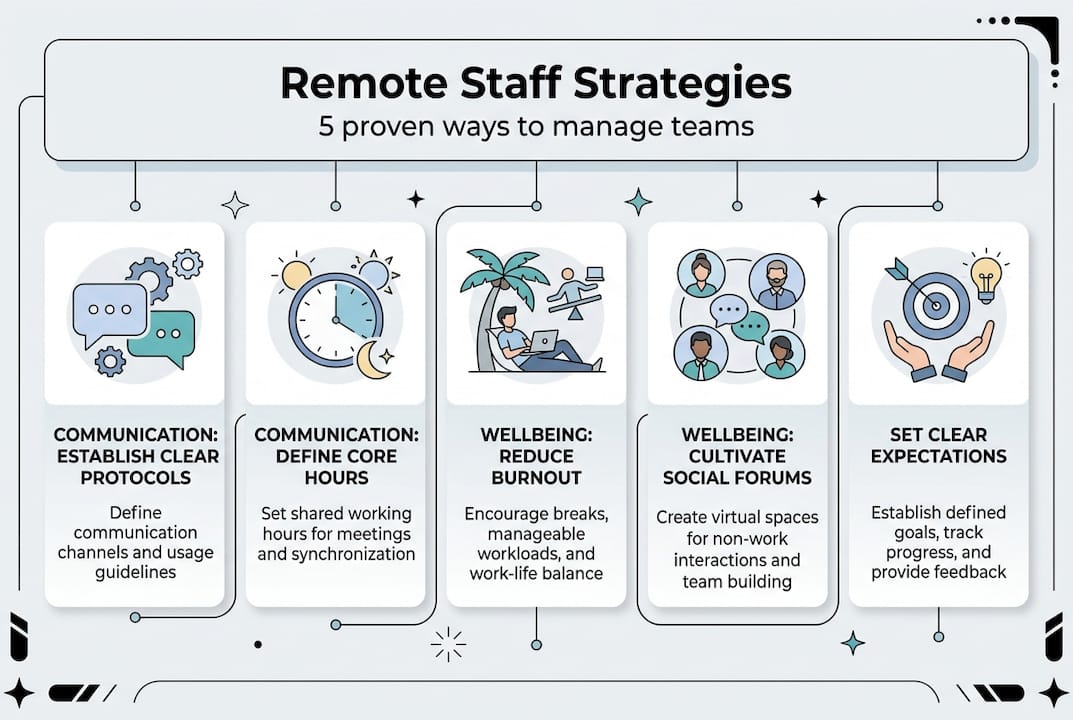
Remote teams collapse without explicit agreements about how work happens. You need documented protocols that answer basic questions: Which tool for what purpose? Who responds to whom, and how fast? What hours must everyone be available?
Start by setting clear expectations including communication channels, workflows, and core hours to accommodate time zones. Assign Slack for quick questions, email for formal requests, and video calls for complex discussions. Document these rules in your team handbook. When everyone knows that Slack messages get responses within two hours during core hours but emails can wait 24 hours, anxiety drops and productivity climbs.
Establish core overlap hours when all team members are available simultaneously. For a team spanning New York to Warsaw, this might be 9 AM to 12 PM Eastern. Reserve these hours for collaborative work, decisions, and quick syncs. Outside this window, prioritize asynchronous communication using tools like Slack, Loom, and Notion for updates. Record video updates instead of scheduling meetings. Share written project summaries in shared docs. This approach respects different schedules and reduces meeting overload that drains remote workers.
Create explicit workflows for common tasks. How does a marketing request move from concept to approval to execution? Who hands off to whom? What information must each handoff include? These documented processes prevent the “I thought you were handling that” disasters that plague distributed teams. Your remote team management guide should map every recurring workflow visually.
Recommended tools by purpose:
- Quick communication: Slack, Microsoft Teams
- Asynchronous updates: Loom, Notion, Confluence
- Project tracking: Asana, Monday.com, Jira
- Document collaboration: Google Workspace, Microsoft 365
- Video meetings: Zoom, Google Meet (scheduled sparingly)
Pro Tip: Establish channel-specific norms in Slack or Teams. Pin a message in each channel explaining its purpose, expected response times, and when to escalate to video. This simple step eliminates 80% of communication friction and helps new team members onboard faster. When scaling managed services, these norms become critical infrastructure.
Focusing on outcomes and avoiding micromanagement
Tracking hours worked destroys trust in remote teams. You can’t see someone at their desk, so measuring productivity by presence becomes impossible and counterproductive. The solution is shifting entirely to outcomes: what gets delivered, at what quality, by what deadline.
Focus on deliverables rather than hours worked to build trust and avoid micromanagement. Define clear success metrics for each role. A content writer delivers three polished articles weekly. A developer closes assigned tickets within sprint deadlines. A customer support specialist maintains response times under four hours. These concrete outputs matter far more than whether someone worked 37 or 42 hours.
Set goals collaboratively with team members rather than imposing them. Schedule monthly one-on-ones where you jointly define the next month’s deliverables, priorities, and success criteria. This approach creates buy-in and ensures goals are realistic. When team members help set their own targets, they take ownership and perform better.
Use project management tools that emphasize task completion over time tracking. Configure Asana or Monday.com to show deliverable status, not hours logged. Your dashboard should answer “What shipped this week?” not “Who worked the most hours?” This visibility satisfies your need to monitor progress without creating surveillance culture that drives top talent away.
Avoid micromanaging by trusting professionals to manage their own schedules. If deliverables arrive on time at high quality, the specific hours someone worked are irrelevant. Some people are morning people, others night owls. Remote work’s greatest advantage is accommodating different working styles. Micromanagement through constant check-ins or activity monitoring software signals distrust and triggers resignation.
Encourage regular updates via asynchronous methods. Ask team members to post brief weekly summaries in a shared channel: what they completed, what’s in progress, where they’re blocked. These updates provide visibility without pressure. You see progress, they maintain autonomy. For complex projects, your remote team management guide offers templates for effective async updates.
Pro Tip: Implement peer accountability by pairing team members on projects or creating small pods that review each other’s work. This builds quality control into the team structure rather than requiring constant manager oversight. Peer feedback loops reinforce trust and improve output quality naturally. When scaling managed services, peer accountability becomes essential for maintaining standards.
Monitoring burnout, isolation, and promoting wellbeing
Remote work’s flexibility can paradoxically lead to overwork. Without physical separation between office and home, some employees never truly disconnect. Others feel isolated, missing the social aspects of office life. You must actively monitor for burnout and isolation to maintain team health.

Recognize common burnout indicators early. Watch for lateness to meetings, reduced output quality, missed deadlines from previously reliable performers, or withdrawal from team conversations. These signs often appear before an employee explicitly asks for help. When you spot them, reach out privately with genuine concern, not judgment.
Foster open communication channels specifically for emotional check-ins. Add a wellbeing question to your one-on-ones: “How are you really doing? Is the workload sustainable?” Create psychological safety so team members feel comfortable admitting struggles. Some managers start team meetings with a brief mood check-in where everyone shares their current state using simple emoji or a one-word descriptor.
Encourage clear work-life boundaries and flexible scheduling. Remind team members to set “do not disturb” hours and actually disconnect. Lead by example by not sending messages outside core hours, or if you do, explicitly noting that no immediate response is expected. Promote flexible schedules that let parents handle school runs or employees exercise during traditional work hours, as long as deliverables stay on track.
Promote equity in workload and visibility among remote team members. Remote workers sometimes get overlooked for high-profile projects or promotions compared to office-based colleagues. Actively ensure remote staff receive equal opportunities, recognition, and development support. Track who gets assigned to visible projects and consciously distribute opportunities fairly.
Offer concrete resources:
- Virtual wellness programs or gym membership reimbursements
- Mental health support through employee assistance programs
- Flexible PTO policies that encourage actual time off
- Stipends for home office equipment and ergonomic furniture
- Access to online learning and professional development
Create forums for social interaction to reduce isolation. Schedule optional virtual coffee chats, online game sessions, or interest-based channels in Slack. Some teams do monthly virtual lunches where everyone orders delivery and eats together on video. These informal connections build team cohesion and remind people they’re part of something larger. Your remote team management guide includes specific activities that build remote team culture.
Encourage managers to model empathy and proactive listening. Train them to notice subtle cues in video calls or written communication that suggest someone is struggling. A manager who demonstrates vulnerability by sharing their own challenges creates space for team members to do the same.
Optimizing team structures and hybrid work models
Team structure and work model dramatically impact productivity and satisfaction. Research shows that hybrid working with 2 days in the office optimizes work-life balance and satisfaction compared to fully remote or fully onsite arrangements. This model reduces isolation while preserving flexibility.
As teams scale, structure must evolve. Scaling requires structural changes at 20, 50, and 100 people with explicit norms and time zone strategies. At 20 people, you can still function with informal communication. At 50, you need defined teams, clear reporting lines, and documented processes. At 100, you require specialized roles for coordination, multiple management layers, and sophisticated async workflows.
Implement a follow-the-sun model for global teams. Organize work so tasks hand off between time zones, enabling near-continuous progress. A developer in Europe fixes bugs and hands off to QA in North America, who then passes to the Asia-Pacific team for the next phase. This approach requires meticulous documentation and clear handoff protocols but can accelerate project timelines significantly.
Define core overlap hours strategically based on your team’s geographic distribution. Calculate the windows when most team members are awake and designate these for synchronous work. For teams spanning multiple continents, you might have two core windows to accommodate different regions. Outside these hours, everything runs asynchronously.
| Work Model | Pros | Cons | Best For |
|---|---|---|---|
| Fully Remote | Maximum flexibility, wider talent pool, lower real estate costs | Higher isolation risk, harder culture building | Distributed teams, cost-conscious orgs |
| Hybrid (2-3 days office) | Balance of collaboration and flexibility, reduced isolation | Requires office space, coordination complexity | Teams within commutable distance |
| Fully Onsite | Easier spontaneous collaboration, stronger culture | Reduced flexibility, smaller talent pool, higher costs | Roles requiring physical presence |
Steps to implement effective hybrid models:
- Assess team needs through surveys about preferred work arrangements and collaboration requirements
- Define office days that maximize in-person value, such as Tuesdays and Thursdays for team meetings and collaboration
- Maintain remote workflows even on office days so remote team members aren’t disadvantaged
- Equip offices for hybrid meetings with quality video conferencing so remote participants are full equals
- Measure and adjust by tracking satisfaction and productivity metrics quarterly
Help teams navigate cultural differences to reduce miscommunication. When managing staff across countries, invest in cultural competency training. Understand that communication styles, feedback preferences, and work-life boundaries vary by culture. A direct communication style valued in the Netherlands might seem rude to someone from Japan. Build awareness of these differences and create team norms that respect diverse approaches. Your guide to managing cross-border teams addresses these nuances in depth.
When scaling managed services, hybrid models often deliver the best results by combining the cost advantages of remote work with the collaboration benefits of periodic in-person time.
How StorsenDigital supports your remote team management
Implementing these strategies becomes simpler with expert support. StorsenDigital specializes in helping enterprises build and manage high-performing remote and nearshore teams across Europe. Our outsourcing process guide walks you through every step of establishing distributed teams that deliver results.

We provide comprehensive support for HR outsourcing that handles recruitment, onboarding, and ongoing management of remote staff. Our nearshoring solutions reduce costs while improving collaboration through strategic European talent placement. Access our nearshoring workflow guide to understand how hybrid and remote models deliver measurable cost savings in 2026 while maintaining quality and team cohesion.
Frequently asked questions about managing remote staff
What are the best communication practices for remote teams?
Prioritize asynchronous communication using Slack for quick updates, Loom for video explanations, and shared documents for detailed information. Establish core overlap hours for real-time collaboration and define clear response time expectations for each channel. Document these norms in your team handbook so everyone operates with the same expectations.
How can I measure productivity without micromanaging?
Focus on deliverables and outcomes rather than hours worked or online status. Set clear goals collaboratively with team members, track completion of specific tasks and projects, and measure quality of output. Use project management tools that show what’s been delivered, not how long someone spent working. Regular asynchronous updates provide visibility without surveillance.
What signs indicate remote employee burnout?
Watch for lateness to meetings, declining output quality, missed deadlines from previously reliable performers, reduced participation in team discussions, and visible exhaustion or irritability in video calls. Burnout often appears gradually, so track patterns over weeks rather than reacting to single incidents. When you notice these signs, reach out privately with genuine concern and support.
How do I handle time zone differences effectively?
Establish core overlap hours when all team members are available, typically 2-4 hours daily depending on geographic spread. Use these windows for synchronous collaboration and decisions. Outside core hours, rely entirely on asynchronous communication through recorded videos, detailed written updates, and shared documents. Rotate meeting times periodically so no one always joins at inconvenient hours.
Is hybrid work better than fully remote or onsite?
Research shows hybrid arrangements with 2 days in the office optimize work-life balance and team satisfaction compared to fully remote or fully onsite models. Hybrid reduces isolation while preserving flexibility advantages. However, the best model depends on your specific team’s needs, geographic distribution, and role requirements. Survey your team and experiment to find what works for your situation. Our remote team management guide helps you evaluate options systematically.


