


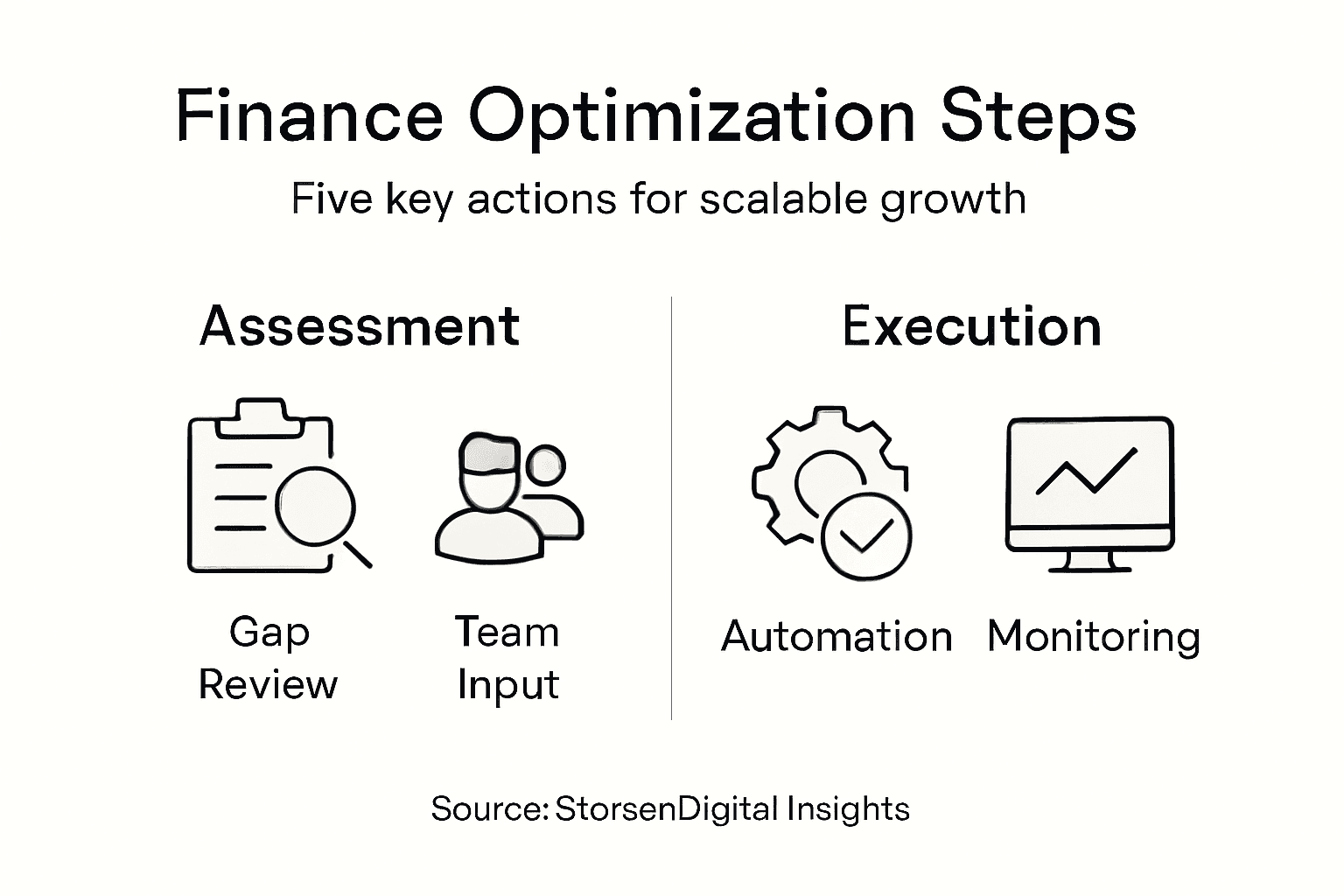
Faced with mounting complexity and rising operational costs, many European business leaders are rethinking how they manage finance functions. Systematic gap analysis reveals the difference between current finance processes and ideal performance, providing a strategic foundation for improvement. By harnessing structured assessment methods, executives can uncover hidden inefficiencies and build the groundwork for more effective outsourcing partnerships and smarter automation decisions.
Table of Contents
- Step 1: Assess Current Finance Processes And Identify Gaps
- Step 2: Define Strategic Outsourcing Objectives And KPIs
- Step 3: Select And Onboard The Right Outsourcing Partner
- Step 4: Implement Automation And Digital Tools For Finance Tasks
- Step 5: Monitor Performance And Validate Finance Process Improvements
Quick Summary
| Main Insight | Description |
|---|---|
| 1. Conduct a Gap Analysis | Evaluate current finance processes to identify inefficiencies and areas for improvement. This sets the foundation for effective optimization. |
| 2. Define Clear Outsourcing Objectives | Establish specific and measurable goals for outsourcing finance operations. This ensures alignment with broader business strategies and enhances value. |
| 3. Choose the Right Partner | Select an outsourcing partner based on expertise and cultural fit, ensuring they align with your operational goals for effective collaboration. |
| 4. Implement Automation Technologies | Adopt digital tools that enhance efficiency in finance tasks, transforming operations and increasing responsiveness through advanced technologies. |
| 5. Monitor and Validate Performance | Regularly track performance metrics to validate improvements and identify areas for continuous enhancement in finance operations. |
Step 1: Assess current finance processes and identify gaps
To optimize your finance operations and drive scalable growth, you’ll first need to conduct a comprehensive gap analysis to understand your current financial performance and potential improvement areas. This strategic assessment helps identify performance discrepancies between your existing finance processes and your ideal operational state.
Begin by mapping out your current finance workflows and collecting detailed performance data. Systematic gap analysis enables companies to pinpoint exactly where operational inefficiencies exist. Focus on capturing key metrics across critical finance functions such as:
- Accounts payable processing times
- Financial reporting accuracy
- Expense management cycle
- Reconciliation speed
- Budgeting and forecasting precision
Utilize both quantitative data and qualitative feedback from your finance team to create a holistic view. Gather input through structured interviews, performance reviews, and detailed process documentation. Compare your current capabilities against industry benchmarks and best practices to understand potential optimization opportunities.

Here’s a comparison of common finance process gaps and their business impact:
| Finance Process Gap | Typical Consequence | Opportunity for Improvement |
|---|---|---|
| Slow accounts payable | Delayed vendor payments | Streamline with automation |
| Inaccurate financial reports | Poor decision-making | Implement real-time reporting tools |
| Lengthy reconciliation | Increased error risk | Use automated reconciliation systems |
| Inefficient expense tracking | Budget overruns | Adopt intelligent expense management |
| Unrealistic forecasting | Missed growth targets | Integrate predictive analytics |
Identifying finance process gaps is not just about finding weaknesses – it’s about discovering strategic opportunities for transformation.
Document each identified gap with specific details: what the current process looks like, what the ideal process should be, and the potential impact of addressing the gap. Prioritize these gaps based on their potential financial and operational benefits, focusing first on areas that can deliver the most significant improvements in efficiency and cost reduction.
Pro tip: Consider leveraging external expertise or diagnostic tools to ensure a truly objective and comprehensive gap assessment process.
Step 2: Define strategic outsourcing objectives and KPIs
Defining clear strategic objectives and key performance indicators (KPIs) is crucial for successful finance operations outsourcing. By establishing precise metrics and goals, you’ll create a robust framework that ensures your outsourcing initiative delivers tangible business value.
Start by developing strategic outsourcing objectives that align closely with your overall business strategy. These objectives should be specific, measurable, and directly tied to your organization’s broader financial goals. Consider the following key areas when establishing your outsourcing objectives:
- Cost reduction and financial efficiency
- Process standardization and quality improvement
- Enhanced scalability and flexibility
- Access to specialized financial expertise
- Risk management and compliance
Each objective requires corresponding quantifiable KPIs that will help you track progress and evaluate the performance of your outsourcing partnership. These indicators should provide clear, actionable insights into how well the outsourced finance function is meeting your strategic requirements.
Strategic outsourcing objectives transform external partnerships from transactional arrangements into powerful growth catalysts.
When designing KPIs, focus on metrics that offer genuine visibility into operational performance. This might include indicators such as processing time, error rates, cost per transaction, reporting accuracy, and compliance adherence. Ensure these KPIs are:
Below is a summary of key performance indicators for outsourced finance operations:
| KPI Type | What It Measures | Benefit to Organization |
|---|---|---|
| Processing time | Task completion speed | Boosts operational efficiency |
| Error rate | Accuracy of outputs | Reduces compliance risk |
| Cost per transaction | Financial efficiency | Controls business expenses |
| Reporting accuracy | Information reliability | Improves strategic decisions |
| Compliance adherence | Regulatory alignment | Enhances risk management |
- Specific and well-defined
- Measurable with clear benchmarks
- Achievable and realistic
- Relevant to your business context
- Time-bound with regular review periods
Pro tip: Conduct periodic reviews of your outsourcing objectives and KPIs, allowing for flexible adjustments as your business needs evolve.
Step 3: Select and onboard the right outsourcing partner
Selecting the ideal outsourcing partner is a critical decision that can significantly impact your finance operations’ efficiency and long-term success. Your goal is to find a partner who not only meets your technical requirements but also aligns with your organizational culture and strategic vision.
Begin by conducting comprehensive partner evaluations that go beyond surface-level assessments. Look for providers with proven expertise in finance operations, a track record of successful implementations, and a deep understanding of your industry’s specific challenges. Consider the following key evaluation criteria:
- Technical capabilities and technological infrastructure
- Industry-specific experience and domain expertise
- Financial stability and company reputation
- Cultural compatibility and communication practices
- Scalability and flexibility of services
- Compliance and security standards
When evaluating potential partners, develop a structured assessment framework that allows for objective comparison. This might involve creating a detailed scorecard that weights different evaluation criteria based on their importance to your organization.
The right outsourcing partner is not just a vendor, but a strategic extension of your finance team.
During the onboarding process, focus on establishing clear communication channels and setting explicit expectations. This involves:
- Defining comprehensive service level agreements (SLAs)
- Establishing robust reporting and performance tracking mechanisms
- Creating detailed transition and knowledge transfer plans
- Setting up regular review and feedback sessions
- Developing a collaborative governance model
Pro tip: Prioritize partners who demonstrate a commitment to continuous improvement and are willing to invest in understanding your unique business context.
Step 4: Implement automation and digital tools for finance tasks
Transforming your finance operations requires strategic implementation of cutting-edge digital technologies that can dramatically improve efficiency, accuracy, and scalability. By carefully selecting and integrating intelligent automation tools, you’ll create a more responsive and agile financial ecosystem.
Advances in artificial intelligence are revolutionizing finance tasks, offering unprecedented opportunities for operational optimization. Focus on identifying and implementing digital solutions that address specific pain points in your finance workflow. Consider the following key areas for digital transformation:
- Accounts payable and receivable automation
- Real-time financial reporting and analytics
- Predictive cash flow forecasting
- Automated reconciliation processes
- Intelligent expense management systems
- Compliance and risk monitoring tools
When evaluating automation technologies, prioritize solutions that offer seamless integration with your existing systems. Look for platforms that provide:
- Robust data security features
- Scalable infrastructure
- User-friendly interfaces
- Advanced machine learning capabilities
- Comprehensive reporting and insights
Digital transformation is not about replacing human expertise, but amplifying human potential through intelligent technological support.
Implement a phased approach to digital tool integration, starting with pilot projects that demonstrate clear value and minimal disruption. This strategy allows you to validate technology effectiveness, train your team, and build organizational confidence in new digital capabilities.
Pro tip: Continuously monitor emerging technologies and maintain a flexible technology roadmap that can adapt to evolving finance automation trends.
Step 5: Monitor performance and validate finance process improvements
Establishing a robust performance monitoring framework is crucial for ensuring the long-term success of your finance operations transformation. By systematically tracking and analyzing key metrics, you’ll gain actionable insights that drive continuous improvement and strategic decision-making.
Performance measurement techniques enable organizations to validate the effectiveness of their finance process improvements through data-driven analysis. Develop a comprehensive monitoring approach that encompasses both quantitative and qualitative assessment methods. Focus on tracking the following critical performance dimensions:
- Cost efficiency and reduction metrics
- Process cycle time and productivity
- Error rates and accuracy improvements
- Compliance and risk management indicators
- Team productivity and skill development
- Financial reporting quality and speed
Implement a structured performance validation framework that includes regular review cycles and comparative analysis. This approach should involve:
- Establishing baseline performance metrics
- Setting clear improvement targets
- Conducting periodic performance reviews
- Collecting stakeholder feedback
- Identifying continuous improvement opportunities
Performance monitoring is not a one-time event, but a continuous journey of organizational refinement and strategic adaptation.
Utilize advanced analytics and reporting tools to create transparent, real-time dashboards that provide immediate visibility into your finance operations’ performance. These tools should enable quick identification of potential bottlenecks, emerging trends, and areas requiring immediate attention.
Pro tip: Create a cross-functional performance review team that includes finance, operations, and technology experts to ensure holistic and objective performance assessment.
Unlock Scalable Growth by Optimizing Your Finance Operations Today
The challenge of achieving efficient finance operations while managing cost, accuracy, and scalability is real. This article highlights key pain points like slow accounts payable, inaccurate financial reports, and inefficient expense tracking that hold businesses back from reaching their full potential. By embracing strategic outsourcing objectives and leveraging automation, companies can transform these challenges into powerful growth opportunities.
At StorsenDigital, we specialize in tailored Business Process Outsourcing solutions designed to address these exact finance optimization needs. Our expertise in nearshoring and managed finance services provides you with scalable support, advanced technology adoption, and access to European talent that drives measurable improvement in processing speed, error reduction, and compliance. Start your transformation journey with us and see why so many medium to large enterprises trust our strategic guidance.
Elevate your finance operations now with a partner who understands your unique challenges. Explore how our services can help you implement effective KPIs, select the right outsourcing partner, and integrate intelligent automation seamlessly.
Explore our managed BPO solutions
Learn about our strategic consulting approach
Take the first step to optimize your finance operations and scale confidently. Contact StorsenDigital today at https://www.storsendigital.com/contact/ to discover a customized solution that delivers real impact.

Frequently Asked Questions
How do I assess my current finance processes for scalability?
To assess your current finance processes, conduct a comprehensive gap analysis to identify performance discrepancies. Start by mapping your existing workflows and collecting key performance data within 30 days to pinpoint areas needing improvement.
What key metrics should I focus on for optimizing finance operations?
Focus on metrics such as accounts payable processing times, financial reporting accuracy, and budgeting precision to drive improvements. Aim to establish clear benchmarks for each metric within 60 days to measure progress effectively.
How can I define strategic outsourcing objectives for finance tasks?
Define strategic outsourcing objectives by aligning them with your overall business goals, focusing on areas like cost reduction and quality improvement. Develop specific, measurable KPIs to track these objectives and review them quarterly for ongoing relevance.
What criteria should I use to select an outsourcing partner for finance operations?
Evaluate potential outsourcing partners based on their technical capabilities, industry experience, and cultural compatibility. Create a scorecard to objectively compare candidates against these criteria and aim to finalize your selection within 30 days.
How should I implement digital tools for finance automation?
To implement digital tools, start with pilot projects that address specific workflow challenges, like accounts payable automation. Prioritize user-friendly solutions, and plan to integrate them completely within 90 days for optimal efficiency gains.


