


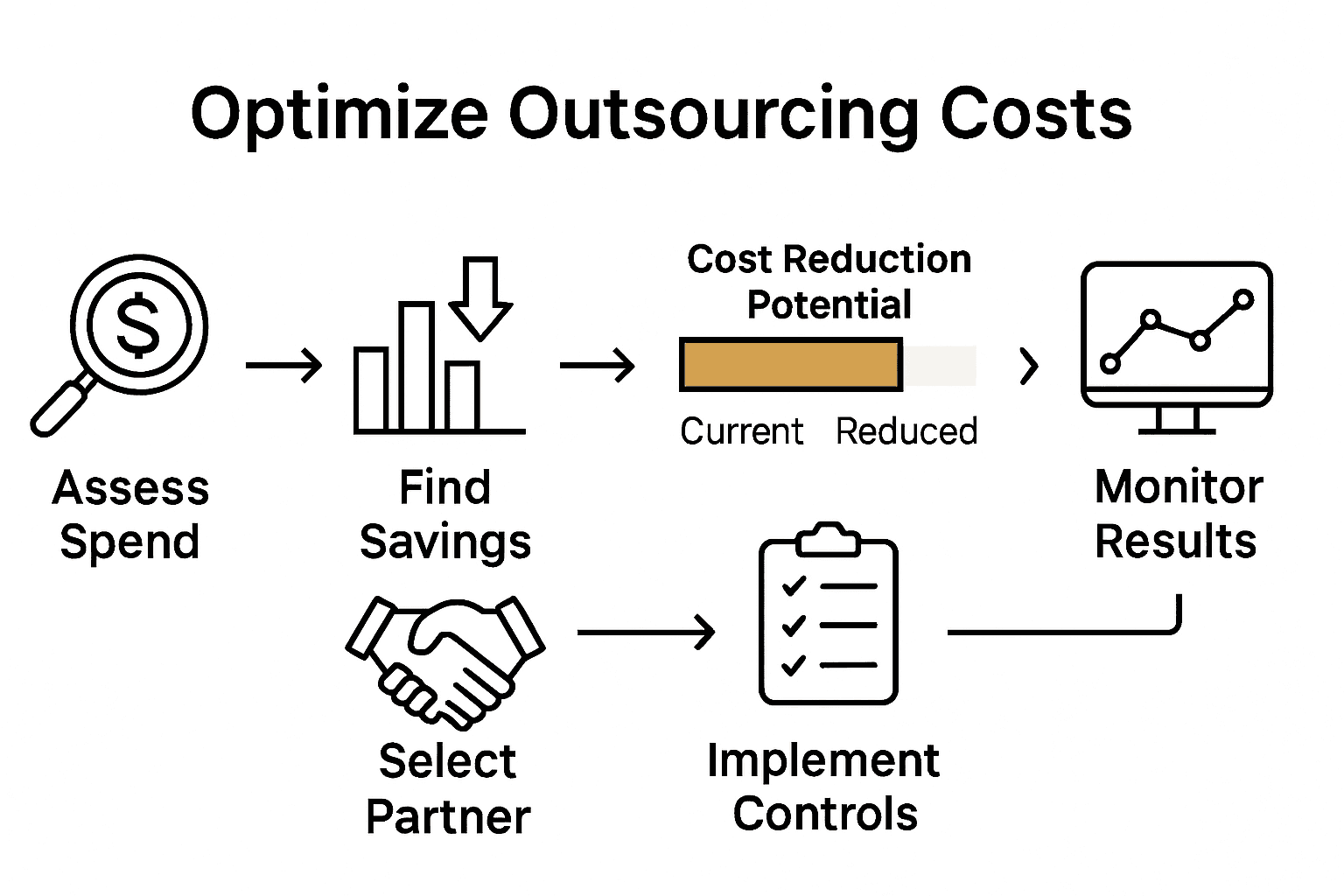
Over 60 percent of companies report unexpected cost overruns in their outsourcing agreements each year. Keeping outsourcing costs under control matters now more than ever as businesses seek to maximize efficiency without sacrificing quality. By understanding each step, from auditing current spend to selecting the right partner and tracking results, you gain practical strategies to pinpoint waste, reduce risk, and turn outsourcing into a driver of real savings.
Table of Contents
- Step 1: Assess Current Outsourcing Expenditure
- Step 2: Identify Strategic Cost-Saving Opportunities
- Step 3: Select the Right Nearshoring or BPO Partner
- Step 4: Implement Performance and Cost Controls
- Step 5: Monitor Results and Adjust Processes
Quick Summary
| Key Point | Explanation |
|---|---|
| 1. Assess current outsourcing costs thoroughly | Gather and analyze all financial documents related to outsourcing to identify spending patterns and potential hidden costs. |
| 2. Identify strategic cost-saving opportunities | Classify outsourced functions and explore alternatives that can offer better cost efficiency without sacrificing quality. |
| 3. Select an appropriate outsourcing partner | Use a comprehensive evaluation framework to find partners who align with your business goals and demonstrate expertise. |
| 4. Implement robust performance controls | Establish key performance indicators and cost monitoring systems to ensure accountability and effective management of outsourcing arrangements. |
| 5. Continuously monitor and adjust processes | Develop a dynamic feedback loop for assessing performance and adjusting outsourcing strategies to remain adaptable and optimize costs. |
Step 1: Assess Current Outsourcing Expenditure
Understanding your current outsourcing expenditure is the critical first step in optimizing costs and maximizing return on investment. In this section, you will learn how to conduct a comprehensive financial audit of your existing outsourcing arrangements.
Start by gathering all financial documents related to your current outsourcing contracts. According to anzam.org, firms must carefully evaluate whether outsourcing suppliers can achieve lower costs compared to in-house production. Pull together expense reports, vendor invoices, annual contract summaries, and any related financial statements. Create a detailed spreadsheet that breaks down costs by vendor, service type, and department.
As research from sloanreview.mit.edu indicates, strategic outsourcing requires integrating activities across divisions to optimize expenses. Calculate the total spending for each outsourced function and compare these costs against potential internal production expenses. Look for patterns such as recurring charges, unexpected fees, or services with inconsistent pricing. Pay special attention to scalability and potential hidden costs that might not be immediately apparent.
Pro Tip: Use a standardized template when documenting expenses to ensure consistent and comparable financial tracking across different outsourcing partnerships.
Once you have compiled and analyzed your current expenditure, you will be ready to move forward with identifying potential cost optimization strategies in the next phase of your outsourcing review.
Step 2: Identify Strategic Cost-Saving Opportunities
Now that you have a clear picture of your current outsourcing expenditure, it is time to uncover strategic opportunities for reducing costs without compromising operational effectiveness. This step will help you pinpoint areas where smart outsourcing can drive significant financial efficiencies.
According to sloanreview.mit.edu, strategic outsourcing involves leveraging external expertise to achieve cost savings and improve efficiency. Start by categorizing your current outsourced functions into core and non-core activities. Focus on identifying functions that can be more cost-effectively managed by specialized external providers. Look for opportunities where vendors can offer economies of scale or advanced technological capabilities that would be expensive to develop internally.
Research from mdpi.com suggests evaluating outsourcing strategies through a comprehensive risk and cost analysis. Examine each outsourced function for potential optimization by comparing current vendor rates with market benchmarks. Assess factors like operational costs, capacity flexibility, and potential risks associated with changing service providers. Create a comparative matrix that scores potential outsourcing partners based on cost effectiveness, quality of service, technological capabilities, and long-term scalability.
Pro Tip: Always maintain a balanced perspective. The lowest cost is not always the best value. Consider the total cost of ownership, including potential transition expenses and long-term performance implications.
With these strategic insights, you are now prepared to develop a targeted approach for negotiating better rates and restructuring your outsourcing portfolio to maximize cost efficiency.
Step 3: Select the Right Nearshoring or BPO Partner
Selecting the perfect outsourcing partner is a critical decision that can make or break your cost optimization strategy. In this step, you will learn how to systematically evaluate and choose a nearshoring or Business Process Outsourcing (BPO) partner that aligns with your organizational goals and budgetary requirements.
According to research from link.springer.com, choosing an appropriate outsourcing partner involves carefully analyzing factors beyond simple cost minimization. Begin by creating a comprehensive evaluation framework that assesses potential partners across multiple dimensions. Look for providers who demonstrate strong alignment with your core competencies and can offer specialized expertise. Develop a detailed scorecard that rates potential partners on criteria such as technological capabilities, industry experience, cultural compatibility, communication skills, and proven track record of delivering results.
Research from researchgate.net emphasizes that the right partner should offer strategic innovation beyond mere cost savings. Conduct thorough due diligence by requesting detailed case studies, client references, and performance metrics. Schedule in depth discovery calls and potentially arrange site visits to gain firsthand insights into their operational capabilities. Pay special attention to their adaptability, scalability, and potential to contribute strategic value to your organization.
Pro Tip: Trust your instincts but back them up with data. A partner that looks perfect on paper might not mesh well with your company culture.
By methodically evaluating potential nearshoring and BPO partners, you are now prepared to make an informed decision that balances cost efficiency with strategic potential.

Step 4: Implement Performance and Cost Controls
With your outsourcing partner selected, the next critical phase is establishing robust performance and cost control mechanisms that ensure accountability, transparency, and ongoing value delivery. This step is about creating a comprehensive framework that keeps your outsourcing strategy aligned with your organizational objectives.
Research from arxiv.org emphasizes the importance of clear objectives and effective communication in transformational outsourcing. Develop a detailed performance management system that includes key performance indicators (KPIs) specific to each outsourced function. These metrics should be quantifiable, time bound, and directly tied to your strategic goals. Create a collaborative dashboard that allows real time tracking of performance, cost efficiency, and project milestones. Schedule regular review meetings with your outsourcing partner to discuss these metrics, provide feedback, and make data driven adjustments.
According to arxiv.org, implementing cost aware controls is crucial for managing outsourcing expenses effectively. Establish a comprehensive cost monitoring mechanism that tracks not just direct expenses but also indirect costs such as transition expenses, potential risks, and opportunity costs. Develop a flexible budgeting approach that allows for periodic recalibration based on actual performance and changing market conditions. Build in financial safeguards like penalty clauses for missed performance targets and incentive structures that reward exceptional service delivery.
Pro Tip: Balance rigorous controls with collaborative partnership. Overly punitive measures can damage the relationship and discourage innovative problem solving.
By implementing these strategic performance and cost controls, you are setting the stage for a dynamic, accountable, and value driven outsourcing relationship that can adapt and grow with your business needs.
Step 5: Monitor Results and Adjust Processes
Monitoring and continuously adjusting your outsourcing processes are essential to maintaining long-term cost optimization and operational excellence. This step is about creating a dynamic feedback loop that allows your organization to respond quickly to performance variations and emerging opportunities.
Research from arxiv.org suggests using systematic verification approaches to ensure the integrity and performance of outsourced services. Implement a comprehensive monitoring system that goes beyond simple performance metrics. Develop a multi layered assessment framework that includes quantitative data analysis, qualitative feedback from internal stakeholders, and periodic comprehensive performance reviews. Use advanced analytics tools to track key performance indicators in real time, allowing you to identify trends, potential issues, and optimization opportunities quickly.
According to arxiv.org, effective process adjustment requires a dynamic approach to workload management and cost optimization. Create a flexible adjustment mechanism that allows for rapid recalibration of outsourcing strategies. This might involve quarterly performance reviews, scenario planning workshops, and agile response protocols. Develop a structured process for evaluating and implementing process improvements, including clear escalation paths and decision making frameworks. Encourage open communication with your outsourcing partner, treating them as a collaborative extension of your team rather than a purely transactional service provider.
Pro Tip: Establish a culture of continuous improvement. The most successful outsourcing relationships are those that view monitoring as a collaborative opportunity for mutual growth, not just a compliance exercise.
By implementing a robust monitoring and adjustment process, you transform outsourcing from a static contract into a dynamic, value generating partnership that can adapt to your evolving business needs.
Unlock True Savings by Optimizing Your Outsourcing Strategy Today
Optimizing outsourcing costs is more than just cutting expenses. It is about strategically selecting partners, establishing transparent controls, and continuously adjusting to maximize ROI. If you found yourself challenged by hidden fees, inconsistent vendor pricing, or the difficulty of balancing cost with quality then you are not alone. The journey outlined in “How to Optimize Outsourcing Costs for Maximum ROI” highlights key steps from auditing current expenditures to choosing the right nearshoring partner and implementing performance metrics. These steps require a reliable and experienced outsourcing provider who understands your business goals deeply.
At StorsenDigital.com we specialize in delivering tailored outsourcing and nearshoring solutions across Europe to help medium and large enterprises unlock operational efficiencies while controlling costs. Our expertise in Business Process Outsourcing services including HR, finance, IT, and customer support, ensures you do not just pay less but gain strategic value and scalable capabilities. Partner with us to get comprehensive support in talent recruitment, office establishment, and managed services designed for your unique needs.

Ready to break free from costly inefficiencies and build a dynamic outsourcing partnership? Discover the tangible benefits of working with an expert team committed to your success. Visit StorsenDigital.com now to explore how we make outsourcing cost optimization a reality for your business. Take the first step toward smarter, more strategic outsourcing today.
Frequently Asked Questions
How can I assess my current outsourcing expenditure effectively?
To assess your current outsourcing expenditure, gather all relevant financial documents such as expense reports and vendor invoices. Create a detailed spreadsheet that breaks down costs by vendor and service type to identify areas for optimization.
What key metrics should I track to monitor outsourcing performance?
Track key performance indicators (KPIs) that are specific to each outsourced function, focusing on quantifiable and time-bound metrics. Set up a dashboard for real-time tracking to quickly identify performance trends and areas needing improvement.
How can I identify potential cost-saving opportunities in my outsourcing strategy?
Categorize your outsourced activities into core and non-core functions to pinpoint areas where specialized providers can offer cost savings. Conduct a market comparison of current vendor rates against industry benchmarks to find opportunities for cost optimization.
What criteria should I use when selecting an outsourcing partner?
When selecting an outsourcing partner, evaluate them based on technological capabilities, industry experience, and cultural compatibility. Develop a scorecard to systematically rate each provider on these criteria to ensure alignment with your organizational goals.
How can I implement cost controls in my outsourcing agreements?
Implement cost controls by establishing a comprehensive monitoring mechanism that tracks both direct and indirect expenses related to outsourcing. Develop flexible budgeting that allows for regular recalibration based on actual performance metrics and changing market conditions.
What steps can I take to continuously improve my outsourcing processes?
Create a dynamic feedback loop by implementing a comprehensive monitoring system that includes both quantitative data and qualitative feedback. Schedule regular performance reviews and encourage open communication with your outsourcing partner to facilitate ongoing improvements.


