


Over 60% of European tech leaders now turn to American outsourcing partners to tackle talent shortages and sharpen their competitive edge. For C-suite executives aiming to grow without stretching internal resources, efficient outsourcing is more than a trend—it is a strategic move. This guide breaks down actionable steps for defining objectives and building successful partnerships so you can accelerate capacity while securing the right talent.
Table of Contents
- Step 1: Define Your Outsourcing Objectives
- Step 2: Select The Right Outsourcing Partner
- Step 3: Set Clear Requirements And Expectations
- Step 4: Integrate Outsourced Talent With Your Team
- Step 5: Evaluate And Optimize Service Quality
Quick Summary
| Key Insight | Explanation |
|---|---|
| 1. Define Clear Objectives | Establish specific, measurable outsourcing goals to guide vendor selection and evaluate performance. |
| 2. Select the Right Partner | Choose outsourcing partners based on technical capabilities, cultural fit, and alignment with business goals. |
| 3. Set Comprehensive Requirements | Create detailed, clear requirements to ensure mutual understanding and drive project success. |
| 4. Integrate Outsourced Teams | Foster collaboration and alignment between in-house and outsourced teams through effective integration strategies. |
| 5. Continuously Evaluate Quality | Implement regular performance reviews and feedback loops to optimize service quality and align with business objectives. |
Step 1: Define your outsourcing objectives
Successful outsourcing begins with crystal clear objectives that align your business strategy with external talent acquisition. By meticulously defining what you want to achieve, you create a roadmap that guides vendor selection and performance evaluation.
To develop precise outsourcing objectives, start by conducting an internal assessment of your current operational challenges. Strategic research indicates that companies must distinguish between outsourcing non-core and core business functions, which means carefully identifying which processes are candidates for external support. Common objectives include cost reduction, accessing specialized expertise, improving product quality, overcoming recruitment bottlenecks, and enabling technological innovation.
Break down your objectives into specific, measurable goals. For instance, instead of a vague aim like “reduce costs,” specify “decrease operational expenses by 22% within 12 months through targeted talent outsourcing.” Each objective should be SMART: Specific, Measurable, Achievable, Relevant, and Time-bound. This approach transforms abstract aspirations into concrete benchmarks that can guide your outsourcing strategy and help you evaluate potential partners effectively.
Here’s a summary of SMART outsourcing objectives versus vague objectives:
| Criteria | Vague Objective | SMART Outsourcing Objective |
|---|---|---|
| Specificity | Reduce costs | Decrease expenses by 22% |
| Measurability | Not clearly measurable | Track progress via cost reports |
| Achievability | Outcome uncertain | Based on historic data |
| Relevance | May lack business alignment | Linked to budget strategy |
| Time-bound | No deadline | Within 12 months |
Pro Tip: Create a prioritized matrix of your outsourcing objectives, ranking them by potential business impact and implementation complexity to focus your efforts strategically.
Step 2: Select the right outsourcing partner
Selecting the ideal outsourcing partner represents a critical strategic decision that can significantly impact your business performance and growth trajectory. This step requires a comprehensive evaluation process that goes beyond simple cost comparisons.

European market research highlights the importance of conducting thorough vendor assessments that consider labor market trends, regulatory compliance, and cultural compatibility. When evaluating potential outsourcing partners, develop a robust selection framework that encompasses multiple critical dimensions. Examine their technical capabilities, industry experience, talent pool quality, data protection standards, and proven track record of delivering results for businesses similar to yours.
Prioritize partners who demonstrate not just technical proficiency but also strategic alignment with your organizational goals. Look for vendors who show deep understanding of your industry, flexibility in service delivery, and a commitment to continuous improvement. Request detailed case studies, client references, and portfolio demonstrations that validate their expertise. Pay special attention to their communication protocols, project management approaches, and ability to scale services as your business evolves. A truly exceptional outsourcing partner will function as an extension of your team, bringing specialized knowledge and innovative solutions that drive your business forward.
Below is a comparison of key outsourcing partner evaluation dimensions:
| Evaluation Dimension | Why It Matters | What to Look For |
|---|---|---|
| Technical Capability | Quality and reliability | Modern tech stack, certifications |
| Cultural Compatibility | Minimizes miscommunication | Shared values, open communication |
| Industry Experience | Domain expertise | Similar client portfolio |
| Data Protection | Regulatory compliance | Strong security protocols |
| Scalability | Supports business growth | Flexible service models |
Pro Tip: Request a small pilot project to assess the potential partner’s actual performance and cultural fit before committing to a long-term engagement.
Step 3: Set clear requirements and expectations
Successful outsourcing hinges on establishing precise, comprehensive requirements that eliminate ambiguity and create a shared understanding between your organization and the outsourcing partner. This critical step transforms abstract business needs into concrete, actionable guidelines that will drive project success.
Research on requirements management reveals that structured specification techniques dramatically reduce miscommunication and potential scope creep in outsourcing relationships. Begin by developing a detailed requirements document that goes beyond surface level descriptions. Include specific deliverables, performance metrics, quality standards, communication protocols, and expected outcomes. Your documentation should be comprehensive yet flexible, allowing room for iterative refinement as the project evolves. Break down complex requirements into measurable components and use clear language that leaves no room for interpretation.
Consider creating a collaborative framework that involves regular check-ins, feedback loops, and performance reviews. This approach ensures that requirements remain dynamic and aligned with your evolving business objectives. Establish explicit key performance indicators (KPIs) that provide objective measures of success, and build in mechanisms for ongoing evaluation and adjustment. Remember that effective requirements management is not a one time event but a continuous process of alignment, communication, and mutual understanding.
Pro Tip: Conduct a comprehensive requirements workshop with key stakeholders before finalizing the contract to ensure all perspectives are captured and potential misunderstandings are addressed upfront.
Step 4: Integrate outsourced talent with your team
Successfully integrating outsourced talent requires a strategic approach that bridges cultural differences, technological platforms, and collaborative workflows. Your goal is to create a seamless extension of your existing team that operates with the same cohesion and effectiveness as your in-house employees.
Effective integration methodologies emphasize creating synchronized workflows and structured onboarding processes that foster workforce unity and operational agility. Start by establishing shared digital collaboration platforms that enable real time communication and project management. Implement comprehensive onboarding programs that not only cover technical skills but also introduce your company culture, communication norms, and strategic objectives. Focus on creating opportunities for virtual team building activities that help outsourced team members feel connected and valued.
Develop clear communication protocols that eliminate potential misunderstandings. Schedule regular video conferences, create cross team projects, and establish mentorship programs that facilitate knowledge transfer and relationship building. Recognize that successful integration is an ongoing process that requires consistent effort, cultural sensitivity, and a commitment to treating outsourced team members as genuine partners rather than external resources. By investing time and resources in creating a truly collaborative environment, you transform outsourced talent from a transactional service into a strategic extension of your organizational capabilities.
Pro Tip: Designate a dedicated integration manager who can serve as a bridge between your in-house team and outsourced talent, ensuring smooth communication and addressing potential cultural or operational challenges proactively.
Step 5: Evaluate and optimize service quality
Evaluating and optimizing service quality is a critical ongoing process that ensures your outsourcing partnership continues to deliver exceptional value and align with your strategic business objectives. This step transforms performance measurement from a passive monitoring activity into a dynamic mechanism for continuous improvement.
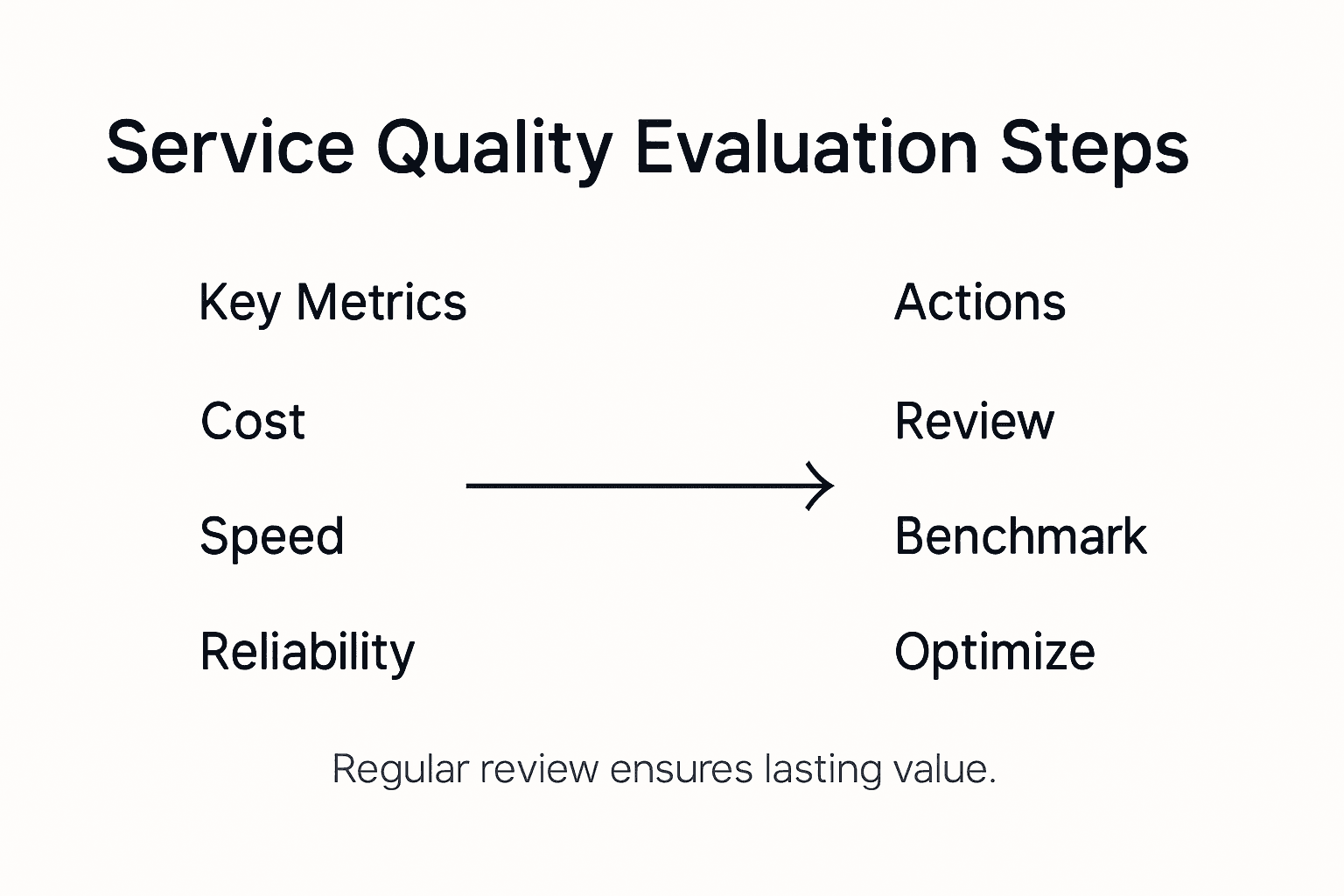
Recent research highlights a strategic framework for assessing outsourced service quality through comprehensive Key Performance Indicators that directly link performance metrics to broader business goals. Establish a robust evaluation system that goes beyond traditional metrics by implementing periodic performance reviews, gathering qualitative feedback, and creating clear benchmarks. Develop a scorecard that captures both quantitative results and qualitative insights such as communication effectiveness, innovation potential, and cultural alignment. Regularly schedule detailed performance discussions that allow for transparent dialogue about achievements, challenges, and potential areas of enhancement.
Leverage technological tools to enhance your evaluation process. Implement digital monitoring systems that provide real time insights into service performance, enabling proactive identification of potential issues and opportunities for optimization. Create a collaborative environment where feedback flows bidirectionally, allowing your outsourcing partner to understand your evolving needs while also receiving constructive input about their performance. Remember that service quality optimization is not about identifying failures but about creating a continuous improvement ecosystem that drives mutual growth and strategic value.
Pro Tip: Develop a weighted scoring system for performance evaluation that balances objective metrics with strategic alignment and innovation potential, ensuring a holistic assessment of your outsourcing partnership.
Unlock European Business Growth by Outsourcing Talent with Confidence
Outsourcing talent to support your European business success can be challenging without crystal clear objectives and the right partner. If you are seeking to reduce costs, access specialized skills, and seamlessly integrate external teams while ensuring top service quality, you need a strategic outsourcing ally who understands your goals and the European market landscape. The article “How to Outsource Talent for European Business Success” highlights the importance of SMART objectives, thorough partner evaluation, clear requirement setting, and effective talent integration, all essential to overcome operational hurdles and maximize your investment.
At StorsenDigital, we specialize in tailored outsourcing, nearshoring, and managed BPO services designed specifically for businesses expanding across Europe. Our expertise in talent recruitment, office setup, and strategic consulting ensures we align perfectly with your SMART objectives. We help you evaluate and select partners who fit your culture and industry requirements while managing seamless integration with your in-house teams. By leveraging our capabilities, you gain a trusted extension of your business to unlock scalable growth and innovation.

Ready to elevate your European outsourcing strategy now Choose StorsenDigital’s expert team to guide you through every step from objective definition to service optimization. Act today to transform outsourcing challenges into strategic advantages. Contact us and start building your competitive edge in Europe with confidence.
Frequently Asked Questions
What are the key objectives for outsourcing talent effectively?
To effectively outsource talent, identify clear objectives that are specific, measurable, achievable, relevant, and time-bound (SMART). Start by conducting an internal assessment to determine which functions can benefit from outsourcing, such as reducing operational costs by 22% within 12 months.
How do I choose the right outsourcing partner for my business?
Selecting the right outsourcing partner involves evaluating their technical capabilities, industry experience, and cultural compatibility. Create a detailed selection framework and request case studies or client references to ensure they align with your business goals.
What are the essential requirements to set for an outsourcing partnership?
Establishing clear requirements for an outsourcing partnership is vital for success. Develop a comprehensive requirements document that outlines specific deliverables, performance metrics, and communication protocols, and ensure all parties have a shared understanding from the start.
How can I integrate outsourced talent with my in-house team?
To integrate outsourced talent efficiently, set up shared collaboration platforms and implement comprehensive onboarding programs that introduce your company culture. Schedule regular check-ins and team-building activities to foster a unified team environment.
What methods can I use to evaluate and optimize service quality in outsourcing?
Evaluating and optimizing service quality requires a robust evaluation system, including periodic performance reviews and key performance indicators (KPIs). Create a scorecard combining quantitative results and qualitative feedback to ensure continuous improvement and alignment with business goals.


