


American organizations have reported up to 30 percent savings by proactively auditing managed service capabilities before scaling. For European tech firms aiming to maximize operational value and minimize risk, following a structured assessment process is critical. This guide offers practical steps and proven frameworks to help your leadership team uncover inefficiencies, benchmark performance, and create a reliable roadmap for smarter, cost-effective growth through managed services.
Table of Contents
- Step 1: Assess Current Managed Service Capabilities
- Step 2: Identify Critical Scalability Drivers and Resources
- Step 3: Implement Robust Service Expansion Strategies
- Step 4: Integrate Automation and Process Optimization
- Step 5: Verify Scalability Through Pilot Testing and Feedback
Quick Summary
| Key Insight | Explanation |
|---|---|
| 1. Conduct Internal Audits | Regularly assess current managed service capabilities to identify strengths, weaknesses, and areas for improvement. |
| 2. Identify Scalability Drivers | Focus on key drivers like technological flexibility and specialized talent to enhance service scalability. |
| 3. Implement Flexibility in Strategies | Develop adaptable service expansion strategies that facilitate modular integration and real-time adjustments. |
| 4. Utilize Automation Effectively | Integrate automation in repetitive tasks to optimize resources and enhance service efficiencies. |
| 5. Pilot Test New Services | Use pilot testing frameworks to validate scalability and gather performance data before full implementation. |
Step 1: Assess current managed service capabilities
Assessing your current managed service capabilities requires a systematic approach to understanding your organization’s existing technological infrastructure and performance levels. This step helps you identify strengths, weaknesses, and potential areas for strategic improvement.
Begin by conducting a comprehensive internal audit using structured evaluation frameworks like the Cybersecurity Capability Maturity Model. This involves gathering data across multiple dimensions: technological resources, skill sets, process effectiveness, and overall operational performance. Map out your current service delivery models, examining key metrics such as response times, service quality, resource allocation, and customer satisfaction scores. Pay special attention to identifying skill gaps and technological limitations that might hinder scalability.
Analyze your assessment results through a strategic lens. Look for patterns that reveal systemic challenges or opportunities for optimization. Benchmark your capabilities against industry standards and competitors to gain perspective on your relative performance. The goal is not just to understand your current state but to develop a clear roadmap for enhancement and growth.
Pro tip: Create a visual dashboard that tracks your managed service capabilities across different performance indicators to make complex assessment data more accessible and actionable for leadership teams.
Here’s a summary of key performance indicators for auditing managed service capabilities:
| Indicator | What It Measures | Why It Matters |
|---|---|---|
| Response Time | Incident handling speed | Reveals service efficiency |
| Resource Allocation | Use of personnel/tools | Identifies potential bottlenecks |
| Service Quality | Consistency and accuracy | Impacts customer satisfaction |
| Skill Set Breadth | Range of technical skills | Exposes talent gaps for growth |
| Customer Satisfaction | User feedback and scores | Indicates overall effectiveness |
Step 2: Identify critical scalability drivers and resources
Scaling managed services requires strategic identification of key drivers and resources that enable sustainable organizational growth. This step focuses on uncovering the fundamental elements that will power your service expansion and operational efficiency.
Start by analyzing digital scalability through strategic resources that extend beyond traditional infrastructure. Evaluate your technological capabilities, workforce skills, and operational models. Key scalability drivers typically include cost optimization, technological flexibility, access to specialized talent, and adaptive platform technologies. Examine your current technological ecosystem and identify potential bottlenecks or limitations that might restrict future growth. This involves assessing your existing technology stack, workforce competencies, and operational workflows.

Prioritize resources that enable rapid adaptation and efficient service delivery. Look for opportunities to leverage AI integration, cloud technologies, and flexible staffing models that can quickly respond to changing market demands. Consider both tangible resources like technology platforms and intangible assets such as organizational knowledge and process efficiencies. Your goal is to build a scalable framework that allows seamless expansion without compromising service quality or operational integrity.
Pro tip: Create a dynamic resource mapping tool that continuously tracks your scalability potential, helping you proactively identify and address potential growth constraints before they become significant challenges.
Compare the focus of each scalability driver and their impact:
| Scalability Driver | Primary Focus | Impact on Growth |
|---|---|---|
| Cost Optimization | Reducing expenses | Frees resources for expansion |
| Technological Flexibility | Adapting platforms | Enables quick integration of tools |
| Specialized Talent | Hiring skilled workers | Supports advanced service delivery |
| Process Efficiency | Streamlining workflows | Increases reliability and speed |
Step 3: Implement robust service expansion strategies
Implementing robust service expansion strategies requires a comprehensive approach that balances technological capabilities, risk management, and strategic planning. This step focuses on developing a systematic framework for scaling your managed services effectively and sustainably.
Begin by examining risk considerations for service expansion to ensure a risk-informed approach. Create a detailed roadmap that outlines incremental expansion steps, accounting for technological infrastructure, workforce capabilities, and potential operational challenges. Develop flexible architectural designs that allow for modular service integration, enabling you to add new capabilities without disrupting existing systems. Prioritize adaptable technologies that support seamless scaling, such as cloud platforms, microservices architectures, and automated deployment systems.
Foster a culture of continuous improvement and strategic agility. This means developing cross functional teams capable of rapid adaptation, implementing robust governance frameworks, and maintaining transparent communication channels. Establish clear metrics and performance indicators that track expansion progress, allowing for real time adjustments and proactive risk management. Your expansion strategy should be dynamic, responsive to market changes, and aligned with your organization’s long term strategic objectives.
Pro tip: Develop a quarterly review process that systematically evaluates your expansion strategy, allowing you to quickly pivot and optimize your approach based on emerging technologies and market dynamics.
Step 4: Integrate automation and process optimization
Integrating automation and process optimization is crucial for transforming managed services from traditional operational models to high-performance, scalable systems. This step focuses on strategically implementing technological solutions that enhance efficiency, reduce manual workload, and create more intelligent service delivery mechanisms.
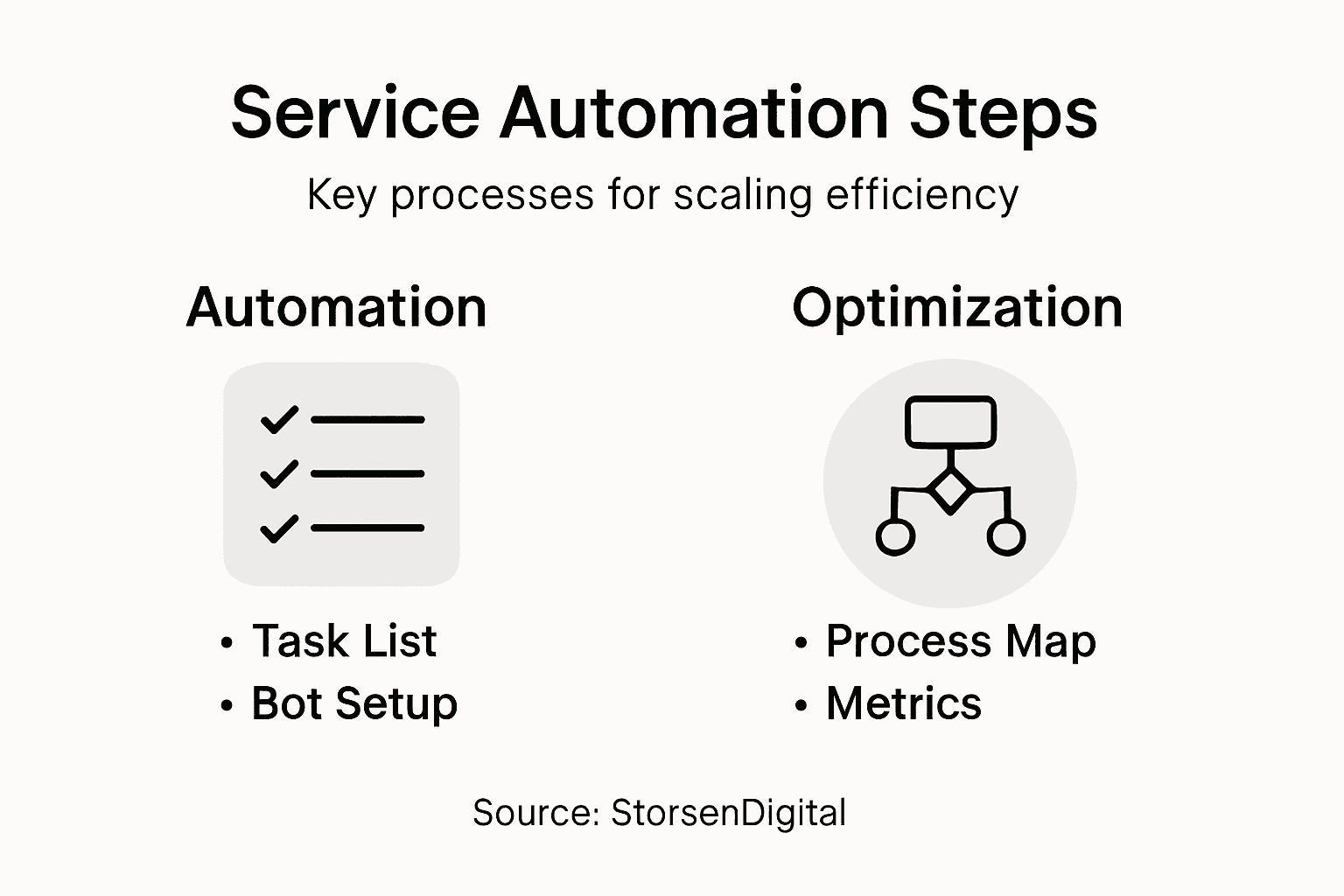
Explore robotic process automation strategies to identify repetitive tasks suitable for automation. Begin by conducting a comprehensive workflow analysis that maps out existing processes, identifying areas with high potential for optimization. Focus on rules-based tasks that consume significant human resources such as data entry, report generation, and routine customer service interactions. Select automation technologies that integrate seamlessly with your existing technological infrastructure, prioritizing solutions that offer flexibility, scalability, and minimal disruption to current operations. Implement automation in phases, starting with low risk processes and progressively expanding to more complex workflows.
Develop a robust change management strategy that supports technological integration. This involves training your workforce to work alongside automated systems, creating new roles that focus on oversight, strategy, and advanced problem solving. Establish clear performance metrics that track the impact of automation, measuring improvements in speed, accuracy, and cost efficiency. Continuously monitor and refine your automation approach, ensuring that technological solutions evolve alongside your organization’s changing needs and market dynamics.
Pro tip: Create a dedicated automation task force that continuously evaluates emerging technologies and identifies new opportunities for process optimization and technological integration.
Step 5: Verify scalability through pilot testing and feedback
Verifying scalability through strategic pilot testing provides critical insights into your managed service expansion potential. This step focuses on creating a systematic approach to validate your service model, identify potential challenges, and gather comprehensive performance data before full scale implementation.
Leverage pilot study methodologies to design a robust testing framework. Select a representative sample of your services that reflects the complexity and diversity of your full operational model. Develop clear quantitative and qualitative metrics that measure performance across multiple dimensions including efficiency, user satisfaction, technological integration, and operational flexibility. Implement the pilot in a controlled environment that mimics real world conditions while allowing for careful monitoring and rapid adjustments. Collect detailed feedback from all stakeholders, including frontline staff, management, and potential end users, to gain comprehensive insights into the service’s scalability and potential improvement areas.
Create a structured feedback analysis process that transforms raw data into actionable strategic insights. Develop a systematic approach to evaluating pilot test results, looking beyond surface level performance metrics to understand deeper operational implications. Use statistical analysis and qualitative assessment techniques to identify patterns, potential bottlenecks, and opportunities for optimization. Be prepared to iterate quickly, making incremental improvements based on pilot test findings. Your goal is to develop a flexible, responsive service model that can adapt and scale efficiently in response to emerging challenges and opportunities.
Pro tip: Establish a dedicated cross functional review team that can provide objective, multidimensional analysis of pilot test results, ensuring comprehensive and unbiased evaluation of scalability potential.
Unlock Scalable Managed Services With Expert Nearshoring Solutions
Scaling managed services for sustainable growth is complex. You face challenges like identifying critical scalability drivers, optimizing processes through automation, and implementing robust expansion strategies without disrupting service quality. The pain of managing limited talent pools, technology bottlenecks, and operational risks can stall your growth ambitions. This article highlights these exact obstacles and the need for flexible, cost-effective frameworks that support rapid scaling and continual improvement.
At StorsenDigital, we understand these challenges and provide tailored outsourcing, nearshoring, and Business Process Outsourcing (BPO) services designed to empower medium and large enterprises across Europe. We specialize in talent acquisition, managed BPO across IT, HR, finance, and customer support, plus strategic consulting to enhance your operational scalability. Our proven nearshoring solutions leverage European talent and digital infrastructure to ensure technological flexibility and cost optimization. Whether you want to optimize resource allocation or automate workflows seamlessly, our expert teams guide you through every step.
Ready to transform your managed services into a scalable growth engine with trusted nearshoring support?
Unlock scalable growth with StorsenDigital

Contact us today for a personalized consultation. Discover how we can help you build flexible, scalable, and efficient managed services designed for long-term success. Visit our contact page now to take the first step toward operational excellence.
Frequently Asked Questions
How do I assess my current managed service capabilities?
To assess your current managed service capabilities, conduct a thorough internal audit using structured evaluation frameworks. Begin by gathering data on your technological resources, skill sets, and process effectiveness to identify strengths and weaknesses.
What key drivers should I focus on for scaling managed services?
Focus on scalability drivers such as cost optimization, technological flexibility, and access to specialized talent. Prioritize resources that offer rapid adaptation and efficient service delivery to support sustainable growth.
How can I implement effective service expansion strategies?
Implement service expansion strategies by creating a detailed roadmap that outlines incremental steps. Ensure that your plan incorporates technological infrastructure, workforce capabilities, and flexible architectural designs for seamless scaling.
What role does automation play in scaling managed services?
Automation significantly enhances efficiency by reducing manual workloads and streamlining processes. Identify repetitive tasks suitable for automation and implement changes in phases to minimize disruptions while measuring improvements in speed and accuracy.
How can I verify scalability through pilot testing?
To verify scalability, design pilot tests that assess a representative sample of your services. Collect quantitative and qualitative data during the pilot to evaluate performance and gather stakeholder feedback for continuous improvement.
What metrics should I track during the scaling process?
Track metrics such as response times, service quality, resource allocation, and customer satisfaction scores. Establish clear performance indicators to monitor progress and make data-driven decisions for optimizing your managed services.


