


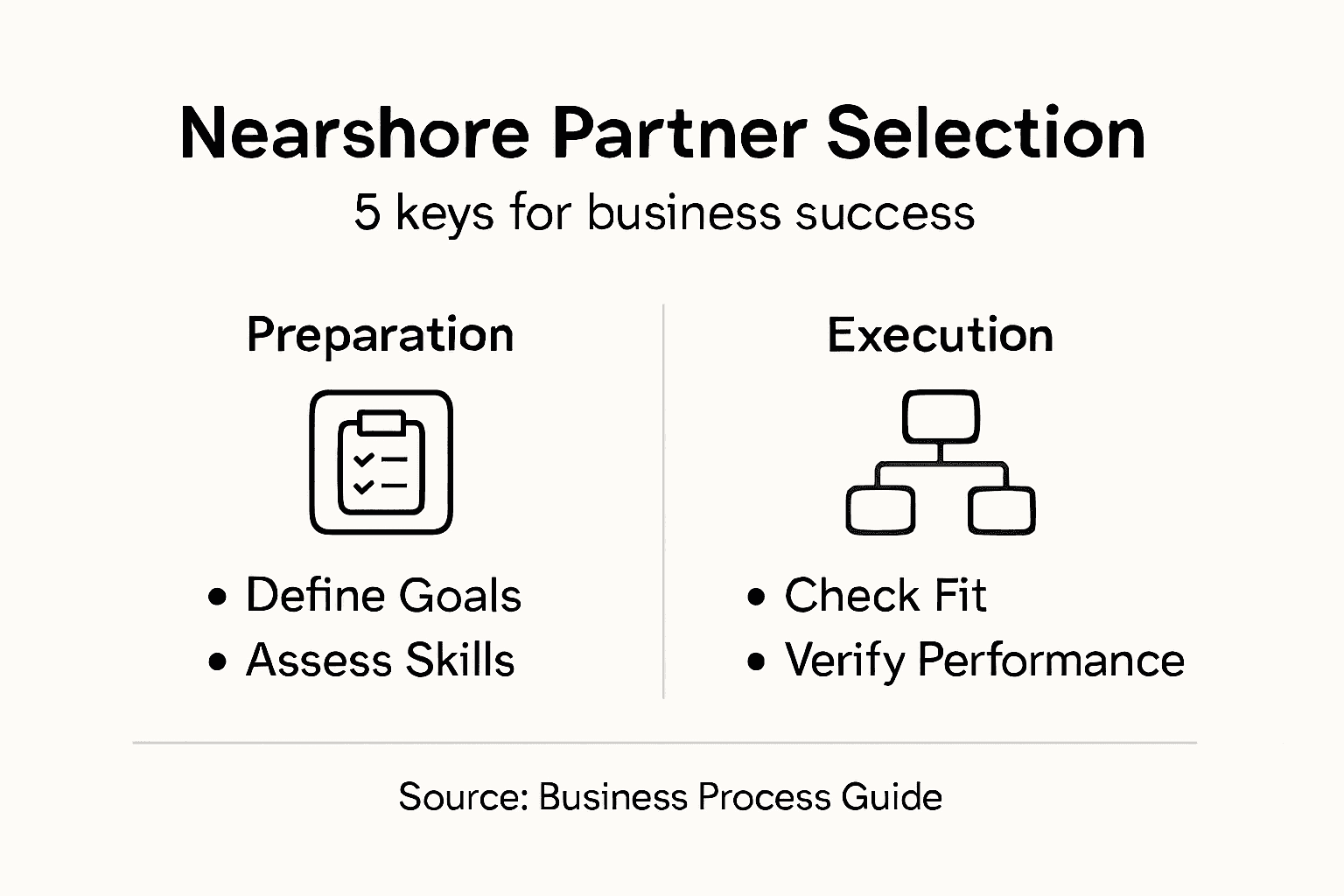
Choosing the right nearshore strategy can determine your company’s ability to access specialized talent while keeping costs under control. For European tech leaders, strategic outsourcing is no longer just an operational choice, but a direct path to competitive advantage. By anchoring your approach in a robust business strategy and using the SMART goal framework, you lay a clear foundation for successful partnerships that drive measurable business impact and align with long-term growth.
Table of Contents
- Step 1: Define Business Goals And Nearshoring Priorities
- Step 2: Assess Potential Partner Capabilities And Expertise
- Step 3: Review Operational Alignment And Cultural Fit
- Step 4: Verify References And Validate Performance
- Step 5: Negotiate Agreements And Establish Metrics
Quick Summary
| Key Takeaway | Explanation |
|---|---|
| 1. Define Clear Business Goals | Identify specific objectives for nearshoring to align collaborations with your strategic direction and operational needs. |
| 2. Assess Partner Expertise | Evaluate potential partners based on their technical skills, experiences, and ability to integrate within your structure. |
| 3. Ensure Cultural Alignment | Analyze how well partner cultures mesh to minimize friction and enhance teamwork, ensuring seamless collaboration. |
| 4. Validate Performance History | Verify past project successes through references and detailed performance metrics to ensure reliability and effectiveness. |
| 5. Negotiate Effective Agreements | Create agreements that address key areas like intellectual property and performance metrics to foster mutual growth. |
Step 1: Define Business Goals and Nearshoring Priorities
Defining clear business goals and nearshoring priorities is the foundational step for successful strategic outsourcing. This critical process ensures your nearshore partnership aligns precisely with your organization’s strategic objectives and operational requirements.
To effectively define your nearshoring priorities, start by conducting a comprehensive internal assessment of your current business challenges and future growth objectives. Business strategy fundamentals emphasize creating value through strategic initiatives that provide competitive advantage. Your nearshoring goals should directly address key performance areas such as:
- Cost optimization
- Talent acquisition
- Operational efficiency
- Technology infrastructure
- Market expansion capabilities
Utilize the SMART goal framework to ensure your nearshoring priorities are well-defined and actionable. SMART goal methodology helps businesses create objectives that are:
- Specific: Clearly articulate what you want to achieve
- Measurable: Establish concrete metrics for success
- Achievable: Set realistic targets
- Relevant: Align with broader business strategy
- Time-bound: Define clear implementation timelines
By meticulously defining your nearshoring priorities through this structured approach, you create a robust foundation for selecting a partner that can genuinely transform your business operations.
Pro tip: Document your nearshoring goals in a formal strategy paper, allowing for transparent communication and future performance tracking.
Step 2: Assess Potential Partner Capabilities and Expertise
Selecting the right nearshore partner requires a comprehensive evaluation of their technical skills, professional competencies, and alignment with your business objectives. This critical assessment ensures you choose a collaborator capable of delivering exceptional results and driving your strategic initiatives forward.
Partner evaluation criteria should encompass a holistic view of the potential nearshore team’s capabilities. Focus on examining their technical expertise, past project performance, and ability to integrate seamlessly with your existing organizational structure. Key areas to thoroughly investigate include:
- Technical skill sets and technology proficiencies
- Industry-specific knowledge and experience
- Track record of successful project implementations
- Evidence of continuous learning and innovation
- Communication and collaboration capabilities
Core professional competencies play a crucial role in determining a partner’s potential. Evaluate their team’s abilities across critical dimensions such as:
- Problem-solving skills
- Critical thinking capabilities
- Communication effectiveness
- Collaborative approach
- Adaptability and flexibility
Comprehensive partner assessment goes beyond technical skills – it’s about finding a strategic collaborator who can truly understand and advance your business objectives.
Consider conducting thorough due diligence, including detailed interviews, technical assessments, reference checks, and potential pilot projects to validate the partner’s claimed capabilities and cultural fit.

Pro tip: Request comprehensive portfolios and case studies that demonstrate the nearshore partner’s ability to solve complex challenges similar to your specific business needs.
Step 3: Review Operational Alignment and Cultural Fit
Successful nearshore partnerships extend far beyond technical capabilities, requiring deep understanding and seamless integration of organizational cultures and operational approaches. This critical step ensures your potential partner can truly become an extension of your team, minimizing potential friction and maximizing collaborative potential.
Operational alignment principles demand a comprehensive examination of how your potential partner’s organizational structure, communication protocols, and decision-making processes complement your own. Key dimensions to evaluate include:
- Communication styles and frequency
- Hierarchical structures and reporting mechanisms
- Problem-solving and conflict resolution approaches
- Work ethic and performance expectations
- Technological infrastructure and collaboration tools
Cultural competence strategies play a pivotal role in establishing successful cross-cultural partnerships. Focus on understanding how the nearshore team:
- Manages cultural differences
- Demonstrates adaptability
- Respects diverse work perspectives
- Communicates across cultural boundaries
- Integrates global best practices
True operational alignment transcends surface-level interactions – it requires genuine mutual understanding and respect for each organization’s unique cultural DNA.
Consider implementing preliminary collaborative projects or workshops to test compatibility, allowing both teams to experience firsthand how well your organizational cultures and work methodologies intersect.
Pro tip: Conduct structured cultural awareness training for both teams to proactively address potential communication and collaboration challenges.
Compare key differences between partner technical evaluation and cultural fit assessment:
| Evaluation Type | Main Criteria | Typical Methods |
|---|---|---|
| Technical Assessment | Skills, experience, innovation | Interviews, portfolio review |
| Cultural Fit Analysis | Values, communication, work style | Workshops, collaborative tests |
Step 4: Verify References and Validate Performance
Evaluating a potential nearshore partner’s performance history is a critical step that goes beyond surface-level assessments. This process requires a systematic and thorough investigation to ensure you select a partner with a proven track record of delivering exceptional results.
Reference verification techniques demand a comprehensive approach to examining the potential partner’s credentials and past performance. Your investigation should encompass multiple verification methods, including:
- Detailed client testimonial analysis
- Independent third-party reviews
- Comprehensive case study examination
- Direct reference checks with previous clients
- Verification of documented project outcomes
Performance assessment strategies require a multidimensional evaluation that considers both tangible results and process capabilities. Key performance validation dimensions include:
- Project delivery consistency
- Quality of work output
- Cost efficiency and budget management
- Skill development and continuous improvement
- Adaptability and problem-solving capabilities
Performance validation is not just about past achievements – it’s about predicting future potential and reliability.
Consider requesting detailed performance metrics, conducting in-depth interviews with their past clients, and potentially initiating a small pilot project to directly assess their capabilities and alignment with your organizational needs.
Pro tip: Request a comprehensive performance portfolio that includes quantifiable metrics, client testimonials, and specific case studies demonstrating their expertise in your industry.
Step 5: Negotiate Agreements and Establish Metrics
Negotiating a nearshore partnership requires strategic precision, carefully crafting agreements that protect both parties’ interests while establishing clear expectations for collaboration. This critical step transforms your potential partnership from a concept into a well-defined, mutually beneficial relationship.
Partnership agreement frameworks are fundamental in defining the legal and operational landscape of your collaboration. Your agreements should comprehensively address multiple dimensions, including:
- Intellectual property rights
- Confidentiality provisions
- Scope of work and deliverables
- Performance expectations
- Dispute resolution mechanisms
- Termination clauses
Performance metric establishment requires developing transparent, measurable indicators that objectively assess the partnership’s effectiveness. Key metrics to consider include:
- Quality of deliverables
- Project completion timelines
- Cost efficiency
- Communication responsiveness
- Innovation and problem-solving capabilities
Successful agreements are not about controlling every detail, but about creating a flexible framework that enables mutual growth and adaptation.
Consider implementing quarterly performance reviews, creating clear escalation pathways for potential issues, and building mechanisms for iterative improvement into your contractual framework.
Pro tip: Draft agreements with balanced language that protects both parties’ interests while maintaining an open, collaborative spirit.
Here’s a summary of how strategic nearshore outsourcing steps contribute to business transformation:
| Step in Process | Core Focus | Business Impact |
|---|---|---|
| Define Goals & Priorities | Strategic alignment | Ensures solutions fit objectives |
| Assess Partner Expertise | Technical and professional review | Enhances project success probability |
| Review Alignment & Fit | Operational and cultural synergy | Minimizes friction, improves teamwork |
| Validate Performance | Track record and reliability | Reduces risk, predicts future results |
| Negotiate & Set Metrics | Agreements and measurement | Enables continuous monitoring and growth |
Unlock Business Success with the Perfect Nearshore Partner
The article highlights the challenges businesses face when selecting a nearshore partner such as defining clear priorities, assessing capabilities, ensuring cultural fit, and validating performance. These critical pain points can create uncertainty and risk in your outsourcing journey. At StorsenDigital, we understand how vital it is to align nearshoring strategies with your goals for cost optimization, talent acquisition, and operational efficiency. Our tailored solutions offer expert talent recruitment, managed BPO services, and strategic consulting designed to seamlessly integrate with your business objectives and culture.
Experience the confidence that comes from partnering with a proven European outsourcing leader dedicated to minimizing friction and maximizing performance through transparent agreements and continuous improvement.
Take the next step NOW to transform your outsourcing approach with a partner who prioritizes operational alignment and measurable success metrics.

Discover how our expertise can empower your business by contacting us today at StorsenDigital Contact. Don’t wait to optimize your operations and gain a competitive edge through strategic nearshoring. Explore our comprehensive outsourcing solutions and begin your journey toward scalable, sustainable growth with StorsenDigital.
Frequently Asked Questions
What are the first steps to define business goals for selecting a nearshore partner?
Defining business goals starts with a thorough internal assessment of your current challenges and future objectives. Identify key performance areas such as cost optimization and operational efficiency, and then document these priorities using the SMART goal framework.
How can I assess the technical skills of a potential nearshore partner?
To assess a partner’s technical skills, review their past project performances and evaluate their industry-specific knowledge. Conduct interviews and request portfolios that demonstrate their expertise in similar challenges to those your business faces.
What criteria should I use to evaluate cultural fit with a nearshore partner?
Evaluate cultural fit by examining communication styles, work ethics, and problem-solving approaches of the potential partner. Implement preliminary collaborative projects to observe how well both teams integrate and adapt to each other’s cultures.
How do I validate the performance and reliability of a nearshore partner?
Validate performance by conducting thorough reference checks and analyzing client testimonials and past project outcomes. Gather detailed performance metrics to assess their consistency and quality of work effectively.
What should be included in a partnership agreement with a nearshore partner?
A partnership agreement should detail intellectual property rights, confidentiality, scope of work, and performance expectations. Ensure your agreement also incorporates mechanisms for dispute resolution and performance reviews to facilitate transparent collaboration.


