


Securing the right offshore team location often determines how well a European tech firm delivers consistent value and scales long term. For C-suite executives aiming to expand capacity while maintaining cost efficiency, the process goes far beyond labor rates. Strategic location selection demands a clear assessment of talent, infrastructure, and business climate, as location choice impacts not only cost, but overall operational performance and scalability. Here you will find a focused guide to help your organization lay a strong foundation for offshore success.
Table of Contents
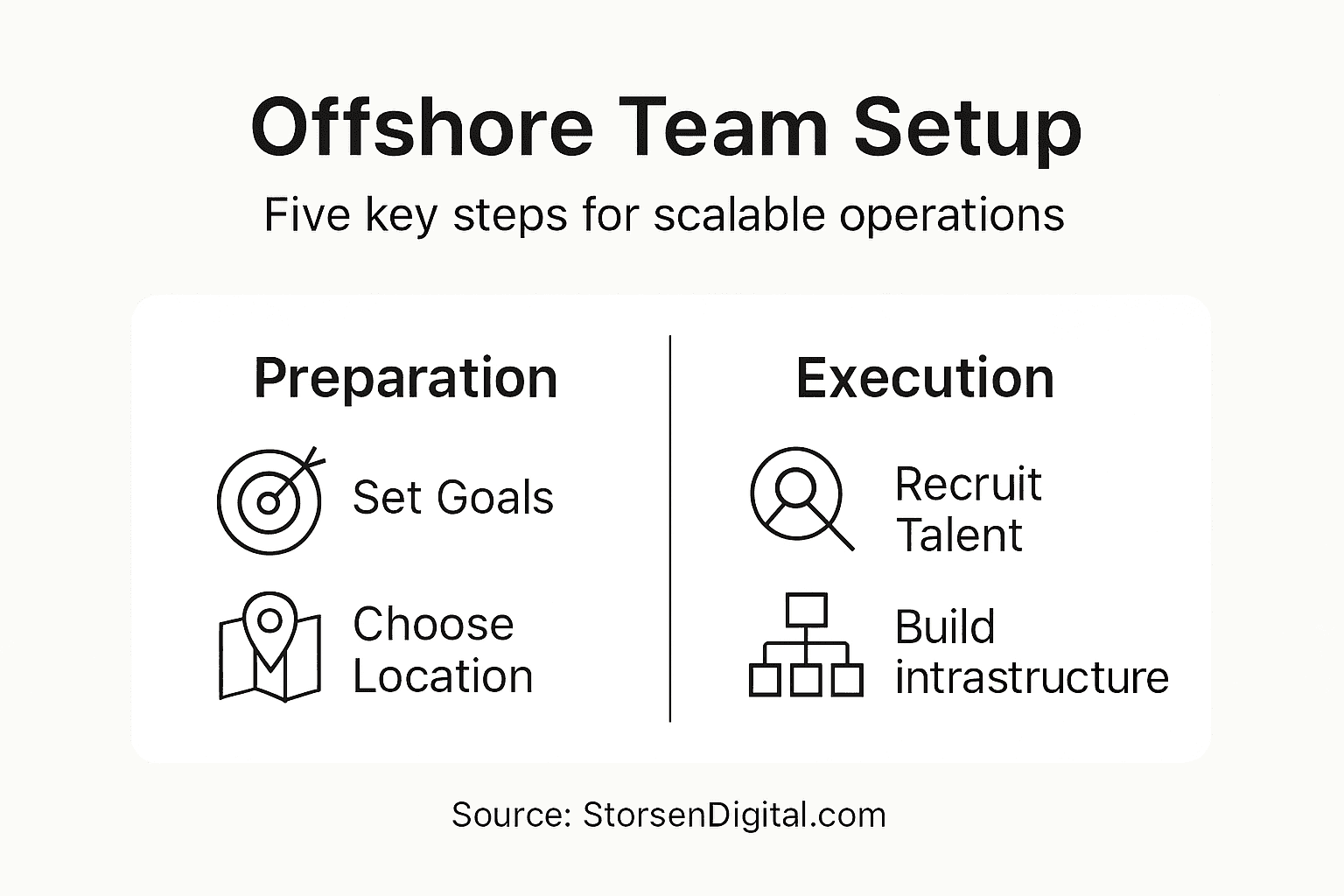
- Step 1: Define Goals And Select Offshore Location
- Step 2: Establish Legal And Compliance Framework
- Step 3: Identify Talent And Build Recruitment Process
- Step 4: Set Up Infrastructure And Collaborative Tools
- Step 5: Monitor Performance And Optimize Workflows
Quick Summary
| Key Insight | Explanation |
|---|---|
| 1. Choose the right offshore location | Selecting a location with a strong talent pool and good infrastructure is vital for operational success and cost efficiency. |
| 2. Establish a legal compliance framework | A robust compliance framework ensures adherence to legal standards and protects your business while operating internationally. |
| 3. Implement a strategic recruitment process | A clearly defined recruitment framework is essential for attracting and retaining top talent aligned with your organization’s goals. |
| 4. Build a strong technological infrastructure | Investing in reliable communication and project management tools facilitates collaboration and enhances team productivity across locations. |
| 5. Monitor performance and optimize workflows | Regularly assess team performance using KPIs to identify opportunities for improvement and maintain operational excellence. |
Step 1: Define goals and select offshore location
Choosing the right offshore location is a critical strategic decision that determines the long term success of your operations. Your goal is to identify a geographic region that offers the best combination of talent, infrastructure, and cost efficiency for your specific business needs.
Begin by conducting a comprehensive assessment of your operational requirements. This means mapping out precise performance metrics and skill sets needed for your offshore team. Strategic location selection involves analyzing multiple factors beyond just labor costs. Consider language capabilities, technological infrastructure, talent market depth, business environment, and potential scalability.
Key criteria for offshore location selection should include workforce quality, English proficiency, educational standards, internet connectivity, time zone alignment with your primary markets, and geopolitical stability. Bosnia and Herzegovina offers an exceptional option with its highly educated workforce, strong technical skills, cultural alignment with European markets, and competitive cost structures. By carefully evaluating these dimensions, you can identify a location that transforms offshore operations from a cost center into a strategic growth accelerator for your organization.
Here’s a quick reference comparing top offshore location selection factors:
| Selection Factor | Why It Matters | Business Impact |
|---|---|---|
| Workforce Quality | Determines productivity levels | Higher output, better quality |
| English Proficiency | Eases global communication | Fewer miscommunications |
| Educational Standards | Ensures deep talent pool | Access to advanced skills |
| Internet Connectivity | Enables remote operations | Reliable workflow, fewer delays |
| Time Zone Alignment | Facilitates real-time support | Smoother project coordination |
| Geopolitical Stability | Reduces operational risks | Secure business continuity |
Pro tip: Create a weighted scoring matrix to objectively evaluate potential offshore locations, assigning numerical values to each critical selection criterion.
Step 2: Establish legal and compliance framework
Creating a robust legal and compliance framework is fundamental to establishing a successful offshore team. This step ensures your international operations align with global regulatory standards while protecting your business interests and maintaining operational integrity.
The foundation of your compliance strategy requires comprehensive understanding of legal requirements for offshore companies. This involves meticulous documentation of beneficial ownership, tracking economic activities, and ensuring transparent reporting mechanisms. For businesses considering Bosnia and Herzegovina, you will need to navigate specific European Union regulatory frameworks, labor laws, tax regulations, and corporate governance standards.
Start by consulting local legal experts specializing in international business operations. Develop a comprehensive compliance checklist that covers employment regulations, tax obligations, intellectual property protections, data privacy laws, and corporate registration requirements. Prioritize creating clear documentation processes, establishing formal reporting structures, and implementing robust internal control systems that demonstrate economic substance and regulatory adherence. Your goal is to build a compliance framework that not only meets legal requirements but also establishes your offshore team as a credible and professional business entity.
Pro tip: Engage a local legal consultant who specializes in international business regulations to conduct a comprehensive compliance audit before finalizing your offshore team structure.
Step 3: Identify talent and build recruitment process
Developing a strategic recruitment process is critical for building a high-performing offshore team that aligns with your organizational goals. Your objective is to create a comprehensive talent acquisition framework that identifies, attracts, and retains top professional talent in your target market.
The recruitment process begins with developing a detailed skills matrix that precisely outlines the technical and soft skills required for each role. Outsourcing recruitment strategies can provide significant advantages in accessing specialized talent pools, particularly in regions like Bosnia and Herzegovina with a rich pipeline of skilled professionals. Focus on creating targeted job descriptions that communicate your company culture, technical requirements, and growth opportunities.

Implement a multi staged recruitment approach that includes rigorous screening, technical assessments, cultural fit interviews, and comprehensive background verification. Partner with local recruitment agencies who understand the nuanced talent landscape and can help you navigate regional hiring complexities. Prioritize candidates with strong English communication skills, relevant educational backgrounds, and demonstrated ability to work in international team environments. Develop a robust onboarding program that provides comprehensive training, clear performance expectations, and opportunities for professional development to ensure long term engagement and productivity.
Pro tip: Create a standardized evaluation scorecard that objectively assesses candidate potential across technical competence, communication skills, and cultural adaptability.
Step 4: Set up infrastructure and collaborative tools
Building a robust technological infrastructure is fundamental to creating a seamless and productive offshore team. Your goal is to establish a comprehensive digital ecosystem that enables smooth communication, efficient workflow management, and secure collaboration across geographic boundaries.
Start by selecting communication tools that enhance collaboration with strong reliability and security features. Implement a mix of synchronous and asynchronous platforms that accommodate different work styles and time zones. Key tools should include video conferencing software for real time interactions, project management platforms for tracking progress, cloud based document sharing systems, instant messaging applications, and secure virtual private network (VPN) solutions. For teams in Bosnia and Herzegovina, prioritize tools with excellent uptime guarantees and multilingual support to ensure seamless integration.
Create a standardized digital onboarding package that provides team members with clear guidelines for tool usage, communication protocols, and cybersecurity best practices. Establish regular virtual check ins, implement performance tracking metrics, and develop a system for transparent reporting and accountability. Invest in high quality technical infrastructure including reliable internet connectivity, ergonomic workstations, and backup communication channels to minimize potential operational disruptions.
Here’s an overview of key tech tools for offshore team collaboration:
| Tool Type | Primary Benefit | Ideal Business Use |
|---|---|---|
| Video Conferencing | Real-time communication | Meetings, daily standups |
| Project Management | Task tracking | Milestone monitoring |
| Document Sharing | Centralized files | Version control, teamwork |
| Instant Messaging | Quick info exchange | Immediate responses |
| VPN Solutions | Secure data access | Protect sensitive workflows |
Pro tip: Conduct periodic technology audits to evaluate tool effectiveness and identify opportunities for streamlining your digital collaboration infrastructure.
Step 5: Monitor performance and optimize workflows
Establishing a robust performance monitoring and workflow optimization strategy is crucial for maintaining the productivity and effectiveness of your offshore team. Your objective is to create a dynamic system that continuously assesses team performance, identifies improvement opportunities, and drives operational excellence.
Implement a comprehensive performance management framework that combines quantitative metrics and qualitative assessments. Develop key performance indicators (KPIs) specific to each role and team function, ensuring they align with your overall business objectives. Utilize project management tools that provide real time tracking of individual and team productivity, including metrics like task completion rates, quality of work, response times, and client satisfaction scores. For offshore teams in Bosnia and Herzegovina, consider cultural nuances and communication styles when designing performance evaluation criteria.
Conduct regular performance review cycles that include both automated metric analysis and personal feedback sessions. Create a transparent performance improvement process that offers targeted training, skill development opportunities, and clear career progression paths. Encourage a culture of continuous learning and improvement by implementing peer review mechanisms, cross functional knowledge sharing sessions, and periodic skill assessment workshops. Regularly analyze workflow bottlenecks, streamline communication channels, and adapt your operational processes to enhance overall team efficiency and output quality.
Pro tip: Develop a balanced scorecard approach that evaluates performance across multiple dimensions including productivity, quality, innovation, and professional growth.
Unlock the Full Potential of Your Offshore Team with Expert Support
Setting up an offshore team for scalable operations can feel overwhelming when faced with challenges like selecting the ideal location, ensuring legal compliance, recruiting top talent, and building seamless infrastructure. You want more than just cost savings—you need strategic growth, reliable performance monitoring, and a partner who understands the complexities of regions like Bosnia and Herzegovina.
StorsenDigital.com specializes in overcoming these exact challenges through tailored outsourcing, nearshoring, and Business Process Outsourcing (BPO) services across Europe. Whether you need expert guidance on recruiting skilled professionals, establishing compliant operations, or implementing cutting-edge collaborative tools, we provide the comprehensive solutions that transform your offshore team into a strong competitive advantage.
Take action now and move beyond uncertainty. Discover how our proven recruitment strategies, managed BPO services, and strategic consulting can accelerate your success. Explore our contact page to start a conversation with our experts.

Ready to build an offshore team that scales with confidence and compliance Visit https://www.storsendigital.com/contact/ to connect with specialists who are committed to your growth and operational excellence today.
Frequently Asked Questions
What are the key factors to consider when selecting an offshore location?
Choosing the right offshore location involves evaluating workforce quality, English proficiency, educational standards, internet connectivity, and time zone alignment. Assess these criteria to ensure you select a location that supports scalability and reduces operational risks.
How can I create a legal and compliance framework for my offshore team?
To establish a legal and compliance framework, consult local legal experts to understand the specific regulations, labor laws, and tax obligations in your chosen offshore location. Create a comprehensive compliance checklist and document key processes to protect your business interests and maintain operational integrity.
What steps should I follow to identify and recruit talent for my offshore team?
Begin by developing a detailed skills matrix that outlines the necessary technical and soft skills for each role. Implement a multi-stage recruitment process that includes rigorous screening, cultural fit interviews, and background checks to attract top talent.
How do I set up effective collaboration tools for my offshore team?
Select communication and project management tools that facilitate secure collaboration and accommodate different time zones. Prioritize tools that offer strong reliability and security features, and create standardized guidelines for usage to enhance efficiency and communication.
How can I monitor performance and optimize workflows for my offshore team?
Implement a performance management framework that includes specific key performance indicators (KPIs) for each role. Conduct regular performance reviews and utilize project management tools to track productivity, identifying workflow bottlenecks and optimizing processes for better efficiency.


