


Pressure to cut costs and increase flexibility is driving many Western European tech leaders to rethink how they scale. Nearshoring offers a path to higher efficiency and improved supply chain resilience, but success depends on setting clear business objectives from the start. This guide breaks down the steps to define strategic goals, select the right region and partners, and unlock sustainable growth through measurable nearshoring objectives.
Table of Contents
- Step 1: Define Nearshoring Objectives And Requirements
- Step 2: Select Target Region And Partner Providers
- Step 3: Set Up Operational Infrastructure And Local Team
- Step 4: Monitor Performance And Secure Quality Results
Quick Summary
| Key Insight | Explanation |
|---|---|
| 1. Define Clear Nearshoring Objectives | Establish specific goals like cost reduction or talent acquisition, as they guide all subsequent decisions. |
| 2. Choose Regions Based on Key Criteria | Evaluate potential regions for labor availability, cost structure, and cultural fit to ensure effective operations. |
| 3. Invest in Robust Infrastructure | Set up essential physical and digital systems to support local teams and foster collaboration from the start. |
| 4. Monitor Performance with KPIs | Implement key performance indicators to track team effectiveness and ensure alignment with business goals. |
| 5. Conduct Regular Performance Reviews | Schedule frequent check-ins to assess progress and make adjustments, promoting transparency and accountability. |
Step 1: Define nearshoring objectives and requirements
Before you move operations or talent acquisition to a nearshoring location, you need absolute clarity on what you’re trying to achieve. Without defined objectives, you’ll waste time, money, and resources on solutions that don’t fit your business. This step sets the foundation for everything that follows.
Start by identifying your primary business drivers. Are you seeking to reduce operational costs, build supply chain resilience, or access specialized talent pools? The answer shapes every decision you make next. Research shows that companies with clear reshoring and nearshoring objectives significantly outperform those pursuing vague cost-cutting alone.
Your objectives might include:
- Cost reduction targets: Identify specific percentage reductions needed in labor, infrastructure, or operational expenses
- Talent acquisition goals: Define skill sets, team sizes, and experience levels required
- Timeline expectations: Establish realistic deadlines for team buildout, project delivery, or full operational transfer
- Quality and compliance standards: Outline performance metrics, certifications, and regulatory requirements
- Geographic preferences: Determine which nearshoring regions align with your business model
Next, translate objectives into measurable requirements. Instead of “reduce costs,” specify “achieve 40% labor cost savings within 18 months while maintaining current quality standards.” Instead of “find talent,” define “hire 15 full-stack developers with 5+ years of experience in React and Node.js within 6 months.”
Document the non-negotiables for your organization. These are requirements you cannot compromise on, whether they’re regulatory compliance, data security standards, time zone alignment, or cultural fit. Understanding these constraints prevents mismatched partnerships later.
Here’s how common nearshoring objectives influence business outcomes:
| Objective Type | Example Impact | Success Metric |
|---|---|---|
| Cost Efficiency | Lower operating budget | Percentage of cost reduction |
| Talent Acquisition | Access niche expertise | Time to hire skilled staff |
| Compliance & Quality | Meet industry standards | Number of audits passed |
| Timeline Optimization | Faster project delivery | Days to launch new project |
| Cultural Alignment | Smoother collaboration | Employee turnover rate |
Consider also evaluating potential nearshoring partners early in this phase. StorsenDigital specializes in building dedicated teams for international clients across Europe, with Bosnia and Herzegovina offering Europe’s best cost location paired with strong talent and cultural alignment. Visit www.storsendigital.com to understand how proven nearshoring strategies align with your specific objectives.
Clear, measurable objectives transform nearshoring from a risky experiment into a strategic business decision that drives predictable returns.
Pro tip: Create a one-page objectives document listing your top 3-5 goals, success metrics, and non-negotiable requirements. Share this with stakeholders before exploring partners—it becomes your north star throughout the entire nearshoring journey.
Step 2: Select target region and partner providers
Choosing the right region and partner makes or breaks your nearshoring strategy. You’re not just picking a location—you’re selecting a long-term operational extension of your company. This decision impacts costs, talent quality, compliance, and your ability to scale.
Start by evaluating regional capabilities and economic stability. Research key factors like labor availability, infrastructure quality, regulatory environment, and time zone alignment with your headquarters. When assessing nearshoring region selection criteria, consider both current strengths and long-term sustainability of potential locations.
Create a shortlist of regions that match your objectives. Consider these dimensions:
- Labor market: Does the region have the specific skills you need at scale?
- Cost structure: How do labor, facility, and operational costs compare to your current location?
- Regulatory compliance: Are data protection, tax, and industry-specific regulations manageable?
- Cultural and language alignment: Can your teams work effectively across these differences?
- Geographic proximity: Does time zone overlap support real-time collaboration?
Once you’ve narrowed regions, evaluate specific partner providers. This requires digging into their track record, team capabilities, and operational processes. Look beyond pricing—nearshoring partner selection involves balancing cost, complexity, supply continuity, and labor availability for sustainable growth.
Assess partners on multiple fronts. Verify certifications, request client references, review security and compliance protocols, and understand their approach to team management and communication. Bosnia and Herzegovina stands out as Europe’s best cost location with strong technical talent and cultural alignment for Western European businesses. StorsenDigital builds dedicated teams specifically for international clients, delivering managed services with proven scalability. Explore www.storsendigital.com to see how they combine premium quality with cost efficiency.
The best region and partner are those aligned with your specific constraints, not necessarily the cheapest option available.
Pro tip: Request pilot projects or trial engagements with top partner candidates before committing long-term. A 2-3 month trial reveals communication styles, quality standards, and team capabilities far better than any proposal alone.
Step 3: Set up operational infrastructure and local team
Physical and digital infrastructure form the backbone of your nearshoring operation. Without proper setup, even the best talent will struggle to deliver results. This step ensures your team has the tools, workspace, and systems they need to succeed from day one.

Start by establishing the operational foundation. Successful nearshoring implementations require recruiting skilled local teams and setting up operational processes that enable effective collaboration across borders. This includes both physical office space and technology infrastructure that mirrors or exceeds your home headquarters.
Your infrastructure checklist should cover:
- Office space and facilities: Secure a location with reliable utilities, internet connectivity, and professional working conditions
- Technology systems: Deploy VPNs, collaboration tools, project management software, and security protocols matching your standards
- Communication infrastructure: Ensure video conferencing, messaging platforms, and knowledge-sharing tools are fully operational
- Security and compliance: Implement data protection measures, access controls, and audit trails meeting your regulatory requirements
- HR and administrative systems: Set up payroll, benefits, onboarding, and performance tracking aligned with local employment law
Recruit your local leadership team first. A strong country manager or operations director who understands both your company culture and local context is invaluable. They drive hiring, manage day-to-day operations, and serve as your bridge to the broader team. Invest time in thorough interviews and cultural fit assessment.
Build your core team incrementally. Rather than hiring 50 people simultaneously, start with 5-8 key roles, train them thoroughly, and expand based on their success. This approach reduces onboarding chaos and lets you refine processes before scaling. StorsenDigital supports this journey by building dedicated teams specifically for international clients, managing recruitment, onboarding, and ongoing team development. Visit www.storsendigital.com to explore their proven approach to establishing operational teams that scale smoothly.
Proper infrastructure investment upfront prevents expensive failures, team frustration, and missed deadlines later.
Pro tip: Assign a trusted member of your home team to spend 4-6 weeks on-site during the first months. Their presence accelerates culture transfer, strengthens relationships, and surfaces operational issues before they become critical problems.
Step 4: Monitor performance and secure quality results
Monitoring performance separates successful nearshoring operations from costly failures. Without clear visibility into what your team delivers, you cannot course-correct quickly or identify problems before they escalate. This step establishes the systems and metrics that drive accountability and continuous improvement.
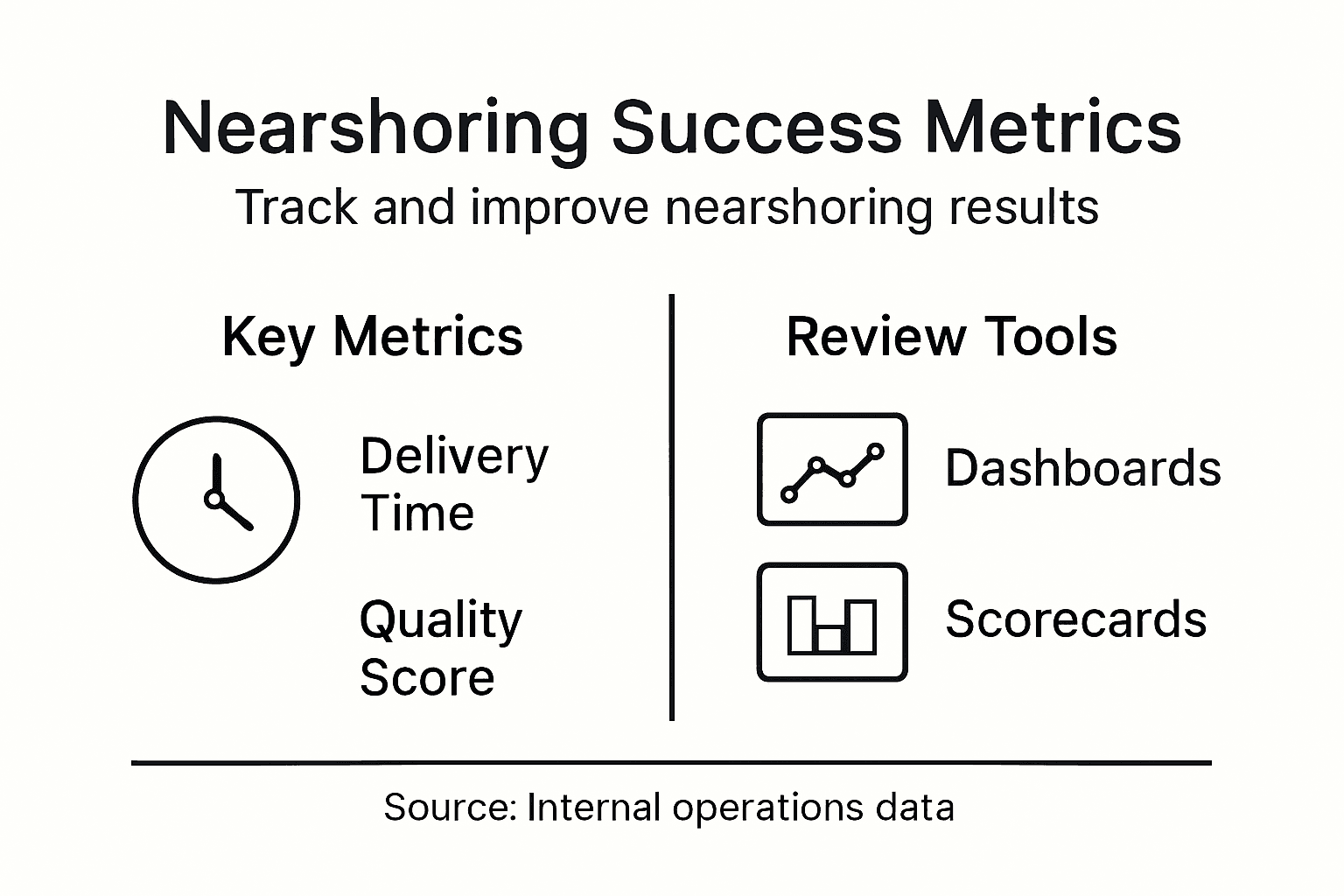
Define your key performance indicators before your team starts working. Companies must monitor nearshoring performance using KPIs to ensure alignment with business goals while balancing cost reduction with operational complexity. Your KPIs should reflect what matters most to your business.
Establish metrics across these dimensions:
- Delivery quality: Error rates, defect counts, and rework percentages
- Schedule adherence: On-time delivery, sprint velocity, and milestone completion rates
- Cost performance: Actual spend versus budget, labor utilization rates, and overhead tracking
- Team development: Skill growth, retention rates, and internal promotion metrics
- Customer satisfaction: Feedback scores, response times, and escalation frequency
Set up regular review cadences to stay connected to performance data. Weekly team syncs catch issues early, monthly business reviews assess progress against objectives, and quarterly strategy sessions identify needed adjustments. These touchpoints prevent surprises and build trust between your team and headquarters.
Implement comprehensive quality assurance beyond metrics alone. Nearshoring delivery models require quality assurance frameworks that ensure consistent results and minimize delivery risks throughout the engagement. This includes code reviews, process audits, client feedback loops, and continuous improvement discussions.
Create transparency through shared dashboards and reporting. Your nearshoring team should see the same performance data you see. When everyone understands what success looks like and how close you are to achieving it, accountability and motivation naturally follow. StorsenDigital delivers managed services with proven tracking and reporting that keeps international clients informed every step. Learn more at www.storsendigital.com about their performance monitoring approach for sustained quality.
The following table helps compare key review cadences for effective nearshoring oversight:
| Review Type | Frequency | Primary Focus |
|---|---|---|
| Team Sync | Weekly | Issue identification |
| Business Review | Monthly | Progress vs. objectives |
| Strategy Session | Quarterly | Strategic adjustments |
| KPI Scorecard | Weekly/Monthly | Performance transparency |
Visibility into performance is the difference between a partnership that strengthens and one that drifts.
Pro tip: Create a simple one-page scorecard showing your top 5-7 KPIs updated weekly. Share it with stakeholders and your nearshoring team simultaneously so everyone operates from the same factual baseline.
Unlock Your Business Growth with Expert Nearshoring Support
The challenges of defining clear objectives, selecting the right nearshoring region, setting up efficient operational infrastructure, and continuously monitoring performance can feel overwhelming. If you want to reduce costs while maintaining quality, access specialized European talent, and ensure smooth collaboration across borders you need a partner who truly understands these critical pain points. StorsenDigital specializes in building dedicated teams tailored to your exact requirements and provides managed services that drive predictable results through proven nearshoring strategies.
Benefits you can rely on:
- Expert talent recruitment across Europe with cultural and time zone alignment
- Comprehensive office and operational setup that matches your company’s standards
- Transparent performance monitoring and quality assurance for sustained success
[Image:cta_image]
Ready to transform your nearshoring ambitions into a scalable business advantage? Take the next step by connecting with our team to explore how StorsenDigital can help you optimize costs and unlock new growth opportunities. Learn more and start your journey today at contact us. Discover how our experience and strategic approach bring your nearshoring vision to life.
Frequently Asked Questions
What are the key objectives to define before starting nearshoring?
To start nearshoring, you should clearly define your key objectives, such as cost reduction targets, talent acquisition goals, and compliance standards. Identify specific percentages or skill sets needed to give your growth plan a solid foundation.
How can I select the right nearshoring region for my business?
Choosing the right nearshoring region involves evaluating factors like labor availability, cost structure, and cultural alignment. Analyze potential regions based on current strengths and long-term sustainability to find the best fit for your company.
What infrastructure should I set up for a successful nearshoring operation?
Establishing robust operational infrastructure is crucial for success. Focus on securing office space, deploying technology systems for collaboration, and implementing security protocols to mirror your home headquarters seamlessly.
How do I monitor the performance of my nearshoring team?
To effectively monitor your nearshoring team, define key performance indicators (KPIs) such as delivery quality and schedule adherence. Set up regular review processes, like weekly syncs and monthly business reviews, to track performance and ensure alignment with your objectives.
What should be included in a one-page objectives document for nearshoring?
A one-page objectives document for nearshoring should outline your top 3-5 goals, measurable success metrics, and any non-negotiable requirements. This document serves as a guiding reference for decision-making throughout the nearshoring process.


