


Every IT operations manager knows the challenge of keeping complex systems running smoothly while balancing budgets and resources. For medium to large European enterprises, finding hidden inefficiencies and gaps can make a significant difference in daily performance. This article offers practical steps to assess workflows, address bottlenecks, and adopt nearshoring solutions that enhance efficiency and deliver measurable cost optimization.
Table of Contents
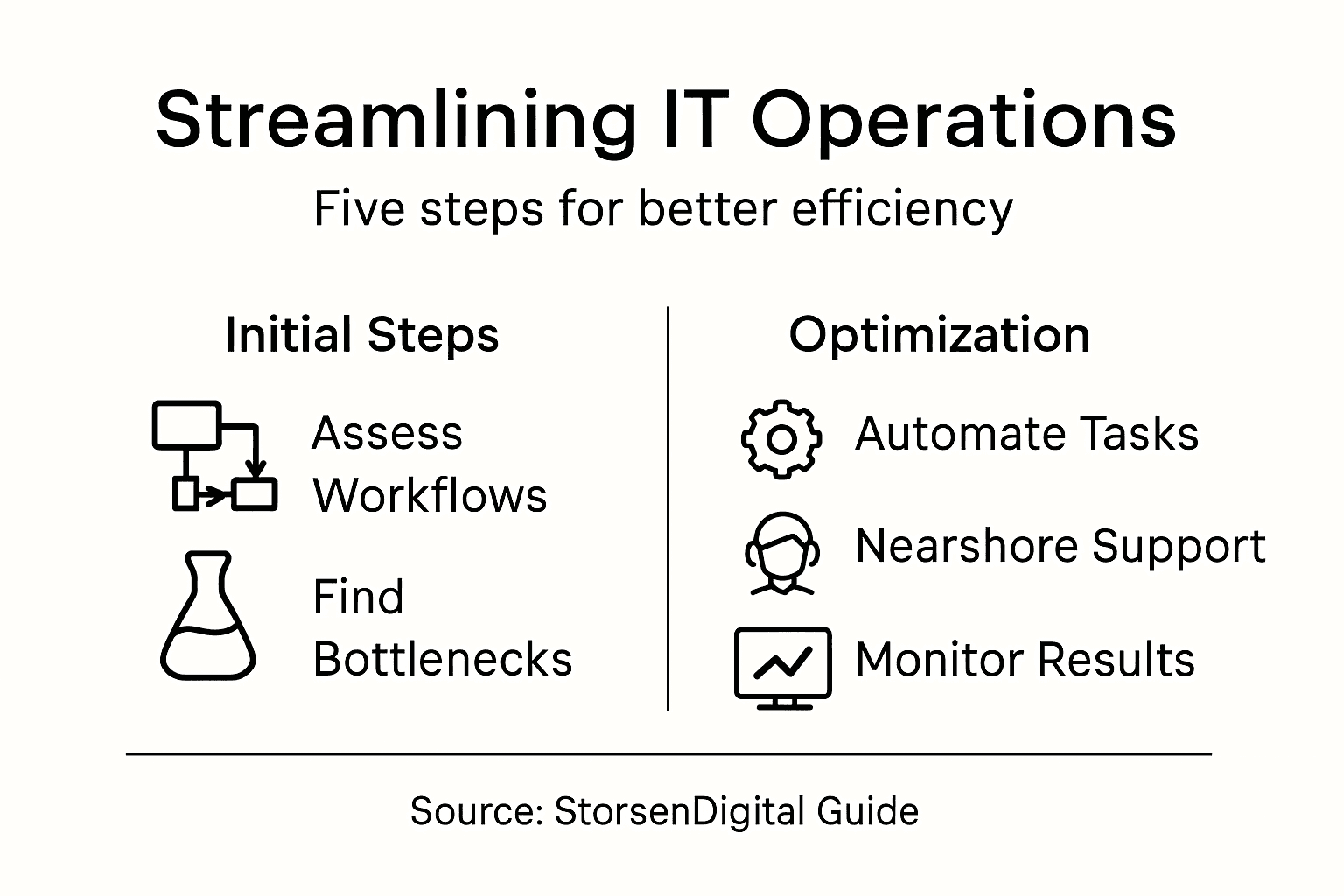
- Step 1: Assess Current It Workflows And Resources
- Step 2: Identify And Prioritize Process Bottlenecks
- Step 3: Implement Automation And Standardized Solutions
- Step 4: Leverage Nearshoring For Scalable It Support
- Step 5: Monitor Outcomes And Refine Operations
Quick Summary
| Key Insight | Explanation |
|---|---|
| 1. Assess Existing IT Workflows | Evaluate your current IT processes to identify inefficiencies and resource gaps for strategic improvements. |
| 2. Prioritize Process Bottlenecks | Systematically analyze and rank workflow constraints to focus on those with the greatest operational impact. |
| 3. Implement Automation Solutions | Automate repetitive tasks to increase efficiency and free up employee time for more strategic work. |
| 4. Leverage Nearshoring | Use nearshoring to enhance IT capabilities with cost-effective and scalable support solutions. |
| 5. Continuous Monitoring is Essential | Establish robust monitoring metrics to track performance and encourage ongoing operational refinement. |
Step 1: Assess Current IT Workflows and Resources
Streamlining your IT operations starts with a comprehensive assessment of your current workflows and technological infrastructure. This critical first step helps you identify inefficiencies, pinpoint resource gaps, and create a strategic roadmap for operational improvement.
To conduct a thorough evaluation, start by mapping out your existing IT processes. Assess IT workflow frameworks systematically by collecting detailed documentation about current operational procedures. Here’s a structured approach:
- Inventory all existing hardware and software systems
- Document current workflow processes for each department
- Analyze system integration points and potential bottlenecks
- Review current performance metrics and efficiency indicators
A successful IT workflow assessment reveals hidden opportunities for optimization and cost reduction.
Utilize comprehensive tools and methodologies from government IT strategic planning to create a robust evaluation framework. Focus on understanding how different technological components interact, identifying redundant processes, and determining areas where automation or restructuring could yield significant improvements.
Recommended assessment techniques include conducting stakeholder interviews, performing technical audits, and analyzing system logs to gain comprehensive insights. Pay special attention to cross-departmental workflow interactions that might create unnecessary complexity or inefficiency.
Here’s a comparison of IT workflow assessment techniques and their unique advantages:
| Technique | Main Benefit | Typical Application |
|---|---|---|
| Stakeholder Interviews | Uncover user perspectives | Identify pain points across teams |
| Technical Audits | Reveal system inefficiencies | Analyze hardware/software performance |
| System Log Analysis | Provide real-time insights | Detect failures and bottlenecks |
| Cross-Department Reviews | Improve process integration | Resolve workflow disconnects |
Pro tip: Consider involving team members from multiple departments to get a holistic view of your current IT ecosystem and uncover insights that might be missed by a purely top-down assessment.
Step 2: Identify and Prioritize Process Bottlenecks
Understanding and addressing process bottlenecks is crucial for improving your IT operational efficiency. In this step, you’ll learn how to systematically identify, analyze, and prioritize workflow constraints that slow down your organization’s technological performance.
Identifying workflow bottlenecks requires a strategic and comprehensive approach. Start by gathering data on your current processes and examining where tasks get delayed or resources become congested. Consider these key methods:
- Monitor task completion times
- Track resource utilization rates
- Analyze queue lengths and waiting periods
- Examine interdepartmental handoff points
- Review system performance logs
Not all bottlenecks are created equal – focus on those with the most significant impact on overall workflow efficiency.
Utilize detailed process bottleneck analysis techniques to determine which constraints require immediate attention. Prioritize bottlenecks by evaluating their:
- Frequency of occurrence
- Duration of delay
- Financial and operational impact
- Complexity of resolution
Recommended prioritization strategies include creating a bottleneck impact matrix and scoring each constraint based on its potential disruption to your IT operations. Pay special attention to recurring performance issues that consistently impede workflow productivity.

Pro tip: Implement a continuous monitoring system that automatically flags potential bottlenecks, allowing your team to proactively address workflow constraints before they significantly impact operational efficiency.
Step 3: Implement Automation and Standardized Solutions
Transforming your IT operations requires strategic automation and standardization to reduce manual effort and increase overall efficiency. This step focuses on identifying opportunities to streamline processes and implement scalable technological solutions that can dramatically improve your organizational performance.
Robotic process automation strategies enable organizations to systematically reduce repetitive tasks and minimize human error. Begin by mapping out your current workflows and identifying prime candidates for automation:
- Repetitive administrative tasks
- Data entry processes
- Regular reporting requirements
- Routine approval workflows
- Standard communication protocols
Successful automation is not about replacing human workers but empowering them to focus on high-value strategic activities.
Workflow standardization techniques help create consistent, predictable processes across different departments. Implement automation by following these strategic steps:
- Select appropriate automation tools
- Map existing process workflows
- Design standardized process templates
- Configure automation rules
- Test and validate automated processes
Key automation considerations include selecting tools that integrate seamlessly with your existing systems and provide robust reporting capabilities. Focus on creating flexible automation frameworks that can adapt to changing organizational needs.
Pro tip: Start with low-risk, high-volume processes when introducing automation, and gradually expand your automated workflows after demonstrating initial success and gathering measurable performance improvements.
Step 4: Leverage Nearshoring for Scalable IT Support
Nearshoring offers a strategic approach to expanding your IT capabilities while maintaining operational flexibility and cost-effectiveness. This step will guide you through identifying and implementing a robust nearshoring strategy that can transform your technological infrastructure.
European IT nearshoring strategies provide organizations with unique advantages in scaling technological support. Consider these critical factors when evaluating potential nearshoring partnerships:
- Geographic proximity and time zone alignment
- Cultural and linguistic compatibility
- Technical skill depth and expertise
- Cost efficiency compared to local hiring
- Scalability of support infrastructure
Effective nearshoring is about creating a seamless extension of your existing team, not just reducing costs.
Tech talent nearshoring approaches enable companies to build flexible, responsive IT support models. Develop your nearshoring strategy by focusing on these key implementation steps:
- Define specific technological support requirements
- Research potential nearshore talent markets
- Evaluate vendor communication and integration capabilities
- Establish clear performance metrics
- Design comprehensive onboarding processes
Strategic nearshoring considerations include assessing the potential partner’s technological infrastructure, talent pool quality, and ability to integrate smoothly with your existing systems. Prioritize building collaborative, long-term partnerships that offer both skill and adaptability.
This table summarizes the most impactful nearshoring factors and their business importance:
| Factor | Impact on Business | Reason for Importance |
|---|---|---|
| Time Zone Alignment | Enhances collaboration | Enables real-time communication |
| Technical Skill Depth | Boosts service quality | Provides specialized expertise |
| Cost Efficiency | Reduces operational costs | Allows competitive pricing |
| Scalability | Supports business growth | Expands IT capabilities quickly |
Pro tip: Conduct pilot projects with potential nearshore partners to validate their capabilities and cultural fit before making full-scale commitments, allowing you to minimize risks and assess real-world performance.
Step 5: Monitor Outcomes and Refine Operations
Continuous improvement is the cornerstone of effective IT operations management. This final step focuses on establishing robust monitoring mechanisms that will help you track performance, identify improvement opportunities, and systematically refine your technological infrastructure.
Operational efficiency monitoring techniques demonstrate the critical importance of data-driven performance evaluation. Develop a comprehensive monitoring strategy by implementing these key practices:
- Establish clear performance metrics
- Create real-time dashboard tracking
- Set up automated reporting systems
- Define regular review intervals
- Design adaptive feedback mechanisms
Success in IT operations comes from continuous learning and incremental improvements, not from achieving a perfect state.
Your monitoring approach should encompass multiple dimensions of operational performance. Focus on gathering and analyzing data across these critical areas:
- Technical performance indicators
- Resource utilization rates
- Cost efficiency metrics
- Team productivity measurements
- Customer or internal user satisfaction
Performance tracking techniques require a holistic approach that balances quantitative metrics with qualitative insights. Prioritize creating flexible evaluation frameworks that can adapt to changing technological landscapes and organizational needs.
Pro tip: Implement a quarterly review process where you not only analyze performance data but also solicit direct feedback from team members to uncover improvement opportunities that might not be immediately visible in standard metrics.
Elevate Your IT Operations with Tailored Nearshoring and BPO Solutions
Struggling to streamline your IT workflows and eliminate costly bottlenecks? You are not alone. Many businesses face challenges like inefficient processes, scattered resources, and lack of scalable support. This article highlights key steps such as assessing workflows, implementing automation, and leveraging nearshoring to boost operational efficiency. At StorsenDigital, we specialize in providing comprehensive nearshoring and Business Process Outsourcing solutions designed specifically to address these pain points. Our European talent network and managed services empower your teams to focus on innovation while we handle IT support, recruitment, and process optimization.

Take control of your IT operations today. Partner with StorsenDigital to access flexible, cost-effective staffing and automation support that adapts with your growth. Visit our contact page now for a consultation. Discover how strategic outsourcing can transform your technology workflows and drive lasting efficiency improvements.
Frequently Asked Questions
How can I assess my current IT workflows for better efficiency?
Start by mapping out all existing processes and documenting them in detail. Conduct interviews with team members to identify pain points and gather data on operational performance within 30 days.
What are the best techniques to identify bottlenecks in IT processes?
Utilize methods such as monitoring task completion times and analyzing resource utilization rates. Focus on documenting any delays and their impact to prioritize which bottlenecks to address first.
How do I implement automation in my IT operations?
Identify repetitive tasks across your workflows that could benefit from automation. Start by selecting low-risk tasks for automation within 60 days to see initial improvements and gradually expand your automated processes.
What key factors should I consider when evaluating nearshoring options?
Look for elements such as cultural compatibility, technical expertise, and cost efficiency. Create a checklist of essential criteria and spend time researching potential partners to ensure a good fit for your operations.
How often should I monitor the outcomes of my IT operations?
Establish a quarterly review process to measure performance metrics and gather team feedback. This consistent monitoring approach can help you pinpoint opportunities for further refinement of your IT processes.


