


Nearly 60 percent of European enterprises now look to American HR outsourcing models for improved efficiency and cost control. As the expectations for HR functions rapidly evolve, many HR managers and procurement executives need smarter solutions to stay competitive. This practical guide walks you through every step needed to assess, select, and optimize strategic HR outsourcing—ensuring your organization gets the right expertise and measurable results.
Table of Contents
- Step 1: Assess Organizational HR Needs And Readiness
- Step 2: Identify And Shortlist Qualified Outsourcing Partners
- Step 3: Define Service Scope And Negotiate Agreements
- Step 4: Implement Outsourcing Processes And Manage Transition
- Step 5: Monitor Performance And Optimize HR Outcomes
Quick Summary
| Key Insight | Explanation |
|---|---|
| 1. Assess HR Needs Thoroughly | Conduct a detailed review of existing HR capabilities to identify gaps between current and desired performance levels. |
| 2. Shortlist Qualified Partners | Evaluate outsourcing providers based on their comprehensive services, technological capabilities, and client satisfaction to meet organizational needs. |
| 3. Define Clear Service Agreements | Establish explicit expectations and measurable performance indicators in contracts to ensure accountability and alignment with business goals. |
| 4. Plan for Smooth Transition | Develop a detailed transition plan that maps current workflows and communication protocols to ease the outsourcing process. |
| 5. Continuously Monitor and Optimize | Implement a performance monitoring framework that includes data analytics and feedback mechanisms to refine HR outsourcing effectiveness over time. |
Step 1: Assess organizational HR needs and readiness
Getting your HR outsourcing journey started requires a comprehensive assessment of your current organizational capabilities and strategic requirements. This crucial first step helps you understand precisely where your HR functions stand and what transformations are necessary to create an effective global outsourcing strategy.
To begin, you will want to conduct a holistic review of your HR infrastructure by evaluating organizational readiness across multiple dimensions. This involves examining five critical pillars: your existing talent data foundation, governance structures, workforce alignment, technological preparedness, and change management capabilities. Start by gathering detailed information about your current HR processes, technology systems, skill inventories, and operational workflows. Focus on understanding the gaps between your present state and your desired future state of HR service delivery.
Consider conducting stakeholder interviews with leadership across departments to gain insights into specific HR challenges and strategic objectives. The HR Monitor 2025 report highlights that successful global enterprises prioritize strategic workforce planning and technology integration. This means looking beyond immediate needs and anticipating future talent requirements, technological capabilities, and organizational adaptability.
Pro tip: Create a detailed scorecard that objectively rates your current HR capabilities across technology, process efficiency, talent management, and strategic alignment to provide a clear roadmap for your outsourcing transformation.
Here’s a summary of the five key pillars assessed for organizational HR readiness:
| Pillar | What It Examines | Business Impact |
|---|---|---|
| Talent Data Foundation | Quality of employee data systems | Enables data-driven HR decisions |
| Governance Structure | Policies and oversight mechanisms | Ensures legal and regulatory alignment |
| Workforce Alignment | Skills matching and deployment | Optimizes workforce productivity |
| Technology Preparedness | Digital tools and integration | Facilitates scalable HR operations |
| Change Management | Organizational adaptability | Smooths transition and transformation |
Step 2: Identify and shortlist qualified outsourcing partners
Narrowing down potential HR outsourcing partners requires a strategic approach that goes beyond surface-level comparisons. Your goal in this step is to develop a comprehensive shortlist of providers who can genuinely meet your organization’s complex global HR requirements.
Begin by identifying HR outsourcing companies that offer comprehensive integrated services across critical areas such as payroll, benefits administration, employee onboarding, compliance management, and performance tracking. Evaluate potential partners based on key selection criteria that include their enterprise-level experience, global payroll coverage, regulatory compliance expertise, technological capabilities, and track record of client satisfaction. Pay special attention to their data security standards and look for certifications like GDPR and SOC2 compliance, which demonstrate a commitment to protecting sensitive organizational information.
During your evaluation, conduct thorough due diligence by requesting detailed service level agreements, examining case studies of similar enterprise clients, and scheduling discovery calls to assess their communication approach and understanding of your specific organizational needs. Consider creating a weighted scoring matrix that objectively ranks potential partners across dimensions like service breadth, technological infrastructure, regional expertise, pricing models, and cultural alignment with your organization.
Pro tip: Request references from at least three enterprise clients in your industry and conduct structured interviews to gain insights into the provider’s actual performance, responsiveness, and ability to handle complex HR challenges.
Below is a comparison of common HR outsourcing partner evaluation criteria:
| Evaluation Dimension | Why It Matters | Example Assessment Metric |
|---|---|---|
| Global Payroll Coverage | Supports international operations | Number of supported countries |
| Regulatory Compliance | Minimizes risk exposure | Compliance certifications held |
| Technology Capabilities | Drives process automation | Integration with HRIS platforms |
| Client Satisfaction | Indicates reliable performance | Average client retention rate |
Step 3: Define service scope and negotiate agreements
This critical stage transforms your potential HR outsourcing partnership from conceptual discussion to a concrete strategic engagement. Your objective is to craft a comprehensive agreement that precisely defines expectations, deliverables, and mutual responsibilities while protecting your organization’s interests.
Effective negotiation of outsourcing agreements requires establishing clear expectations across multiple dimensions. Begin by developing a detailed scope of work document that explicitly outlines service boundaries, including specific HR functions to be outsourced such as payroll processing, recruitment, compliance management, and performance tracking. Ensure the agreement comprehensively addresses roles, responsibilities, performance metrics, quality standards, and pricing structures to prevent potential misunderstandings and create a framework for accountability.
Pay careful attention to crafting service level agreements (SLAs) that include measurable performance indicators, intellectual property protections, confidentiality clauses, and structured change management processes. Incorporate governance frameworks that allow for periodic performance reviews and continuous improvement mechanisms. These elements will help align vendor performance with your strategic business objectives and provide clear pathways for addressing potential challenges or scope modifications. By establishing transparent expectations and robust accountability measures upfront, you create a solid foundation for a productive long term partnership.
Pro tip: Engage legal and procurement experts during contract negotiations to ensure comprehensive risk mitigation and include specific exit clauses that provide flexibility if the partnership does not meet your evolving organizational needs.
Step 4: Implement outsourcing processes and manage transition
Successfully implementing HR outsourcing requires a strategic and meticulously planned approach that minimizes operational disruption and ensures smooth knowledge transfer. Your primary goal in this phase is to create a seamless transition that maintains organizational continuity while integrating new outsourced capabilities.

Transitioning from in-house HR to outsourcing demands careful assessment and strategic implementation. Begin by developing a comprehensive transition plan that explicitly maps existing HR workflows, identifies potential integration challenges, and establishes clear communication protocols between your internal teams and the outsourcing partner. Focus on creating detailed documentation of current processes, transfer of institutional knowledge, and establishing standardized handoff procedures that ensure no critical information or operational nuances are lost during the transition.
Establish a dedicated transition management team responsible for overseeing the implementation process, monitoring performance metrics, and addressing any emerging challenges. This team should conduct regular checkpoint meetings, develop contingency plans, and create a structured approach to technology integration and data migration. Implement robust change management strategies that include stakeholder communication, training programs for employees adapting to the new outsourcing model, and continuous feedback mechanisms to track the effectiveness of the transition and quickly resolve any potential issues.
Pro tip: Create a detailed transition risk registry that proactively identifies potential implementation challenges and develops specific mitigation strategies for each potential scenario, enabling your organization to respond swiftly and effectively to any unexpected complications.
Step 5: Monitor performance and optimize HR outcomes
Effective HR outsourcing goes beyond initial implementation and requires continuous performance evaluation and strategic refinement. Your goal in this phase is to transform HR outsourcing from a transactional service into a dynamic strategic partnership that drives organizational value.
Organizations benefit most when they leverage data and analytics to track HR function effectiveness. Establish a comprehensive performance monitoring framework that includes quantitative metrics such as recruitment cycle times, employee engagement scores, training completion rates, and compliance adherence. Implement quarterly performance reviews with your outsourcing partner to assess key performance indicators, identify improvement opportunities, and ensure alignment with your evolving business objectives.
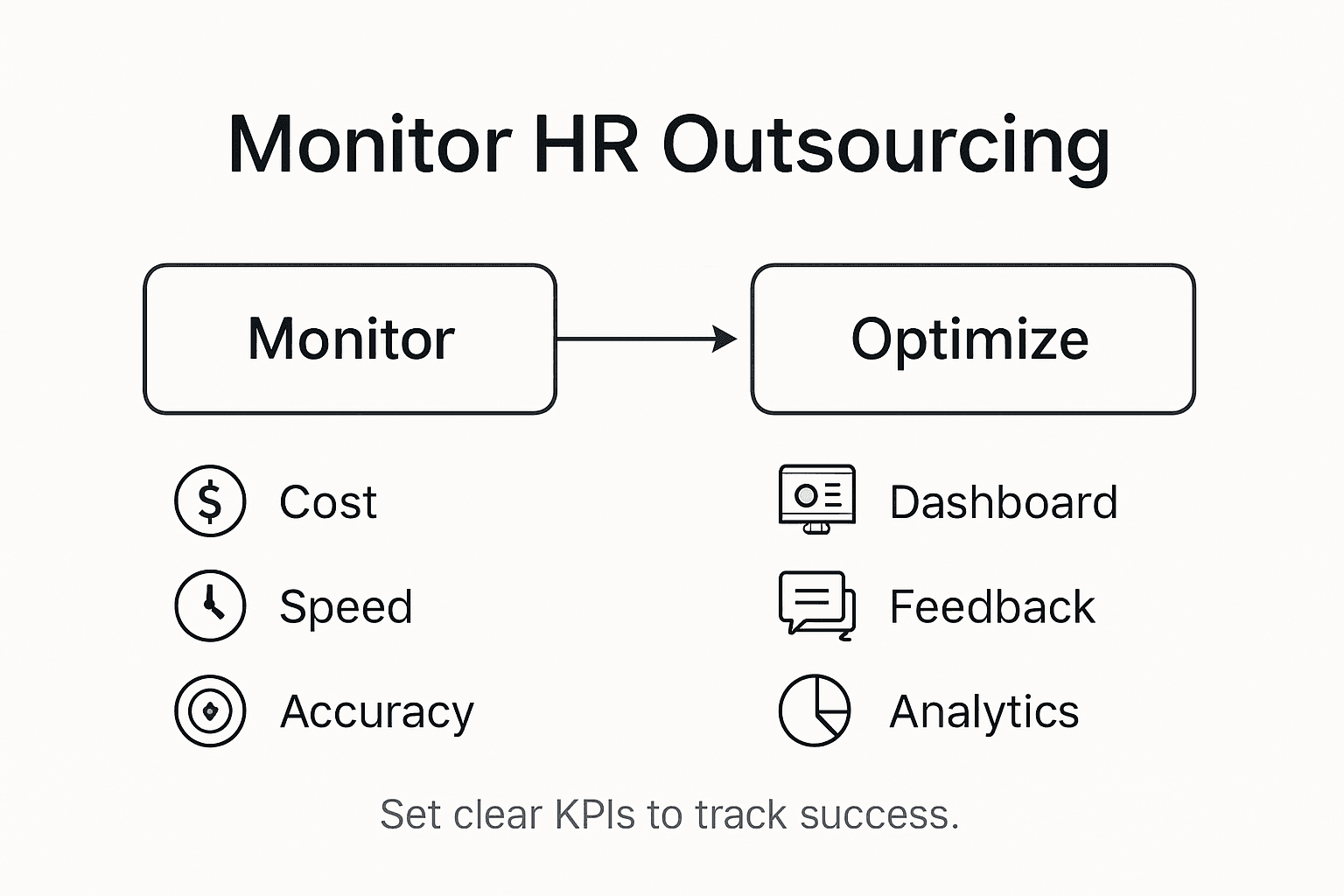
Develop a robust feedback mechanism that combines data analytics with qualitative insights from internal stakeholders. This should include periodic surveys of employees and management to understand the real world impact of outsourced HR services. Create a dynamic optimization process that allows for continuous adjustment of service delivery models, technology integrations, and strategic approaches based on performance data and organizational feedback. By maintaining an agile and responsive approach to HR outsourcing, you can ensure that your partnership remains flexible and aligned with your organization future needs.
Pro tip: Develop a balanced scorecard approach that tracks both quantitative performance metrics and qualitative organizational impact, enabling a holistic view of your HR outsourcing strategy’s effectiveness.
Unlock Seamless HR Outsourcing with Expert Nearshoring Solutions
Navigating the complexities of global HR outsourcing requires more than just a service provider. You need a strategic partner who understands your unique challenges—from assessing organizational readiness and selecting qualified partners to defining clear service scopes and managing smooth transitions. If you are looking to transform your HR operations with trusted expertise in payroll, compliance, talent management, and technology integration, StorsenDigital is here to help.

Experience the difference of tailored outsourced solutions designed specifically for medium to large international enterprises seeking to leverage European talent and digital infrastructure. With StorsenDigital you benefit from scalable managed BPO services, strategic consulting, and dedicated support that ensures continuous performance optimization. Take the next step toward operational excellence by connecting with our specialists through our contact page. We are ready to help you craft a roadmap that aligns perfectly with your business goals and global workforce needs.
Frequently Asked Questions
What should I assess to determine my organization’s HR outsourcing readiness?
To determine your organization’s HR outsourcing readiness, conduct a thorough evaluation of your current HR capabilities across five critical pillars: talent data foundation, governance structure, workforce alignment, technology preparedness, and change management. Start by gathering detailed information about your HR processes and identifying gaps to create an effective outsourcing strategy.
How can I identify qualified HR outsourcing partners for my organization?
To identify qualified HR outsourcing partners, create a shortlist based on their experience in providing integrated services, compliance with regulations, and technological capabilities. Evaluate potential partners by conducting due diligence, such as reviewing service level agreements and case studies, to ensure they meet your specific HR needs.
What key elements should I include in my HR outsourcing agreements?
Your HR outsourcing agreements should clearly define expectations, deliverables, and mutual responsibilities, including roles, performance metrics, and pricing structures. Pay attention to service level agreements that incorporate measurable performance indicators and governance frameworks for accountability and continuous improvement.
How do I effectively manage the transition to outsourced HR services?
To effectively manage the transition to outsourced HR services, develop a comprehensive transition plan that maps existing workflows and establishes communication protocols between your teams and the outsourcing partner. Create detailed documentation and a dedicated transition management team to oversee the implementation and address any challenges that arise.
What metrics should I use to monitor the performance of my HR outsourcing partner?
To monitor performance, establish a framework that includes quantitative metrics such as recruitment cycle times and employee engagement scores alongside qualitative feedback from stakeholders. Implement regular performance reviews to assess key performance indicators and identify opportunities for improvement in your HR outsourcing strategy.
How can I optimize HR outcomes post-outsourcing?
To optimize HR outcomes after outsourcing, leverage data and analytics to track performance continuously and develop a dynamic optimization process. Encourage feedback from employees and management to adapt and refine your HR service delivery based on performance data, ensuring alignment with your organization’s evolving needs.


