


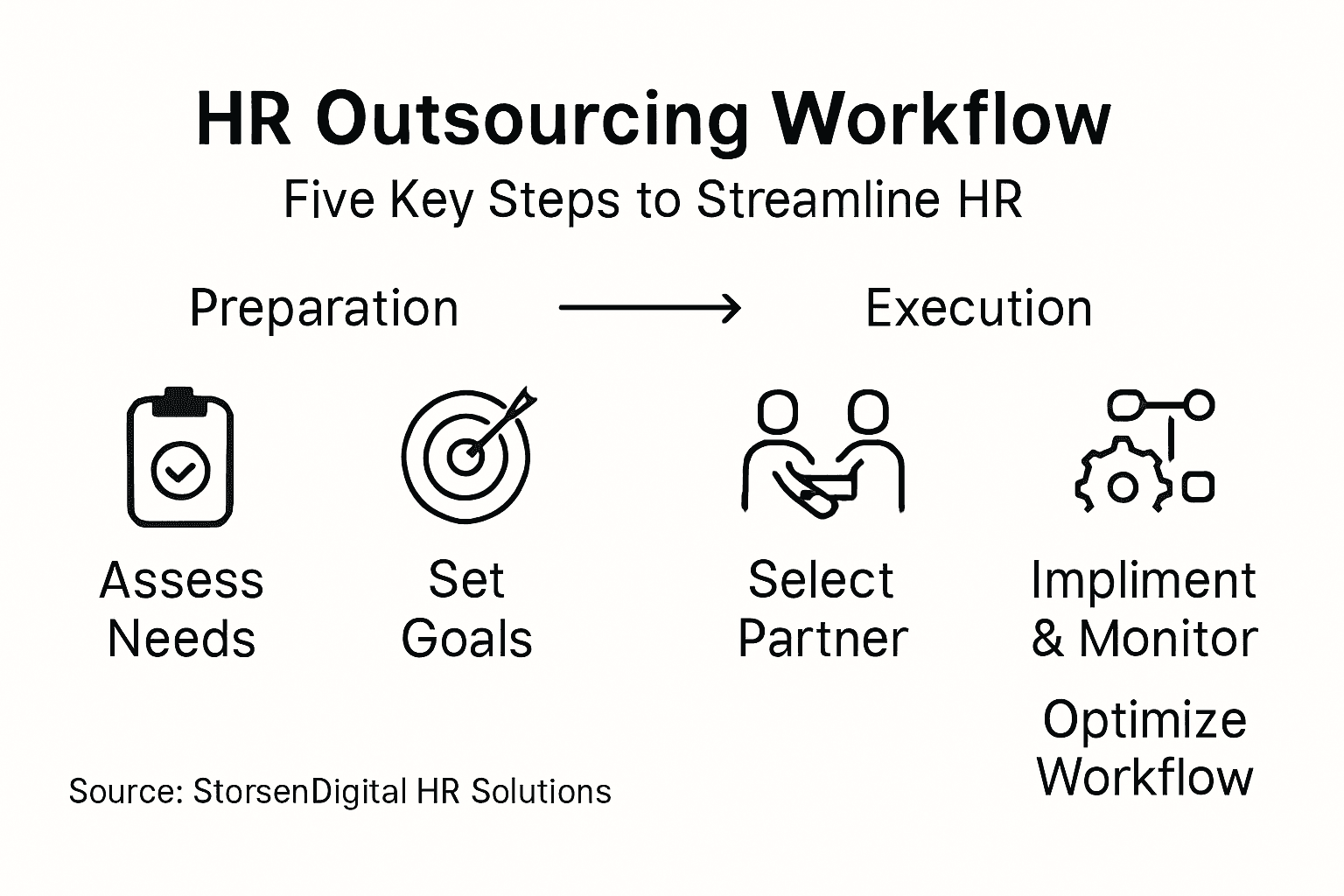
Managing HR operations in a growing European company often means facing mounting administrative tasks while driving cost efficiency and compliance. As organizations look to scale, the challenge becomes finding effective ways to support workforce needs without losing sight of core business goals. This guide breaks down a systematic approach to HR outsourcing, highlighting steps for assessing your internal needs, selecting the right partners, and building workflows that enable sustainable growth and operational improvement.
Table of Contents
- Step 1: Assess HR Needs And Define Outsourcing Goals
- Step 2: Select The Right Outsourcing Partner
- Step 3: Establish Clear Roles And Data Integration
- Step 4: Implement Outsourced Processes And Monitor Performance
- Step 5: Verify Compliance And Optimize Workflow
Quick Summary
| Key Point | Explanation |
|---|---|
| 1. Define Clear Outsourcing Goals | Assess current HR processes to create targeted outsourcing strategies that align with operational needs and growth objectives. |
| 2. Select an Appropriate Partner | Choose an outsourcing partner based on compatibility, expertise, and ability to adapt to your long-term business goals. |
| 3. Implement Structured Data Integration | Establish a data management framework that ensures seamless communication and accountability between internal teams and external partners. |
| 4. Monitor Performance Regularly | Create performance metrics and agreements to evaluate outsourcing effectiveness and ensure quality operational standards are met. |
| 5. Ensure Compliance and Continuous Improvement | Regularly audit compliance and workflow processes to sustain legal standards and enhance operational efficiency. |
Step 1: Assess HR needs and define outsourcing goals
Defining clear HR outsourcing goals requires a strategic and systematic approach to understanding your organization’s unique operational requirements. By carefully mapping out your current HR challenges and future growth objectives, you can create a targeted outsourcing strategy that delivers maximum value.
To effectively assess your HR needs, start by conducting a comprehensive internal audit that evaluates your current HR processes. HR outsourcing functions typically include critical areas such as:
- Payroll management
- Benefits administration
- Recruitment and talent acquisition
- Performance management
- Compliance and regulatory reporting
- Employee training and development
Evaluate each function’s complexity, time investment, and strategic importance to your organization. Some processes might be better managed in-house, while others could benefit significantly from external expertise. Consider factors like cost efficiency, scalability, and potential performance improvements.
Strategic HR outsourcing isn’t about replacing your team – it’s about empowering them with specialized support and advanced capabilities.
During your assessment, document specific pain points and desired outcomes. Quantify metrics like current HR operational costs, time spent on administrative tasks, and areas where process bottlenecks occur. This data will help you define clear, measurable goals for your outsourcing initiative.

Here’s a summary of strategic HR outsourcing benefits across key functions:
| HR Function | Business Impact | Opportunity from Outsourcing |
|---|---|---|
| Payroll Management | Improves accuracy and compliance | Reduces errors and manual effort |
| Benefits Administration | Enhances employee satisfaction | Streamlines benefits processes |
| Recruitment & Talent | Supports workforce growth | Accesses wider talent pools |
| Performance Management | Aligns staff with goals | Modernizes evaluation methods |
| Employee Training | Boosts skill development | Customizes learning for staff needs |
| Compliance Reporting | Maintains legal adherence | Mitigates risk with expert support |
Pro tip: Create a weighted scoring matrix to objectively evaluate which HR functions are most suitable for outsourcing based on strategic impact, cost savings, and operational complexity.
Step 2: Select the right outsourcing partner
Selecting the ideal HR outsourcing partner is a critical decision that can significantly impact your organization’s operational efficiency and strategic growth. Your goal is to find a partner who not only meets your current needs but can also adapt and support your long-term business objectives.
Begin by conducting comprehensive partner evaluation that goes beyond surface-level assessments. Your selection process should include a detailed examination of potential partners across multiple dimensions:
- Cultural compatibility
- Technical expertise
- Service flexibility
- Financial stability
- Regulatory compliance
- Technology integration capabilities
- Proven track record in HR outsourcing
Evaluate each potential partner’s credentials through structured due diligence. Request detailed case studies, client references, and comprehensive service portfolios that demonstrate their ability to handle your specific HR requirements. Pay close attention to their technological infrastructure and scalability potential.
The right outsourcing partner transforms from a vendor to a strategic collaborative resource, enabling your HR team to focus on high-value initiatives.
During your assessment, arrange face-to-face or virtual meetings to gauge the partner’s communication style, responsiveness, and alignment with your organizational values. Discuss transition strategies, onboarding processes, and establish clear performance metrics that will guide your partnership.
Pro tip: Create a weighted scoring system that objectively ranks potential outsourcing partners based on critical criteria, ensuring a data-driven selection approach that minimizes subjective decision-making.
Step 3: Establish clear roles and data integration
Successful HR outsourcing hinges on creating a well-defined framework for data management and organizational responsibilities. Your objective is to design a seamless integration strategy that ensures smooth communication, data flow, and accountability between your internal team and external HR partner.
HR data integration strategies require careful planning to connect disparate information systems and establish comprehensive governance models. Key elements of this process include:
- Defining specific role responsibilities
- Creating clear communication protocols
- Establishing data sharing guidelines
- Implementing secure integration mechanisms
- Developing performance tracking metrics
- Ensuring regulatory compliance
- Setting up automated workflow processes
Focus on strategic role allocation that leverages each team’s strengths. Your internal HR team should focus on high-level strategic planning, while your outsourcing partner handles specialized operational tasks. This approach allows for efficient knowledge transfer and maintains organizational flexibility.
Effective data integration transforms HR from an administrative function into a strategic business partner, driving organizational insights and decision-making.
Establish robust data governance frameworks that specify how information will be collected, processed, analyzed, and protected. This includes defining data ownership, access protocols, and privacy standards that align with your organization’s compliance requirements.
The table below compares data governance best practices for HR outsourcing:
| Practice | Purpose | Result for Business |
|---|---|---|
| Data Ownership Definition | Ensures accountability | Clear responsibility distribution |
| Access Control Protocols | Protects sensitive information | Enhanced data security |
| Privacy Standards | Complies with regulations | Reduces legal risks |
| Performance Metrics | Tracks outsourcing effectiveness | Enables process improvements |
Pro tip: Create a comprehensive data integration playbook that documents every aspect of information sharing, role responsibilities, and communication channels to prevent future misunderstandings and optimize collaboration.
Step 4: Implement outsourced processes and monitor performance
Transitioning to an outsourced HR model requires a strategic and methodical approach to ensure smooth implementation and ongoing performance optimization. Your primary objective is to establish a robust framework that allows seamless integration of external HR services while maintaining high-quality operational standards.
Performance management frameworks are critical for tracking and evaluating your outsourcing partnership’s effectiveness. Key implementation and monitoring strategies include:
- Establishing clear performance metrics
- Creating detailed service level agreements (SLAs)
- Implementing regular performance review cycles
- Developing real-time reporting mechanisms
- Defining accountability protocols
- Setting up continuous improvement processes
- Maintaining transparent communication channels
Focus on structured onboarding processes that facilitate knowledge transfer and alignment between your internal team and the outsourcing partner. Develop comprehensive documentation that outlines roles, responsibilities, and expected performance standards to minimize potential misunderstandings.
Successful process implementation is not about perfect execution, but about creating adaptive systems that can evolve with your organization’s changing needs.
Establish quarterly performance assessment meetings to review key performance indicators, discuss challenges, and identify opportunities for optimization. These sessions should be collaborative, focusing on constructive feedback and mutual growth rather than punitive measures.
Pro tip: Design a dynamic scorecard with weighted metrics that not only measure operational performance but also capture strategic alignment and potential for future innovation.
Step 5: Verify compliance and optimize workflow
Ensuring regulatory compliance and continuous workflow optimization are critical final steps in your HR outsourcing journey. Your goal is to create a robust, adaptable system that maintains legal standards while continuously improving operational efficiency.
Although no specific research link was provided, key compliance and workflow optimization strategies include:
- Conducting comprehensive regulatory audits
- Reviewing data protection protocols
- Verifying contractual compliance
- Mapping current workflow processes
- Identifying potential optimization opportunities
- Implementing performance improvement mechanisms
- Establishing ongoing training programs
Focus on systematic compliance verification that goes beyond surface-level checks. Develop a detailed compliance tracking framework that documents every aspect of your HR outsourcing relationship, ensuring transparency and accountability.
Compliance is not a one-time event, but a continuous journey of alignment, adaptation, and strategic improvement.
Establish periodic review mechanisms that assess both regulatory adherence and operational performance. These reviews should include collaborative sessions with your outsourcing partner to discuss potential workflow enhancements, emerging best practices, and technological innovations.
Pro tip: Create a dynamic compliance dashboard that provides real-time insights into regulatory alignment, performance metrics, and potential optimization opportunities, enabling proactive management and continuous improvement.
Unlock Seamless HR Operations With Expert Outsourcing Solutions
The article highlights common challenges in HR outsourcing such as defining clear goals, selecting the right partner, integrating data effectively, and maintaining compliance. If you are struggling with streamlining complex HR workflows or scaling operations while ensuring regulatory adherence, you are not alone. Understanding operational bottlenecks and managing strategic outsourcing relationships are key to transforming HR into a powerful business driver.
At StorsenDigital, we specialize in providing tailored outsourcing and Business Process Outsourcing (BPO) services that directly address these pain points. Our expertise includes strategic talent recruitment, managed HR processes, and secure data integration that enhance performance and compliance. We empower you to focus on core business growth by handling complex operational tasks with precision and scalability.

Experience how expert nearshoring and outsourcing from StorsenDigital can streamline your HR functions and accelerate business success. Visit our homepage to explore solutions designed for medium to large enterprises seeking operational excellence across Europe. Start your journey towards optimized HR outsourcing workflows today by connecting with our team of specialists at StorsenDigital and take the next step in transforming your HR operations.
Frequently Asked Questions
How do I assess my HR needs before outsourcing?
Start by conducting a comprehensive audit of your current HR processes. Identify pain points, time spent on tasks, and areas that impact strategic objectives to outline your specific outsourcing goals.
What criteria should I use to select the right HR outsourcing partner?
Focus on cultural compatibility, technical expertise, and service flexibility when evaluating potential partners. Create a weighted scoring system to objectively rank the candidates based on their ability to meet your organization’s needs.
What roles should my internal team and the outsourcing partner play?
Define specific role responsibilities to ensure that your internal HR team focuses on strategic planning while the outsourcing partner handles operational tasks. This approach allows for efficient collaboration and knowledge transfer.
How can I ensure compliance after outsourcing HR functions?
Implement a regular review process that includes compliance checks and audits to verify adherence to regulations. Set up a compliance tracking framework that documents all aspects of the outsourcing relationship to ensure ongoing transparency.
How do I track the performance of my HR outsourcing processes?
Establish clear performance metrics and create service level agreements (SLAs) that outline expectations. Conduct quarterly performance assessments and make adjustments based on feedback to optimize the outsourcing partnership.
What steps can I take to optimize workflow in outsourced HR operations?
Map current workflow processes to identify bottlenecks and improvement opportunities. Implement performance improvement mechanisms and establish ongoing training programs to enhance efficiency and adapt to changing needs.


