


Industry news
How to improve BPO efficiency: a 2026 guide

Managing large BPO operations across Europe presents persistent efficiency challenges that directly impact your bottom line and client satisfaction. Many enterprises struggle with hidden inefficiencies stemming from inflexible resource allocation, outdated technology stacks, and fragmented workflows. This guide delivers evidence-backed strategies to identify and eliminate these inefficiencies through operational flexibility, intelligent automation, workforce optimization, and process refinement. You’ll discover practical methods proven to boost productivity by 25-35% while reducing operational costs.
Table of Contents
- Understanding The Challenges To Bpo Efficiency
- Preparing Your Bpo For Efficiency Improvements
- Executing Efficiency Strategies With Technology And Process Optimization
- Verifying Improvements And Sustaining Efficiency Gains
- Optimize Your Outsourcing Strategy With StorsenDigital
- Frequently Asked Questions
Key takeaways
| Point | Details |
|---|---|
| Operational flexibility drives results | Dynamic agent allocation and flexible SLAs significantly improve cost control and service level achievement compared to fixed assignment models. |
| Technology adoption accelerates gains | AI platforms and robotic process automation deliver 25-35% productivity improvements and measurable cost reductions across BPO operations. |
| Process visibility enables optimization | Identifying and addressing workflow bottlenecks through operational analytics creates sustainable efficiency improvements. |
| Nearshoring trends shape 2026 strategies | Cloud-based BPO services and European nearshoring partnerships offer scalable, cost-effective solutions for growing enterprises. |
Understanding the challenges to BPO efficiency
Most efficiency problems in BPO operations trace back to structural limitations in traditional service delivery models. Fixed operator-to-customer assignments create significant underutilized capacity during demand fluctuations, leaving you paying for idle resources while simultaneously missing SLAs during peak periods.
High seasonality compounds this challenge. Client volumes fluctuate dramatically based on product launches, seasonal campaigns, and market conditions. Without operational flexibility, your BPO struggles to scale efficiently, leading to either overstaffing during quiet periods or understaffing when demand spikes.
Multiple concurrent contracts add another layer of complexity:
- Each client brings unique KPIs, service requirements, and performance expectations
- Resource allocation becomes a daily puzzle with conflicting priorities
- Performance monitoring requires sophisticated tools to track diverse metrics across contracts
- Agent expertise becomes fragmented across different client processes and systems
Turnover rates between 30-45% further destabilize operations. Constant recruiting, onboarding, and training drain resources while degrading service quality. New agents take months to reach full productivity, creating ongoing efficiency gaps that impact your operational metrics.
These structural challenges require systematic solutions rather than incremental adjustments. Understanding these root causes positions you to implement managed BPO services workflows that address inefficiencies at their source.
Preparing your BPO for efficiency improvements
Successful efficiency transformation starts with thorough preparation across three critical dimensions. First, evaluate your existing workflows to identify inflexible assignments and bottlenecks that constrain performance. Map each process from initial customer contact through resolution, noting handoffs, approval layers, and manual interventions that slow delivery.

The key insight here is that consistent SLA achievement depends more on how you manage agents than how many agents you employ. This realization should drive your assessment focus toward resource allocation flexibility rather than headcount planning.
Second, redefine your service level agreements to enable dynamic operations:
- Structure SLAs around outcome metrics rather than fixed staffing commitments
- Build in flexibility clauses that allow resource reallocation based on real-time demand
- Establish tiered service levels that balance cost with responsiveness
- Create performance incentives aligned with efficiency gains, not just activity volume
- Document escalation procedures that maintain quality during demand surges
Third, select technology platforms that support centralized queue management and multi-channel handling. Your platform should enable real-time visibility into agent availability, queue depths, and performance trends across all clients and channels. Integration capabilities matter tremendously since disconnected systems create the data silos that hide inefficiencies.
Pro Tip: Introduce conversational AI tools through collaborative pilot programs that engage frontline agents early. When employees help shape implementation, adoption rates increase and resistance drops significantly. Position automation as augmentation rather than replacement to maintain morale during transition periods.
These preparatory steps create the foundation for successful implementation. Selecting an efficient BPO provider or optimizing internal operations requires this same structured approach. With assessment complete and technology selected, you’re ready to execute specific efficiency strategies that deliver measurable improvements.
Consider how your current contracts and workflows align with these preparation requirements. Building BPO teams for scalability becomes significantly easier when foundational elements support flexibility from the start.
Executing efficiency strategies with technology and process optimization
Implementation success depends on deploying proven technologies alongside refined operational processes. AI platforms like KYP.ai provide real-time data analysis that surfaces actionable insights across workforce management and process performance. These tools analyze millions of interactions to identify patterns invisible to manual review, enabling proactive optimization rather than reactive problem solving.
The impact proves substantial. KYP.ai analysis identified 27% potential improvement in operations management for major BPO provider Atento, translating directly to reduced operational costs for their enterprise clients. This level of improvement comes from surfacing specific inefficiencies in agent allocation, process bottlenecks, and quality variations across teams.
Robotic process automation delivers equally impressive results for high-volume transactional work. RPA implementation reduced manual time by 80% per claim while increasing processing capacity by 45% in automotive industry applications. These gains apply directly to BPO operations handling data entry, claims processing, invoice management, and similar repetitive tasks.
| Technology | Primary Benefit | Typical Impact | Implementation Timeline |
|---|---|---|---|
| AI Analytics Platforms | Real-time operational insights | 25-35% productivity gain | 3-6 months |
| Robotic Process Automation | Manual task elimination | 80% time reduction | 2-4 months |
| Multi-channel Queue Management | Dynamic agent allocation | 15-20% utilization improvement | 1-3 months |
| Conversational AI | First-contact resolution | 30-40% volume deflection | 4-8 months |
Multi-channel queue managers enable the operational flexibility discussed earlier. Deploy these systems to dynamically assign agents based on real-time demand shifts, skill matching, and SLA priorities. Modern platforms route work across voice, email, chat, and social channels seamlessly, eliminating the silos that create inefficiencies in traditional channel-specific teams.
Operational analytics tie these technologies together by identifying where to focus improvement efforts:
- Monitor handle times across process types to spot outliers indicating training needs or workflow problems
- Track first-contact resolution rates to measure quality alongside efficiency
- Analyze demand patterns to optimize shift scheduling and reduce idle time
- Measure technology adoption rates to ensure automation investments deliver expected returns
Pro Tip: Review agent allocation against contact volume daily during initial implementation, then weekly once patterns stabilize. This regular analysis reveals utilization gaps during peak and off-peak periods, enabling continuous refinement of staffing models. Small allocation adjustments compound into significant efficiency gains over time.
These execution strategies work best when implemented systematically rather than simultaneously. Start with operational analytics to identify your highest-impact opportunities, then deploy technologies targeting those specific inefficiencies. This focused approach delivers faster ROI and builds organizational confidence in transformation initiatives.
The managed BPO implementation guide provides detailed frameworks for phased deployment. Whether optimizing internal operations or working with BPO partners, structured implementation minimizes disruption while accelerating benefits realization.
Remember that technology enables efficiency but doesn’t guarantee it. Process redesign must accompany technology deployment to eliminate unnecessary steps, clarify decision rights, and streamline approvals. The combination of smart automation and lean processes creates sustainable competitive advantage. Cost reduction through BPO becomes achievable when technology and process improvements reinforce each other.
Verifying improvements and sustaining efficiency gains
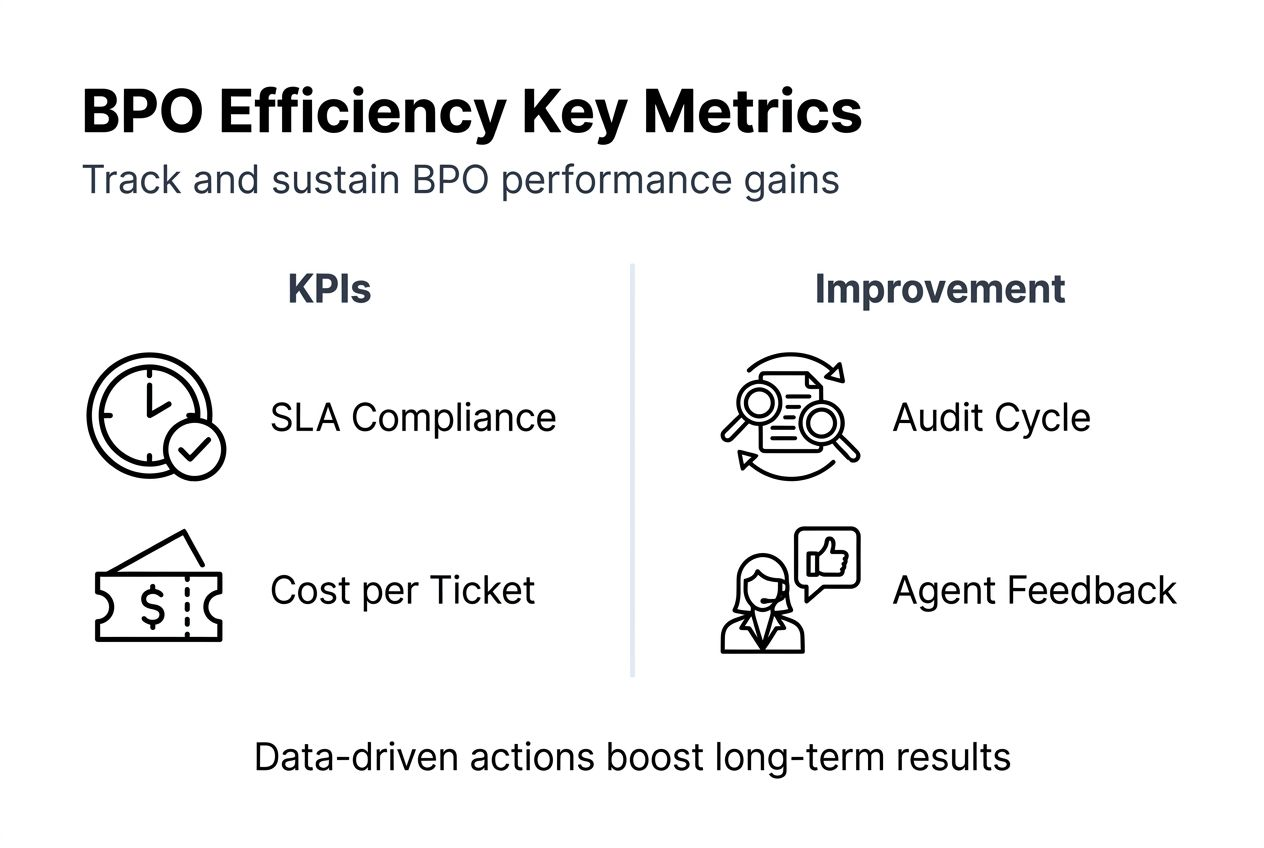
Measurement discipline separates temporary improvements from lasting transformation. Track KPIs continuously across SLA adherence, agent utilization rates, average handle time, first-contact resolution, and process cycle times. Establish baseline metrics before implementation to demonstrate impact and justify ongoing investment in efficiency initiatives.
Real-time dashboards powered by AI tools enable proactive issue identification before problems escalate. Configure alerts for metrics trending outside acceptable ranges, such as queue depths exceeding thresholds or utilization dropping below targets. This visibility lets you course-correct immediately rather than discovering issues in monthly reports when damage is done.
Common troubleshooting scenarios include:
- Resistance to change from agents comfortable with existing processes, addressed through involvement in design and clear communication about benefits
- Technology integration gaps creating data inconsistencies, resolved through dedicated integration resources and staged rollouts
- Data quality problems undermining analytics accuracy, fixed by implementing validation rules and regular data audits
- Process variations across teams diluting efficiency gains, standardized through documented procedures and regular compliance checks
Atento’s experience illustrates the power of continuous refinement. Beyond initial improvements, they identified 20% additional process improvement opportunities through ongoing workflow analysis, enabling further optimization and enhanced organizational efficiency. This iterative approach treats efficiency as a continuous journey rather than a one-time project.
Foster a culture where agents and team leads actively suggest improvements based on frontline experience. Feedback loops between operations and management surface practical insights that top-down analysis misses. Implement regular retrospectives to celebrate wins, analyze setbacks, and identify next optimization targets.
Plan quarterly audits of workflows aligned with evolving client needs and technology advances. Business requirements shift constantly in dynamic markets. Your BPO operations must adapt accordingly to maintain efficiency as contexts change. What optimized performance six months ago may create new bottlenecks today.
Sustainability requires embedding efficiency thinking into organizational culture rather than treating it as an initiative with an end date. Make operational excellence a core value reflected in hiring, training, performance management, and recognition programs. When everyone owns efficiency, improvements compound across the organization.
The guide to improving business process outsourcing offers additional frameworks for continuous improvement. Whether managing internal BPO operations or evaluating external partners, these verification and sustainability practices ensure efficiency gains persist and grow over time.
Optimize your outsourcing strategy with StorsenDigital
Implementing these efficiency strategies requires both expertise and practical resources to navigate complexity successfully. StorsenDigital specializes in helping European enterprises optimize BPO operations through data-driven consulting and scalable managed services. Our team brings deep experience across talent recruitment, office establishment, and comprehensive BPO services spanning HR, finance, IT, customer support, and software development.

We’ve developed comprehensive guides covering the complete outsourcing process for business success, from initial planning through ongoing optimization. Our managed BPO implementation frameworks provide step-by-step approaches to deploy the technologies and processes discussed throughout this guide. When you partner with StorsenDigital, you gain access to proven methodologies that accelerate efficiency improvements while minimizing implementation risk. Our nearshoring expertise across Europe enables you to leverage regional talent advantages while maintaining operational control and cultural alignment. Visit our detailed resource on improving business process outsourcing to explore specific strategies tailored to your industry and operational context.
Frequently asked questions
What are the most effective technologies to improve BPO efficiency in 2026?
AI analytics platforms, robotic process automation, and multi-channel queue management systems lead technology adoption for BPO efficiency. AI adoption in call centers reached 82% as organizations recognize the power of real-time insights and intelligent automation. These technologies complement workforce management by enabling dynamic resource allocation and eliminating repetitive manual tasks that drain productivity.
How quickly can BPO efficiency improvements deliver measurable results?
Initial improvements typically appear within 2-3 months of implementation, with full impact realized over 6-12 months as processes stabilize and adoption matures. Quick wins from queue management optimization and simple automation build momentum, while more complex AI implementations require longer learning curves. Sustained improvements demand ongoing refinement rather than expecting permanent gains from one-time implementations.
What efficiency gains should European enterprises expect from BPO optimization?
Well-executed optimization programs consistently deliver 25-35% productivity improvements alongside 15-25% cost reductions. Specific results vary based on starting maturity, technology selection, and implementation quality. Organizations with highly manual processes and fixed resource models see larger initial gains, while those with existing automation benefit from incremental refinements and strategic reallocation.
How does nearshoring impact BPO efficiency compared to traditional offshoring?
Nearshoring to European locations reduces communication friction, cultural barriers, and time zone challenges that create hidden inefficiencies in offshore models. Closer geographic proximity enables more effective oversight, faster issue resolution, and easier knowledge transfer. RPA is projected to automate 45% of tasks by 2025, making location less critical for routine work while elevating the importance of strategic collaboration that nearshoring facilitates.
What role does workforce management play in sustainable BPO efficiency?
Effective workforce management drives 40-50% of achievable efficiency gains through optimized scheduling, skill-based routing, and performance coaching. Technology amplifies human capabilities but cannot overcome poor workforce practices. Sustainable efficiency requires balancing automation investments with agent development, creating hybrid models where technology handles routine tasks while skilled staff focus on complex, high-value interactions.
How can enterprises verify their BPO provider is delivering efficiency improvements?
Demand transparent access to operational dashboards tracking agreed KPIs in real time, not just monthly summary reports. Require regular business reviews analyzing trends, improvement initiatives, and comparative benchmarks. Include efficiency metrics and continuous improvement commitments directly in SLAs with financial consequences for underperformance. Independent audits provide additional verification when significant investments or strategic relationships warrant external validation.


