


Industry news
Improve operational efficiency with European nearshoring

European enterprises are under real pressure. 60% of executives report operating costs more than 10% higher than their closest rivals, and the gap is widening. Central and Eastern Europe (CEE) has emerged as the most practical answer for medium to large enterprises that need to close that gap fast. This guide walks you through the exact steps to identify your bottlenecks, prepare your organization, execute a nearshoring strategy, and lock in the efficiency gains over the long term.
Table of Contents
- Understanding operational efficiency bottlenecks
- Preparing for efficiency transformation: What enterprises need
- Step-by-step approach to nearshoring for maximum efficiency
- Measuring success and sustaining efficiency gains
- Your next step toward operational excellence
- Frequently asked questions
Key Takeaways
| Point | Details |
|---|---|
| Nearshoring cuts costs | Central and Eastern European nearshoring reduces operational expenses by 23% to 45% without compromising quality. |
| ROI achieved quickly | Well-planned nearshoring can deliver a return on investment within 6 to 12 months for most enterprises. |
| Efficiency transformation requires planning | Operational efficiency gains depend on strong executive sponsorship, clear processes, and the right nearshoring partners. |
| Continuous improvement is vital | To sustain benefits, organizations must track KPIs and adapt their strategies for evolving business needs. |
Understanding operational efficiency bottlenecks
Operational efficiency, in an enterprise context, means producing the maximum output from every dollar of input without sacrificing quality or compliance. It is not just about cutting costs. It is about removing friction from every process so your teams can move faster, serve customers better, and redeploy capital toward growth.
Most large organizations share the same set of internal bottlenecks. Slow approval workflows, duplicated manual tasks, and siloed data all drain productivity before a single external factor enters the picture. Add to that a persistent skill shortage in Western European markets, rising wage inflation, and increasingly complex cross-border compliance requirements, and the picture becomes urgent.
The talent dimension alone is forcing a structural shift. Outsourcing and GICs are rising as enterprises face mounting cost challenges that internal hiring simply cannot solve at the required speed or price point. The nearshoring advantages available in CEE countries address all three pressure points simultaneously: cost, talent access, and compliance proximity.
Here are the most common bottlenecks executives identify before making the nearshoring decision:
- Wage inflation driving up cost of goods sold (COGS) in Western European hubs
- Skill shortages in IT, finance, and customer operations roles
- Slow hiring cycles that delay project launches by months
- Compliance complexity across multiple EU jurisdictions
- Manual, paper-heavy workflows that resist automation
“The enterprises that close the competitiveness gap fastest are not the ones that cut the deepest. They are the ones that restructure where work gets done.”
Recognizing which of these bottlenecks costs you the most is the first step. The second is building a plan to address them systematically.
Preparing for efficiency transformation: What enterprises need
Once the bottlenecks and urgency are clear, the next step is ensuring your organization is prepared for meaningful change. Nearshoring is not a plug-and-play fix. It requires deliberate preparation across three dimensions: leadership, process, and partner readiness.

Executive sponsorship is non-negotiable. Without a C-suite champion who owns the initiative, nearshoring projects stall at the pilot stage. Assign a named executive sponsor with budget authority and a clear mandate to drive the transformation.
Process clarity comes next. You cannot nearshor a broken process and expect it to improve. Map every workflow you plan to transition, identify handoff points, and document decision rights before you engage any external partner. This step alone eliminates the majority of post-launch friction.
Change management is the third pillar. Internal teams often perceive nearshoring as a threat to their roles. Proactive communication, retraining programs, and transparent timelines reduce resistance and accelerate adoption.
The step-by-step nearshoring framework below outlines the core resources you need in place before launch:
| Resource area | What you need | Why it matters |
|---|---|---|
| Internal staff | Process owners, project lead, IT liaison | Ensures accountability and smooth handoffs |
| Partner selection | Vetted CEE nearshoring provider | Reduces risk and accelerates ramp-up |
| Compliance tools | EU labor law advisor, data privacy review | Prevents regulatory exposure |
| Project plan | Phased roadmap with KPIs and milestones | Keeps the initiative on track and measurable |
The financial case for CEE nearshoring is compelling. 23 to 45% cost savings are achievable through wage differentials alone, with wages in CEE running up to 60% lower than Western European equivalents. Most enterprises reach positive ROI within 6 to 12 months.
Key prerequisites to confirm before you proceed:
- Executive sponsor identified and briefed
- Core processes documented and prioritized for transition
- Budget approved for pilot phase
- Legal and compliance review initiated
- Internal communication plan drafted
Pro Tip: Start with one high-volume, well-documented process for your pilot. Finance administration or first-line IT support are ideal candidates because they have clear inputs, outputs, and measurable cycle times. A clean pilot builds internal confidence and gives you real data for the scale-up business case.
Step-by-step approach to nearshoring for maximum efficiency
With foundational readiness covered, here is how to execute nearshoring step-by-step for measurable results.
- Analyze and prioritize processes. Rank every candidate process by volume, cost, and documentation quality. High-volume, well-documented processes deliver the fastest efficiency gains and the cleanest pilot results.
- Define your partner criteria. Shortlist CEE nearshoring providers based on sector expertise, language capability, compliance track record, and scalability. Reference the nearshoring service examples that match your industry to benchmark expectations.
- Run a structured pilot. Launch a 90-day pilot with one process and one team. Set baseline metrics before day one so you can measure improvement objectively. Treat the pilot as a learning exercise, not a final verdict.
- Scale with a phased roadmap. Use pilot data to build a 12-month scale-up plan. Add processes in order of complexity, not urgency. This keeps quality high and prevents your nearshore partner from being overwhelmed.
- Monitor with real-time dashboards. Implement shared reporting tools so both your internal team and your nearshore partner see the same performance data. Transparency accelerates problem-solving and builds trust.
The results from CEE nearshoring are well documented. Admin time drops 57% on average, and foreign direct investment into CEE has grown 28%, reflecting the region’s rising status as a strategic operations hub. Looking ahead, multi-hub strategies and AI readiness are the defining trends shaping how global enterprises structure their nearshore operations in 2026.
The comparison below shows why CEE consistently outperforms Western Europe for nearshoring initiatives:
| Factor | CEE nearshoring | Western Europe in-house |
|---|---|---|
| Average wage differential | Up to 60% lower | Baseline |
| Typical ROI timeline | 6 to 12 months | 18 to 36 months |
| Talent availability | High in IT, finance, BPO | Constrained, competitive |
| Time-zone alignment | Fully aligned with EU | Fully aligned with EU |
| Regulatory environment | EU member states | EU member states |
| Admin time reduction | Up to 57% | Minimal without restructuring |
The nearshoring workflow and the approach to outsourcing talent in CEE are well-established playbooks. You do not need to build from scratch.
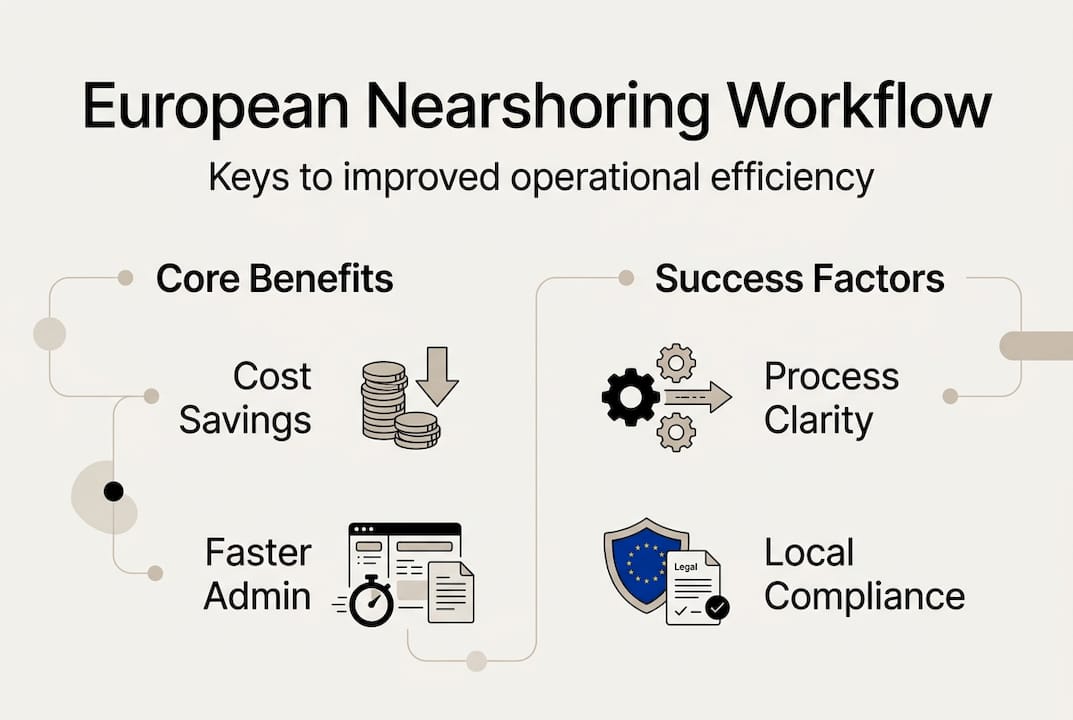
Pro Tip: Prioritize time-zone alignment and local compliance partners from day one. A CEE partner operating in the same or adjacent time zone eliminates the coordination overhead that plagues offshore models and keeps your compliance exposure inside the EU regulatory framework.
Measuring success and sustaining efficiency gains
Execution alone is not enough. Ongoing measurement and optimization ensure efficiency gains stick and compound over time.
Start by defining your success KPIs before the pilot launches. Without a baseline, you cannot prove improvement. The most useful metrics for nearshoring initiatives fall into four categories:
- Process speed: Average cycle time per transaction or task, measured in hours or days
- Cost of goods sold (COGS): Direct labor cost per unit of output, tracked monthly
- HR overhead: Hours spent on HR administration as a percentage of total HR capacity
- Compliance rate: Percentage of processes completed within regulatory deadlines
Tracking these metrics on a shared dashboard gives both your leadership team and your nearshore partner a single source of truth. Review cadence matters. Weekly operational reviews catch problems early. Monthly strategic reviews assess whether the initiative is on track against the original business case.
The efficiency gains from well-executed nearshoring are substantial. HR admin time cut by 57% is a benchmark result, and most enterprises hit positive ROI within 12 months when they follow a structured approach.
For sustained improvement, build a continuous improvement loop into your governance model. This means quarterly process audits, regular benchmarking against CEE market rates, and an annual review of which additional processes are candidates for transition. The nearshoring strategy workflow provides a repeatable framework for this ongoing optimization.
Sustaining gains also requires investing in the relationship with your nearshore partner. Treat them as an extension of your internal team, not a vendor. Share your strategic roadmap, involve them in process improvement discussions, and give them the context they need to anticipate your needs rather than just react to them.
Your next step toward operational excellence
The evidence is clear: structured nearshoring to CEE delivers measurable cost reductions, faster workflows, and sustainable operational improvements for enterprises willing to invest in the right preparation and partnerships.

StorsenDigital works with medium to large enterprises across Europe to design and execute nearshoring strategies that deliver real results. Whether you are starting with a process audit or ready to scale an existing pilot, our CEE nearshoring cost savings guide gives you the financial framework to build your business case. For a broader view of how to structure the transition, the outsourcing process guide and the operations outsourcing workflow walk you through every stage from readiness assessment to full-scale deployment. Connect with our team to explore what a tailored nearshoring solution looks like for your organization.
Frequently asked questions
What are the biggest operational cost advantages of nearshoring to CEE countries?
Nearshoring to CEE delivers 23 to 45% cost savings driven by wage differentials, with most enterprises reaching positive ROI in 6 to 12 months. Countries like Poland, Romania, and Hungary combine low labor costs with strong EU regulatory alignment.
How quickly can operational improvements be seen after implementing nearshoring?
Most enterprises see significant operational improvements within the first 90-day pilot, with full ROI from CEE nearshoring typically achieved between 6 and 12 months post-launch.
What are the main risks when shifting to a nearshore model?
The primary risks are selecting an unreliable partner, underestimating local compliance complexity, and attempting to transition poorly documented processes before they are ready. Structured due diligence and a phased pilot approach mitigate all three.
How does nearshoring impact HR operations?
Nearshoring can reduce HR admin time by 57%, freeing your HR team to focus on strategic talent development rather than administrative overhead.


