


Selecting the right outsourcing approach can shape the resilience and efficiency of your tech operations. The stakes are high for European organizations aiming to reduce expenses while driving innovation and compliance. By focusing on defining clear outsourcing objectives and expectations, you lay a strong foundation for measurable results, vendor accountability, and alignment with your overall business strategy.
Table of Contents
- Step 1: Define Outsourcing Objectives And Expectations
- Step 2: Select Qualified IT Outsourcing Partners
- Step 3: Execute Seamless Transition And Integration
- Step 4: Verify Outcomes And Optimize Performance
Quick Overview
| Key Insight | Explanation |
|---|---|
| 1. Define Clear Objectives | Clearly articulate your outsourcing goals to prevent misalignment and ensure successful partnerships. |
| 2. Evaluate Partner Qualifications | Use established frameworks to assess potential partners’ technical expertise and experience in your industry. |
| 3. Implement a Transition Plan | Develop a structured transition plan to minimize disruption and ensure a smooth integration process. |
| 4. Monitor Performance Metrics | Establish a performance dashboard to track key metrics and hold your outsourcing partner accountable for results. |
| 5. Conduct Regular Reviews | Schedule regular performance and business reviews to ensure strategic alignment and identify improvement areas. |
Step 1: Define outsourcing objectives and expectations
Before you sign anything or commit resources, you need absolute clarity on why you’re outsourcing and what success looks like. This foundational step prevents costly misalignments and ensures your outsourcing partner understands exactly what you need.
Start by articulating your core goals. Are you reducing operational costs, accessing specialized talent, scaling capacity, or freeing internal teams to focus on strategic work? You might have multiple reasons, and that’s fine, but write them down explicitly.
Next, clarify the scope of work. Which specific functions or processes are you outsourcing? Define the boundaries clearly so there’s no confusion about what’s included and what remains in-house. For example, are you outsourcing entire IT infrastructure management, specific application development, or just helpdesk support?
Defining clear outsourcing objectives and expectations is fundamental to aligning your initiatives with organizational strategy. This clarity helps you measure success accurately and enables effective performance management throughout the engagement.
Create specific, measurable outcomes. Instead of “improve efficiency,” target “reduce ticket resolution time from 8 hours to 4 hours” or “decrease IT infrastructure costs by 30%.” Quantifiable metrics give your outsourcing partner concrete targets and let you evaluate results objectively.
Document your performance expectations. What response times, uptime standards, quality levels, and compliance requirements do you need? These become your service level agreements (SLAs), so get specific about thresholds, penalties, and escalation procedures.
Consider your risk tolerance and regulatory environment. Financial services, healthcare, and other regulated sectors have specific compliance requirements. Make sure your outsourcing objectives account for suitable due diligence in selecting service providers and information protection standards.
Identify potential barriers early. Will you need access to legacy systems? Do you require data residency in specific countries? Will ongoing security clearances be necessary? Flag these constraints now so you can evaluate whether providers can meet them.
Vague objectives lead to vague contracts, missed expectations, and failed partnerships. Specificity upfront saves months of frustration later.
AlignYour outsourcing objectives with your overall business strategy. If your company is expanding internationally, does your outsourcing plan support that growth? If you’re pursuing aggressive cost reduction, do your chosen vendor locations deliver the savings you need?
Pro tip: Create a one-page objectives document listing your top 5-7 goals, key performance metrics, and non-negotiables. Share this with your procurement team and potential vendors early, and use it as the foundation for your request for proposal (RFP). This single artifact prevents 80 percent of misunderstandings down the road.
Here’s a quick summary of typical outsourcing objectives and their potential business impact:
| Objective | Expected Outcome | Business Impact |
|---|---|---|
| Reduce operational costs | Lower expenses, improved ROI | Increased profit margins |
| Access specialized talent | Skills unavailable in-house | Faster innovation, fewer mistakes |
| Scale capacity | Flexible resource allocation | Supports business growth |
| Free internal teams | Focus on core initiatives | Accelerates strategic projects |
| Improve compliance | Meet regulatory standards | Reduces risk of penalties |
Step 2: Select qualified IT outsourcing partners
Now that you have clear objectives, you need to find the right partner to deliver them. Selecting a qualified outsourcing provider makes the difference between a transformation and a disaster.
Start your search with established evaluation frameworks. The IAOP Global Outsourcing 100 identifies top providers worldwide based on performance, growth, customer references, and innovation. This authoritative list gives you a vetted starting point rather than searching blindly.
Assess each candidate’s technical expertise and industry experience. Do they have proven success in your specific domain? If you’re in fintech, does the provider have fintech clients? If you manage legacy systems, can they handle modernization alongside maintenance?

Evaluate their governance structures and risk management capabilities. Your outsourcing partner will handle sensitive systems and data, so thorough due diligence matters. Look for providers with strong compliance frameworks, security certifications, and internal audit functions.
Check their service delivery model carefully. Do they offer the flexibility your business needs? Can they scale up or down based on demand? Will they integrate with your existing tools and processes?
Request detailed service level agreements (SLAs). What happens if they miss response time targets? What penalties apply? What escalation procedures exist? These contractual commitments protect your operations when problems occur.
Conduct reference checks with existing clients. Ask specific questions about responsiveness, quality, cost management, and how the provider handles conflicts. Direct conversations reveal more than marketing materials ever will.
Assessing provider risk management and control frameworks ensures alignment with your organization’s standards and regulatory requirements. A qualified partner demonstrates sufficient expertise and governance to support your IT outsourcing objectives.
Evaluate cost proposals alongside capability. The cheapest option rarely delivers the best value. Compare total cost of ownership, including transition expenses, hidden fees, and potential overage charges.
Partners are selected based on capability and cost, but retained based on trustworthiness and responsiveness. Choose accordingly.
Verify their geographic presence and data residency options. Where will your data and systems physically reside? Do they have backup locations? Can they meet regulatory requirements specific to your regions?
Conduct a formal vendor selection process using your objectives document as the evaluation scorecard. Create a scoring rubric that weighs expertise, cost, cultural fit, and risk management equally. This structured approach prevents emotional decisions and bias.
Understand how StorsenDigital can accelerate this process. Bosnia and Herzegovina offers Europe’s best cost location with strong talent pools and cultural alignment. StorsenDigital builds dedicated teams for international clients, delivers comprehensive Managed Services and BPO solutions, and has a proven track record scaling global operations. Visit www.storsendigital.com to review case studies and learn how we support companies like yours in achieving operational excellence through strategic outsourcing partnerships.
Pro tip: Create a weighted scorecard during your initial vendor analysis phase. Assign points for technical capability (30%), cost efficiency (25%), risk management (25%), and cultural fit (20%). This quantitative approach removes subjectivity and creates an audit trail defending your final selection.
Use this comparison to evaluate outsourcing partners during selection:
| Evaluation Area | What to Look For | Why It Matters |
|---|---|---|
| Technical expertise | Relevant industry track record | Ensures effective service delivery |
| Security & compliance | Certifications, audits | Protects data and meets standards |
| Cost efficiency | Transparent pricing, TCO | Enables reliable budgeting |
| Cultural alignment | Communication style, values | Reduces conflicts and friction |
Step 3: Execute seamless transition and integration
The transition phase determines whether your outsourcing investment succeeds or stumbles. Careful planning and coordinated execution prevent disruption to your operations while establishing the partnership for long-term success.
Develop a comprehensive transition plan before work begins. This document outlines timelines, resource allocation, knowledge transfer activities, and risk mitigation strategies. Your plan should align with your software development life cycle if applicable and address all critical systems.
Assign a dedicated transition manager from your organization. This person acts as the single point of contact, coordinates between internal teams and the outsourcing provider, and resolves issues quickly. Clear accountability prevents decisions from falling through cracks.
Break the transition into phases rather than attempting a big bang cutover. Phase one might focus on non-critical systems, building confidence before you move critical workloads. Phase two tackles higher-risk functions once processes stabilize.
Service Integration and Management approaches help coordinate multiple suppliers and ensure smooth transitions across diverse systems. Effective SIAM methodology manages interactions and workflows, enabling operational efficiency when integrating outsourced IT functions.
Communicate the transition plan to all stakeholders. Your IT teams need to understand what’s changing and why. Business units relying on these systems need assurance that service quality will be maintained. Transparency reduces anxiety and increases buy-in.
Conduct thorough knowledge transfer sessions. Document your current processes, system architectures, business rules, and workarounds. Have your teams work alongside the outsourcing partner’s teams to transfer institutional knowledge before internal staff transition elsewhere.
Establish clear escalation procedures and issue resolution protocols. When problems occur during transition, which they will, everyone needs to know how to escalate and get resolution quickly. Define response time targets and communication channels.
Transformational outsourcing involves collaborative transition aligned with your strategic objectives and risk management frameworks. Comprehensive planning and communication strategies ensure operational continuity while achieving your growth and innovation goals.
Perform parallel testing before fully transitioning critical systems. Run the new provider’s processes alongside your existing systems for a defined period. This identifies gaps and allows you to fix issues before cutting over completely.
Transitions fail not because vendors lack capability, but because organizations underestimate planning complexity and communication needs. Over prepare.
Monitor performance metrics closely during transition. Compare actual performance against your SLAs from day one. Identify gaps early and work with your partner to address them before they become entrenched patterns.
Schedule regular transition status reviews with your outsourcing partner. Weekly or bi-weekly check-ins keep momentum and surfaces issues requiring executive attention. Document decisions and action items to maintain accountability.
Plan for staff retention and morale management. Employees worried about their jobs often leave during transitions. Communicate clearly about roles that will remain in-house and growth opportunities within the new structure.
StorsenDigital excels at managing transitions that protect operational continuity while optimizing costs. Our team builds dedicated resources customized to your environment, ensuring smooth knowledge transfer and minimal disruption. Visit www.storsendigital.com to explore how we support transition planning and provide the stability your organization needs during this critical phase.
Pro tip: Create a 100-day plan with weekly milestones and success criteria for each phase. Share this publicly with all stakeholders and track progress visibly. This creates urgency, maintains focus, and demonstrates progress that builds confidence in the partnership.
Step 4: Verify outcomes and optimize performance
You’ve transitioned to your outsourcing partner and work is underway. Now comes the critical phase of verifying that outcomes match your expectations and identifying opportunities to continuously improve results.
Start by establishing a performance monitoring dashboard that tracks all key metrics defined in your SLAs. This should include response times, uptime percentages, ticket resolution rates, cost per transaction, and any domain-specific measurements relevant to your business.
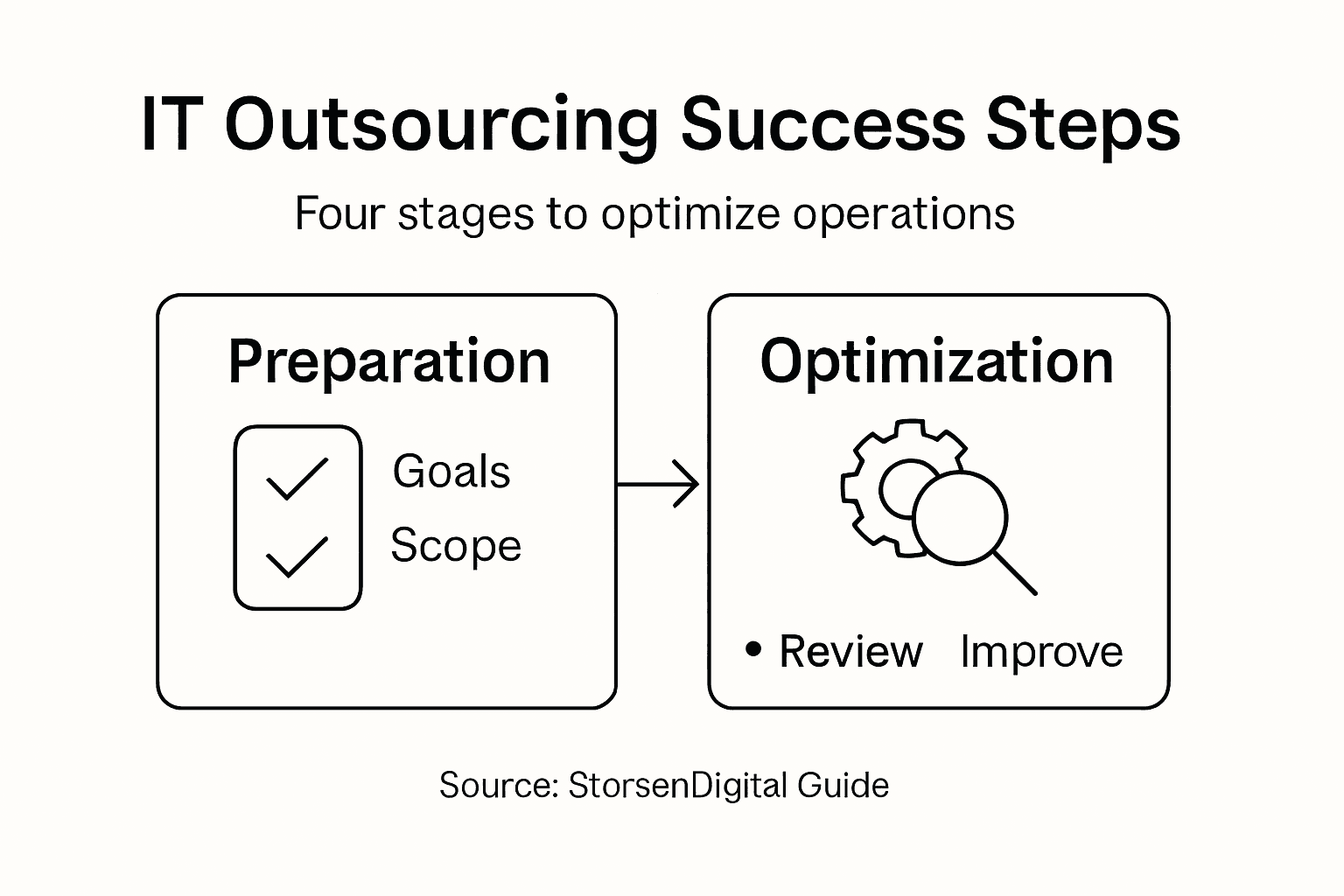
Conduct monthly performance review meetings with your outsourcing partner. Compare actual results against targets, celebrate wins, and dig into shortfalls. These conversations should be data-driven and collaborative, focused on problem solving rather than blame.
Implement benchmarking practices to contextualize your provider’s performance. How do they compare to industry standards? Are competitors achieving better results with similar vendors? This external perspective prevents you from accepting mediocre performance as normal.
Integrating performance management into outsourcing frameworks includes cost analysis, workflow mapping, and continuous monitoring to assess vendor performance and optimize process efficiencies. These techniques drive measurable improvement throughout your engagement.
Conduct quarterly business reviews with executive representation from both organizations. These sessions examine strategic alignment, discuss market changes affecting your arrangement, and identify opportunities to extract additional value from the partnership.
Implement continuous improvement processes like regular workflow mapping and optimization exercises. Where are bottlenecks? What manual steps could be automated? Which processes changed since the partnership began and need adjustment?
Use internal audit functions to verify compliance and effectiveness. Your internal auditors should assess whether the outsourcing arrangement meets control requirements, aligns with governance standards, and delivers expected outcomes. Their independent perspective adds credibility to performance verification.
Clearly defined SLAs and objective performance metrics enable continuous monitoring and verification of compliance. Regular risk and control assessments ensure your outsourcing operations remain effective and aligned with organizational objectives.
Document lessons learned and best practices as your partnership matures. What worked well? What would you do differently? This institutional knowledge informs future outsourcing decisions and improvements to current arrangements.
Verification without action is just reporting. Combine performance data with accountability and decision making to drive real improvement.
Identify quick wins you can implement in the first 90 days. These early successes build momentum, demonstrate value, and strengthen your partnership. Quick wins might include process automation, staffing optimization, or technology upgrades.
Schedule cost optimization reviews semi-annually. As volumes change, technologies evolve, and processes mature, pricing structures may warrant renegotiation. Regular reviews ensure you’re paying fair rates and not leaving savings on the table.
Prepare an annual strategic review with your outsourcing partner’s leadership. Discuss business direction, technology roadmap changes, and strategic initiatives. This forward-looking conversation aligns your partnership with evolving priorities.
StorsenDigital’s approach emphasizes performance transparency and continuous optimization. We build dedicated teams that deliver measurable results, maintain detailed SLAs, and conduct regular performance reviews to ensure you achieve your operational and cost objectives. Visit www.storsendigital.com to learn how we partner with European tech companies to deliver consistent, optimized performance.
Pro tip: Create a simple one-page scorecard capturing your top 10 performance metrics with targets and actual results. Share this visibly across your organization monthly. Transparency on performance maintains accountability and builds confidence that the outsourcing arrangement delivers expected value.
Unlock Seamless IT Outsourcing Success With StorsenDigital
The journey of IT outsourcing requires clear objectives, qualified partners, and flawless transitions to avoid costly pitfalls and maximize operational efficiency. If you are seeking to reduce expenses, scale capacity, and ensure compliance while gaining access to top European talent, these challenges are critical. StorsenDigital specializes in building dedicated teams and managing smooth integration that aligns perfectly with your strategic goals.
Our expertise addresses your pain points such as service level agreement enforcement, risk management, and continuous performance optimization. From tailored managed services to strategic consulting, we help you avoid vague contracts and frustrated partnerships by delivering transparent communication and measurable outcomes. Let us be your trusted partner to accelerate growth and cost-efficiency.
Ready to transform your IT outsourcing approach with a partner who understands every step?

Take the first step toward a successful outsourcing experience by connecting with our experts at StorsenDigital Contact. Discover how our nearshoring and Business Process Outsourcing solutions help companies like yours realize operational excellence today. Explore our commitment to your success by visiting our dedicated solutions page and start building your customized outsourcing strategy now.
Frequently Asked Questions
What are the key objectives to define before outsourcing IT services?
Before outsourcing IT services, clearly outline your objectives such as reducing operational costs, accessing specialized talent, or scaling capacity. Write these down to guide your outsourcing decisions and ensure alignment with your overall business strategy.
How do I select the right IT outsourcing partner?
To select the right IT outsourcing partner, assess candidates based on their technical expertise, industry experience, and governance structures. Use a weighted scorecard to objectively compare providers and ensure they align with your specific requirements.
What should I include in my service level agreements (SLAs) for outsourcing?
Include specific performance expectations in your SLAs, such as response times, uptime standards, and quality levels. Ensure to outline penalties for missed targets and escalation procedures to hold your partner accountable throughout the contract.
How can I ensure a smooth transition when outsourcing IT operations?
To ensure a smooth transition, develop a comprehensive transition plan that includes timelines, knowledge transfer activities, and risk mitigation strategies. Assign a dedicated transition manager to coordinate efforts and communicate openly with stakeholders to minimize disruption.
What steps should I take to verify outcomes after outsourcing?
To verify outcomes, establish a performance monitoring dashboard that tracks key metrics defined in your SLAs. Conduct monthly performance reviews with your outsourcing partner to celebrate successes and address any shortfalls, making necessary adjustments to continuously improve results.
How often should I conduct performance reviews with my outsourcing partner?
Conduct monthly performance review meetings with your outsourcing partner to compare actual results against established targets. This regular interaction allows you to address issues promptly and keep the partnership aligned with your growth and operational goals.


