


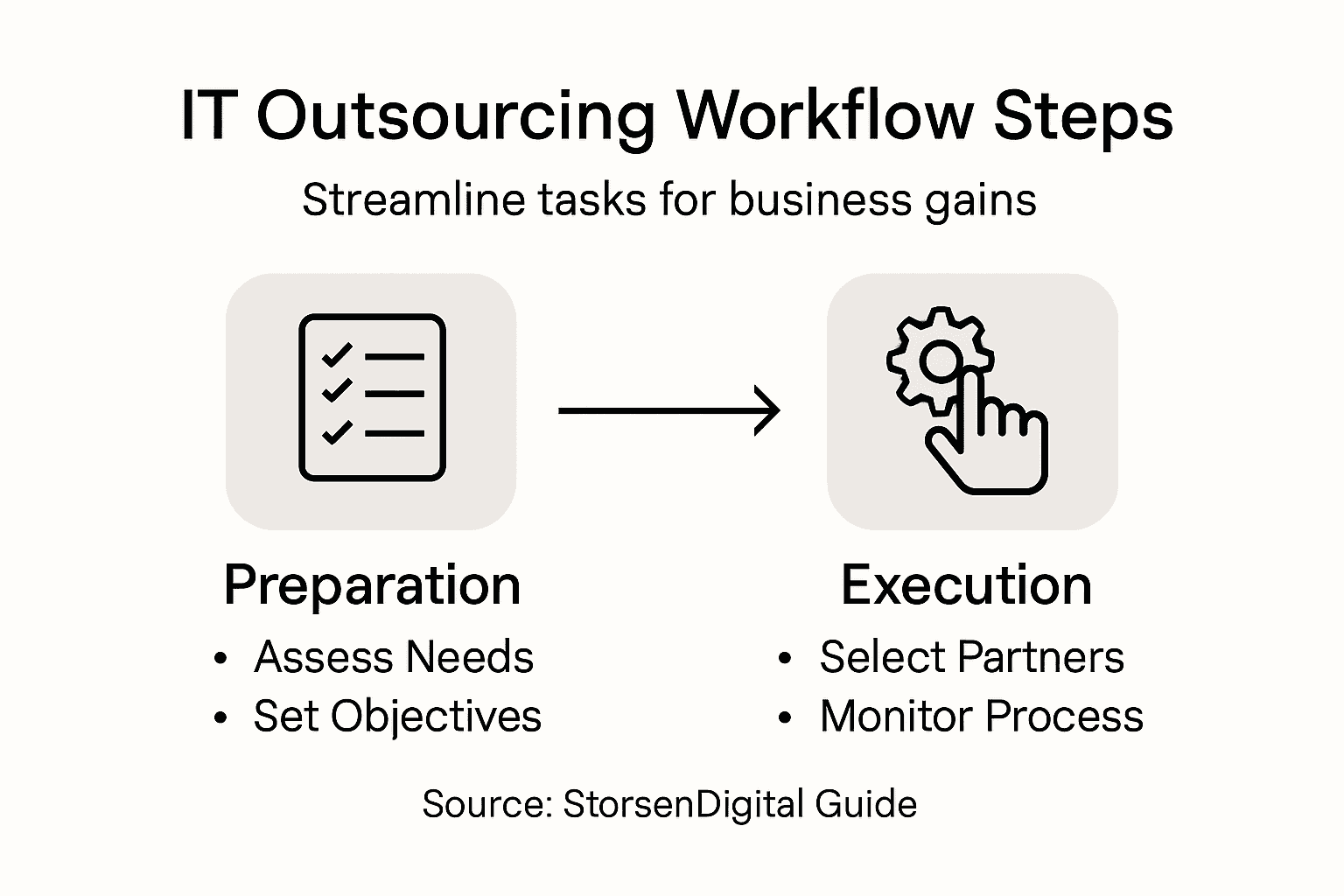
Managing rapid growth while containing costs is a familiar challenge for many European tech leaders. Outsourcing IT operations presents an opportunity to address resource gaps, but success depends on a clear understanding of your unique business objectives and choosing the right partner. This guide delivers actionable steps for C-suite executives to establish targeted IT outsourcing workflows that drive operational efficiency, strategic innovation, and sustainable value.
Table of Contents
- Step 1: Assess Organizational Needs And Objectives
- Step 2: Select Reliable Outsourcing Partners
- Step 3: Define Workflow Processes And Responsibilities
- Step 4: Implement Communication And Monitoring Protocols
- Step 5: Validate Outcomes And Optimize Workflows
Quick Summary
| Key Point | Explanation |
|---|---|
| 1. Assess Organizational Needs Thoroughly | Understand your strategic requirements by conducting an internal audit to identify performance gaps and resource needs. |
| 2. Select Reliable Partners Systematically | Develop a comprehensive evaluation framework to ensure potential partners align with your technical needs and organizational values. |
| 3. Define Clear Workflow Processes | Create structured workflows detailing roles, responsibilities, and communication protocols for effective collaboration. |
| 4. Implement Effective Communication Protocols | Establish regular communication channels and monitoring methods to maintain project visibility and control. |
| 5. Validate and Optimize Outcomes Continuously | Regularly assess performance metrics to identify improvement opportunities and ensure alignment with strategic goals. |
Step 1: Assess organizational needs and objectives
Before diving into IT outsourcing, you must thoroughly understand your organization’s strategic requirements. Identifying performance gaps is critical to determining whether outsourcing makes sense for your business goals.
Start by conducting a comprehensive internal audit that examines your current technological infrastructure, skill gaps, and strategic objectives. This involves gathering input from multiple departments – IT, finance, operations, and executive leadership – to create a holistic view of organizational needs. Key areas to evaluate include:
- Current technological capabilities
- Skill deficiencies within existing teams
- Budget constraints and cost optimization goals
- Specific performance metrics needing improvement
- Long-term strategic growth plans
Market research on vendor capabilities becomes crucial during this assessment phase. You want to match potential outsourcing partners with your precise organizational requirements. This means not just looking at technical skills, but also considering cultural alignment, communication protocols, and shared strategic vision.
Effective needs assessment transforms outsourcing from a transactional service into a strategic partnership.
Documenting these insights creates a clear roadmap for your outsourcing journey. By establishing precise, measurable objectives upfront, you dramatically increase the likelihood of successful collaboration and achieving your desired outcomes.
Below is a comparison of common IT outsourcing partnership types and their strategic impact:
| Partnership Type | Collaboration Depth | Strategic Impact |
|---|---|---|
| Transactional Vendor | Low | Cost savings only |
| Project-Based Partner | Medium | Short-term innovation |
| Strategic Alliance | High | Long-term growth, synergy |
Pro tip: Create a weighted scoring matrix to objectively evaluate potential outsourcing partners against your specific organizational needs and strategic goals.
Step 2: Select reliable outsourcing partners
Selecting the right IT outsourcing partner is a critical decision that can make or break your business strategy. Evaluating vendor expertise requires a systematic approach that goes beyond basic technical capabilities.
To find the most suitable partner, develop a comprehensive evaluation framework that considers multiple dimensions of potential collaboration. This involves examining not just technical skills, but also communication processes, cultural alignment, and long-term strategic compatibility. Key criteria for selection include:
- Proven track record in your specific industry
- Depth of technical expertise and specialization
- Quality of communication and collaboration processes
- References and client testimonials
- Financial stability and business reputation
- Alignment with your organizational culture and values
Comprehensive vendor assessment demands thorough due diligence. Beyond reviewing technical portfolios, you should conduct in-depth interviews, request detailed project case studies, and potentially arrange trial projects to validate potential partnerships.
Successful outsourcing partnerships are built on mutual understanding, shared goals, and transparent communication.
The goal is not just finding a service provider, but identifying a strategic partner who can genuinely contribute to your organizational growth and technological evolution.

Pro tip: Request a detailed capability matrix and arrange face-to-face or virtual meetings with potential outsourcing partners to assess their genuine collaborative potential.
Step 3: Define workflow processes and responsibilities
Creating a robust workflow is the backbone of successful IT outsourcing. Designing structured task sequences ensures clarity, efficiency, and smooth collaboration between your organization and outsourcing partners.
Developing a comprehensive workflow requires careful planning and detailed documentation. You’ll need to map out each stage of the project, clearly defining roles, responsibilities, and communication protocols. This process involves breaking down the entire project into distinct phases and identifying specific deliverables for each team member. Key components of an effective workflow include:
- Clear task ownership and accountability
- Defined communication channels
- Specific milestones and deliverable expectations
- Performance measurement criteria
- Escalation and problem-resolution mechanisms
- Collaboration tools and reporting structures
Workflow management techniques help automate and streamline task sequences, reducing potential bottlenecks and improving overall operational efficiency. Establish a framework that specifies exactly what needs to be done, who will do it, when it must be completed, and the expected quality standards.
Successful workflows transform complex processes into clear, executable strategies that drive organizational performance.
Remember that workflows are living documents. They should remain flexible enough to accommodate changing project requirements while maintaining a structured approach to task management and collaboration.
Pro tip: Create visual workflow diagrams using collaboration tools to provide a clear, accessible reference for all team members and stakeholders.
Step 4: Implement communication and monitoring protocols
Establishing clear communication and robust monitoring protocols is crucial for successful IT outsourcing partnerships. Developing effective communication strategies ensures transparency, alignment, and continuous project progress.
Your communication framework should incorporate multiple layers of interaction and accountability. Key communication channels and monitoring mechanisms will help you maintain visibility and control throughout the outsourcing engagement. Critical components of this implementation include:
- Regular scheduled status meetings
- Real-time collaboration platforms
- Detailed performance reporting templates
- Defined escalation procedures
- Key performance indicator (KPI) tracking
- Transparent progress documentation systems
Develop a comprehensive communication matrix that specifies frequency, format, and participants for different types of interactions. This matrix should outline:
- Daily stand-up meeting protocols
- Weekly detailed progress reviews
- Monthly strategic alignment sessions
- Quarterly performance evaluations
Consistent, structured communication transforms potential misunderstandings into opportunities for collaborative problem solving.
Remember that effective monitoring is not about micromanagement, but creating a transparent environment where both parties can proactively address challenges and celebrate successes.
Here is a summary of key communication channels and their benefits for IT outsourcing projects:
| Communication Channel | Typical Usage | Business Benefit |
|---|---|---|
| Scheduled Status Meetings | Progress tracking | Ensures issue resolution |
| Real-Time Collaboration | Daily task coordination | Boosts response speed |
| Performance Reporting | KPI monitoring | Improves transparency |
| Digital Dashboards | Sharing project metrics | Enables instant insight |
Pro tip: Implement a shared digital dashboard that provides real-time project metrics and enables instant communication between your team and outsourcing partners.
Step 5: Validate outcomes and optimize workflows
Validating and optimizing your IT outsourcing workflow is a critical process that ensures continuous improvement and maximum value delivery. Assessing outsourcing performance metrics allows you to transform potential challenges into strategic opportunities for organizational growth.
Establishing a robust validation framework requires a comprehensive and systematic approach. Your optimization strategy should focus on measuring key performance indicators, analyzing results, and implementing data-driven improvements. Key elements of this validation process include:
- Comparing actual results against predefined metrics
- Conducting thorough performance reviews
- Analyzing cost efficiency and productivity gains
- Identifying process bottlenecks and improvement opportunities
- Measuring alignment with original project objectives
- Tracking innovation and value creation
Workflow optimization techniques help streamline operations and eliminate inefficiencies. Develop a continuous improvement cycle that involves:
- Collecting comprehensive performance data
- Analyzing results against strategic objectives
- Identifying improvement areas
- Implementing targeted optimizations
- Monitoring impact of changes
Successful workflow validation transforms outsourcing from a transactional service to a strategic partnership.
Remember that optimization is an ongoing process. Regularly reassess your workflows, remain open to feedback, and be prepared to adapt your strategies as business needs evolve.
Pro tip: Implement a quarterly review process with transparent reporting and collaborative improvement planning sessions involving both internal teams and outsourcing partners.
Elevate Your IT Outsourcing Workflow with StorsenDigital’s Expert Support
Mastering the IT outsourcing workflow requires clear strategies around partner selection, communication protocols, and continuous validation. If you struggle with aligning outsourcing efforts to your long-term business goals or need help bridging skill gaps and optimizing workflows, you are not alone. This article highlights the importance of strategic alliances, structured communication, and performance validation — all critical areas where many organizations seek trusted expertise.
StorsenDigital offers tailored outsourcing, nearshoring, and managed BPO services across Europe designed to address these exact challenges. Our deep experience in talent acquisition, project collaboration, and workflow optimization can help you transform your IT outsourcing from a transactional cost-saving measure into a powerful growth driver. Whether you need comprehensive strategic consulting or hands-on operational support, our solutions are built to ensure seamless integration and measurable success.
Are you ready to optimize your IT outsourcing workflow and maximize business impact? Discover how our strategic approach can unlock new efficiencies and innovation for your company today.

Start your journey toward streamlined IT outsourcing by contacting our expert team. Visit StorsenDigital Contact to discuss your unique needs and explore customized solutions. Don’t wait to turn your outsourcing challenges into strategic advantages with proven support from StorsenDigital.
Learn more about how our managed BPO services and talent recruitment solutions can be tailored just for you.
Frequently Asked Questions
How can I assess my organization’s needs before outsourcing IT services?
To assess your organization’s needs, conduct a comprehensive internal audit that reviews your current technology, skill gaps, and strategic objectives. Gather input from key departments, such as IT, finance, and operations, to evaluate your requirements thoroughly.
What criteria should I use to select a reliable IT outsourcing partner?
When selecting an IT outsourcing partner, evaluate their proven track record, technical expertise, communication processes, and cultural alignment. Develop a detailed evaluation framework and consider requesting case studies or arranging trial projects to validate their capabilities.
How do I create effective workflow processes with my outsourcing partner?
Create effective workflow processes by clearly defining roles, responsibilities, and communication channels. Break the project into phases and document specific deliverables for each phase to ensure clarity and accountability.
What communication protocols should I implement for outsourcing projects?
Implement communication protocols that include regular status meetings, real-time collaboration platforms, and defined performance reporting. Develop a communication matrix that details the frequency and format of different interactions for better project oversight and transparency.
How can I validate the outcomes of my outsourcing efforts?
Validate outcomes by comparing actual results against predefined metrics and conducting thorough performance reviews. Establish a continuous improvement cycle that involves collecting data, identifying areas for optimization, and implementing targeted changes regularly.
What steps should I take to optimize my IT outsourcing workflow?
To optimize your IT outsourcing workflow, regularly reassess your processes and remain open to feedback. Implement a quarterly review process to analyze performance data and make collaborative improvement plans with your outsourcing partners.


