


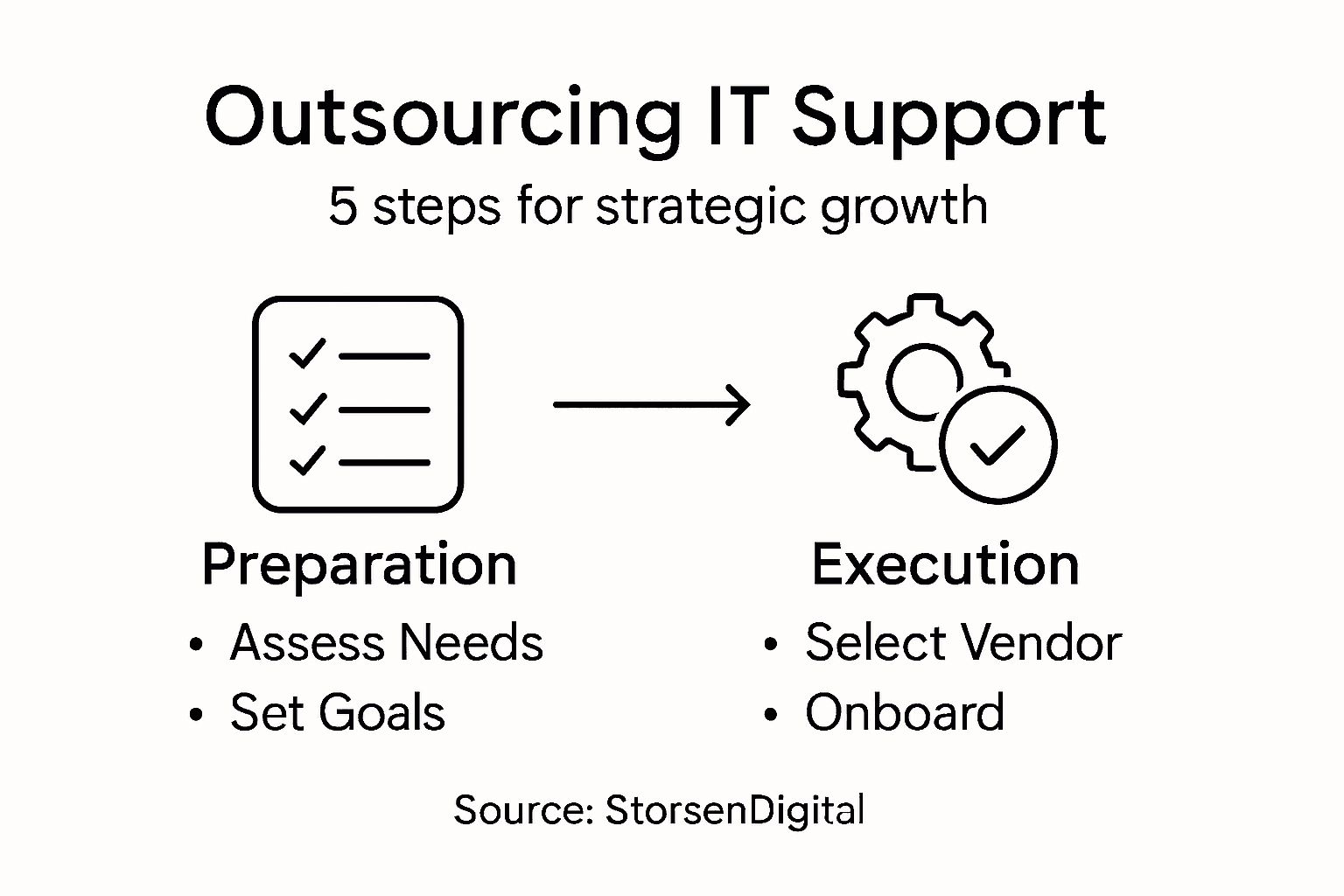
Scaling technology operations across multiple European markets presents real challenges for even well-resourced firms. Achieving business growth while keeping costs controlled often means looking outward for efficient IT support solutions. By focusing on measurable and specific objectives, companies can transform outsourcing from a routine service into a lever for operational excellence. This guide offers practical steps for clarifying requirements, evaluating vendors, and building partnerships that drive strategic outcomes.
Table of Contents
- Step 1: Define Outsourcing Requirements And Objectives
- Step 2: Evaluate And Shortlist Qualified IT Vendors
- Step 3: Negotiate And Formalize Service Agreements
- Step 4: Implement Transition And Onboarding Processes
- Step 5: Monitor Performance And Ensure Ongoing Quality
Quick Summary
| Key Point | Explanation |
|---|---|
| 1. Define outsourcing goals | Establish clear objectives to align IT support with business priorities, enhancing strategic value. |
| 2. Assess vendor capabilities | Conduct thorough evaluations of potential vendors to ensure they meet your organization’s specific needs. |
| 3. Negotiate clear agreements | Create detailed service level agreements to outline expectations and responsibilities, reducing future misunderstandings. |
| 4. Structure transition processes | Implement a comprehensive onboarding plan to smoothly integrate new IT support vendors and minimize disruptions. |
| 5. Continuously monitor performance | Regularly evaluate vendor performance to ensure they deliver quality service and adapt to changing needs. |
Step 1: Define outsourcing requirements and objectives
Defining clear outsourcing requirements and objectives is the foundation of a successful IT support strategy. This critical first step helps organizations align their technology support needs with broader business goals, ensuring a targeted and effective approach to external service procurement.
To establish precise outsourcing requirements, begin by conducting a comprehensive internal assessment of your current IT support infrastructure. Analyze existing pain points, resource constraints, and performance gaps that indicate where external support could provide strategic advantages. Strategic sourcing framework considerations emphasize the importance of mapping organizational technology needs against potential outsourcing solutions.
Key steps in defining requirements include:
- Identifying specific IT support domains needing external expertise
- Determining performance metrics and service level expectations
- Assessing current internal capabilities and skill gaps
- Estimating budget allocations for outsourced services
- Defining scalability and flexibility requirements
Organizations should focus on developing measurable and specific objectives that directly connect outsourcing efforts to strategic business outcomes. This approach ensures that external IT support is not just a cost-reduction strategy, but a mechanism for driving operational efficiency and technological innovation.
Clear objectives transform outsourcing from a transactional service to a strategic partnership.
Consider potential goals such as reducing operational costs, accessing specialized technical talent, improving response times, or enabling faster technology adoption. By establishing precise evaluation criteria upfront, companies can effectively measure the success of their outsourcing initiatives and make data-driven decisions about future partnerships.
Here’s a summary of how outsourcing IT support can impact core business outcomes:
| Outcome Area | Outsourcing Benefit | Long-Term Impact |
|---|---|---|
| Cost Management | Reduces operational expenses | Enables budget flexibility |
| Technical Expertise | Accesses specialized talent | Drives business innovation |
| Performance | Improves service response | Enhances customer satisfaction |
| Scalability | Adapts to changing needs | Supports business growth |
Pro tip: Create a detailed requirements document that serves as a comprehensive reference point for potential IT support vendors, ensuring alignment and preventing misunderstandings.
Step 2: Evaluate and shortlist qualified IT vendors
Evaluating and shortlisting qualified IT vendors is a critical phase in your outsourcing strategy that requires systematic research and comprehensive assessment. This step transforms your initial requirements into actionable vendor selection criteria, ensuring you partner with a provider that can truly meet your technological and business needs.
Begin by conducting thorough market research to identify potential IT support vendors. Develop a comprehensive evaluation framework that goes beyond surface-level comparisons and delves into substantive capabilities. Key assessment criteria should include:
- Technical expertise and specialized skill sets
- Proven track record in your specific industry
- Scalability and flexibility of service offerings
- Cultural and communication alignment
- Financial stability and long-term viability
- Compliance with relevant industry standards
- Security protocols and data protection measures
Vendor capability assessment requires a multi-dimensional approach. Request detailed portfolios, case studies, and references that demonstrate the vendor’s ability to deliver complex IT support solutions. Conduct in-depth interviews and technical assessments to validate their claims and understand their operational methodologies.
Strategic vendor selection transforms outsourcing from a transactional service to a collaborative partnership.
Implement a structured scoring mechanism to objectively evaluate potential vendors. This approach enables you to quantify different aspects of their service offerings, creating a transparent and data-driven shortlisting process. Consider developing a weighted scoring system that aligns with your organization’s specific priorities and strategic objectives.

Pro tip: Create a detailed vendor evaluation scorecard with predefined criteria, allowing for systematic and objective comparison across multiple potential IT support partners.
Step 3: Negotiate and formalize service agreements
Negotiating and formalizing service agreements represents the pivotal moment where your IT outsourcing strategy transitions from conceptual planning to concrete implementation. This critical phase determines the framework of your partnership, establishing the expectations, responsibilities, and legal protections that will guide your collaboration.
Empirical research on outsourcing partnerships highlights the importance of creating comprehensive agreements that balance risk management with collaborative potential. Your negotiation process should focus on developing a robust service level agreement (SLA) that addresses key operational and strategic dimensions:
- Precise definition of service scope and deliverables
- Clearly articulated performance metrics and key performance indicators (KPIs)
- Pricing structure and payment terms
- Data security and confidentiality provisions
- Flexibility and scalability clauses
- Dispute resolution mechanisms
- Exit and transition strategies
Contractual detail and clarity are paramount in preventing future misunderstandings. Engage legal and technical experts to ensure that the agreement comprehensively covers potential scenarios and provides adequate protection for both parties. Pay special attention to defining measurable performance standards that align with your organization’s strategic objectives.
A well-crafted service agreement transforms potential risks into collaborative opportunities.
Implement a systematic review process that allows periodic assessment of the agreement’s effectiveness. This approach enables you to adapt the contract to changing technological landscapes and business requirements, ensuring the continued relevance and value of your outsourcing partnership.
Pro tip: Include granular performance metrics and specific consequences for non-compliance to create a transparent and accountable service framework.
Step 4: Implement transition and onboarding processes
Implementing effective transition and onboarding processes is the critical bridge that transforms your outsourcing strategy from theoretical planning into operational reality. This phase determines how smoothly your organization integrates the new IT support vendor and establishes the foundation for long-term collaborative success.
Best practices in vendor transition emphasize the importance of creating a structured, comprehensive approach that minimizes disruption and accelerates operational integration. Your transition strategy should encompass several key dimensions:
- Detailed knowledge transfer protocols
- Comprehensive technology infrastructure mapping
- Clear communication channels and escalation procedures
- Cross-team training and cultural alignment initiatives
- Phased implementation with milestone-based progress tracking
- Robust documentation and process standardization
- Continuous feedback and adjustment mechanisms
Transition management requires meticulous planning and proactive communication. Designate dedicated transition teams from both your organization and the vendor to ensure seamless knowledge exchange and minimize potential operational gaps. Systematic knowledge transfer becomes crucial in maintaining continuity and preventing potential service interruptions.
Successful onboarding transforms external resources into integrated strategic partners.
Implement a comprehensive monitoring framework that allows real-time tracking of transition progress. This approach enables quick identification and resolution of potential challenges, ensuring that the onboarding process remains aligned with your original strategic objectives.
Pro tip: Create a detailed transition playbook with specific roles, responsibilities, and contingency plans to provide clear guidance during the integration process.
Step 5: Monitor performance and ensure ongoing quality
Monitoring performance and ensuring ongoing quality represents the critical ongoing phase of your IT support outsourcing strategy. This continuous evaluation process transforms your initial vendor relationship into a dynamic, adaptive partnership that consistently delivers strategic value and operational excellence.
Performance monitoring strategies emphasize establishing a robust framework for tracking vendor performance across multiple dimensions. Your monitoring approach should incorporate comprehensive evaluation mechanisms that go beyond traditional metrics:
- Real-time performance tracking systems
- Quarterly comprehensive performance reviews
- Quantitative and qualitative assessment metrics
- Continuous feedback and improvement loops
- Technology and competency benchmarking
- Risk management and compliance verification
- Adaptive service level agreement adjustments
Performance management requires a proactive and collaborative approach. Develop a transparent reporting mechanism that provides clear visibility into service delivery, enabling quick identification of potential issues and opportunities for optimization. Regular communication and joint performance reviews create a culture of continuous improvement and mutual accountability.
Effective monitoring transforms outsourcing from a transactional relationship to a strategic partnership.
Implement data-driven evaluation frameworks that leverage advanced analytics and machine learning technologies to provide deeper insights into vendor performance. This approach allows you to move beyond surface-level metrics and understand the nuanced dynamics of your outsourcing relationship.
Compare monitoring approaches for outsourced IT support:
| Approach | Key Features | Best For |
|---|---|---|
| Real-Time | Automated tracking systems | Rapid issue resolution |
| Quarterly Review | In-depth performance audits | Strategic vendor analysis |
| Adaptive Scorecard | Flexible metrics, analytics | Continuous improvement |
Pro tip: Create a dynamic performance scorecard with weighted metrics that adapt to changing business requirements and technological landscapes.
Transform Your IT Support Strategy with StorsenDigital
Outsourcing IT support for strategic growth requires clear objectives, careful vendor selection, detailed service agreements, smooth onboarding, and ongoing performance monitoring. If you face challenges like aligning technology with business goals or ensuring seamless transition and quality control this guide highlights key pain points we specialize in solving. From accessing specialized European talent to scaling operations efficiently we help medium to large enterprises overcome common outsourcing hurdles with tailored managed services.
Let StorsenDigital be your strategic partner for IT support outsourcing and digital transformation. Benefit from our expertise in talent recruitment, scalable managed IT and BPO solutions, and comprehensive support designed to maximize operational efficiency and innovation.

Ready to reduce costs and accelerate growth with trusted outsourcing? Connect with our experts today for personalized consulting and next-step planning at StorsenDigital Contact. Your strategic growth through smart IT outsourcing starts now.
Frequently Asked Questions
What are the key steps in defining IT support outsourcing requirements?
Defining IT support outsourcing requirements involves assessing your current IT infrastructure, identifying specific support domains, and determining performance metrics. Start by conducting an internal assessment to highlight pain points and skill gaps. Create a requirements document to ensure clear communication with potential vendors.
How can I evaluate and shortlist qualified IT support vendors?
To evaluate and shortlist vendors, develop a comprehensive evaluation framework focusing on technical expertise, industry experience, and alignment with your organizational culture. Conduct market research, request case studies, and utilize a structured scoring mechanism to objectively compare candidates. Aim to finalize your shortlist within a few weeks for timely progress.
What should be included in a service agreement for IT outsourcing?
A service agreement should clearly define the service scope, performance metrics, pricing structure, and data security provisions. Ensure it includes flexibility clauses and dispute resolution mechanisms to manage risks effectively. Review this agreement with legal and technical experts to ensure comprehensiveness before signing.
How can I ensure a smooth transition when onboarding an IT support vendor?
A smooth transition can be achieved by establishing detailed knowledge transfer protocols and clear communication channels. Designate transition teams from both your organization and the vendor to facilitate integration and track progress with milestone-based assessments. Implement these strategies within the first few weeks of engagement to minimize disruptions.
What metrics should I monitor to ensure ongoing quality in outsourced IT support?
Ongoing quality can be monitored through real-time performance tracking systems, quarterly reviews, and adapting service level agreements as needed. Establish a transparent reporting mechanism that allows visibility into service delivery, aiming to identify areas for improvement regularly. Set up bi-weekly or monthly check-ins to keep performance on track.


