


More than 60 percent of European businesses now look to American managed BPO models as benchmarks for efficiency and scalability. With operational demands rising and competition intensifying, understanding how to plan a seamless BPO implementation can make the difference between stagnation and growth. This guide delivers actionable insights for C-suite leaders and procurement managers ready to transform core operations, reduce overhead, and position their organizations ahead in a rapidly evolving global market.
Table of Contents
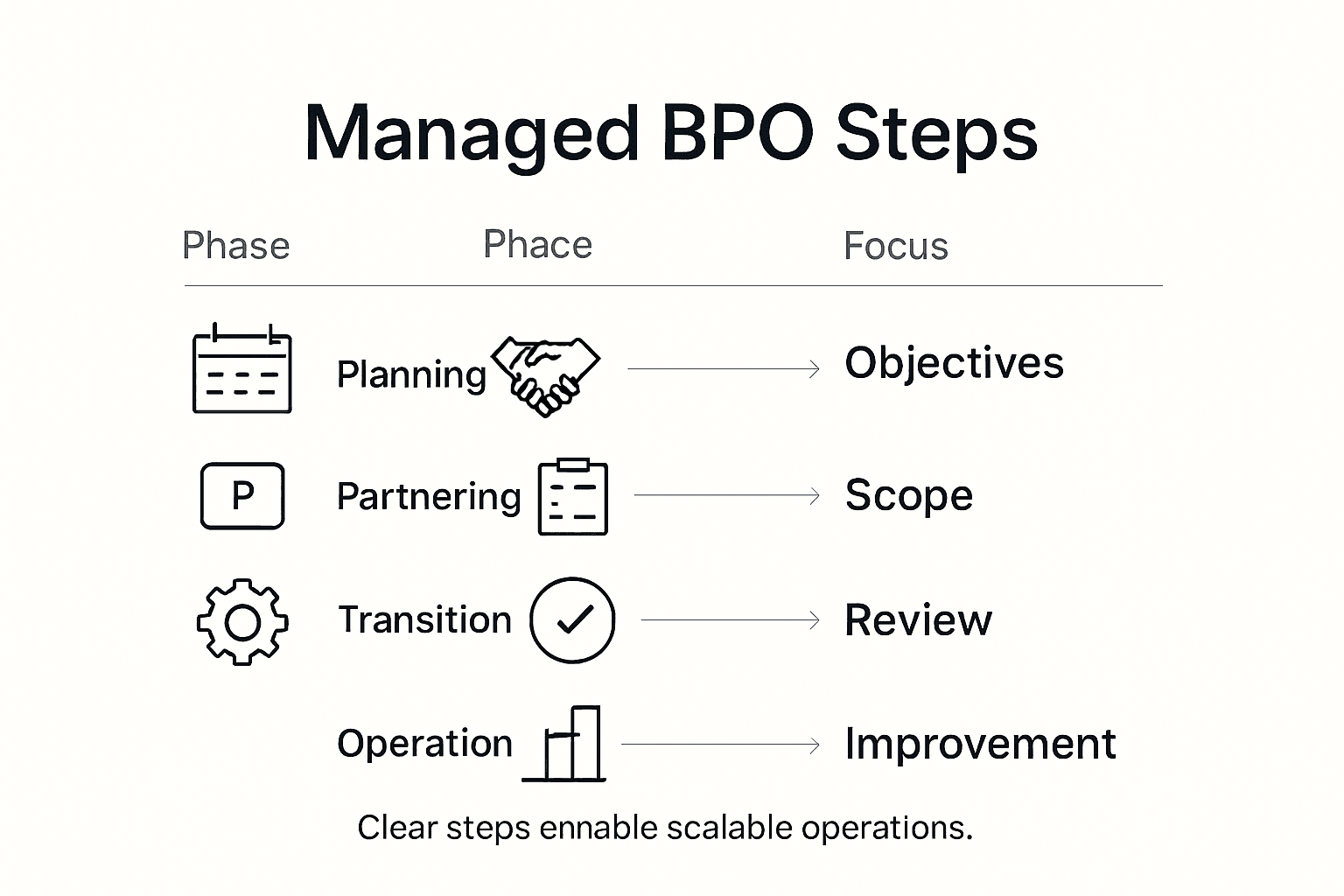
- Step 1: Assess Organizational Needs And Set Objectives
- Step 2: Select The Right BPO Partner And Define Scope
- Step 3: Develop Robust Onboarding And Transition Plans
- Step 4: Implement Service Integration And Change Management
- Step 5: Monitor Performance And Validate Service Delivery
Quick Summary
| Key Point | Explanation |
|---|---|
| 1. Assess Organizational Needs | Conduct an internal audit to identify operational gaps and define measurable objectives for BPO success. |
| 2. Choose the Right BPO Partner | Evaluate potential partners based on industry expertise, technological capabilities, and cultural compatibility. |
| 3. Develop Transition Plans | Create a structured onboarding strategy to facilitate knowledge transfer and ensure clear communication. |
| 4. Monitor Performance Metrics | Establish KPIs to track service delivery and operational efficiency, ensuring alignment with business goals. |
| 5. Implement Change Management | Develop a change management team to oversee communication and training, addressing employee concerns proactively. |
Step 1: Assess organizational needs and set objectives
Before diving into managed Business Process Outsourcing (BPO), you need a crystal clear understanding of your organization’s current operational landscape and future goals. This critical first step involves systematically evaluating your existing processes, identifying performance gaps, and establishing precise objectives that will guide your entire BPO implementation strategy.
Start by conducting a comprehensive internal audit that maps your current workflows, resource allocation, and performance metrics. Analyzing organizational needs helps directors prioritize time and resources effectively. Look for bottlenecks, inefficiencies, and areas where outsourcing could potentially streamline operations. Pay special attention to repetitive tasks, departments with high administrative overhead, and processes that consume significant internal resources without delivering proportional value.
When setting objectives, follow a structured approach. Create objectives that are specific, measurable, and directly aligned with your organization’s broader mission. Instead of vague goals like “improve efficiency,” develop precise targets such as “reduce customer support response times by 40% within six months” or “decrease administrative processing costs by 25% through specialized BPO partnerships.” These clear, quantifiable objectives will serve as benchmarks for evaluating your BPO implementation’s success.
Pro tip: Engage cross functional teams during your needs assessment to gain comprehensive insights. Different departments often have unique perspectives on operational challenges that might not be immediately apparent from a top down view.
Step 2: Select the right BPO partner and define scope
Selecting the right Business Process Outsourcing (BPO) partner is a critical decision that will shape your organization’s operational efficiency and growth potential. Your goal in this step is to methodically evaluate potential partners, ensuring they align with your strategic objectives and can deliver the precise services your business requires.
Defining a comprehensive service scope requires a detailed mapping exercise that meticulously outlines every process and deliverable you expect from your BPO partner. Begin by creating a comprehensive inventory of all functions you plan to outsource, including specific performance metrics, expected quality standards, and key performance indicators (KPIs). This granular approach helps prevent misunderstandings and establishes clear expectations from the outset. Look beyond basic cost considerations and evaluate potential partners based on their technological capabilities, industry expertise, scalability, cultural compatibility, and proven track record in your specific domain.
When assessing potential BPO providers, develop a quantifiable framework for evaluating their potential impact on your operational performance. Request detailed case studies, reference checks, and evidence of successful implementations in similar business contexts. Pay close attention to their technological infrastructure, data security protocols, compliance standards, and ability to integrate seamlessly with your existing systems. Consider conducting pilot projects or requesting small scale trials to validate their capabilities before committing to a full partnership.
Pro tip: Always include an exit strategy and flexibility clauses in your BPO contract to protect your organization’s interests and maintain adaptability as your business evolves.
Here’s a comparison of key criteria for selecting a BPO partner:
| Evaluation Criterion | Why It Matters | Impact on Outsourcing Success |
|---|---|---|
| Industry Expertise | Ensures process understanding | Reduces ramp-up and errors |
| Technological Capabilities | Enables seamless system integration | Streamlines workflow and reporting |
| Cultural Compatibility | Fosters strong working relationships | Minimizes communication setbacks |
| Scalability | Supports future business growth | Adapts to changing needs easily |
| Data Security Standards | Protects sensitive information | Builds trust and compliance |
Step 3: Develop robust onboarding and transition plans
Successful Business Process Outsourcing (BPO) hinges on creating a comprehensive onboarding strategy that smoothly integrates external teams with your existing organizational infrastructure. Your primary objective is to design a structured transition plan that minimizes disruption, ensures knowledge transfer, and establishes clear communication channels between your internal teams and the new BPO partner.

Conducting a thorough implementation needs assessment provides the foundation for a successful transition. Begin by creating a detailed roadmap that outlines every aspect of the knowledge transfer process, including comprehensive documentation of current workflows, operational protocols, and specific performance expectations. This mapping should include granular details about existing systems, technological interfaces, key performance indicators, and cultural nuances specific to your organization. Develop a phased approach that allows for incremental integration, starting with less critical processes and gradually expanding the scope of outsourced functions.
Establish a dedicated transition team comprising members from both your internal organization and the BPO partner. This team should be responsible for developing training modules, creating standardized operating procedures, and designing continuous feedback mechanisms. Focus on creating robust communication protocols that include regular status meetings, performance reviews, and real time reporting systems. Implement a comprehensive training program that not only covers technical skills but also addresses cultural alignment, communication styles, and your organization’s specific values and working methodologies.
Pro tip: Create a contingency plan that includes specific trigger points and alternative strategies to address potential implementation challenges, ensuring your transition remains flexible and responsive to unexpected complications.
Step 4: Implement service integration and change management
Successful Business Process Outsourcing (BPO) transformation requires a strategic approach to integrating new services and managing organizational change. Your primary goal is to create a seamless transition that minimizes disruption, aligns technological systems, and maintains employee engagement throughout the implementation process.
Developing a comprehensive framework for planning organizational information systems is critical to ensuring smooth service integration. Begin by conducting a thorough analysis of your existing technological infrastructure, identifying potential integration points, and mapping out detailed compatibility requirements. Create a phased implementation strategy that allows for gradual system integration, starting with non critical processes and progressively expanding to more complex operational areas. This approach enables your team to identify and address potential challenges incrementally, reducing the risk of widespread operational disruptions.
Effective strategy implementation depends heavily on communication and organizational structure during change management. Establish a dedicated change management team responsible for developing comprehensive communication protocols, training programs, and employee support mechanisms. This team should focus on creating transparent communication channels that keep all stakeholders informed about the transition process, expected changes, and potential impacts on their roles. Implement regular feedback sessions, town hall meetings, and individual consultations to address concerns, manage expectations, and maintain organizational morale throughout the BPO implementation.
Pro tip: Create a comprehensive change impact assessment that identifies potential resistance points and develops targeted strategies to address employee concerns before they become significant obstacles to implementation.
Step 5: Monitor performance and validate service delivery
Monitoring the performance of your Business Process Outsourcing (BPO) partnership is crucial to ensuring long term success and achieving your strategic objectives. Your primary focus will be establishing robust performance measurement systems that provide transparent, actionable insights into service delivery and operational efficiency.
Developing comprehensive outcome statements and strategic planning frameworks is fundamental to effective performance validation. Create a detailed performance dashboard that tracks key performance indicators (KPIs) aligned with your original business objectives. These metrics should include quantitative measurements such as processing times, error rates, cost savings, and productivity levels, as well as qualitative assessments of service quality, customer satisfaction, and strategic alignment. Implement automated reporting systems that provide real time data visualization, enabling quick identification of potential issues and opportunities for optimization.
Strategic plan implementation requires continuous management oversight and organizational culture alignment to validate service delivery effectively. Schedule regular performance review meetings with your BPO partner, using a structured evaluation framework that goes beyond numerical metrics. Assess the partnership holistically by examining communication effectiveness, cultural compatibility, innovation potential, and long term strategic value. Develop a balanced scorecard approach that considers both operational performance and strategic contribution, ensuring your BPO relationship remains dynamic and adaptable to changing business needs.
Pro tip: Establish quarterly comprehensive review sessions that include not just performance metrics, but also forward looking strategy discussions to maintain a proactive and collaborative partnership.
The following table summarizes performance metrics crucial for managing BPO relationships:
| Metric Type | Example Metric | Value Provided |
|---|---|---|
| Quantitative | Processing time | Highlights efficiency gains |
| Quantitative | Error rate | Identifies quality weaknesses |
| Qualitative | Customer satisfaction | Reveals end-user experience |
| Strategic Alignment | Innovation potential | Gauges long-term partnership fit |
Transform Your BPO Implementation into Scalable Success
Navigating the complex world of Managed Business Process Outsourcing requires precise planning, strategic partner selection, and seamless integration. If you are determined to streamline your operational workflows, reduce costs, and accelerate scalability while avoiding common pitfalls like unclear objectives and poor change management, you are in the right place. The article highlights critical steps such as assessing organizational needs, defining service scope, and developing robust onboarding plans that resonate closely with the expert solutions we provide.
At StorsenDigital.com, we specialize in delivering tailored BPO services across Europe designed to tackle these exact challenges. Our comprehensive approach ensures industry expertise, technological integration, and cultural compatibility to elevate your operations. We understand that monitoring performance and fostering collaboration with your BPO partner is essential to drive sustained success. Leverage our managed BPO solutions for HR, finance, IT, customer support, and software development to experience smoother transitions and measurable impact.
Are you ready to turn your BPO strategy into a competitive advantage without the typical execution headaches

Take the next step with StorsenDigital.com to build your scalable outsourcing operation today. Connect with us for a personalized consultation and discover how our nearshoring and managed service expertise can empower your business growth. Contact our team now through our contact page to start optimizing your operational performance with confidence.
Frequently Asked Questions
What are the first steps in a Managed BPO implementation process?
To start a Managed BPO implementation, assess your organizational needs and set clear objectives. Conduct an internal audit of your current operations to identify areas for improvement and define specific goals that will guide the entire BPO strategy.
How do I choose the right BPO partner for my organization?
Selecting the right BPO partner involves evaluating potential providers based on their industry expertise, technological capabilities, and cultural compatibility. Define a comprehensive service scope with clear performance metrics to ensure expectations are aligned.
What are key components of an effective onboarding and transition plan for BPO?
An effective onboarding and transition plan should include a detailed roadmap that outlines knowledge transfer processes and communication protocols. Create training programs and establish a dedicated transition team to facilitate integration and minimize disruption within your organization.
How can I ensure successful service integration and manage organizational change during BPO implementation?
To ensure successful service integration, develop a phased implementation strategy that allows for incremental changes. Establish a change management team to create clear communication protocols and address employee concerns throughout the implementation process.
What performance metrics should I monitor to evaluate BPO effectiveness?
Monitor key performance metrics such as processing times, error rates, and customer satisfaction to evaluate BPO effectiveness. Schedule regular performance review meetings to assess both quantitative and qualitative aspects, ensuring the partnership aligns with your strategic objectives.
How often should I review BPO performance and what should be included in those reviews?
You should conduct performance reviews quarterly to ensure ongoing alignment and assess both operational effectiveness and strategic contribution. Include a balanced scorecard approach that examines both quantitative metrics and qualitative insights to maintain a proactive partnership.


