


For many European tech leaders, aligning daily operations with ambitious business goals is a constant challenge. Gaps in performance and misaligned systems can slow growth and weaken your competitive stance. A systematic needs assessment process shines a light on hidden inefficiencies, helping C-suite executives identify where targeted managed services can deliver tangible results and elevate HR and IT outcomes across your organization.
Table of Contents
- Step 1: Assess Business Needs And Operational Gaps
- Step 2: Define Managed Services Scope And Objectives
- Step 3: Select And Onboard Service Provider
- Step 4: Integrate Processes And Enable Collaboration
- Step 5: Verify Service Alignment And Measure Outcomes
Quick Summary
| Key Takeaway | Explanation |
|---|---|
| 1. Assess Organizational Needs | Conduct a comprehensive review to identify operational gaps and improvement areas. |
| 2. Define Service Scope Clearly | Outline specific IT functions and responsibilities to align managed services with your goals. |
| 3. Select the Right Provider | Evaluate potential providers based on expertise and align their services with your needs. |
| 4. Integrate Workflows Effectively | Create seamless communication and standard procedures between your team and the provider. |
| 5. Monitor and Measure Performance | Use KPIs to track service effectiveness and ensure alignment with strategic objectives. |
Step 1: Assess Business Needs and Operational Gaps
Understanding your organization’s current performance and identifying potential improvement areas is crucial for strategic planning. A systematic needs assessment process helps you pinpoint exactly where your business can evolve and optimize operations.
To effectively assess business needs, start by conducting a comprehensive organizational review. This involves gathering data from multiple departments and stakeholders to create a holistic view of your current operational landscape. Map out existing processes, review performance metrics, and identify areas where current capabilities fall short of strategic goals. A structured fit gap analysis will help you evaluate misalignments between your current systems and desired outcomes.
Your assessment should cover key operational domains such as technology infrastructure, workforce capabilities, workflow efficiency, and strategic alignment. Engage team leaders and key personnel to gather qualitative insights alongside quantitative data. Look for patterns of inefficiency, bottlenecks, and areas where additional resources or process improvements could yield significant benefits.
Pro tip: Create a standardized assessment template that can be consistently used across different departments to ensure comprehensive and comparable evaluation results.
Here is a summary of key areas to consider during a business needs assessment:
| Operational Domain | Purpose | Typical Data Sources |
|---|---|---|
| Technology Infrastructure | Identify tech gaps and risks | System audits, IT reports |
| Workforce Capabilities | Assess skill alignment | Staff interviews, HR data |
| Workflow Efficiency | Detect bottlenecks | Process maps, productivity metrics |
| Strategic Alignment | Ensure goals match execution | Executive feedback, business reviews |
Step 2: Define Managed Services Scope and Objectives
Successfully implementing managed services begins with crystal clear definition of your service boundaries and strategic goals. Defining service scope precisely ensures alignment between your organization’s needs and the services being provided.
Start by outlining the specific IT functions and operational domains that will be managed externally. Clarify service provider responsibilities versus internal team capabilities. This involves creating detailed documentation that specifies exactly which services are included, performance expectations, response times, and key performance indicators (KPIs). Consider aspects like technical support, infrastructure management, cybersecurity monitoring, software updates, and help desk operations.
Ensure your managed services objectives are measurable, specific, and directly tied to your broader business strategy. Develop a comprehensive service level agreement (SLA) that clearly articulates expected outcomes, measurement criteria, and potential remediation strategies if performance targets are not met. Your objectives should focus on improving operational efficiency, reducing technology risks, controlling costs, and enabling your core team to concentrate on strategic business initiatives.
Pro tip: Create a matrix that visually maps out service responsibilities, showing precise boundaries between managed service provider and internal team to prevent potential overlap or accountability gaps.
Step 3: Select and Onboard Service Provider
Choosing the right managed services partner is a critical decision that will shape your organization’s technological capabilities and operational efficiency. Comprehensive provider assessment involves evaluating potential candidates based on their technical expertise, track record, and alignment with your specific business requirements.

Begin by developing a detailed request for proposal (RFP) that outlines your exact service needs, performance expectations, and evaluation criteria. Conduct thorough due diligence by reviewing potential providers’ case studies, client testimonials, industry certifications, and technical capabilities. Arrange initial discovery meetings and technical assessments to gauge their understanding of your unique organizational challenges. Evaluate provider competencies through structured interviews, technical demonstrations, and reference checks that validate their ability to deliver consistent, high quality service.
Once you select a service provider, develop a comprehensive onboarding plan that facilitates smooth integration. This should include detailed knowledge transfer sessions, collaborative workshops to align processes, and establishing clear communication channels. Create a governance framework that defines escalation protocols, performance monitoring mechanisms, and regular review checkpoints to ensure ongoing alignment and continuous improvement throughout the partnership.
Pro tip: Schedule quarterly strategic alignment meetings with your service provider to proactively discuss emerging technology trends, potential optimization opportunities, and maintain a dynamic partnership.
Step 4: Integrate Processes and Enable Collaboration
Successful managed services implementation hinges on creating seamless workflows and communication channels between your organization and the service provider. Aligning organizational workflows requires a strategic approach that goes beyond technical integration and addresses cultural and operational synchronization.
Begin by establishing a comprehensive integration framework that defines shared tools, communication protocols, and collaborative platforms. Create joint working groups with representatives from both your internal team and the service provider to facilitate knowledge transfer and develop mutual understanding. Focus on creating standardized procedures for key operational activities, including incident management, reporting mechanisms, escalation protocols, and performance tracking. Implement collaborative technologies that enable real time information sharing, such as integrated project management software, shared dashboards, and secure communication channels.
Recognize that process integration is not just about technical alignment but also about harmonizing organizational culture. Invest time in cross team training sessions, periodic strategic alignment workshops, and development of shared performance metrics. These activities help build mutual trust, create a unified operational approach, and ensure that both organizations are working towards common strategic objectives.
Pro tip: Develop a comprehensive integration playbook that documents all collaboration processes, communication channels, and escalation procedures to provide a clear reference point for both teams.
Step 5: Verify Service Alignment and Measure Outcomes
Successfully implementing managed services requires ongoing verification and rigorous performance assessment. Monitoring service performance metrics enables your organization to validate that the managed services are delivering the expected business value and strategic objectives.
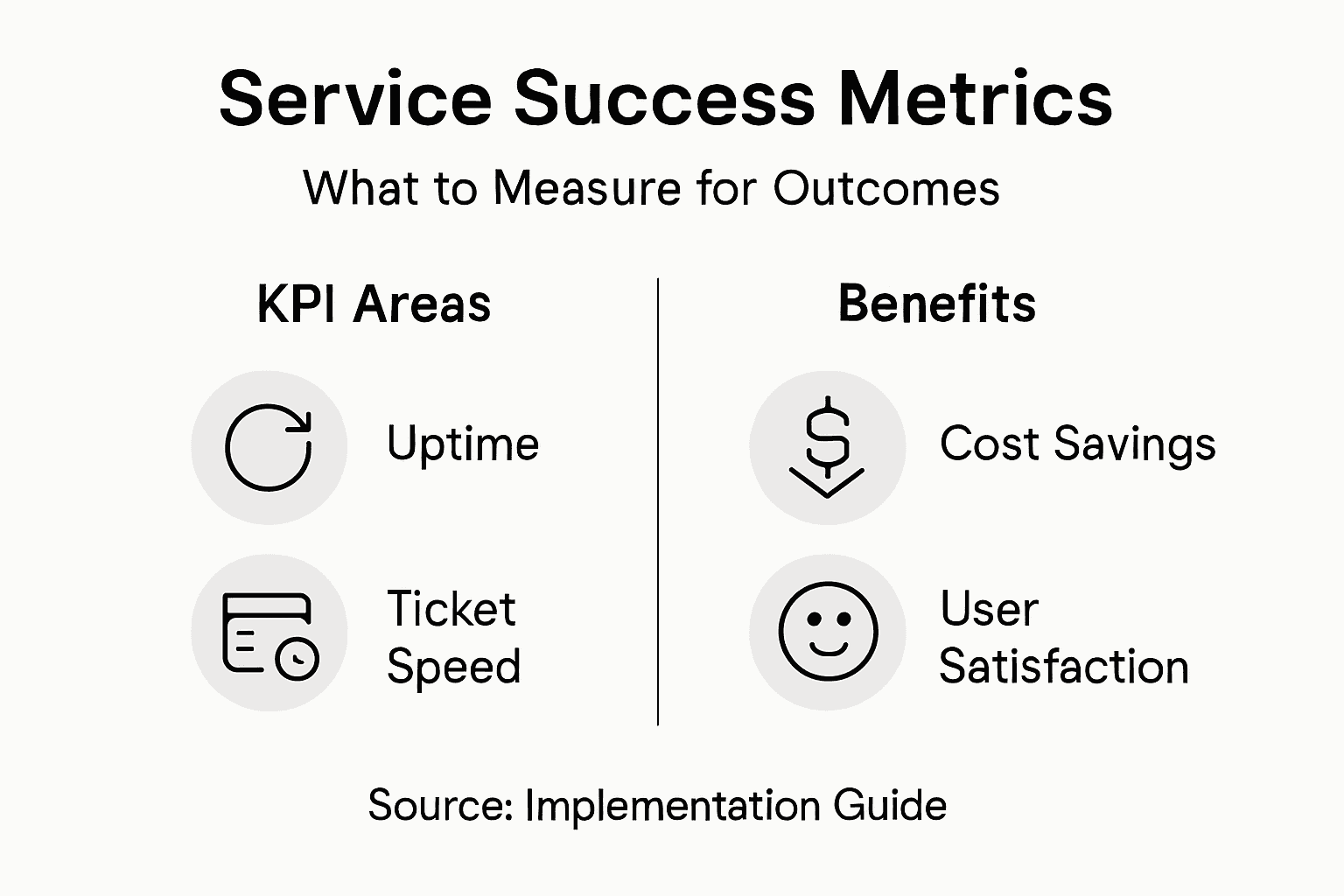
Develop a comprehensive performance measurement framework that includes both quantitative and qualitative key performance indicators (KPIs). These metrics should cover critical dimensions such as operational efficiency, service quality, compliance, response times, problem resolution rates, and customer satisfaction. Schedule regular review meetings with your service provider to analyze these metrics, discuss performance trends, and identify areas for improvement. Use advanced analytics and reporting tools to generate real time insights and create visual dashboards that provide transparent performance tracking.
Conduct systematic gap analysis to compare current service performance against your original strategic objectives and service level agreements. This process helps you identify potential misalignments, performance shortfalls, and opportunities for optimization. Be prepared to collaborate with your service provider on corrective action plans, adjusting strategies and workflows to maintain continuous improvement and ensure that the managed services evolve in line with your changing business needs.
Pro tip: Implement a balanced scorecard approach that weights different performance metrics to provide a holistic view of service effectiveness, preventing overemphasis on any single performance dimension.
This table highlights essential managed service KPIs and their benefits:
| KPI Area | What It Measures | Business Benefit |
|---|---|---|
| Response Time | Speed of issue resolution | Minimizes business disruption |
| Problem Resolution | Rate of issue completion | Boosts service reliability |
| User Satisfaction | Employee/end-user experience | Increases adoption and trust |
| Compliance Rate | Adherence to standards | Reduces regulatory risk |
Accelerate Your Managed Services Implementation with StorsenDigital
Implementing managed services can be complex. You need to clearly define service scopes, select the right provider, and ensure seamless process integration. Challenges like aligning workflows, measuring outcomes, and closing operational gaps demand expert support to drive business success. Our approach at StorsenDigital focuses on tailored managed BPO solutions that enhance workforce capabilities, optimize workflows, and improve service performance across HR, IT, finance, and customer support.
Gain confidence with our proven expertise in European nearshoring and outsourcing. Whether you are addressing technology infrastructure needs or strategic alignment, StorsenDigital offers end-to-end support that makes managed services implementation efficient and impactful. Explore how we can help your business reduce operational risks, improve service quality, and accelerate digital transformation.
Ready to elevate your managed services approach today? Don’t wait to bridge the gap between strategy and execution with customized solutions from StorsenDigital. Contact us now to discover how our team can become your strategic partner for operational excellence.
Discover Our Outsourcing Solutions
Schedule a Consultation
Start Your Managed Services Journey with StorsenDigital

Frequently Asked Questions
What steps should I take to assess my business’s needs for managed services?
To assess your business’s needs, begin by conducting a comprehensive organizational review. Gather data from various departments to identify areas for improvement, focusing on technology, workforce capabilities, and workflow efficiency. Create a standardized assessment template to ensure consistent evaluation across departments.
How do I define the scope and objectives for managed services in my organization?
Define the scope and objectives by outlining specific IT functions to be managed externally. Document service provider responsibilities and establish measurable performance expectations, response times, and key performance indicators (KPIs) to align services with your business strategy.
What criteria should I use when selecting a managed services provider?
Evaluate potential managed services providers based on their technical expertise, past performance, and alignment with your business needs. Craft a detailed request for proposal (RFP) that includes your expectations and assessment criteria to guide your selection process effectively.
How can I integrate processes and facilitate collaboration between my team and the service provider?
Establish a comprehensive integration framework that defines shared tools and communication protocols. Create joint working groups and implement standardized procedures for key operational activities, ensuring both teams understand and work towards common strategic objectives.
What performance metrics should I measure to ensure the success of managed services?
Utilize a balanced scorecard approach to track key performance indicators (KPIs), such as response time, problem resolution rate, and user satisfaction. Schedule regular review meetings with your service provider to analyze these metrics, identify misalignments, and adjust strategies as necessary for continuous improvement.


