


Finding a path to sustained operational efficiency often begins with clarifying what your business truly needs to succeed. For C-suite leaders and procurement VPs across European enterprises, identifying and documenting the key business requirements is essential before engaging managed service providers or exploring nearshoring options. This approach enables precise alignment between your organization’s strategic vision and the real-world solutions necessary to drive performance and cost-effectiveness.
Table of Contents
- Step 1: Define Business Requirements and Objectives
- Step 2: Select Optimal Managed Service Providers
- Step 3: Customize Service Level Agreements and Workflows
- Step 4: Integrate Managed Services with Internal Systems
- Step 5: Monitor Performance and Ensure Compliance
Quick Summary
| Key Insight | Explanation |
|---|---|
| 1. Define Business Objectives | Clearly articulate key business needs and goals to guide managed services initiatives effectively. |
| 2. Evaluate Service Providers | Develop a comprehensive evaluation framework for selecting managed service providers that fit operational needs. |
| 3. Customize Service Agreements | Tailor service level agreements to reflect unique operational requirements and objectives for better alignment. |
| 4. Integrate Systems Efficiently | Create a detailed integration blueprint to align managed services with internal systems seamlessly. |
| 5. Monitor Compliance Continuously | Establish a robust monitoring framework to ensure performance aligns with strategic and regulatory expectations. |
Step 1: Define Business Requirements and Objectives
In this step, you will clearly articulate the key business needs and strategic goals that will drive your managed services initiative. The goal is to create a comprehensive roadmap that transforms your organizational objectives into actionable requirements.
Defining business requirements starts with understanding your company’s core strategic vision. Begin by conducting structured meetings with key stakeholders to map out specific business requirements that align with your long-term goals. Involve representatives from finance, operations, technology, and executive leadership to ensure a holistic perspective. Document each requirement with precise language that highlights the expected business value and desired outcomes.
Focus on capturing the essential elements that define success: What specific problems are you trying to solve? What performance metrics will indicate achievement? What constraints or limitations exist? Create a detailed requirements document that outlines business context, stakeholder expectations, success criteria, and potential constraints. This document serves as a critical reference point for your entire managed services implementation strategy.
Pro tip: Always validate your business requirements with multiple stakeholders and obtain formal sign-off to ensure alignment and prevent future misunderstandings.
Step 2: Select Optimal Managed Service Providers
In this step, you will strategically evaluate and select managed service providers that align perfectly with your organization’s specific operational needs and strategic objectives. Your goal is to identify a partner who can deliver comprehensive, reliable, and cost-effective managed services.
Begin by developing a comprehensive evaluation framework that goes beyond surface level assessments. Cybersecurity and risk management considerations should be a critical component of your selection process. Create a detailed scorecard that assesses potential providers across multiple dimensions including technical capabilities, industry expertise, service scope, pricing models, security protocols, and proven track record of supporting businesses similar to yours. Conduct thorough due diligence by requesting detailed service level agreements, case studies, client references, and comprehensive security documentation.

Look for managed service providers who demonstrate not just technical proficiency but a strategic approach to partnership. Evaluate their ability to scale services, adapt to your evolving business needs, and provide proactive management rather than reactive solutions. Pay close attention to their disaster recovery capabilities, cybersecurity measures, compliance certifications, and technological infrastructure. The ideal provider should act as an extension of your internal team, offering transparent communication, predictable performance, and continuous improvement strategies.
Pro tip: Always conduct a pilot project or phased implementation to validate a managed service provider’s capabilities before committing to a full scale engagement.
The table below summarizes the critical evaluation dimensions for selecting a managed service provider:
| Evaluation Factor | Why It Matters | What to Look For |
|---|---|---|
| Technical Capabilities | Ensure scalable, up-to-date solutions | Modern infrastructure, expertise |
| Security & Compliance | Protect data and meet regulations | Robust protocols, certifications |
| Service Scope | Align offerings with business needs | Comprehensive, flexible options |
| Pricing Model | Control costs, plan budgets | Transparent, predictable fees |
| Partnership Approach | Foster long-term business alignment | Proactive management, clear communication |
| Track Record | Minimize risk of service disruption | Proven results, strong references |
Step 3: Customize Service Level Agreements and Workflows
In this step, you will transform standard service agreements into precise, tailored documents that precisely reflect your organization’s unique operational requirements and strategic expectations. Your goal is to create a comprehensive framework that aligns service delivery with your specific business objectives.
Start by developing a robust service management framework that goes beyond generic templates. Collaborate closely with your managed service provider to craft service level agreements that include granular performance metrics, clear responsibility definitions, response time expectations, and detailed escalation protocols. Focus on establishing quantifiable key performance indicators that directly tie to your business outcomes such as system uptime, response times, resolution speeds, and quality benchmarks. Ensure the agreement includes transparent remediation clauses that provide concrete recourse if service standards are not met.
The customization process requires deep collaboration and iterative refinement. Work with your provider to integrate specific workflow methodologies that match your organizational culture and operational cadence. This might involve adopting Agile methodologies, establishing regular communication checkpoints, defining precise reporting structures, and creating flexible mechanisms for ongoing service optimization. The most effective service level agreements function as living documents that can adapt to your evolving business needs while maintaining clear accountability and performance standards.
Pro tip: Schedule quarterly review meetings to reassess and recalibrate your service level agreements to ensure continuous alignment with your changing business landscape.
Here is a side-by-side comparison of standard vs. customized service level agreements (SLAs):
| Aspect | Standard SLA | Customized SLA |
|---|---|---|
| Performance Metrics | Generic, broad targets | Specific, business-aligned KPIs |
| Flexibility | Fixed terms, little adjustment | Adaptable to changing business needs |
| Accountability | Vague responsibility definitions | Clear roles, detailed escalation protocols |
| Continuous Improvement | Rarely updated | Regular review, ongoing optimization |
Step 4: Integrate Managed Services with Internal Systems
In this step, you will strategically align your managed service provider’s technological infrastructure with your existing internal systems to create a seamless operational ecosystem. Your objective is to establish robust integration mechanisms that enable smooth data flow, minimize disruption, and maximize operational efficiency.
Begin by conducting a comprehensive systems engineering assessment that maps out your current technological landscape. Identify all critical integration points, potential interface challenges, and specific requirements for data exchange, security protocols, and system interoperability. Work closely with both your internal IT team and managed service provider to develop a detailed integration blueprint that addresses technical compatibility, data migration strategies, authentication mechanisms, and real time synchronization protocols. Pay special attention to establishing secure communication channels, defining data governance standards, and creating flexible integration architectures that can adapt to future technological evolution.
The integration process requires a methodical and collaborative approach. Implement the integration in controlled phases, starting with non critical systems and gradually expanding to more complex operational domains. Develop comprehensive testing protocols that validate data accuracy, system performance, and security integrity at each integration stage. Create robust monitoring mechanisms that provide real time visibility into system interactions, enabling quick identification and resolution of any potential integration challenges. Establish clear escalation procedures and maintain open communication channels between your internal teams and managed service providers to ensure smooth ongoing system alignment.
Pro tip: Develop a dedicated integration task force with representatives from both your internal IT team and managed service provider to oversee and continuously optimize the integration process.
Step 5: Monitor Performance and Ensure Compliance
In this step, you will establish a comprehensive monitoring and compliance framework that enables continuous assessment of your managed services performance, ensuring alignment with strategic objectives and regulatory requirements. Your goal is to create a proactive system that identifies potential issues before they escalate and maintains the highest standards of operational excellence.
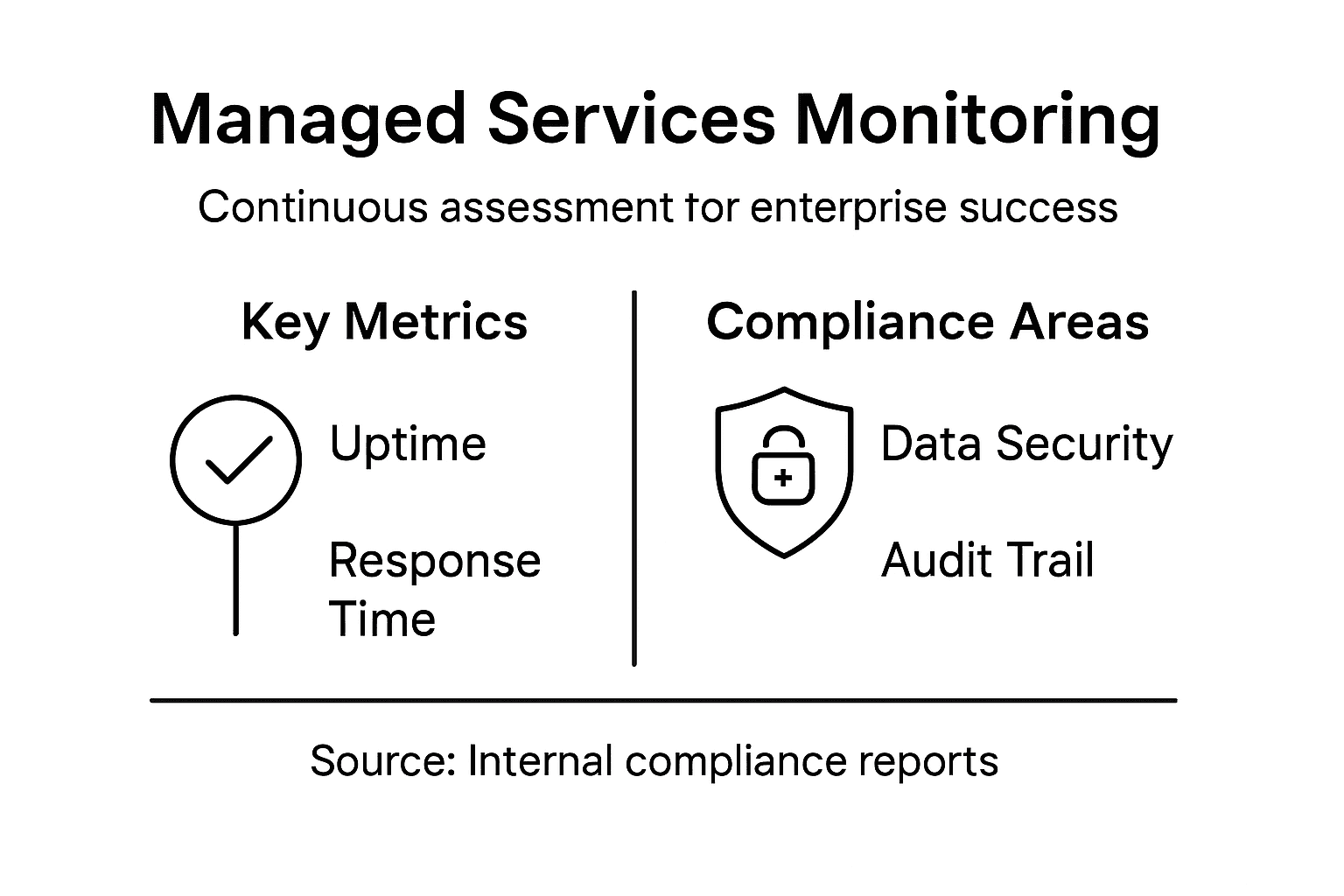
Begin by developing a robust compliance management system that goes beyond basic tracking. Design a multifaceted monitoring approach that includes real time performance metrics, periodic comprehensive audits, and detailed reporting mechanisms. Implement key performance indicators that measure not just operational efficiency but also regulatory adherence, security protocols, and service quality. Create a dashboard that provides transparent visibility into critical metrics such as system uptime, response times, resolution speeds, and compliance status. Establish clear thresholds for acceptable performance and develop immediate escalation protocols for any deviations.
The monitoring process requires a dynamic and collaborative approach. Schedule regular review meetings with your managed service provider to analyze performance data, discuss emerging trends, and identify opportunities for continuous improvement. Develop a risk assessment framework that proactively evaluates potential compliance vulnerabilities and creates mitigation strategies. Ensure your monitoring processes are flexible enough to adapt to changing regulatory landscapes and technological advancements. Maintain detailed documentation of all monitoring activities, audit findings, and corrective actions to demonstrate ongoing diligence and commitment to excellence.
Pro tip: Implement an automated compliance tracking system that provides real time alerts and generates comprehensive compliance reports to streamline your monitoring efforts.
Accelerate Your Managed Services Journey with Expert Nearshoring Support
Are you struggling to define clear business requirements or find the right managed service provider that perfectly fits your enterprise goals? Achieving seamless integration and continuous performance monitoring can feel overwhelming without a trusted strategic partner. The pains of unclear SLAs, security compliance, and fragmented workflows can hold your business back from success.
StorsenDigital.com specializes in delivering tailored outsourcing and managed BPO services across Europe designed to solve these exact challenges. With deep expertise in talent acquisition, IT, finance, and customer support managed services, we help you create flexible service level agreements aligned directly with your business KPIs while connecting you to scalable European talent and digital infrastructure. Our strategic consulting ensures smooth integration and compliance monitoring so your enterprise stays ahead.
Unlock the full potential of your managed services implementation today. Explore how our nearshoring and outsourcing solutions can transform your operational model with proven results and transparent partnership approaches.
Outsourcing and Nearshoring Solutions
Schedule a Consultation with StorsenDigital

Ready to eliminate operational roadblocks and achieve managed services success at scale? Connect with our experts now at StorsenDigital.com and take the first step toward optimized performance and compliance today.
Frequently Asked Questions
What are the key business requirements to define for managed services?
To define key business requirements, start by understanding your organization’s strategic vision through meetings with stakeholders from finance, operations, technology, and leadership. Document the specific problems you’re aiming to solve, the performance metrics you’ll use to measure success, and any constraints you may face.
How can I evaluate and select the right managed service provider?
Begin by developing a comprehensive evaluation framework that assesses potential providers on technical capabilities, service scope, pricing models, and security protocols. Use a detailed scorecard to score each provider, and conduct due diligence, such as reviewing service level agreements and requesting client references.
What should I include in tailored service level agreements (SLAs) for managed services?
Your SLAs should include specific performance metrics, clear definitions of responsibilities, and robust escalation protocols that align with your business objectives. Collaborate with your managed service provider to ensure the agreement can adapt to evolving needs and includes transparency regarding remediation processes if standards aren’t met.
How do I ensure successful integration of managed services with internal systems?
To ensure integration success, conduct a systems engineering assessment to identify critical integration points and potential interface challenges. Collaborate with your internal IT team and your managed service provider to develop an integration blueprint, and implement the integration in controlled phases with comprehensive testing at each stage.
What performance monitoring and compliance measures should I implement for managed services?
Establish a robust compliance management system that includes real-time performance metrics, periodic audits, and a dashboard for visibility into key indicators like system uptime and compliance status. Schedule regular review meetings with your managed service provider to analyze performance data and adjust strategies as necessary to maintain high standards.


