


Keeping operational costs in check while scaling a tech business across Europe often feels like navigating shifting terrain. Leaders know the risk of moving forward without clear outsourcing objectives—every missed detail can mean wasted resources and misaligned partnerships. By focusing on defining your core business problem and measurable outcomes from the outset, you lay the foundation for tangible performance gains and real cost control. This guide breaks down how to secure clarity, alignment, and value through outsourcing tailored to your needs.
Table of Contents
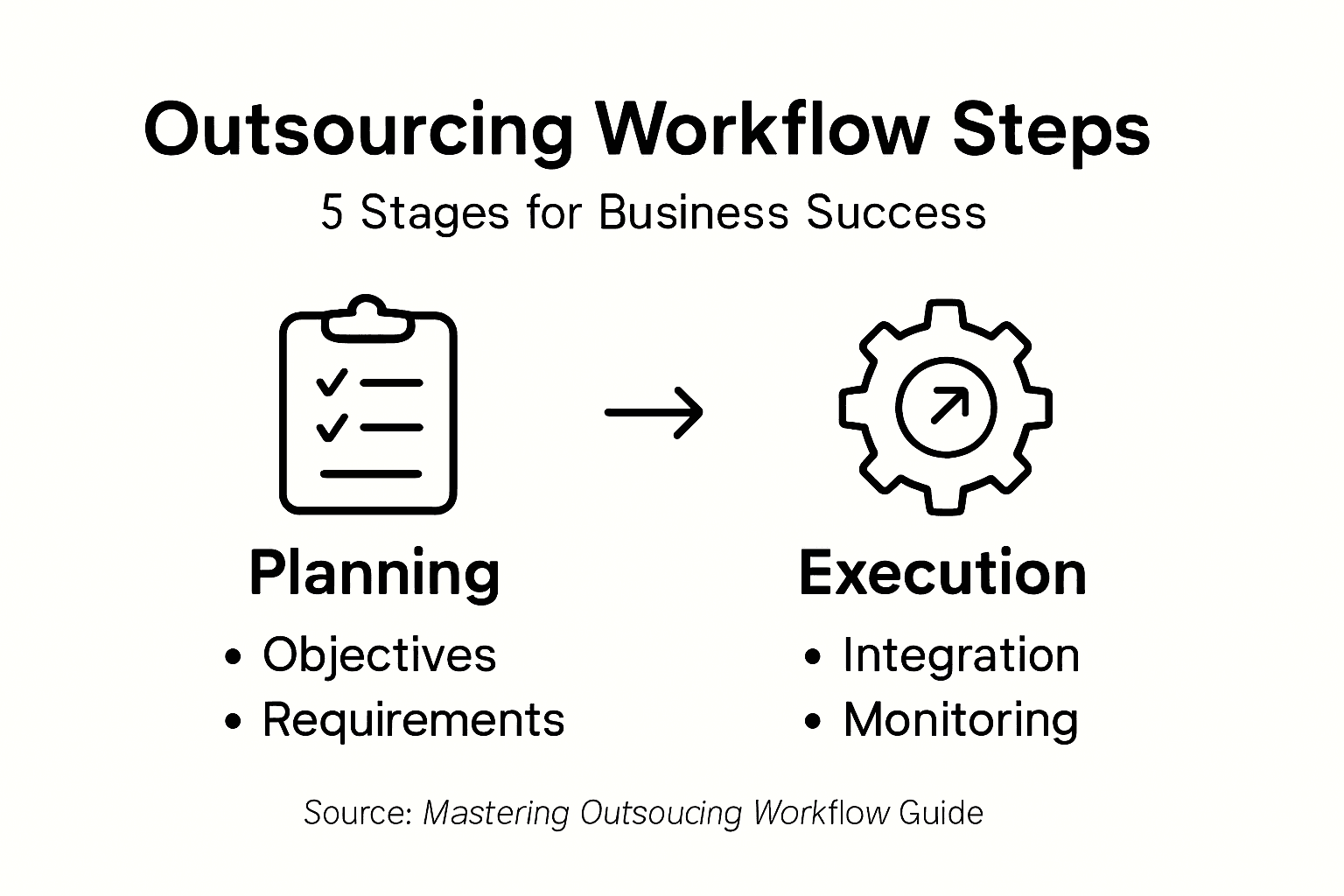
- Step 1: Define Outsourcing Objectives And Requirements
- Step 2: Select And Onboard The Right Outsourcing Partner
- Step 3: Implement Workflow Integration And Knowledge Transfer
- Step 4: Monitor Performance And Optimize Processes
- Step 5: Verify Outcomes And Ensure Ongoing Compliance
Quick Summary
| Key Point | Explanation |
|---|---|
| 1. Define clear objectives | Establish measurable goals to guide your outsourcing strategy and prevent costly misalignment. |
| 2. Select the right partner | Research candidates thoroughly to ensure they have the necessary expertise and cultural fit for your business needs. |
| 3. Focus on workflow integration | Embed your outsourced team into core functions to promote collaboration and seamless operations. |
| 4. Implement continuous monitoring | Track performance indicators in real-time to identify issues early and drive ongoing improvements. |
| 5. Ensure compliance and verification | Regularly verify outcomes and maintain compliance to protect your business and uphold industry standards. |
Step 1: Define outsourcing objectives and requirements
Before you sign any agreement or hand off work to a partner, you need absolute clarity on what you’re trying to achieve. This step sets the foundation for everything that follows. Without it, you’re guessing, and guessing costs money.
Start by identifying the core business problem you’re solving. Are you drowning in operational costs? Struggling with hiring talent locally? Facing seasonal workload spikes? Each reason demands a different outsourcing strategy. Understanding firm performance and cost reduction goals helps you align your outsourcing engagement with measurable outcomes.
Next, map out your specific business needs. Which processes will you outsource? Finance and accounting? Customer support? IT infrastructure? Software development? The more precise you are, the easier it becomes to find the right partner and measure success.
Define these critical objectives:
- Cost reduction targets (e.g., reduce operational expenses by 35%)
- Quality standards (response times, error rates, uptime percentages)
- Timeline expectations (when do you need this operational?)
- Headcount or capacity needs (10 FTEs, 50 agents, specific skill sets)
- Technology and infrastructure requirements (tools, systems integration, security standards)
Document your operational constraints too. Does your team work across multiple time zones? Do you have strict data security or compliance requirements? Are there cultural or language preferences? These shape what’s realistic and what isn’t.
Here’s a quick reference on matching outsourcing goals with the best-fit strategies:
| Objective | Optimal Strategy | Example Approach |
|---|---|---|
| Cost reduction | Offshore outsourcing | Assign tasks to lower-cost regions |
| Quality improvement | Specialist vendor selection | Partner with industry experts |
| Fast scaling | Flexible headcount model | On-demand staffing solutions |
| Compliance focus | Regulated market partners | Use vendors with certifications |
StorsenDigital specializes in helping European companies like yours define these objectives precisely, then matching them with dedicated teams in Bosnia and Herzegovina where you get premium quality at your best cost position. When you connect with us at www.storsendigital.com, we help translate your business goals into concrete outsourcing specifications that drive real results.
Clear objectives eliminate wasted effort and vendor mismatch. Vague goals guarantee disappointment.
Pro tip: Document your requirements in a brief one-page summary—cost targets, FTE count, quality metrics, and timeline. This becomes your north star during vendor evaluation and partner management.
Step 2: Select and onboard the right outsourcing partner
You have your objectives locked down. Now comes the critical decision: who actually executes this work? Picking the wrong partner wastes months and money. Picking the right one transforms your operation.
Start your search by researching provider reputation and expertise. Look beyond marketing websites. Check client testimonials, case studies, and industry recognition. Does this partner have proven success in your specific domain? If you need customer support outsourcing, find someone with customer support experience. This matters more than you think.
Evaluate these factors when comparing candidates:
- Financial stability (Can they sustain operations long-term?)
- Technical capabilities (Do they have the tools and infrastructure you need?)
- Cultural alignment (Do they understand your business values and work style?)
- Scalability (Can they grow with you from 10 people to 100?)
- Communication approach (How responsive and transparent are they?)
Once you narrow your list, conduct provider selection interviews with your top 2-3 candidates. Ask tough questions about their processes, team stability, quality assurance, and how they handle issues. Listen for specifics, not corporate platitudes.
Requesting a trial project is non-negotiable. This is your insurance policy. Start with a smaller, lower-risk engagement before committing to full-scale operations. A 30-day pilot reveals incompatibilities faster than any contract review.
During onboarding, establish clear communication protocols and expectations. Weekly check-ins? Daily standups? Define your escalation process upfront. Who owns what? When decisions need to happen? Clarity prevents friction.
StorsenDigital helps European companies skip the trial-and-error phase. Our dedicated teams in Bosnia and Herzegovina have proven track records scaling businesses across industries. Visit www.storsendigital.com to see how we match companies with the right talent and processes from day one.
The best partnership starts with alignment on fundamentals. Test before you commit.
Pro tip: Run a structured scoring matrix comparing candidates across cost, capability, culture fit, and timeline. Assign weights to each factor so decisions are objective, not emotional.
Step 3: Implement workflow integration and knowledge transfer
Your partner is onboarded. Now you need to weave them seamlessly into your operations. This is where many outsourcing relationships stumble. Poor integration creates silos, duplicated effort, and frustrated teams on both sides.

Start by embedding your outsourcing team into core business functions. They shouldn’t exist in isolation. Your outsourced developers need access to your product roadmap. Your outsourced accountants need visibility into your financial planning. This integration removes barriers and accelerates decision-making.
Design your knowledge transfer framework with these components:
- Documentation systems (wikis, process guides, standard operating procedures)
- Regular synchronization meetings (daily standups, weekly reviews, monthly strategy calls)
- Hands-on shadowing (your team works alongside theirs to learn processes)
- Gradual responsibility handoff (start supervised, build independence over time)
- Feedback loops (continuous improvement channels for issues and suggestions)
Knowledge exchange through transparent communication drives better outcomes than one-way instruction. Your outsourced team should ask questions, challenge assumptions, and contribute ideas.
Standardize your knowledge exchange methods across the organization. If Finance uses one documentation system and Customer Support uses another, you create confusion and knowledge gaps. A unified approach ensures consistent, efficient transfer of critical information.
Measure integration success through performance metrics. Are response times improving? Is quality increasing? Are escalations decreasing? Track these weekly to catch integration problems early before they compound.
StorsenDigital builds teams specifically designed to integrate seamlessly into your operations from day one. Our experience scaling global businesses means we understand how to embed talent, transfer knowledge, and maintain quality across time zones. Learn more at www.storsendigital.com about our proven integration frameworks.
Successful integration happens when your outsourced team thinks like your team. Build that culture intentionally.
Pro tip: Assign a dedicated integration lead on your side who owns the knowledge transfer timeline and meets weekly with your partner’s counterpart. This single point of accountability prevents knowledge from slipping through cracks.
Step 4: Monitor performance and optimize processes
Once your outsourcing operation is running, the real work begins. Monitoring isn’t a one-time audit. It’s continuous vigilance that catches problems early and drives improvement over time.
Start by defining Key Performance Indicators aligned with your strategic objectives. These aren’t vanity metrics. They’re concrete measures tied directly to your business goals. If cost reduction was your objective, track cost per transaction. If quality matters most, measure defect rates and customer satisfaction scores.
Your KPI framework should include:
- Service level metrics (response times, uptime, turnaround times)
- Quality measures (error rates, rework costs, customer satisfaction)
- Compliance tracking (regulatory adherence, security incidents, audit results)
- Operational efficiency (cost per unit, throughput, resource utilization)
- Team health indicators (employee retention, training completion, engagement)
Continuous monitoring with real-time data insights drives process optimization far better than monthly reports. Use dashboards that show performance live. When something dips, you catch it immediately, not weeks later.
Implement a risk-based monitoring approach. High-risk areas demand closer scrutiny. Finance and compliance require stricter oversight than less critical functions. Allocate your monitoring resources where they matter most.
Schedule regular feedback and optimization sessions with your partner. Review the data together monthly. Where are bottlenecks? What’s working exceptionally well? What’s costing more than expected? Use these insights to adjust processes collaboratively.
Adaptive management is essential. Your initial processes won’t be perfect. Meta-analysis on outsourcing performance confirms that organizations optimizing through feedback loops achieve sustainable outcomes. Treat your outsourcing relationship as a living system that evolves.
StorsenDigital provides transparent, real-time performance visibility for all our clients. You get dedicated reporting, monthly business reviews, and collaborative optimization sessions. Our teams at www.storsendigital.com are committed to continuous improvement that directly impacts your bottom line.
What gets measured gets managed. Vague monitoring creates complacency.
Pro tip: Create a simple one-page scorecard showing your five most critical KPIs updated weekly. Share it with your partner and your leadership team. Transparency creates accountability and aligns everyone toward the same outcomes.
Step 5: Verify outcomes and ensure ongoing compliance
You’re tracking performance. You’re optimizing processes. Now you need to verify that your outsourcing arrangement actually delivers what was promised and remains compliant with all legal and regulatory requirements. This step protects your business and your reputation.
Begin with comprehensive outcome verification. Compare actual results against the objectives you defined in Step 1. Did you achieve your cost reduction targets? Are quality metrics where they should be? Is your team satisfied with the partnership? Honest assessment reveals whether the outsourcing arrangement is truly successful or needs course correction.
Establish a robust compliance management framework that addresses your specific industry and regulatory environment. Compliance framework implementation requires continuous risk assessment and contractual due diligence. What regulations apply to your business? Data protection? Financial regulations? Industry-specific standards? Your outsourcing partner must meet every requirement.
Your compliance checklist should cover:
- Data security and protection (GDPR, industry standards, encryption protocols)
- Legal and regulatory adherence (licenses, certifications, compliance documentation)
- Contractual obligations (service levels, confidentiality, liability, termination clauses)
- Audit mechanisms (regular internal audits, third-party assessments, documentation)
- Risk management (business continuity, disaster recovery, incident response plans)
Conduct vendor due diligence periodically, not just at the start. Regulations evolve. Your partner’s circumstances change. Annual compliance audits catch drift before it becomes a problem. Request audit reports, certifications, and compliance documentation regularly.
Protecting sensitive data and adapting to evolving regulations requires active monitoring and policy updates. Review your contracts annually to ensure they still align with current regulations. Refresh data security protocols as threats evolve.
StorsenDigital maintains strict compliance across all operations in Bosnia and Herzegovina. We handle GDPR, financial regulations, and industry-specific requirements with expertise. Our teams undergo regular audits and certifications to ensure your data and operations stay protected. Connect with us at www.storsendigital.com to discuss your specific compliance needs.
Compliance violations don’t forgive ignorance. Verify regularly and document everything.
Pro tip: Schedule quarterly compliance review meetings with your partner where you jointly review audit findings, regulatory changes, and any incidents. Document everything in writing. This creates accountability and builds evidence of due diligence if regulators ever ask questions.
The following table summarizes key stages in the outsourcing lifecycle and highlights primary success factors:
| Stage | Primary Success Factor | Risk if Missed |
|---|---|---|
| Define requirements | Clear, measurable objectives | Misaligned expectations |
| Select partner | Domain-specific expertise | Project delays |
| Workflow integration | Structured knowledge transfer | Process disconnects |
| Performance monitoring | Real-time data tracking | Undetected issues |
| Ongoing compliance | Regular audits and updates | Regulatory penalties |
Unlock Seamless Outsourcing Success with Expert Support
Mastering the operations outsourcing workflow is essential for businesses aiming to reduce costs, ensure quality, and maintain compliance. If you are struggling with selecting the right partner, integrating workflows, or continuously monitoring performance, you are not alone. Many enterprises face challenges aligning clear objectives with scalable managed services that fit their unique needs and strict compliance requirements.
StorsenDigital offers tailored nearshoring and Business Process Outsourcing (BPO) solutions specifically designed to eliminate these pain points. With proven expertise in talent recruitment, workflow integration, and continuous optimization across Europe, especially Bosnia and Herzegovina, we help you embed outsourcing teams into your core operations flawlessly. This ensures your strategic goals around cost reduction, quality improvement, and compliance management are met without compromise.
Leverage our experience to avoid vendor mismatches, accelerate knowledge transfer, and monitor outcomes in real-time. Visit our contact page to discover how our dedicated teams can be your trusted extension on this journey.

Take control of your outsourcing outcomes now. Connect with StorsenDigital to start defining your objectives clearly, select the ideal partner confidently, and implement integration frameworks that transform your business operations. Don’t let vague goals and poor monitoring hold you back. Begin your path toward efficient and compliant outsourcing today.
Frequently Asked Questions
What are the key objectives for outsourcing operations?
Defining the key objectives is crucial for successful outsourcing. Identify core business problems, such as reducing operational costs or enhancing service quality, and set measurable targets. For instance, aim to reduce operational expenses by 35% within a specified period.
How should I select the right outsourcing partner?
To select the right partner, assess their reputation, expertise, and financial stability. Conduct thorough research, review their past performance in your industry, and schedule interviews to ask specific questions about their processes. Aim to narrow down candidates to 2–3 top choices before moving forward.
What processes should I consider outsourcing for improved efficiency?
Consider outsourcing repetitive or specialized processes that are not core to your business, such as finance and accounting, customer support, or IT infrastructure. Focus on areas where you lack resources or expertise, as outsourcing can enhance efficiency and allow your team to concentrate on core functions.
How can I ensure successful integration of my outsourcing partner?
Successful integration involves embedding your outsourcing team within your existing operations. Establish clear communication protocols, conduct regular meetings, and encourage knowledge sharing. Implement a gradual responsibility handoff to ensure smooth collaboration.
What metrics should I track to evaluate outsourcing performance?
Track Key Performance Indicators (KPIs) relevant to your outsourcing objectives, such as cost per transaction, response times, and quality measures. Use real-time data insights to monitor performance continuously and schedule monthly reviews to address any issues proactively.
How do I maintain compliance with outsourcing operations?
To maintain compliance, establish a rigorous compliance management framework tailored to your industry. Conduct regular audits, verify that your outsourcing partner meets all legal and data protection requirements, and update your compliance protocols annually to adapt to any regulatory changes.


