


Digital transformation initiatives fail at alarming rates, with 70% of enterprise projects not achieving their intended outcomes. European executives face mounting pressure to modernize operations while controlling costs and maintaining competitive advantage. The challenge intensifies when transformation efforts lack structured processes, clear metrics, or alignment with outsourcing and managed services strategies. This guide delivers a proven framework for mid to large enterprises seeking to optimize digital transformation outcomes. You will learn how to assess digital maturity, develop strategic roadmaps, execute technology implementations, leverage outsourcing for efficiency gains, and sustain long-term success through continuous measurement and governance.
Table of Contents
- Key takeaways
- Understanding the digital transformation process: foundations for success
- Preparing for transformation: digital maturity assessment and strategy development
- Executing the transformation: technology implementation and change management
- Verifying and sustaining success: continuous measurement and avoiding common pitfalls
- Enhance your digital transformation with expert outsourcing solutions
- FAQ
Key Takeaways
| Point | Details |
|---|---|
| Structured Process Framework | Successful digital transformation relies on a structured, phased process with clear milestones and governance. |
| Outsourcing for Efficiency | Outsourcing and managed services can boost efficiency, scale capabilities, and reduce overall costs when aligned with the transformation plan. |
| Tech Alone Not Enough | Technology alone does not drive lasting change; leadership, culture, and governance are essential. |
| Maturity Assessment First | Assess digital maturity and define KPIs before selecting technologies to avoid rushed, misaligned investments. |
Understanding the digital transformation process: foundations for success
Successful digital transformation requires more than purchasing new software or migrating to cloud platforms. Digital transformation processes follow structured methodologies with distinct phases including maturity assessment, strategy development, process redesign, technology implementation, change management, and continuous measurement. Each phase builds on the previous one, creating a roadmap that aligns business objectives with technical capabilities.
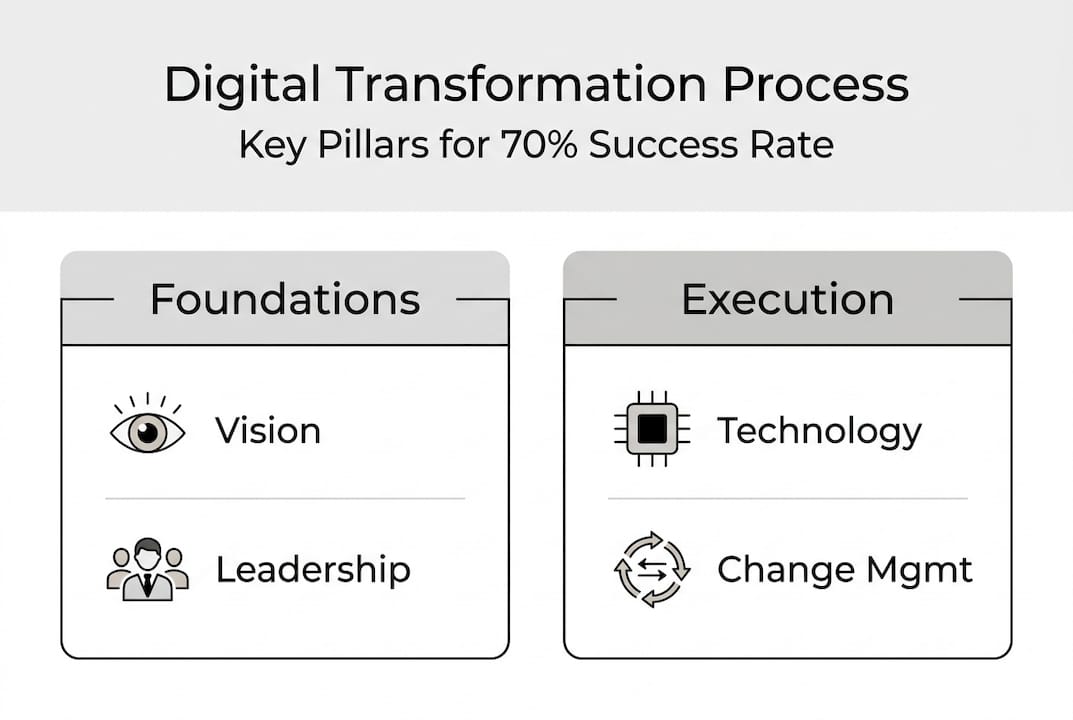
The foundation rests on recognizing key pillars essential for sustainable success: strategy and roadmap development, business and operating model redesign, data analytics and AI integration, technology platform selection, talent and leadership development, plus governance frameworks. These pillars work together to support transformation initiatives that deliver measurable business value rather than isolated technology upgrades.
Technology alone never drives successful transformation. Leadership commitment, organizational culture, and governance structures determine whether digital initiatives create lasting change or fade into expensive failures. Enterprises that treat transformation as purely technical projects miss opportunities to redesign workflows, empower teams, and establish data-driven decision making processes that compound returns over time.
Continuous measurement and iterative improvement separate sustainable transformations from short-lived initiatives. Establishing feedback loops, monitoring KPIs, and adjusting strategies based on real-world performance data ensures your digital transformation workflow evolves with changing business needs and market conditions.
Core elements of a structured digital transformation process include:
- Current state assessment to identify capability gaps and prioritize improvement areas
- Strategic roadmap linking business objectives to specific digital initiatives
- Technology selection based on scalability, integration capabilities, and total cost of ownership
- Change management programs addressing organizational resistance and skill gaps
- Governance frameworks ensuring accountability, risk management, and compliance
- Measurement systems tracking progress against predefined success metrics
Preparing for transformation: digital maturity assessment and strategy development
Preparation determines transformation outcomes more than any other factor. Executives should start with digital maturity assessment and clear KPIs before technology selection to avoid the 70% failure trap that plagues enterprises rushing into implementation without strategic foundations. Digital maturity assessment evaluates your organization across dimensions including technology infrastructure, data management capabilities, workforce skills, leadership commitment, and process automation levels.
Conducting a thorough maturity assessment involves gathering input from stakeholders across departments, analyzing current technology investments, reviewing process documentation, and benchmarking against industry standards. This assessment reveals where your organization stands today and identifies specific gaps preventing you from achieving transformation goals. The insights guide resource allocation and help prioritize initiatives delivering maximum business impact.

Defining KPIs before implementation creates accountability and enables objective progress tracking. Critical metrics vary by industry and objectives but typically include operational efficiency improvements, cost reduction percentages, customer satisfaction scores, time-to-market reductions, and revenue growth from new digital channels. Establishing baseline measurements for each KPI allows you to quantify transformation impact and adjust strategies when results fall short of targets.
Strategic roadmap development translates assessment findings and KPIs into actionable plans. Your roadmap should sequence initiatives logically, starting with foundational capabilities and building toward more complex transformations. Early wins build momentum and demonstrate value to skeptical stakeholders, while phased approaches reduce risk and allow for course corrections. Integrating outsourcing process considerations into roadmap planning ensures you identify opportunities to leverage external expertise and scale resources efficiently.
Aligning business goals with outsourcing capabilities from the start prevents costly rework and accelerates implementation timelines. When developing your strategy, evaluate which functions benefit most from external specialists versus internal development. IT support outsourcing often delivers faster results than building in-house teams, particularly for emerging technologies like AI, machine learning, and advanced cybersecurity.
Follow these steps to develop an effective transformation strategy:
- Map current state capabilities across all business functions and technology systems
- Define target state vision with specific, measurable outcomes for each capability area
- Identify gaps between current and target states, quantifying resource requirements
- Prioritize initiatives based on business impact, implementation complexity, and dependencies
- Develop detailed implementation plans with timelines, budgets, and responsibility assignments
- Establish governance structure with executive sponsors and cross-functional steering committees
- Create communication plan ensuring stakeholder alignment and managing expectations throughout transformation
Pro Tip: Involve outsourcing partners during strategy development rather than treating them as implementation vendors. Their experience across multiple client transformations provides valuable insights into common pitfalls, realistic timelines, and proven approaches that accelerate your success while reducing risk.
Executing the transformation: technology implementation and change management
Execution requires balancing technical implementation with organizational change management. Technology deployment involves selecting platforms, integrating systems, migrating data, and configuring applications to support redesigned business processes. However, the technical work represents only half the execution challenge. Managing organizational change determines whether employees adopt new tools and processes or resist transformation efforts.
Key technology implementation considerations include system integration complexity, data migration risks, security requirements, scalability needs, and vendor support quality. Enterprises often underestimate integration challenges when connecting new platforms with legacy systems. Planning for these complexities upfront, including fallback options and contingency budgets, prevents project delays and cost overruns that erode stakeholder confidence.
Change management strategies must address resistance at all organizational levels. Executives need clarity on how transformation supports strategic objectives. Middle managers require tools and training to lead their teams through transitions. Front-line employees want to understand how changes affect their daily work and job security. Tailoring communication and training programs to each audience increases adoption rates and accelerates time to value.
Outsourcing partners contribute significantly to both technology deployment and organizational change. Managed services providers bring specialized skills, proven methodologies, and scalable resources that internal teams often lack. They reduce operational risk by handling complex technical tasks while your team focuses on business-critical activities and change management.
Data demonstrates the value outsourcing delivers during transformation execution. Enterprises leverage providers like IBM, Accenture, and Deloitte achieving 30-70% cost savings and 95% project success rates compared to purely internal initiatives. These providers offer end-to-end support from initial assessment through post-implementation optimization, ensuring transformations deliver sustained business value.
Outsourcing service categories provide different benefits depending on your transformation needs:
| Service Category | Primary Benefits | Typical Cost Savings | Best Use Cases |
|---|---|---|---|
| Infrastructure Management | 24/7 monitoring, reduced downtime, predictable costs | 40-60% | Cloud migration, data center consolidation |
| Application Development | Faster delivery, specialized skills, scalability | 30-50% | Custom software, legacy modernization |
| Cybersecurity Services | Threat detection, compliance, risk mitigation | 35-55% | Security transformation, regulatory compliance |
| Business Process Outsourcing | Process optimization, quality improvement | 45-70% | Finance, HR, customer support automation |
Successful execution requires establishing clear roles and responsibilities between internal teams and outsourcing partners. Define decision-making authority, escalation procedures, communication protocols, and performance expectations in detailed service level agreements. Regular status reviews and transparent reporting ensure alignment and enable rapid problem resolution when issues arise.
Critical execution practices include:
- Pilot programs testing new technologies and processes with limited user groups before full deployment
- Agile methodologies enabling iterative development and faster feedback cycles
- Training programs delivered through multiple formats (classroom, online, hands-on) to accommodate different learning styles
- Support systems providing immediate assistance when users encounter problems
- Recognition programs celebrating early adopters and transformation champions
Pro Tip: Create a dedicated transformation management office with authority to resolve cross-functional conflicts and remove roadblocks. This centralized coordination prevents initiatives from stalling due to competing priorities or resource constraints that plague matrix organizations.
Leverage comprehensive IT outsourcing guides and solution comparisons to evaluate providers objectively and select partners aligned with your transformation objectives and organizational culture.
Verifying and sustaining success: continuous measurement and avoiding common pitfalls
Verification begins with measuring actual outcomes against predefined KPIs. Establish dashboards tracking key metrics in real time, enabling rapid identification of underperforming initiatives. Compare results across business units, geographies, and time periods to identify patterns and best practices worth replicating. Regular executive reviews ensure transformation maintains strategic alignment and secures continued investment.
Continuous improvement processes turn initial transformation success into sustained competitive advantage. Gather feedback from employees, customers, and partners about what works well and what needs refinement. Use this input to optimize workflows, enhance user experiences, and expand successful initiatives to additional business areas. Transformation never truly ends but evolves as technologies advance and business needs change.
Common pitfalls destroy transformation value even after successful implementation. Failure rates reach 70% when transformations are treated as tech-only projects with no clear metrics or change management. Understanding these failure patterns helps you avoid repeating expensive mistakes that have derailed countless enterprise initiatives.
Most frequent transformation pitfalls include:
- Focusing exclusively on technology while ignoring organizational culture and process redesign
- Lacking executive sponsorship and sustained leadership commitment throughout multi-year initiatives
- Failing to establish clear success metrics and accountability for achieving them
- Underestimating change management requirements and employee training needs
- Creating data silos that prevent information sharing and integrated analytics
- Neglecting cybersecurity and compliance requirements until problems emerge
- Selecting technologies based on vendor relationships rather than strategic fit
- Attempting too many simultaneous initiatives without adequate resources or prioritization
Comparing tech-led versus business-led approaches reveals why transformation strategy matters more than technology selection:
| Approach | Primary Focus | Success Rate | Typical Outcomes |
|---|---|---|---|
| Tech-Led | Implementing latest technologies | 30% | Underutilized systems, disappointed stakeholders, limited business impact |
| Business-Led | Solving business problems with appropriate technologies | 65% | Measurable ROI, sustained adoption, competitive advantages |
Governance frameworks sustain transformation outcomes by establishing ongoing oversight, resource allocation processes, and accountability mechanisms. Effective governance includes executive steering committees, transformation management offices, and cross-functional working groups addressing specific initiative areas. These structures ensure transformations maintain momentum beyond initial implementation and adapt to changing business conditions.
Recommendations for sustained success:
- Schedule quarterly transformation reviews assessing progress, identifying risks, and adjusting strategies
- Maintain dedicated transformation budgets separate from operational expenses to prevent resource competition
- Develop internal capabilities through training and knowledge transfer from outsourcing partners
- Document lessons learned and best practices for future transformation initiatives
- Celebrate successes publicly to maintain organizational enthusiasm and commitment
Consider European outsourcing legal and risk frameworks when structuring long-term partnerships that support sustained transformation. Proper governance of outsourcing relationships ensures providers remain aligned with evolving business needs while maintaining service quality and cost efficiency.
Continuous measurement systems should track both leading indicators (user adoption rates, training completion, process compliance) and lagging indicators (cost savings, revenue growth, customer satisfaction). This balanced approach provides early warning of problems while quantifying ultimate business impact. Adjust initiatives quickly when leading indicators signal trouble rather than waiting for poor financial results.
Enhance your digital transformation with expert outsourcing solutions
Successful digital transformation demands more than internal resources and good intentions. You need partners who bring proven methodologies, specialized expertise, and scalable capacity to accelerate your initiatives while reducing risk. StorsenDigital delivers comprehensive outsourcing and managed services designed specifically for European enterprises pursuing digital transformation excellence.

Our services support every transformation phase from initial assessment through sustained optimization. Whether you need cloud migration expertise, AI implementation support, cybersecurity enhancement, or business process automation, our team provides the specialized skills your transformation requires. We help you avoid common pitfalls while achieving measurable efficiency gains and cost reductions.
Explore our practical outsourcing process guides and managed services implementation frameworks to understand how strategic partnerships accelerate transformation success. Ready to optimize your digital transformation outcomes? Contact StorsenDigital today to discuss how our outsourcing solutions can enhance your transformation results and drive scalable growth across your enterprise.
FAQ
What is the digital transformation process?
The digital transformation process is a structured approach enterprises use to integrate digital technologies into all business areas, fundamentally changing operations and value delivery. It involves distinct phases: assessing current digital maturity, developing strategic roadmaps, redesigning business processes, implementing appropriate technologies, managing organizational change, and establishing continuous improvement systems. Successful processes balance technical implementation with cultural transformation, ensuring technologies serve business objectives rather than existing as isolated upgrades.
How can outsourcing improve digital transformation outcomes?
Outsourcing brings specialized skills, proven methodologies, and scalable resources that accelerate transformation while reducing risk. Providers like IBM, Accenture, and Deloitte help enterprises achieve 30-70% cost savings and significantly higher project success rates compared to purely internal initiatives. Managed services providers handle complex technical tasks like cloud migration, cybersecurity implementation, and application development, allowing your internal teams to focus on strategic priorities and change management. Strategic IT support outsourcing particularly benefits enterprises lacking in-house expertise for emerging technologies.
What are common reasons for digital transformation failure?
Failure typically stems from treating transformation as purely technical projects without organizational alignment. Common pitfalls include tech-only focus, lack of clear KPIs, resistance to change, and siloed data that prevents integrated analytics and decision making. Insufficient executive sponsorship, inadequate change management, and underestimating training requirements also contribute to poor outcomes. Organizations that select technologies based on vendor relationships rather than strategic fit often implement systems that fail to address actual business needs. Attempting too many simultaneous initiatives without proper prioritization spreads resources too thin and prevents any single initiative from achieving meaningful impact.
How do I measure success in a digital transformation process?
Define specific KPIs upfront aligned with strategic business objectives before beginning implementation. Effective metrics include operational efficiency improvements, cost reduction percentages, customer satisfaction scores, time-to-market reductions, and revenue growth from digital channels. Establish baseline measurements for each KPI to quantify transformation impact accurately. Implement real-time dashboards tracking both leading indicators like user adoption rates and lagging indicators like financial performance. Conduct regular executive reviews comparing actual outcomes against targets, using governance frameworks to ensure ongoing accountability and rapid course correction when results fall short of expectations.


