


European enterprises face a persistent challenge: outsourcing strategies that promise efficiency often deliver the opposite. Cost overruns, communication breakdowns, and talent mismatches drain resources while competitors gain ground. Optimizing your outsourcing approach strategically unlocks 20-30% cost savings and access to skilled European talent pools. This guide walks you through a proven framework covering preparation, partner selection, management practices, risk mitigation, and performance tracking to transform outsourcing from a pain point into a competitive advantage.
Table of Contents
- Prerequisites: What You Need Before Optimizing Outsourcing
- Step 1: Define Business Objectives And Outsourcing Needs
- Step 2: Selecting The Right Outsourcing Partner
- Step 3: Establish Communication And Collaboration Frameworks
- Step 4: Risk Management, Compliance, And Contract Structuring
- Step 5: Monitor And Measure Outsourcing Performance
- Common Mistakes And Troubleshooting In Outsourcing Optimization
- Expected Results And Measurable Outcomes
- Optimize Your Outsourcing With StorsenDigital Solutions
- Frequently Asked Questions About Optimizing Outsourcing
Key Takeaways
| Point | Details |
|---|---|
| Strategic alignment cuts costs | Properly aligned outsourcing reduces operational expenses by up to 30% while improving service quality. |
| Partner compatibility matters | Selecting providers with cultural and technical fit dramatically improves project outcomes and reduces friction. |
| Communication frameworks prevent failure | Clear collaboration structures and regular check-ins minimize the misunderstandings that cause 30-40% of outsourcing failures. |
| Risk management protects investments | Robust SLAs and compliance planning safeguard legal and operational interests across European jurisdictions. |
| Continuous monitoring drives improvement | Tracking relevant KPIs and conducting regular reviews enables data-driven adjustments that sustain long-term success. |
Prerequisites: What You Need Before Optimizing Outsourcing
Before diving into optimization, you need solid groundwork. Start with a thorough internal audit of your current operations. Identify which processes consume the most resources, where bottlenecks occur, and which functions are truly core to your competitive advantage. This clarity prevents the common mistake of outsourcing critical capabilities that should stay in-house.
Next, define measurable objectives tied directly to business outcomes. Vague goals like “reduce costs” fail because they lack specificity. Instead, aim for targets such as “cut customer support expenses by 25% while maintaining 90% satisfaction scores” or “access 15 senior developers within 90 days.” These concrete metrics let you track progress and hold partners accountable.
Understanding European regulatory landscapes is non-negotiable. GDPR compliance, local labor laws, and industry-specific regulations vary significantly across jurisdictions. Research requirements in your target outsourcing locations or consult legal experts to avoid costly violations. Documenting your compliance obligations upfront streamlines vendor evaluation later.
Budgeting requires more than estimating vendor fees. Factor in transition costs, technology integration expenses, training investments, and ongoing management overhead. Many enterprises underestimate these hidden costs by 20-30%, creating budget shortfalls that undermine optimization efforts. Build in contingency reserves to handle unexpected expenses.
Establish baseline performance data before making changes. Document current costs per transaction, average delivery times, error rates, and customer satisfaction scores. Without this benchmark, you cannot prove that optimization efforts deliver real improvements. Our outsourcing process guide provides detailed frameworks for conducting these assessments systematically.
Pro Tip: Create a simple scoring matrix rating your current operations on cost, quality, speed, and flexibility. This visual baseline makes it easier to identify optimization priorities and communicate improvements to stakeholders later.
Step 1: Define Business Objectives and Outsourcing Needs
Successful outsourcing starts with strategic clarity about what you want to achieve beyond saving money. Conduct workshops with department heads to identify non-core functions that consume disproportionate resources. Customer support, data entry, back-office processing, and certain IT functions often emerge as prime candidates because they require specialized skills but do not differentiate your brand.
Defining clear business objectives transforms outsourcing into a growth enabler beyond cost savings, allowing you to leverage external expertise for innovation. For example, outsourcing routine IT maintenance frees your internal team to focus on developing proprietary technology that creates competitive advantages. Similarly, delegating recruitment logistics to specialists accelerates talent acquisition while your HR leaders concentrate on culture building and retention strategies.
Set specific, measurable KPIs for each outsourced function. For customer support, track first-response time, resolution rates, and satisfaction scores. For software development, monitor sprint velocity, code quality metrics, and deployment frequency. These granular measurements reveal whether outsourcing delivers the intended business value or merely shifts problems elsewhere.
Avoid treating outsourcing as purely transactional cost reduction. The best partnerships foster operational agility and innovation. When evaluating what to outsource, ask: “Will this partnership give us capabilities we cannot build internally at reasonable cost?” and “Can this provider help us adapt faster to market changes?” If the answers are yes, you have identified strategic outsourcing opportunities rather than just expense management exercises.
Document your outsourcing rationale in a brief strategy document. Include business objectives, success criteria, budget parameters, and timeline expectations. This artifact aligns internal stakeholders and serves as a reference point when evaluating potential partners. Our guide on outsourcing strategy for European growth offers templates to structure these strategic documents effectively.
Pro Tip: Rank potential outsourcing functions by impact and effort. Tackle high-impact, low-effort opportunities first to build momentum and demonstrate quick wins that secure buy-in for larger transformation initiatives.
Step 2: Selecting the Right Outsourcing Partner
Choosing the wrong partner dooms even well-planned outsourcing initiatives. Start by evaluating industry experience and verifiable credentials. Request case studies from similar-sized companies in your sector. Generic portfolios filled with unrelated projects signal that a provider lacks the domain expertise to understand your specific challenges and regulatory requirements.

Assess technology infrastructure and security practices rigorously. Selecting an outsourcing partner with proven industry expertise, technology infrastructure, and cultural alignment significantly improves outsourcing outcomes. Request detailed information about data centers, redundancy systems, cybersecurity certifications, and disaster recovery protocols. A provider with outdated technology or weak security creates vulnerabilities that offset any cost savings.
Cultural compatibility matters more than most enterprises realize. Misaligned work styles, communication preferences, and business ethics cause friction that erodes productivity. During vendor evaluations, arrange video calls with the actual team members who would work on your account, not just sales representatives. Pay attention to communication clarity, responsiveness, and problem-solving approaches.
Demand transparent pricing models with detailed breakdowns. Beware of quotes that seem too good to be true because they often hide fees for essential services or include unrealistic assumptions about scope. Ask for all-in pricing that includes transition costs, technology licensing, training, and ongoing support. Compare proposals using total cost of ownership over a three-year period, not just first-year expenses.
| Factor | Nearshoring (Eastern Europe) | Offshoring (Asia) |
|---|---|---|
| Time Zone Overlap | 1-3 hours difference enables real-time collaboration | 6-8 hours difference requires asynchronous workflows |
| Cultural Alignment | Similar business practices and work ethics | May require significant cultural bridging efforts |
| Cost Savings | 40-50% lower than Western Europe | 60-70% lower than Western Europe |
| Travel Accessibility | 2-4 hour flights for in-person meetings | 10-15 hour flights complicate relationship building |
| Language Proficiency | High English fluency common | Variable English skills may require additional support |
| Regulatory Alignment | GDPR compliant, EU legal frameworks | Different data protection and legal standards |
Verify references thoroughly. Contact at least three current clients and ask specific questions about responsiveness during crises, adherence to SLAs, and whether the provider proactively suggests improvements. Vague praise without concrete examples suggests coached references. Learning how to improve business process outsourcing starts with selecting partners who demonstrate continuous improvement mindsets.
Pro Tip: Create a weighted scorecard rating providers across 8-10 criteria including experience, technology, security, pricing, and cultural fit. This objective approach prevents decisions based solely on lowest cost or personal rapport and helps you outsource talent effectively.
Step 3: Establish Communication and Collaboration Frameworks
Poor communication kills outsourcing relationships faster than any other factor. Establishing clear communication channels and collaborative tools reduces misunderstandings and aligns expectations, boosting outsourcing success rates. Start by defining meeting cadences: daily standups for active projects, weekly progress reviews, and monthly strategic planning sessions. Consistent rhythms create accountability and surface issues before they escalate.
Implement shared dashboards and project management tools that provide real-time visibility into work status, blockers, and upcoming deadlines. Tools like Asana, Jira, or Monday.com eliminate the “black box” problem where you only discover problems during formal status meetings. Transparency builds trust and allows faster problem resolution.
Invest in cross-cultural competence training for both your internal team and outsourcing partners. Understanding communication styles, feedback preferences, and decision-making norms prevents misinterpretations. For example, some cultures view direct negative feedback as rude while others see indirect criticism as unclear. Bridging these gaps early avoids frustration later.
Create explicit escalation paths for different issue types. Document who handles technical problems, contract disputes, quality concerns, and scope changes. When everyone knows the proper channels, problems get resolved quickly rather than bouncing between contacts or festering unaddressed. Include response time expectations in your escalation procedures.
Promote trust through regular video calls rather than relying solely on email or chat. Seeing faces builds rapport and makes collaboration feel more personal. Schedule informal virtual coffee chats where teams can interact beyond formal project discussions. These relationship-building moments pay dividends when navigating challenging situations. Effective HR outsourcing collaboration depends on these human connection strategies.
Step 4: Risk Management, Compliance, and Contract Structuring
Comprehensive contracts protect your interests while setting clear expectations. Include detailed service level agreements specifying performance standards, response times, and quality metrics. Attach meaningful penalties for SLA violations to ensure accountability. Without financial consequences, SLAs become aspirational goals rather than commitments.
Robust risk management and SLAs protect legal and operational interests in outsourcing engagements across Europe. Your contracts must address GDPR compliance explicitly, specifying data handling procedures, breach notification protocols, and audit rights. Include provisions for data deletion or return when the relationship ends. Non-compliance risks massive fines and reputational damage that dwarf outsourcing savings.
Develop thorough onboarding plans with structured knowledge transfer. Document critical processes, system access requirements, and key contacts before transitioning work. Schedule overlap periods where your internal team and outsourcing partners work together to ensure smooth handoffs. Rushed transitions lead to quality problems and service disruptions that damage customer experiences.
Build in mutual success metrics and continuous improvement clauses. Specify that both parties will collaborate on quarterly reviews to identify optimization opportunities. Include provisions allowing scope adjustments as business needs evolve. Rigid contracts that cannot adapt to changing circumstances create adversarial relationships rather than partnerships.
Plan for exit scenarios even when starting a relationship. Define transition assistance requirements, data return procedures, and knowledge transfer obligations if you need to change providers or bring work back in-house. Clear termination clauses reduce switching costs and prevent vendor lock-in that weakens your negotiating position. Understanding nearshoring risk management principles helps structure these protective provisions.
Step 5: Monitor and Measure Outsourcing Performance
Systematic performance tracking separates successful outsourcing from disappointment. Monitoring outsourcing performance via KPIs and regular reviews enables continuous improvement and ensures alignment with business goals. Define 5-8 critical metrics for each outsourced function that directly tie to your original objectives.
Establish baseline measurements before outsourcing begins. Track the same metrics using identical methodologies to enable accurate comparisons. Changing measurement approaches mid-stream makes it impossible to assess true impact.
Create automated reporting dashboards that update daily or weekly. Manual reporting creates delays and introduces errors. Real-time data lets you spot negative trends quickly and intervene before small problems become crises.
Schedule formal quarterly business reviews with outsourcing partners. Review performance against SLAs, discuss challenges openly, and collaborate on improvement initiatives. Use these sessions to recognize excellent performance and address shortfalls constructively.
Gather feedback from internal stakeholders who interact with outsourced teams regularly. Their frontline perspectives reveal issues that do not appear in quantitative metrics like communication gaps, cultural friction, or workflow inefficiencies.
Conduct annual comprehensive audits covering financial performance, security practices, compliance adherence, and strategic alignment. Bring in independent assessors for objective evaluations that identify blind spots.
Implement continuous improvement cycles using data insights. When metrics show declining performance, investigate root causes systematically rather than making assumptions. Test solutions on a small scale before rolling out broad changes.
Document lessons learned and share knowledge across your organization. Outsourcing optimization insights from one department often apply to others. Building institutional knowledge prevents repeating mistakes and accelerates future optimization initiatives. Our outsourcing performance monitoring resources provide templates for tracking frameworks.
Common Mistakes and Troubleshooting in Outsourcing Optimization
Poor communication, misaligned objectives, and neglecting cultural fit cause 30-40% of outsourcing failures or suboptimal results. Avoid launching outsourcing initiatives without crystal-clear goals and success criteria. Vague objectives like “improve efficiency” provide no basis for measuring success or holding partners accountable.
Do not underestimate cultural compatibility during vendor selection. The cheapest provider with perfect technical credentials will still fail if their work style clashes fundamentally with your organization. Invest time in compatibility assessment upfront rather than paying the higher cost of switching providers later.
Never neglect compliance and risk management planning. European data protection regulations impose serious obligations that cannot be ignored. Budget cuts to legal review or security assessments create massive liabilities that eclipse any savings from outsourcing.
Avoid ambiguous contracts that leave critical details undefined. Specify exact service levels, response times, deliverable formats, and quality standards. Ambiguity creates disputes that damage relationships and waste time on conflict resolution rather than productive work.
Do not set initial KPIs and then ignore them. Performance monitoring requires ongoing attention and adjustment as business conditions evolve. Regular reviews keep everyone focused on what matters and enable course corrections before problems become entrenched. Check our outsourcing troubleshooting tips for specific problem-solving frameworks.
Expected Results and Measurable Outcomes
European enterprises can achieve operational cost savings of 20-30% and 25% faster project delivery times through optimized outsourcing strategies. These improvements stem from accessing specialized expertise, eliminating recruitment and training overhead, and leveraging favorable cost structures in nearshore locations.
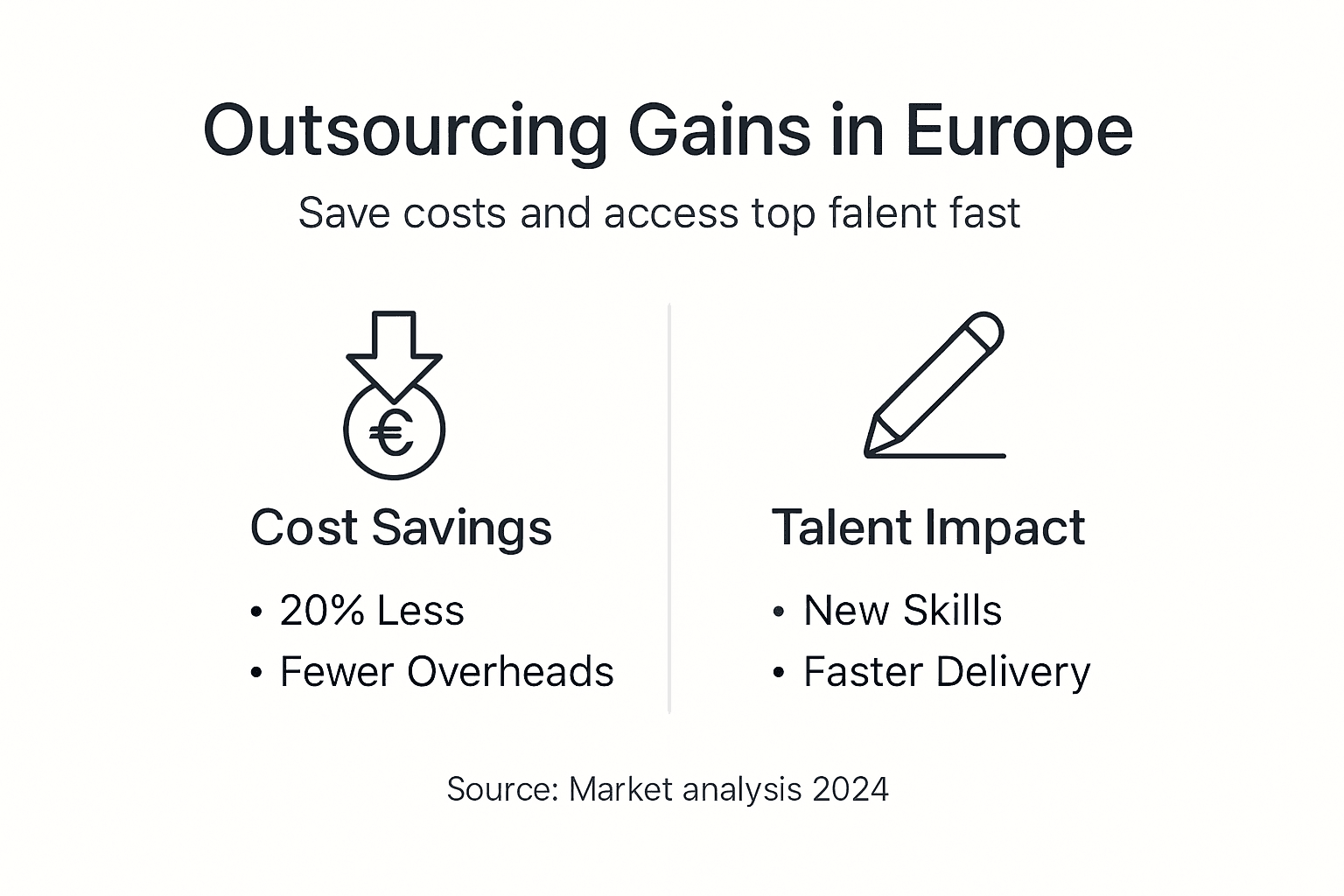
Project delivery acceleration comes from tapping into established teams rather than building capabilities from scratch. A customer support operation that would take 6-9 months to staff and train internally can launch in 4-6 weeks with an experienced outsourcing partner. This speed advantage matters critically in competitive markets where delayed launches mean lost revenue.
Access to diverse talent pools solves the skills shortage plaguing European enterprises. Rather than competing for scarce specialists in high-cost markets, you can recruit from broader geographic areas with strong technical education systems. This expanded reach improves both candidate quality and hiring speed.
| Performance Metric | Before Optimization | After Optimization | Improvement |
|---|---|---|---|
| Operational Cost per Transaction | €12.50 | €8.75 | 30% reduction |
| Average Project Delivery Time | 16 weeks | 12 weeks | 25% faster |
| Time to Fill Open Positions | 90 days | 30 days | 67% improvement |
| First Response Time (Support) | 4 hours | 1 hour | 75% improvement |
| Customer Satisfaction Score | 78% | 88% | 10 point increase |
Continuous monitoring and optimization compound these benefits over time. Initial improvements represent the baseline, but mature outsourcing relationships often deliver additional 10-15% efficiency gains in years two and three as teams refine processes and deepen collaboration. This sustained improvement separates strategic outsourcing from short-term cost cutting.
Tracking these outcomes rigorously validates your optimization efforts and builds the business case for expanding outsourcing strategically. Document successes and share them with leadership to secure support for future initiatives. Measurable results speak louder than theoretical benefits when justifying investment in optimization. Our outsourcing success results case studies demonstrate real-world performance improvements across industries.
Optimize Your Outsourcing with StorsenDigital Solutions
Transforming outsourcing from a tactical cost measure into strategic advantage requires expertise, proven workflows, and committed partnership. StorsenDigital specializes in helping European enterprises optimize outsourcing across talent acquisition, BPO operations, and nearshoring strategies. We bring deep understanding of European regulatory environments, cultural dynamics, and operational best practices.

Our consultants work with you to assess current operations, define optimization opportunities, and implement frameworks that deliver measurable results. Whether you need to streamline your outsourcing process, develop a comprehensive nearshoring strategy, or access specialized talent outsourcing solutions, we provide the expertise and resources to succeed. Partner with us to unlock the full potential of strategic outsourcing for your organization.
Frequently Asked Questions about Optimizing Outsourcing
How can I align outsourcing with my company’s growth objectives?
Start by identifying non-core functions that consume resources better invested in competitive differentiation. Set specific KPIs linking outsourcing outcomes to business goals like faster market entry, improved customer satisfaction, or innovation capacity. Treat outsourcing partners as strategic collaborators who enable growth rather than just cost centers.
What are the best practices for managing cultural differences in outsourcing?
Invest in cross-cultural training for both internal teams and outsourcing partners. Establish explicit communication norms covering feedback styles, decision-making processes, and conflict resolution. Schedule regular video calls to build personal relationships that transcend cultural boundaries and create mutual understanding.
How often should outsourcing performance be reviewed and updated?
Conduct weekly operational reviews to track immediate performance metrics and identify emerging issues. Schedule monthly strategic discussions to assess alignment with business objectives. Perform comprehensive quarterly business reviews with formal audits annually to ensure sustained optimization and compliance.
What key legal risks should be considered in European outsourcing contracts?
GDPR compliance requires explicit data handling provisions, breach notification procedures, and audit rights. Address intellectual property ownership clearly. Include jurisdictional clauses specifying which country’s laws govern disputes. Define termination procedures and data return obligations to prevent vendor lock-in.
Which metrics best indicate successful outsourcing optimization?
Track cost per transaction or unit to measure efficiency gains. Monitor quality metrics like error rates and customer satisfaction scores. Measure delivery speed through cycle times and time-to-market improvements. Assess talent acquisition success via time-to-fill and candidate quality ratings. Strategic impact shows through innovation contributions and business agility improvements.


