


Outsourcing has dramatically shaped how american businesses grow and compete. Over 80 percent of Fortune 500 companies use some form of outsourcing to access specialized talent and drive innovation far beyond cutting costs. As markets evolve and demands shift, understanding the core principles and strategic distinctions of outsourcing becomes essential for leaders seeking sustainable growth. This guide explains how organizations can unlock the full potential of external partnerships while navigating risks in an ever-changing global business landscape.
Table of Contents
- Defining Outsourcing and Its Core Principles
- Major Outsourcing Types and Their Distinctions
- Key Drivers of Business Expansion via Outsourcing
- Evaluating Risks and Mitigating Challenges
- Nearshoring vs Offshoring: Strategic Implications
- Best Practices for Sustainable Outsourcing Success
Key Takeaways
| Point | Details |
|---|---|
| Strategic Partnership | Outsourcing should be viewed as a collaborative partnership focused on innovation and mutual growth, rather than just a cost-cutting measure. |
| Types of Outsourcing | Different types of outsourcing, including General, Transitional, BPO, and Business Benefit Contracting, serve unique organizational needs and should align with specific strategic objectives. |
| Risk Management | Effective outsourcing requires a comprehensive approach to mitigate risks associated with operational, compliance, data security, and cultural challenges. |
| Sustainable Practices | Sustainable outsourcing success demands clear performance metrics, continuous communication, and adaptable contracts, transforming services into strategic capabilities. |
Defining Outsourcing and Its Core Principles
Outsourcing represents a strategic business approach where organizations delegate specific tasks, processes, or functions to external service providers. According to research from arxiv.org, outsourcing fundamentally involves the delegation of tasks that often includes the transfer of personnel and resources between organizations. This practice has evolved from a simple cost-cutting mechanism to a sophisticated strategic partnership model.
The core principles of outsourcing extend far beyond traditional cost reduction strategies. Research from arxiv.org highlights a transformative framework where outsourcing is now viewed as an innovation-driven partnership. This modern approach encompasses four critical phases:
- Strategic Decision-Making: Identifying which functions are suitable for external management
- Arrangement Options: Selecting appropriate partnership structures
- Innovation Generation: Creating collaborative environments for mutual growth
- Outcome Realization: Measuring and evaluating partnership effectiveness
By understanding these core principles, businesses can transform outsourcing from a transactional process into a strategic growth mechanism. Modern outsourcing is not just about reducing expenses but about accessing specialized expertise, improving operational flexibility, and driving organizational innovation. Companies that approach outsourcing as a collaborative, strategic partnership are more likely to achieve sustainable competitive advantages. When implemented thoughtfully, outsourcing can provide access to global talent, advanced technologies, and specialized skills that might be challenging to develop internally.
For deeper insights into strategic outsourcing models, explore our comprehensive guide on IT outsourcing which breaks down the nuanced approaches businesses can adopt to maximize their external partnerships.
Major Outsourcing Types and Their Distinctions
Outsourcing encompasses diverse strategies that businesses can leverage to optimize their operational efficiency. According to research from International Journal of Research and Engineering Studies (ijres.org), there are four primary outsourcing types: general outsourcing, transitional outsourcing, business process outsourcing (BPO), and business benefit contracting. Each of these approaches offers unique advantages and is tailored to address specific organizational needs.
General Outsourcing involves delegating standard, non-core business functions to external service providers. Transitional Outsourcing focuses on temporary arrangements designed to help organizations navigate complex operational transformations. Business Process Outsourcing (BPO) represents a more comprehensive strategy where entire business processes are managed externally. Business Benefit Contracting emphasizes outcome-based partnerships where compensation is tied directly to achieved results.
Research from Springer further distinguishes these approaches by highlighting their strategic nuances. The study categorizes outsourcing strategies into:
- Comprehensive BPO: Full-scale process management across multiple departments
- Selective BPO: Targeted outsourcing of specific, well-defined business processes
- Transitional Outsourcing: Temporary arrangements facilitating organizational change
- Business Benefit Contracting: Performance-driven external partnerships
Understanding these distinctions enables businesses to select the most appropriate outsourcing model aligned with their strategic objectives.
The choice depends on factors like organizational complexity, required flexibility, desired level of control, and specific operational challenges. Organizations must carefully evaluate their unique requirements to determine which outsourcing type will deliver maximum strategic value.

For a more detailed exploration of back-office management strategies, explore our comprehensive guide on back office outsourcing which provides deeper insights into implementing effective external partnership models.
Key Drivers of Business Expansion via Outsourcing
Business expansion through outsourcing has emerged as a sophisticated strategic approach that transcends traditional cost-cutting methodologies. Research from arxiv.org reveals that contemporary organizations are increasingly leveraging outsourcing as a mechanism for accessing specialized capabilities, driving innovation, and securing competitive advantages. This transformative perspective represents a significant shift from viewing outsourcing merely as a financial optimization strategy to recognizing it as a powerful growth enabler.
The key drivers of business expansion via outsourcing can be categorized into several strategic dimensions:
- Access to Specialized Talent: Acquiring expertise not available internally
- Technological Innovation: Leveraging cutting-edge technologies and methodologies
- Operational Flexibility: Scaling resources dynamically based on business needs
- Cost Efficiency: Optimizing resource allocation and reducing operational expenses
- Global Market Penetration: Expanding organizational reach through strategic partnerships
Transformational outsourcing research emphasizes that successful business expansion requires a holistic approach where outsourcing is viewed as a strategic initiative rather than a transactional process. IT companies, in particular, have demonstrated remarkable growth by focusing on core competencies while externally managing peripheral functions. This approach enables organizations to redirect internal resources toward innovation, strategic planning, and value-creation activities.
The most successful businesses view outsourcing as a collaborative ecosystem that extends beyond traditional vendor-client relationships. By strategically selecting partners who align with their vision, companies can transform outsourcing from a mere operational tool into a powerful growth accelerator. When implemented thoughtfully, outsourcing provides access to global talent pools, advanced technological infrastructure, and specialized expertise that can significantly enhance competitive positioning.
For practical insights into maximizing your outsourcing investments, explore our comprehensive guide on optimizing outsourcing costs which offers strategic approaches to achieving maximum return on investment.
Evaluating Risks and Mitigating Challenges
Outsourcing, while a powerful strategic tool, inherently involves complex risks that require meticulous management and proactive mitigation strategies. Research from arxiv.org highlights three critical risk domains in transformational outsourcing: quality control, data security, and communication challenges. Organizations must develop comprehensive approaches to address these potential pitfalls and protect their strategic investments.
The primary risks associated with outsourcing can be systematically categorized:
- Operational Risks: Potential disruptions in service delivery and performance
- Compliance Risks: Regulatory and legal uncertainties in external partnerships
- Data Security Risks: Potential breaches of sensitive organizational information
- Cultural and Communication Risks: Misalignments arising from different organizational contexts
- Strategic Misalignment Risks: Divergence from core business objectives
Theoretical research suggests that mitigating these risks requires a multifaceted approach. Successful risk management involves establishing clear communication channels, developing robust vendor selection processes, and fostering collaborative relationships that transcend traditional transactional interactions. Companies must invest significant effort in due diligence, creating detailed contractual frameworks that explicitly define performance expectations, data protection protocols, and accountability mechanisms.
Effective risk mitigation demands a proactive and dynamic strategy. This includes continuous vendor performance monitoring, regular strategic reviews, and maintaining flexible contract structures that allow rapid adaptation to changing business landscapes. Organizations should develop comprehensive risk assessment frameworks that evaluate potential partners across multiple dimensions, including technological capabilities, cultural compatibility, financial stability, and alignment with long-term strategic goals.
For strategic guidance on navigating outsourcing complexities, explore our comprehensive guide on optimizing outsourcing costs, which provides actionable insights into managing potential risks and maximizing partnership effectiveness.
Nearshoring vs Offshoring: Strategic Implications
Navigating the complex landscape of global business expansion requires a nuanced understanding of strategic outsourcing approaches. Research from International Journal of Management reveals critical distinctions between nearshoring and offshoring that extend far beyond simple geographic considerations. While both strategies aim to optimize operational capabilities, they differ significantly in their strategic implications, cost structures, and organizational dynamics.
Key comparative dimensions between nearshoring and offshoring include:
- Geographic Proximity: Nearshoring involves partnering with countries in close geographical and cultural proximity
- Communication Efficiency: Reduced language barriers and similar time zones in nearshoring
- Cost Considerations: Potentially higher per-unit costs in nearshoring, but lower hidden expenses
- Cultural Alignment: Greater cultural compatibility in nearshoring
- Talent Accessibility: More direct talent acquisition and skill matching
The Offshoring Research Network emphasizes that modern organizations must view these strategies as dynamic capabilities rather than static decisions. Offshoring traditionally focuses on significant cost reductions by leveraging labor markets with substantially lower wage structures, often spanning continents. Nearshoring, conversely, prioritizes strategic alignment, operational efficiency, and reduced complexity through partnerships with geographically closer regions.
Strategic decision making between nearshoring and offshoring requires comprehensive evaluation of multiple factors beyond immediate financial considerations.
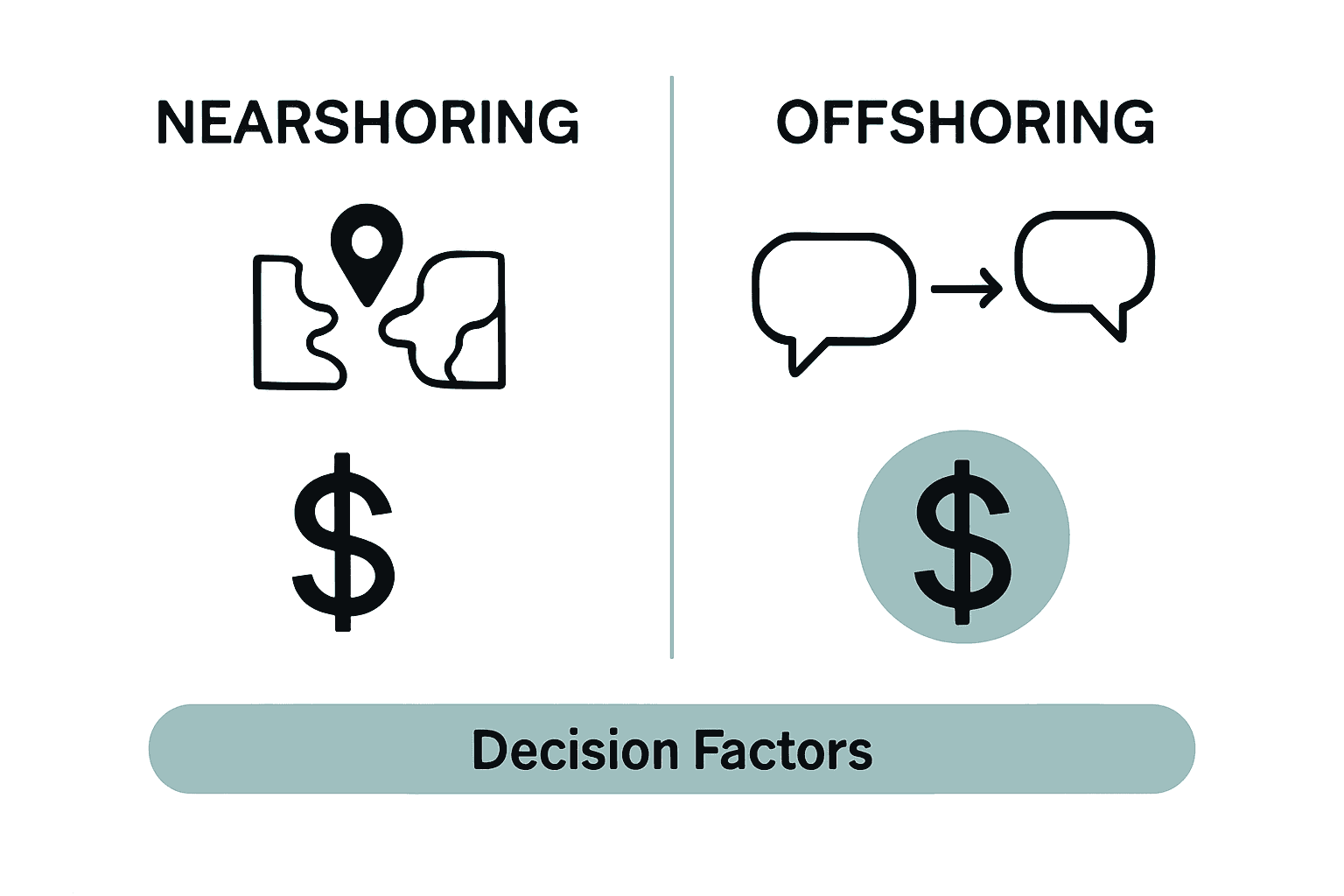 Organizations must assess long-term implications including talent quality, innovation potential, regulatory environments, and potential risks associated with each approach. Successful global expansion demands a sophisticated understanding of how geographic, cultural, and operational nuances can impact overall business performance and competitive positioning.
For practical guidance on establishing effective nearshoring strategies, explore our guide on setting up nearshoring for European expansion, which provides actionable insights into navigating complex international business partnerships.
Best Practices for Sustainable Outsourcing Success
Sustainable outsourcing success demands a strategic and holistic approach that transcends traditional transactional relationships. Research from arxiv.org emphasizes the critical importance of meticulous planning, clear objective setting, and robust risk management in achieving long-term outsourcing effectiveness. Organizations must view outsourcing not as a mere cost-cutting mechanism, but as a collaborative partnership that drives mutual growth and innovation.
Key best practices for sustainable outsourcing include:
- Comprehensive Partner Selection: Rigorous evaluation of potential service providers
- Clear Performance Metrics: Establishing quantifiable and transparent success indicators
- Cultural Alignment: Ensuring compatibility in organizational values and working approaches
- Continuous Communication: Maintaining open and transparent dialogue channels
- Flexible Contract Structures: Creating adaptable agreements that allow for evolving business needs
Theoretical research suggests that successful outsourcing hinges on strategic alignment between organizational objectives and external partnership goals. This requires a sophisticated approach that goes beyond surface-level cost considerations. Companies must develop a nuanced understanding of how outsourcing can contribute to broader strategic initiatives, focusing on value creation rather than simple resource optimization.
Implementing sustainable outsourcing practices demands ongoing commitment and strategic thinking. Organizations should invest in building long-term relationships, developing shared knowledge repositories, and creating collaborative frameworks that enable continuous improvement. This approach transforms outsourcing from a transactional service into a strategic capability that drives organizational innovation, operational efficiency, and competitive advantage.
The most successful outsourcing partnerships are built on mutual understanding, shared objectives, and a commitment to continuous learning and adaptation. By approaching outsourcing as a strategic collaboration rather than a simple vendor-client relationship, organizations can unlock unprecedented potential for growth and innovation.
Unlock Strategic Growth with Expert Outsourcing Solutions
Struggling to harness the full potential of outsourcing for your business growth The challenges of navigating complex outsourcing types, managing risks, and choosing between nearshoring and offshoring can feel overwhelming. This guide highlights the need for tailored, strategic partnerships that align with your goals for innovation, operational flexibility, and cost efficiency. At StorsenDigital.com, we specialize in helping medium to large enterprises overcome these hurdles through comprehensive solutions in talent recruitment, managed BPO services, and nearshoring across Europe. Our proven expertise transforms outsourcing from a transactional task into a strategic growth accelerator.

Explore how our flexible, scalable services and deep understanding of outsourcing principles can empower your global expansion. Do not wait to optimize your operational efficiency and secure competitive advantages through carefully crafted partnerships. Visit StorsenDigital.com now to discover our tailored Business Process Outsourcing (BPO) services, learn about nearshoring for European expansion, and find trusted support to mitigate risks and maximize value. Take the first step toward your outsourcing success today.
Frequently Asked Questions
What is outsourcing in business?
Outsourcing is a strategic approach where organizations delegate specific tasks, processes, or functions to external service providers to optimize efficiency and achieve business goals.
What are the core principles of outsourcing?
The core principles include strategic decision-making, choosing partnership arrangements, fostering innovation, and measuring outcomes to ensure effective collaboration and growth.
How can outsourcing drive business expansion?
Outsourcing can drive business expansion by providing access to specialized talent, leveraging technological innovations, offering operational flexibility, improving cost efficiency, and facilitating entry into new markets through strategic partnerships.
What are the main risks associated with outsourcing?
The main risks involve operational disruptions, compliance challenges, data security breaches, communication difficulties, and potential misalignment with core business objectives. Effective risk management strategies are essential to mitigate these risks.


