


Selecting the right outsourcing path often begins with one deceptively simple question: What business objectives are you truly aiming to achieve? Without clear goals, outsourcing can lead to wasted spend and confusion among your teams. For C-suite executives and procurement VPs in European tech companies, setting a well-defined outsourcing scope ensures everyone agrees on outcomes, timelines, and cost control. This article reveals how crystal-clear requirements build a foundation for scalable partnerships and sustainable growth.
Table of Contents
- Step 1: Define Outsourcing Objectives And Requirements
- Step 2: Select And Qualify Outsourcing Providers
- Step 3: Onboard Teams And Align Workflows
- Step 4: Monitor Performance And Ensure Compliance
Quick Summary
| Key Point | Explanation |
|---|---|
| 1. Define clear outsourcing objectives | Establish specific goals to avoid scope creep and ensure alignment with stakeholders before beginning any outsourcing process. |
| 2. Select providers based on qualifications | Focus on the provider’s capabilities and cultural fit, not just cost, to ensure they can truly meet your needs. |
| 3. Onboard teams with clear communication | Ensure both internal and outsourced teams understand their roles and objectives clearly to foster effective collaboration. |
| 4. Monitor performance with specific metrics | Establish KPIs and track them regularly to identify issues early and maintain compliance with business objectives. |
| 5. Regularly review and adjust contracts | Conduct periodic assessments of the outsourcing agreement to ensure ongoing alignment with changing business needs. |
Step 1: Define outsourcing objectives and requirements
Your outsourcing success depends entirely on clarity before you hire anyone. Without defined objectives, you’ll end up with scope creep, budget overruns, and partners who don’t understand what you actually need. This step sets the foundation for everything that follows.
Start by asking yourself what problems you’re solving. Are you looking to reduce operational costs? Scale a specific department without hiring? Gain access to specialized talent you can’t find locally? Your answer determines which functions to outsource and what kind of partner you’ll need.
Engage your key stakeholders early. Your finance team, operations managers, and department heads all have different perspectives on what outsourcing should accomplish. Get them in the room and align on priorities before moving forward.
Benchmark your current performance against industry standards. What are you spending today? What’s your timeline? What quality standards do you need to maintain? Defining clear scope and objectives ensures all parties understand desired outcomes, timelines, and responsibilities, which reduces scope creep and prevents hidden costs.
Create a detailed list of requirements for your outsourcing partner:
- Technical capabilities and certifications required
- Team size and skill levels needed
- Language requirements and cultural fit
- Data security and compliance standards
- Communication protocols and reporting frequency
- Geographic location preferences (nearshoring offers advantages in cost and time zone alignment)
- Flexibility to scale up or down as your business grows
Define your success metrics before you sign anything. How will you measure whether outsourcing is actually working? Set specific, measurable KPIs that align with your business priorities. This includes cost savings targets, quality benchmarks, turnaround times, and error rates.
Clear objectives guide what to outsource, how to measure success, and which provider will actually fit your organization’s needs.
Document everything in a requirements specification that potential partners can review. This becomes the foundation for evaluating proposals and negotiating contracts. When you understand your needs precisely, you can compare providers fairly and avoid surprises later.
StorsenDigital specializes in building dedicated teams for European tech companies seeking tailored outsourcing solutions. Visit www.storsendigital.com to explore how our nearshoring model from Bosnia and Herzegovina delivers premium quality at the best cost. We provide GBS and BPO services that scale with your business, with teams aligned to your culture and objectives.
Pro tip: Write your objectives as business outcomes, not activities. Instead of “handle customer support calls,” say “reduce average response time from 4 hours to 1 hour while maintaining 95% satisfaction scores.” This clarity helps partners understand what success actually looks like for your organization.
Step 2: Select and qualify outsourcing providers
Now that you know what you need, finding the right partner matters more than cost alone. A cheap provider who can’t deliver on your requirements will drain your resources faster than keeping work in-house. This step is about matching your needs with capable providers who can actually execute.
Start with market analysis before diving into cost comparisons. Research what outsourcing providers exist in your target regions, what services they offer, and what quality levels are available. Market analysis before cost analysis helps you determine the availability and quality of suppliers, leading to better decisions about which functions truly make sense to outsource.
Create a shortlist of 3 to 5 potential partners. Look for providers with proven experience in your industry. Check their certifications, client testimonials, and case studies. Ask for references and actually contact them. Talk to their current clients about responsiveness, quality, and reliability.
Evaluate each provider systematically using these criteria:
- Technical expertise matching your requirements
- Team stability and retention rates
- Geographic location and time zone coverage
- Data security certifications and compliance standards
- Communication capabilities and language skills
- Scalability to grow or shrink with your needs
- Pricing transparency and contract flexibility
- Cultural alignment with your organization
Request detailed proposals from your top candidates. A good proposal addresses your specific requirements, shows understanding of your business challenges, and outlines their approach to solving them. Vague proposals that read like templates are red flags.
Conduct structured interviews with decision-makers at each provider. Ask about their process for onboarding clients, how they handle disputes, and what happens if key team members leave. Pay attention to how well they listen to your needs rather than pitching generic solutions.
The providers you qualify now become extensions of your team, so cultural fit and communication matter as much as technical skills.
Request trial periods or pilot projects before committing long-term. A 30 to 90-day trial shows how well the partner performs in your actual environment. It also gives both sides time to identify workflow issues early.
Here’s a summary of key outsourcing provider evaluation criteria and their business impacts:
| Evaluation Criteria | Why It Matters for Business Success | Potential Risks if Ignored |
|---|---|---|
| Technical Expertise | Ensures required skills and quality delivery | Low-quality output, rework costs |
| Communication Proficiency | Reduces misunderstandings, boosts efficiency | Delays, project failure |
| Geographic Fit | Supports time zone and cultural compatibility | Collaboration friction, missed deadlines |
| Scalability & Flexibility | Adapts to changing business needs | Service bottlenecks, stagnant growth |
| Pricing Transparency | Aids cost control and predictable budgeting | Unexpected costs, disputes |
StorsenDigital brings European talent with proven capability and cultural alignment. Our guide to choosing an outsourcing partner walks you through selecting the right fit. From Bosnia and Herzegovina, we deliver dedicated teams with premium quality at the best cost in Europe, ensuring you get capable partners who scale with your business.
Pro tip: Request a small paid project before signing long-term contracts. This real-world test reveals communication patterns, quality standards, and cultural fit far better than interviews alone, saving you from costly mistakes down the road.
Step 3: Onboard teams and align workflows
A great partner on paper means nothing if your teams can’t work together effectively. Onboarding is where potential becomes reality. This step determines whether your outsourced team integrates seamlessly or becomes a bottleneck.

Start with crystal clear communication about roles and expectations. Your outsourced team needs to understand not just what they’re doing, but why it matters to your business. Hold a kickoff meeting with both your internal team and the outsourced partner to establish working relationships and shared objectives.
Documentation is your foundation for smooth operations. Clear communication of roles, responsibilities, and objectives aligns workflows between internal and external teams, preventing misunderstandings that derail projects. Create detailed process documentation that shows how work flows, what quality looks like, and what success means.
Set up collaborative tools and systems early. Both teams need access to the same platforms for communication, file sharing, project tracking, and documentation. Standardize your processes so everyone follows the same playbook, not their own interpretation of it.
Establish your communication protocols from day one:
- Daily standups or status updates (synchronous or asynchronous depending on time zones)
- Weekly sync meetings for alignment and problem solving
- Monthly business reviews to track performance against KPIs
- Clear escalation paths for urgent issues
- Defined communication channels for different types of requests
- Response time expectations and availability windows
Arrange knowledge transfer sessions with your subject matter experts. The outsourced team needs to understand your systems, tools, customer base, and business context. Don’t assume they can figure it out alone. Invest time in formal training, shadowing sessions, and hands-on guidance during the first weeks.
Teams that understand your business context, not just their tasks, make better decisions and catch problems before they become expensive mistakes.
Schedule frequent coordination meetings early on, then adjust frequency once workflows stabilize. Weekly check-ins catch misalignments quickly. Monthly business reviews track progress against service-level agreements and identify improvement opportunities.
StorsenDigital specializes in setting up offshore teams with seamless workflow integration. Our onboarding process ensures your dedicated teams from Bosnia and Herzegovina align with your operations from day one, delivering the quality and cultural fit that European companies expect.
Pro tip: Assign a dedicated internal point person to manage the outsourced team during the first 90 days. This person becomes the bridge between cultures and time zones, accelerating integration and catching workflow problems before they cascade into larger issues.
Step 4: Monitor performance and ensure compliance
You can’t manage what you don’t measure. Once your outsourced teams are operational, monitoring becomes your primary tool for staying aligned with business objectives and catching problems early. This step keeps your partnership on track and protects your organization.
Start by establishing clear performance baselines from your service-level agreements. Your KPIs should track quality, speed, cost, and compliance. Define what success looks like in measurable terms: response times under 4 hours, error rates below 1%, 99.5% uptime, or whatever metrics matter to your business.
Create a dashboard that displays real-time performance data. Both your team and the outsourced partner should see the same metrics updated regularly. Transparency builds accountability and helps catch issues before they escalate. Track metrics that matter to your specific business, not generic ones that look good but don’t reflect actual performance.
Monitor these critical areas consistently:
- Quality metrics (error rates, rework requirements, customer satisfaction scores)
- Delivery metrics (on-time completion, turnaround times, SLA compliance)
- Cost metrics (actual spend versus budget, cost per unit, efficiency gains)
- Compliance metrics (data security audits, regulatory adherence, documentation completeness)
- Team stability (turnover rates, key person dependencies, skill gaps)
- Communication effectiveness (response times, escalation resolution, meeting attendance)
Schedule regular review meetings to analyze performance trends. Monthly reviews work for most outsourcing relationships, though some require weekly check-ins early on. Use these meetings to celebrate wins, address gaps, and plan improvements collaboratively.
Address compliance proactively. Your outsourced partner must meet all regulatory requirements relevant to your industry. Request regular compliance certifications, conduct periodic audits, and maintain documentation. Don’t assume compliance without verification.
Use this table to reference key metrics for outsourcing performance monitoring:
| Metric Type | Example Indicator | Why It Matters |
|---|---|---|
| Quality | Customer satisfaction score | Ensures consistent service |
| Delivery | On-time completion rate | Tracks reliability |
| Compliance | Successful security audits | Prevents legal and financial issues |
| Cost | Spend vs. budget analysis | Maintains profitability |
| Team Stability | Turnover percentage | Protects continuity and knowledge |
| Communication | Average response time | Keeps projects on track |
Problems caught in the first 30 days are fixable conversations. Problems caught in month six become expensive escalations or contract terminations.
Build in regular contract reviews to ensure the partnership still meets your needs. Business changes, and your outsourcing arrangement may need adjustment. Quarterly or semi-annual reviews allow both parties to discuss scaling, service adjustments, or scope changes without friction.
StorsenDigital provides transparent performance reporting and compliance documentation for all client engagements. Our dedicated teams maintain consistent quality metrics and regulatory adherence, ensuring your outsourcing relationship delivers measurable value. Visit www.storsendigital.com to explore how our managed services support your compliance and performance requirements.
Pro tip: Set up automated alerts for any KPI that drops below your threshold, rather than waiting for monthly reviews to discover problems. Early warning systems let you address small issues before they become partnership crises.
Unlock Seamless Outsourcing with Expert Guidance and Tailored Solutions
Navigating the complexities of the outsourcing process requires clarity, the right partner, and ongoing alignment to ensure success. If you are challenged with defining clear objectives, selecting a capable provider, or integrating external teams smoothly, you are not alone. Many businesses face issues such as scope creep, communication gaps, and compliance worries that threaten to derail potential cost savings and growth.
At StorsenDigital, we specialize in solving these exact challenges through our comprehensive nearshoring and Business Process Outsourcing (BPO) services designed specifically for European companies. Our approach covers everything from talent recruitment and office setup to managed BPO services and strategic consulting. With dedicated teams adept in your business culture and goals, you gain flexibility, transparency, and measurable performance across HR, finance, IT, customer support, and software development.
Experience how carefully crafted onboarding and real-time performance monitoring can turn your outsourcing partnership into a competitive advantage. Visit our contact page to explore custom solutions that fit your unique outsourcing journey.
Looking for proven expertise to reduce risk, accelerate implementation, and ensure compliance? Discover how StorsenDigital can be your strategic outsourcing partner today.

Start your path to outsourcing success now by connecting with our experts at https://www.storsendigital.com/contact/. Don’t wait to transform your business operations with trusted European talent and scalable managed services.
Frequently Asked Questions
What are the key steps in the outsourcing process?
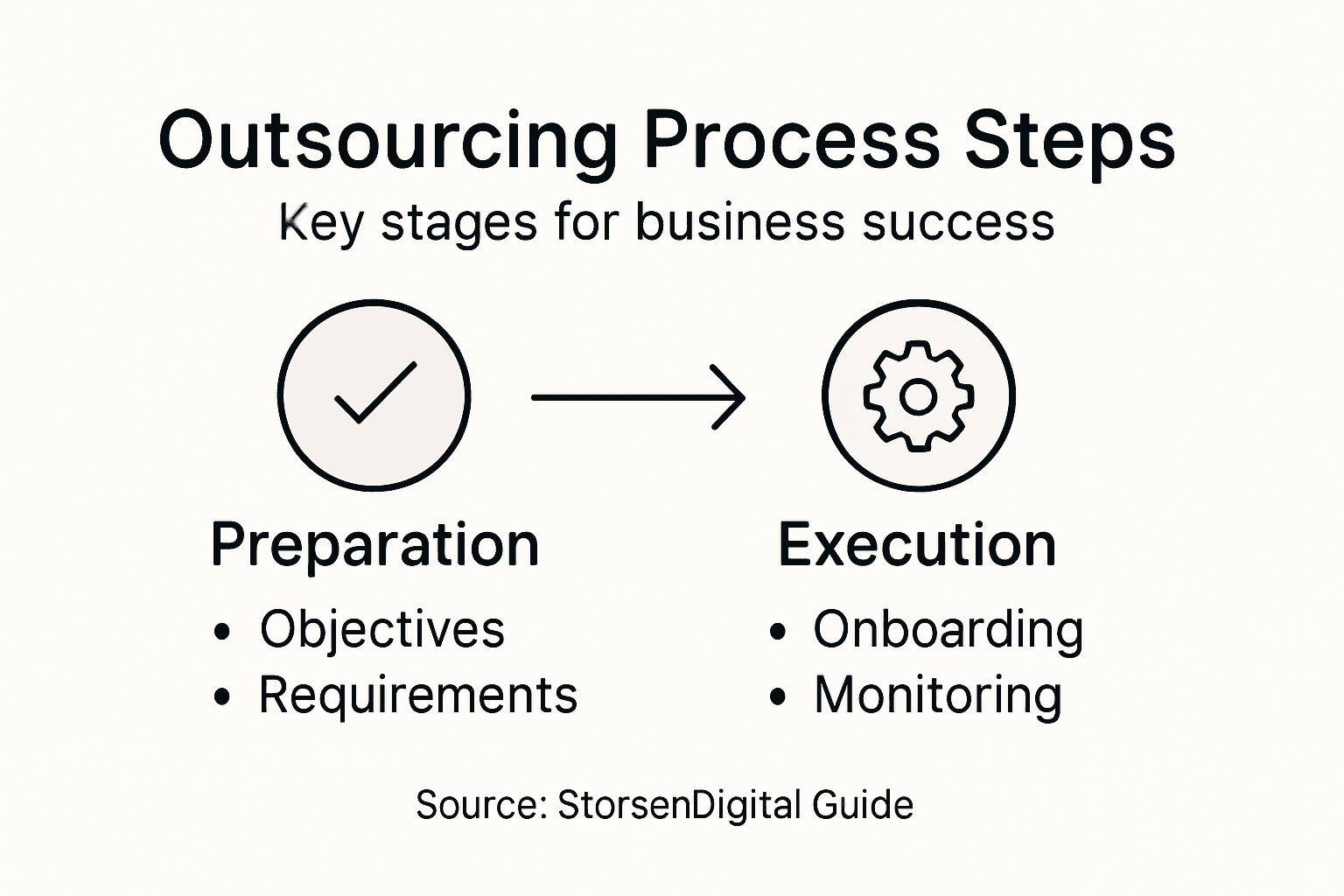
To successfully outsource, start by defining your objectives and requirements, then select and qualify providers, onboard teams, and monitor performance. Take time at each step to communicate clearly and document your processes for effective collaboration.
How can I measure the success of my outsourcing efforts?
Define specific, measurable KPIs aligned with your business goals, such as cost savings or customer satisfaction scores. Track these metrics regularly to assess performance and adjust strategies as necessary, aiming for improvements within the first few months.
What should I include in my requirements specification for outsourcing?
Your specification should detail technical capabilities, team size, language skills, and data security standards. Include clear communication protocols and success metrics to align expectations with potential partners.
How do I choose the right outsourcing provider?
Analyze market options and create a shortlist of providers with relevant industry experience. Request proposals, conduct interviews, and use structured criteria to evaluate their capabilities and cultural fit before making a decision.
What strategies can I use to onboard my outsourced team effectively?
Start with a kickoff meeting to set roles and expectations, and provide thorough training for knowledge transfer. Establish standardized communication tools and regular meetings to ensure smooth collaboration and align workflows swiftly.
How often should I monitor the performance of my outsourced team?
Aim to conduct performance reviews monthly, especially during the initial stages of the partnership. Regular check-ins help catch issues early and keep the relationship aligned with your business objectives.


