


Managing complex operations across multiple markets means every new outsourcing decision can either strengthen your growth or introduce hidden vulnerabilities. For many European tech leaders, scaling at speed demands more than cost reduction—it calls for a strategic approach to risk assessment and continuous oversight. This guide focuses on building a robust outsourcing framework that balances ambition with reliable risk controls at every stage, helping you safeguard reputation and business continuity as you expand.
Table of Contents
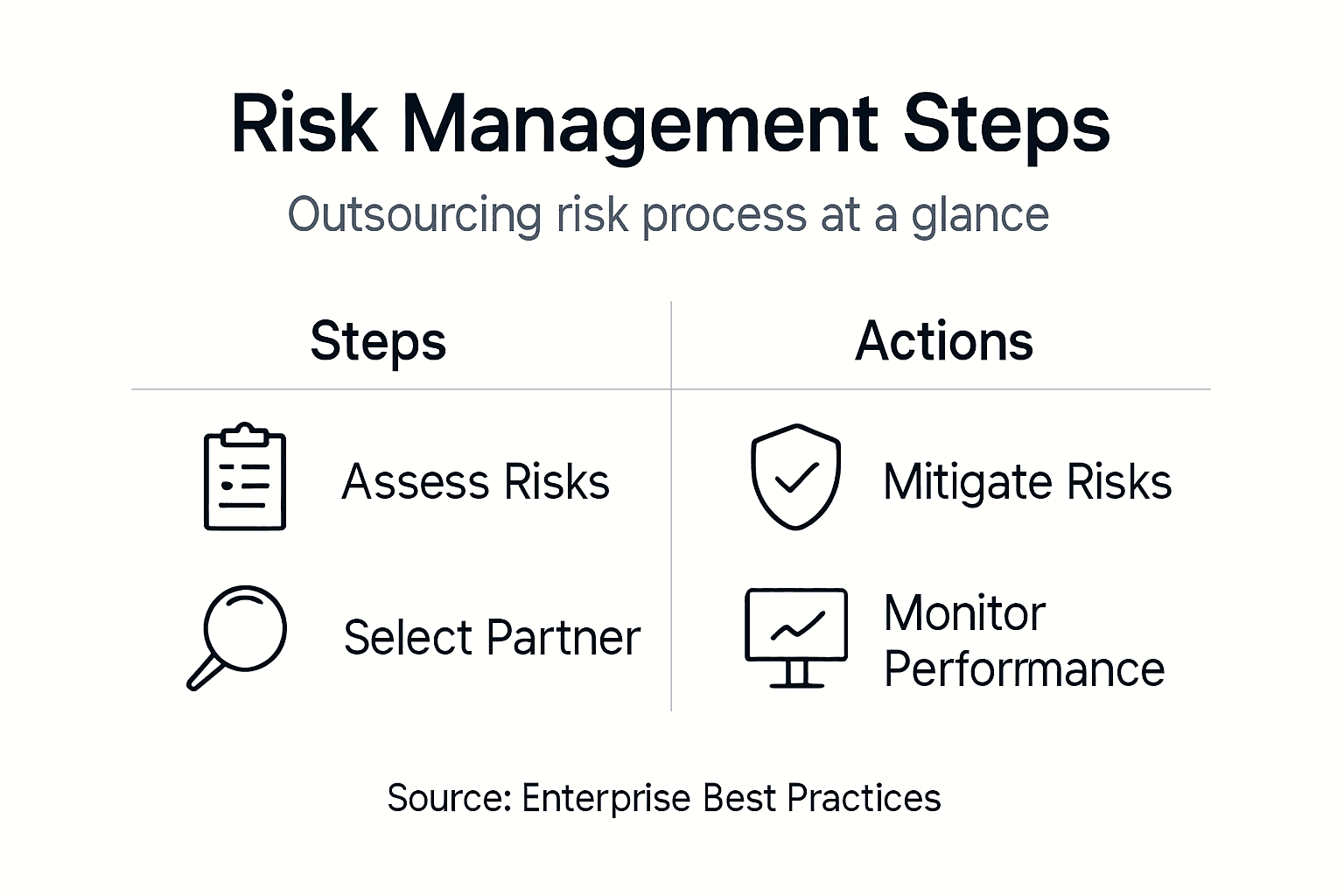
- Step 1: Assess Outsourcing Risks And Requirements
- Step 2: Select And Onboard Qualified Outsourcing Partners
- Step 3: Implement Customized Risk Mitigation Strategies
- Step 4: Monitor And Validate Risk Management Performance
Quick Summary
| Key Insight | Explanation |
|---|---|
| 1. Assess outsourcing risks first | Understanding potential risks and clear requirements is crucial before making outsourcing decisions. |
| 2. Develop a detailed vendor scorecard | Create criteria to evaluate potential outsourcing partners based on risk assessment and operational needs. |
| 3. Customize risk mitigation strategies | Tailor risk management strategies to address specific risks associated with each vendor and business context. |
| 4. Implement continuous monitoring | Regularly track vendor performance to ensure adherence to contracts and identify emerging risks early. |
| 5. Establish clear communication protocols | Define escalation paths and governance structures to effectively manage vendor relationships. |
Step 1: Assess outsourcing risks and requirements
Before you outsource any business function, you need a clear understanding of what risks you’re taking on and what your operation actually requires. This foundational step determines whether outsourcing makes sense for your organization and shapes every decision that follows.
Start by defining your outsourcing scope with precision. What processes are you considering? Are these mission-critical functions or support operations? The scope directly impacts your risk profile, so get specific about what you’re handing off.
Next, evaluate the materiality of the outsourcing decision. Companies often lack well-substantiated approaches to defining outsourcing and assessing materiality, which can lead to underestimating risks. Ask yourself: How much would a failure in this area damage our operations, reputation, or financials? This assessment guides your due diligence intensity.
Conduct a thorough due diligence review covering these key areas:
- Financial impact if the service fails or is disrupted
- Regulatory and compliance obligations you must maintain
- Data security and confidentiality requirements
- Integration complexity with your existing systems
- Concentration risks if a single vendor controls critical functions
- Reputational consequences tied to the outsourced service
Identify your internal expertise gaps. Can your team effectively manage and monitor an outsourced function? If not, that’s a risk factor that needs addressing before you proceed. You’ll need sufficient internal resources to oversee the relationship throughout its lifecycle.
Assess concentration risks by understanding how dependent your business becomes on a single vendor. Heavy concentration elevates your exposure if that vendor fails. Diversification or backup contingencies might be necessary.
Document your requirements clearly. What service levels do you expect? What quality standards must the vendor meet? What security protocols are non-negotiable? Vague requirements create disputes and hidden risks later.
Proper risk assessment at this stage prevents costly surprises during implementation and ongoing operations.
Finally, create a written risk register that captures potential issues, their likelihood, impact, and mitigation strategies. This living document guides your vendor selection and becomes your monitoring roadmap.
Pro tip: Create a risk assessment checklist customized to your industry and function—this ensures consistency across evaluations and accelerates the assessment process when evaluating multiple vendors.
Step 2: Select and onboard qualified outsourcing partners
Once you understand your risks and requirements, finding the right partner becomes critical. Selecting and onboarding qualified outsourcing partners requires rigorous evaluation to ensure they can deliver on your needs while managing associated risks effectively.
Begin by creating a vendor evaluation scorecard. What criteria matter most for your outsourcing function? Technical capability, financial stability, security certifications, industry experience, cultural fit? Weight these factors based on your risk assessment from Step 1.
Conduct thorough due diligence on potential partners. Assess their operational capacity to handle your volume and complexity. Review their financial health to ensure they can sustain the relationship long term. Examine their risk management practices and data security controls thoroughly.
Evaluate these critical vendor capabilities:
- Track record delivering similar services to comparable organizations
- Compliance certifications relevant to your industry and regulations
- Disaster recovery and business continuity protocols
- Quality assurance processes and performance metrics
- Technology infrastructure stability and scalability
- Team expertise and staff retention rates
Check references from current and former clients. Ask specifically about challenges they faced and how the vendor resolved them. Don’t rely solely on vendor-provided references. Speak with multiple organizations operating in your industry.
Screening also helps you prevent concentration risks by ensuring no single vendor becomes too critical to your operations. Diversifying across multiple vendors or having backup capabilities protects your business.
Below is a quick reference comparing one-vendor vs. multi-vendor outsourcing:
| Approach | Key Benefit | Main Drawback |
|---|---|---|
| Single Vendor | Easier relationship management | High concentration risk |
| Multiple Vendors | Risk diversification | Increased oversight effort |
Once you select a partner, create detailed contractual terms that define service levels, responsibilities, performance standards, and exit provisions. Clarity prevents disputes later. Include specific language around data protection, compliance obligations, and breach notification procedures.
Clear contracts and aligned expectations from day one eliminate misunderstandings and establish the foundation for a successful partnership.
Establish governance structures before operations begin. Who manages the relationship on your side? How often will you meet? What metrics will you track? Define escalation paths for issues.
Conduct structured knowledge transfer sessions. Ensure your team and the vendor’s team understand each other’s processes, systems, and communication preferences. This onboarding phase sets the tone for the entire relationship.
Pro tip: Create a vendor scorecard template and evaluation checklist before you begin vendor research—this standardizes your selection process and makes comparing multiple candidates significantly faster and more objective.
Step 3: Implement customized risk mitigation strategies
Generic risk mitigation rarely works for outsourcing. Your strategies must address your specific risks, vendor profile, and business context. This step transforms your risk assessment into actionable safeguards that protect your operations.
Start by categorizing your risks into operational, financial, geopolitical, and cybersecurity domains. Each category requires different mitigation approaches. A data breach demands different controls than a vendor financial collapse or service quality degradation.

Develop contingency plans for your highest-impact risks. What happens if your primary vendor fails? Do you have a backup vendor identified? Can you temporarily handle the function in-house? Create written procedures that your team can execute under pressure.
Address these critical risk areas with tailored controls:
- Operational resilience through redundancy and failover procedures
- Financial safeguards including escrow arrangements and insurance requirements
- Geopolitical risk assessments integrated into your strategic planning
- Cybersecurity enhancements guarding against data breaches and system disruptions
- Communication protocols for issue escalation and crisis management
- Regular performance monitoring against defined service levels
Cybersecurity deserves special attention. Your vendor handles sensitive data, so enhance your security processes to guard against breaches and operational disruptions. Require regular security audits, penetration testing, and compliance certifications.
Implement strategic alignment mechanisms that keep vendor incentives linked to your success. Performance-based pricing, penalty clauses for missed targets, and bonus opportunities for exceeding expectations create mutual accountability.
Establish continuous threat monitoring systems. Don’t wait for annual reviews to catch problems. Monitor vendor performance metrics monthly. Track geopolitical developments affecting their location or operations. Stay alert to regulatory changes impacting their certifications.
Create control frameworks that address loss of control and dependency risks inherent in outsourcing. Define which decisions require vendor input and which remain under your control. Maintain transparency into their operations through audit rights and regular reporting.
Customized risk mitigation strategies aligned with your specific risk profile turn outsourcing from a source of vulnerability into a competitive advantage.
Document all mitigation strategies in a risk mitigation register. Assign owners, define implementation timelines, and track completion. This living document guides your ongoing risk management.
Pro tip: Map each identified risk to a specific mitigation strategy and assign one owner responsible for implementation—clear ownership accelerates execution and ensures nothing falls through the cracks.
Here’s a summary of typical risk categories and possible mitigation strategies for outsourcing:
| Risk Category | Common Threat | Mitigation Strategy |
|---|---|---|
| Operational | Service disruption | Redundant systems and backup plans |
| Financial | Unexpected costs | Fixed pricing and financial audits |
| Geopolitical | Political instability | Vendor location diversification |
| Cybersecurity | Data breach | Regular audits and encryption |
Step 4: Monitor and validate risk management performance
Your risk mitigation strategies only work if you actively monitor them. This step ensures your outsourcing arrangement stays on track and that emerging risks get caught before they become crises.
Establish continuous oversight mechanisms that track service delivery against your contractual obligations. Don’t rely on annual reviews alone. Monthly performance reviews, quarterly business reviews, and real-time dashboards create transparency and early warning signals.
Define clear performance metrics aligned with your business objectives. What does success look like for this outsourced function? Set specific, measurable targets for quality, timeliness, accuracy, and compliance. Track actual performance against these targets consistently.
Implement a robust monitoring framework covering these areas:
- Service level agreement compliance and trending
- Financial performance and cost management
- Compliance with regulatory and contractual requirements
- Security and data protection incident reporting
- Quality metrics and error rates
- Vendor financial health indicators
- Staff turnover and resource stability
Conduct periodic audits of your vendor’s operations. These audits assess whether they’re maintaining the controls and practices they committed to. Schedule audits annually at minimum, more frequently for critical functions. Include both announced and unannounced assessments.
Validation requires integrating monitoring into your routine management processes rather than treating it as a separate activity. Assign someone on your team primary responsibility for vendor oversight. Build vendor performance reviews into your regular business cycles.
Develop escalation procedures that define how problems get addressed. What happens when a vendor misses a target? Who gets notified? What’s the timeline for resolution? Clear escalation paths prevent minor issues from becoming major problems.
Adapt your risk mitigation approach in response to changing conditions throughout the outsourcing lifecycle. New regulations, market shifts, or vendor changes may require adjusting your controls. Review your risk mitigation strategies annually and update them as needed.
Document all monitoring activities with clear records. Keep audit reports, performance data, and corrective action logs organized and accessible. This documentation demonstrates to regulators that you’re actively managing outsourcing risks.
Consistent, documented monitoring transforms outsourcing from a passive arrangement into an actively managed partnership with accountability on both sides.
Use monitoring data to inform strategic decisions about the vendor relationship. Is performance trending positively or negatively? Are new risks emerging? Should you invest in strengthening the relationship or begin evaluating alternatives?
Pro tip: Create a vendor scorecard dashboard that updates monthly with key performance metrics—this single source of truth keeps your team aligned and makes performance trends immediately visible to leadership.
Strengthen Your Outsourcing Risk Management With Trusted Expertise
Managing outsourcing risks requires a precise understanding of your operational needs and tailored risk mitigation strategies. Whether you are facing concentration risks, cybersecurity challenges, or complex vendor relationships, aligning with the right partner ensures operational resilience and long-term success. StorsenDigital specializes in comprehensive outsourcing solutions designed to address exactly these challenges by providing scalable managed services and expert strategic consulting across Europe.
By leveraging our deep industry insights and proven track record, you gain access to customized outsourcing services that safeguard your business against unexpected disruptions while optimizing costs. Let us help you transform your outsourcing risks into competitive advantages supported by continuous monitoring and clear governance. Learn more about how we can partner for your enterprise success by reaching out today.
Explore tailored solutions with StorsenDigital Contact

Take the first step toward secure, scalable outsourcing now by connecting with our team of specialists at StorsenDigital Contact. Discover how our nearshoring and BPO services align with your risk management goals in Europe and beyond.
Frequently Asked Questions
What are the first steps in the outsourcing risk management process?
To begin the outsourcing risk management process, assess the potential risks and specific requirements of your business functions. Clearly define the scope of outsourcing and evaluate the materiality of each decision to guide your due diligence efforts.
How do I create a risk assessment checklist for outsourcing?
Start by identifying key risk categories relevant to your business, such as operational, financial, and cybersecurity risks. Then, customize a checklist that includes specific criteria for each category, which will help ensure a thorough evaluation of each vendor during the selection process.
What should I include in the vendor evaluation scorecard?
Your vendor evaluation scorecard should incorporate criteria such as technical capability, financial stability, security certifications, and industry experience. Assign weights to each factor based on your risk assessment to prioritize what matters most to your outsourcing success.
How can I effectively monitor vendor performance once outsourcing begins?
Implement continuous oversight mechanisms that track performance against predetermined metrics, such as service level agreements and quality standards. Schedule regular reviews, at least monthly, to ensure that any emerging risks or issues are addressed promptly.
What happens if an outsourced vendor fails to meet their obligations?
If a vendor fails to meet their obligations, follow defined escalation procedures to address the issue. Notify the vendor, assess the impact, and implement any agreed-upon penalties or resolutions as per your contractual terms to mitigate further risks.
How often should I review my outsourcing risk management strategies?
Review your outsourcing risk management strategies at least annually, or more frequently if significant changes occur in the market or your vendor’s operations. This ensures your strategies remain effective and relevant to current conditions, helping maintain the integrity of your outsourcing relationships.


