


Over half of American companies report that outsourcing has directly contributed to their business growth. The real challenge is turning this process into something more than just a way to cut costs. With so many options and risks involved, making the right outsourcing decisions impacts your performance and long-term strategy. Discover reliable ways to align partnerships with your goals, minimize risks, and create a pathway for innovation.
Table of Contents
- Step 1: Define Business Objectives And Outsourcing Needs
- Step 2: Assess Regions And Providers For Optimal Fit
- Step 3: Develop Compliance And Risk Management Plans
- Step 4: Structure Contracts And Facilitate Smooth Onboarding
- Step 5: Monitor Performance To Ensure Delivery And Scalability
Quick Summary
| Key Point | Explanation |
|---|---|
| 1. Define Business Objectives | Clearly outline your strategic goals to align your outsourcing strategy with organizational growth and innovation. |
| 2. Assess Regions and Providers | Evaluate potential regions and providers based on innovation, skills, and cultural fit to optimize partnerships. |
| 3. Develop Risk Management Plans | Create thorough compliance and risk management frameworks to protect against operational and legal vulnerabilities. |
| 4. Structure Collaborative Contracts | Develop relational contracts that focus on mutual success and establish clear expectations and performance metrics. |
| 5. Monitor Performance Effectively | Implement a robust performance tracking system to drive continuous improvement and strategic alignment with your outsourcing goals. |
Step 1: Define Business Objectives and Outsourcing Needs
Defining clear business objectives is a critical foundation for successful outsourcing strategy. Your goal is to create a strategic roadmap that transforms outsourcing from a traditional cost reduction exercise into a transformational approach driving organizational innovation.
Start by conducting a comprehensive internal assessment of your current operational capabilities and identifying specific areas where external support can accelerate growth. This means examining your existing processes through a strategic lens and determining which functions could benefit from specialized expertise or enhanced scalability. Look for opportunities where outsourcing can provide more than just cost savings – seek potential partners who can bring innovative solutions and contribute to your broader business transformation.
The most effective outsourcing strategies align closely with your organization’s long-term goals. Consider how potential outsourcing partnerships can help you achieve key performance indicators, expand market reach, or introduce technological capabilities that might be challenging to develop internally. By integrating business objectives directly into your outsourcing framework, you create a more purposeful and strategic approach to external collaboration.
Pro tip: Begin with a pilot project that allows you to test your outsourcing strategy with minimal risk, providing valuable insights and allowing for iterative refinement before full scale implementation.
Step 2: Assess Regions and Providers for Optimal Fit
Choosing the right geographic region and outsourcing provider is crucial for creating a successful strategic partnership. Your assessment should go beyond simple cost comparisons and focus on understanding the regional innovation context that impacts technological collaboration.

Begin by evaluating potential regions based on their technological infrastructure, talent pool, and innovation ecosystem. Look for locations with strong educational institutions, robust digital infrastructure, and a history of supporting international business partnerships. Consider factors like language compatibility, cultural alignment, legal frameworks, and time zone proximity that can significantly impact collaboration effectiveness. Pay close attention to the specialized skills available in each region and how they match your specific business requirements.
When assessing potential providers, conduct comprehensive due diligence that extends beyond initial proposals. Request detailed case studies, speak with existing clients, and evaluate the provider’s track record in your specific industry. Look for partners who demonstrate not just technical capability but also strategic thinking and a proven ability to adapt to changing business landscapes. Examine their innovation potential, technological investments, and capacity for scalable solutions that can grow alongside your business objectives.
Pro tip: Create a detailed scoring matrix that weights different evaluation criteria such as technical expertise, cultural fit, cost efficiency, and innovation potential to enable a more objective and comprehensive provider selection process.
Here’s how key outsourcing evaluation factors compare across regions and providers:
| Evaluation Factor | Geographic Region Example | Provider Example |
|---|---|---|
| Talent Availability | Large engineering pool in India | Certified experts in technology |
| Innovation Ecosystem | Startups in Eastern Europe | Investment in R&D initiatives |
| Language Compatibility | High in Philippines | Multilingual support offered |
| Cultural Alignment | Similar business culture in Canada | Frequent cross-cultural training |
| Legal/Regulatory Fit | Strong IP protection in EU | Compliance with major standards |
| Time Zone Proximity | Nearshore in Latin America | Dedicated time overlap teams |
| Cost Efficiency | Lower in Southeast Asia | Transparent pricing structures |
| Industry Experience | Tech hubs in Israel | Experience in your industry |
Step 3: Develop Compliance and Risk Management Plans
Developing robust compliance and risk management plans is essential to protect your organization and ensure a successful outsourcing partnership. Your strategy should focus on creating a comprehensive framework that identifies and mitigates potential security and operational risks.
Begin by conducting a thorough risk assessment that examines potential vulnerabilities across technological, legal, and operational domains. This involves mapping out potential scenarios that could impact your business, from data security breaches to regulatory compliance challenges. Utilize relational contracting principles to establish clear governance structures and mutual expectations that create transparency and alignment between your organization and the outsourcing provider. Develop detailed protocols for data protection, confidentiality, intellectual property rights, and performance monitoring.
Implement a multi-layered risk management approach that includes regular audits, continuous monitoring mechanisms, and clearly defined escalation procedures. Create contingency plans that outline specific actions to be taken in various risk scenarios, ensuring your organization can quickly respond to and mitigate potential disruptions. Consider engaging legal and cybersecurity experts to review and validate your risk management strategy, providing an additional layer of professional oversight.
Pro tip: Develop a dynamic risk management document that is reviewed and updated quarterly, allowing your compliance strategy to evolve alongside changing technological and regulatory landscapes.
Summary comparison of risk management components for outsourcing partnerships:
| Component | Description | Business Benefit |
|---|---|---|
| Risk Assessment | Identifying security and operational vulnerabilities | Early issue detection |
| Legal Compliance | Meeting regulatory and contractual requirements | Reduced legal exposure |
| Monitoring & Auditing | Ongoing reviews and checks of provider performance | Sustained accountability |
| Contingency Planning | Documented responses to disruptions or breaches | Faster recovery from risks |
| Stakeholder Communication | Regular updates and transparency measures | Improved trust and clarity |
Step 4: Structure Contracts and Facilitate Smooth Onboarding
Structuring effective outsourcing contracts requires a strategic approach that goes beyond traditional transactional agreements. Your goal is to develop a relational contract that establishes collaborative, win-win partnerships focused on mutual success.
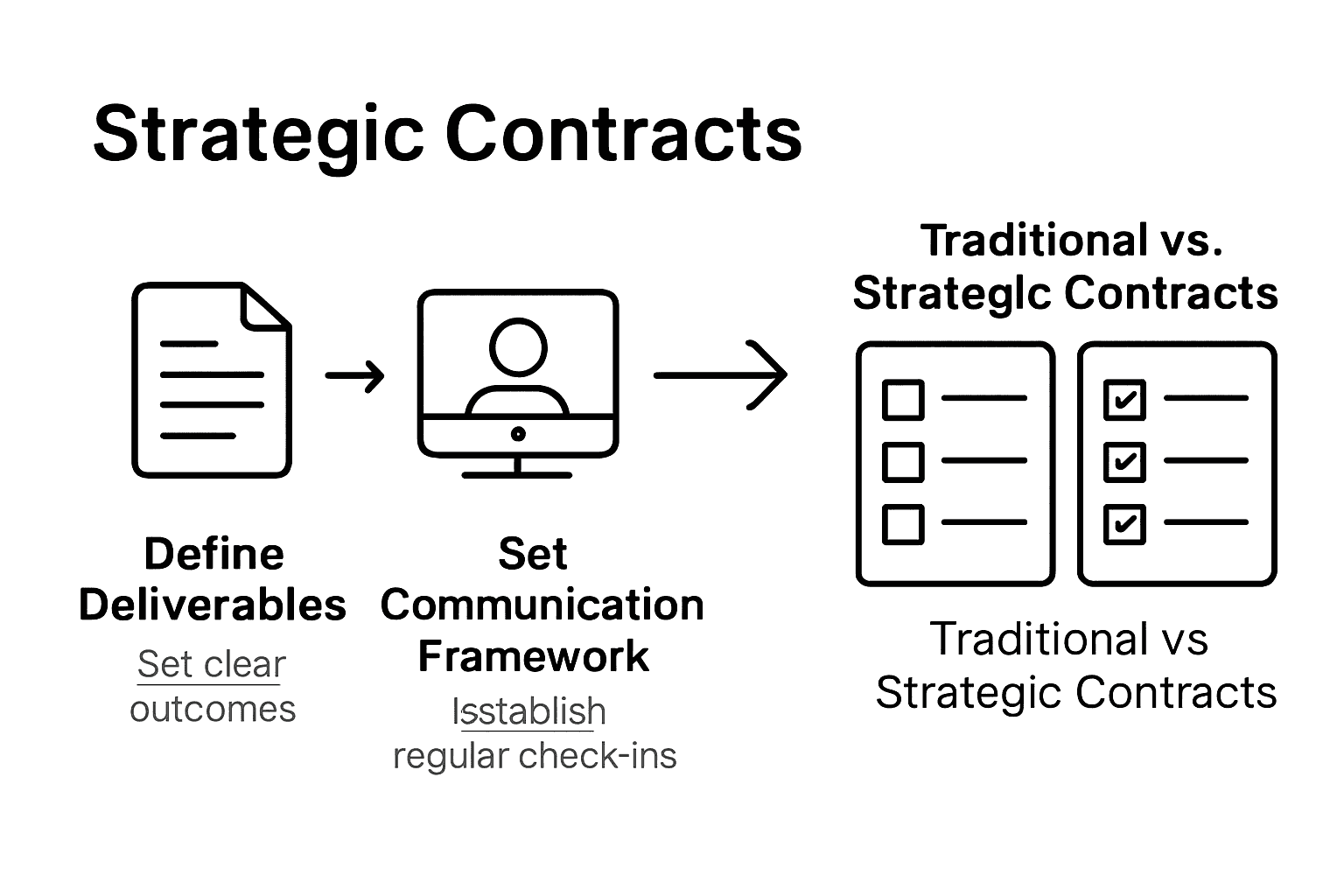
Begin by clearly defining the scope of work, performance metrics, and key deliverables with unprecedented levels of specificity. Include comprehensive clauses that address potential scenarios such as performance variances, technological changes, and potential scaling requirements. Research indicates that carefully structured contracts directly impact organizational performance and strategic outcomes, so invest significant time in crafting agreements that are flexible yet precise. Develop detailed onboarding protocols that include comprehensive knowledge transfer mechanisms, training schedules, and integration workshops to ensure seamless collaboration from the initial engagement.
Prioritize creating communication frameworks that establish regular check-ins, performance reviews, and collaborative problem-solving channels. Include provisions for periodic contract reviews, allowing both parties to reassess and realign objectives as business landscapes evolve. Ensure your contract includes clear escalation paths, performance improvement strategies, and mutually agreed-upon mechanisms for addressing potential challenges or disputes.
Pro tip: Develop a comprehensive onboarding playbook that includes not just contractual details but also cultural integration strategies, helping both your internal team and external partners understand expectations and collaboration approaches.
Step 5: Monitor Performance to Ensure Delivery and Scalability
Continuous performance monitoring is crucial for maintaining strategic alignment and achieving long-term outsourcing success. Establishing a comprehensive performance tracking system will help you proactively manage your outsourcing partnership and drive consistent value creation.
Develop a robust performance management framework that includes quantitative and qualitative metrics tailored to your specific business objectives. Implement key performance indicators (KPIs) that measure not just operational efficiency but also strategic impact, innovation potential, and adaptability. Create a dynamic dashboard that provides real-time insights into productivity, quality, cost efficiency, and technological responsiveness. Schedule regular performance review meetings that go beyond simple data presentation to facilitate strategic discussions about continuous improvement, emerging opportunities, and potential scaling strategies.
Ensure your monitoring approach is holistic and forward looking. This means not just tracking current performance but also assessing the provider’s capacity for future growth, technological innovation, and alignment with your evolving business landscape. Build mechanisms for rapid feedback, quick course corrections, and collaborative problem solving that transform performance monitoring from a compliance exercise into a strategic partnership optimization process.
Pro tip: Implement a quarterly performance scorecard that includes both objective metrics and subjective feedback from key stakeholders, providing a comprehensive view of your outsourcing partnership’s effectiveness and potential.
Elevate Your Outsourcing Strategy in Europe with StorsenDigital
The journey to successful outsourcing in 2025 starts with addressing critical challenges like defining clear business objectives, selecting the ideal regions and providers, and establishing strong compliance and risk management plans. If you are looking to transform your outsourcing efforts from simple cost reduction into a driver of innovation and growth, StorsenDigital offers tailored solutions perfectly aligned with the strategic insights from the article “Outsourcing Strategy 2025 for European Growth | StorsenDigital.” Our expertise in talent acquisition, managed BPO services, and strategic consulting directly supports your goals in scalability, operational excellence, and seamless collaboration.

Unlock the potential of nearshoring and outsourcing across Europe with confidence by partnering with experts who understand how to integrate your business objectives into every stage of the outsourcing lifecycle. Whether you need support with office establishment, HR, IT, or finance, visit our Contact page to connect with our team. Take the next step toward efficient, innovative, and compliant outsourcing today — your European growth opportunity awaits. Learn more about how we can help you build stronger partnerships and drive measurable success at StorsenDigital Contact.
Explore our services and begin your transformation now by visiting StorsenDigital Contact.
Frequently Asked Questions
How do I define my business objectives before outsourcing?
Defining your business objectives requires a comprehensive internal assessment of your current capabilities. Start by identifying specific areas where external support can accelerate your growth and contribute to your broader organizational goals.
What criteria should I use to evaluate potential outsourcing providers?
When evaluating outsourcing providers, focus on their technical expertise, cultural fit, and industry experience. Create a scoring matrix that includes these criteria to help you make a more objective decision over a 30-day evaluation period.
How can I ensure my outsourcing contracts facilitate a successful partnership?
To facilitate a successful outsourcing partnership, structure your contracts to include clear performance metrics and communication frameworks. Focus on creating relational contracts that promote collaboration, ensuring both parties actively engage in regular performance reviews.
What steps should I take to monitor the performance of my outsourcing partners?
To monitor performance effectively, develop a performance management framework that includes both quantitative and qualitative metrics. Schedule regular performance review meetings to drive discussions on improvement strategies, aiming for feedback cycles within 30–60 days.
How can I assess the risks associated with outsourcing?
Assessing risks in outsourcing involves conducting a thorough risk assessment that identifies potential vulnerabilities in technological, legal, and operational areas. Create a dynamic risk management document that you review quarterly to adapt to evolving risks and maintain compliance.
What is a pilot project, and how can it benefit my outsourcing strategy?
A pilot project is a small-scale trial that allows you to test your outsourcing strategy with minimal risk. Implement a pilot project to gain valuable insights and refine your approach before full-scale implementation, which can help you reduce uncertainties and improve outcomes.


