


European enterprises are pouring unprecedented capital into nearshoring projects, with investments surging 62% in recent years. Yet this rapid expansion brings complex risks that can derail even well-planned initiatives. Financial overruns, talent shortages, and supply chain disruptions threaten project success and competitive advantage. Smart decision-makers recognize that robust risk management isn’t optional, it’s the foundation for sustainable nearshoring outcomes. This guide walks you through proven strategies to identify, mitigate, and monitor risks throughout your nearshoring journey, ensuring your investments deliver the operational efficiency and cost savings you expect.
Table of Contents
- Understanding The Risks In Nearshoring Investments
- Preparing For Nearshoring Success: Prerequisites And Risk Mitigation
- Executing Your Nearshoring Strategy With Effective Risk Management
- Verifying Results And Continuous Risk Evaluation Post-Nearshoring Implementation
- Explore Expert Outsourcing Solutions To Secure Your Nearshoring Success
- Frequently Asked Questions
Key takeaways
| Point | Details |
|---|---|
| Rising investment stakes | Nearshoring capital in Europe jumped 62% between 2022 and 2023, making risk management more critical than ever. |
| Preparation reduces failure | Thorough upfront assessments of financial, legal, and operational factors prevent costly implementation pitfalls. |
| Active monitoring sustains success | Continuous KPI tracking and adaptive strategies keep projects aligned with business goals despite evolving challenges. |
| Verification drives improvement | Post-implementation reviews and compliance audits confirm risk mitigation effectiveness and inform future decisions. |
Understanding the risks in nearshoring investments
The explosive growth in European nearshoring creates substantial financial exposure for enterprises. Nearshoring investment increased by 62% between 2022 and 2023 compared to 2018-19, signaling both opportunity and heightened risk. When projects involve millions in capital expenditure, even small miscalculations cascade into major setbacks.
Three risk categories demand your immediate attention. Financial risks include budget overruns, currency fluctuations, and unexpected regulatory costs that erode projected savings. Operational risks encompass supply chain disruptions, technology integration failures, and process misalignment between your home operations and nearshore facilities. Strategic risks involve talent acquisition challenges, cultural friction, and vendor reliability issues that undermine long-term sustainability.
The consequences of inadequate risk management extend beyond immediate project failure. You lose competitive positioning when delayed implementations allow rivals to capture market share. Your organization’s reputation suffers when quality issues stem from poorly managed nearshore operations. Employee morale deteriorates when internal teams struggle with unclear responsibilities and communication breakdowns.
“Enterprises that treat risk management as an afterthought rather than a strategic priority consistently experience 40% higher project failure rates and significantly reduced ROI from their nearshoring investments.”
Consider how these risks interconnect. A talent shortage in your chosen location forces rushed hiring decisions, leading to quality problems that damage client relationships. Supply chain disruptions delay your go-live timeline, increasing carrying costs and opportunity costs simultaneously. Understanding these advantages of nearshoring benefits requires equally understanding the pitfalls that can negate them.
Key risk indicators to monitor include:
- Capital expenditure variance exceeding 15% of budget
- Talent turnover rates above industry benchmarks for your sector
- Service level agreement breaches occurring more than twice monthly
- Compliance violations or regulatory warnings from local authorities
- Communication gaps causing project delays beyond two weeks
Your risk profile varies based on project scope, geographic location, and industry sector. Manufacturing nearshoring carries different supply chain vulnerabilities than software development operations. Eastern European locations present distinct regulatory environments compared to Southern European markets. Tailoring your risk assessment to your specific context separates successful implementations from expensive failures.
Preparing for nearshoring success: prerequisites and risk mitigation
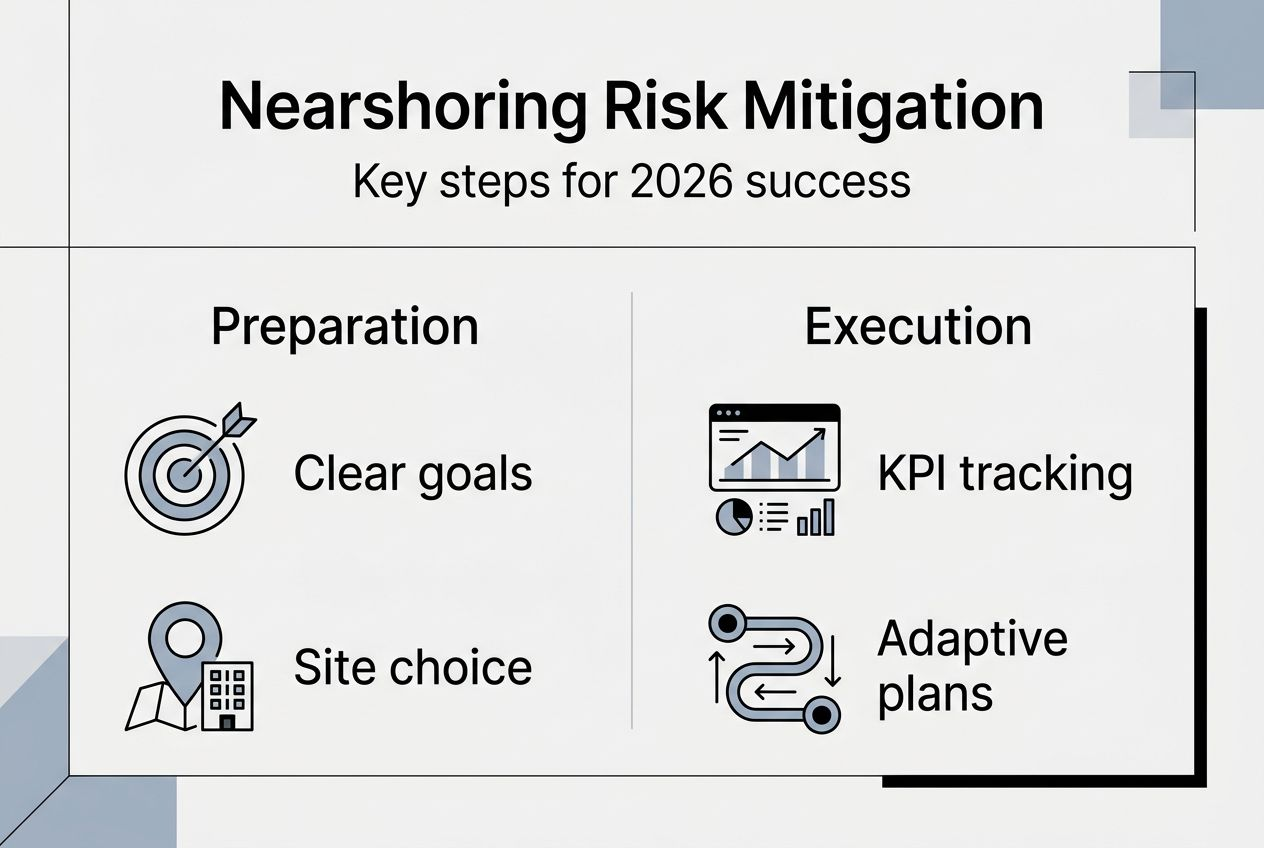
Solid preparation transforms nearshoring from a gamble into a calculated strategic move. Start by defining crystal-clear business objectives that extend beyond simple cost reduction. What operational capabilities do you need to build? Which markets do you aim to serve more effectively? How does nearshoring support your three-year growth plan? Vague goals produce vague results and make risk assessment nearly impossible.
Your risk assessment process must be comprehensive and honest. Average capital expenditure increased 3X to $131 million compared to 2019, making financial due diligence non-negotiable. Examine total cost of ownership, not just labor arbitrage. Factor in infrastructure investments, technology licensing, training expenses, travel costs, and the hidden overhead of managing distributed teams.
Follow this preparation sequence:
- Conduct stakeholder interviews across finance, operations, HR, and IT to identify concerns and requirements from each function.
- Analyze three to five potential locations using weighted criteria including talent availability, regulatory stability, infrastructure quality, and cultural compatibility.
- Develop detailed financial models with sensitivity analysis showing best case, expected case, and worst case scenarios for each location.
- Create a governance framework defining decision rights, escalation paths, reporting cadences, and accountability structures.
- Draft preliminary contracts and service level agreements with clear performance metrics and remediation clauses.
- Establish a dedicated project management office with authority to make real-time decisions and resolve conflicts.
Location selection deserves special attention because it’s difficult to reverse. Poland offers strong technical talent and EU regulatory alignment but faces wage inflation. Romania provides cost advantages and growing IT capabilities but has infrastructure gaps in secondary cities. Portugal delivers cultural affinity with Western Europe and government incentives yet struggles with talent scarcity in specialized fields.

Pro Tip: Build a 20% contingency buffer into your initial budget and timeline. Projects consistently encounter unexpected costs related to regulatory compliance, facility modifications, or extended ramp-up periods. This buffer prevents panic decisions when reality diverges from projections.
Your governance plan should address these critical elements:
| Governance Component | Key Requirements | Risk Mitigation |
|---|---|---|
| Decision authority | Clear escalation matrix with response time commitments | Prevents delays from approval bottlenecks |
| Performance metrics | Weekly KPI dashboards covering cost, quality, and delivery | Enables early detection of variance |
| Communication protocols | Daily standups, weekly reviews, monthly business reviews | Reduces misunderstanding and misalignment |
| Vendor management | Quarterly audits, contract compliance checks, relationship reviews | Protects against vendor underperformance |
Legal and compliance preparation cannot wait until implementation. Engage local counsel early to navigate employment law, data protection regulations, tax obligations, and intellectual property protections. GDPR compliance alone requires substantial process documentation and technical controls that take months to implement properly.
These best practices for nearshoring expansion and how to set up nearshoring europe expansion provide frameworks you can adapt to your organization’s specific needs and risk tolerance.
Executing your nearshoring strategy with effective risk management
Execution separates planning from results, and this phase demands relentless attention to emerging risks. Transparency becomes your most powerful tool. Share project status, challenges, and wins with all stakeholders weekly, not just when problems escalate. Hidden issues metastasize into crises, while openly discussed challenges generate collaborative solutions.
Your KPI dashboard must track leading indicators, not just lagging results. Monitor recruitment pipeline velocity, not just headcount. Track defect rates during development, not just at final testing. Measure employee engagement scores monthly, not annually. Leading indicators give you time to intervene before problems impact deliverables.
Adaptive management means adjusting your approach based on real-world feedback. If talent acquisition takes longer than projected, expand your geographic search radius or adjust role requirements. When quality metrics slip, increase training investment or revise processes rather than simply demanding better performance. Rigidity in execution guarantees failure when conditions change.
Pro Tip: Establish a weekly risk review ritual where your project team explicitly discusses new risks, evaluates existing risk mitigation effectiveness, and updates contingency plans. This 30-minute investment prevents surprises and builds organizational muscle for proactive problem-solving.
Partner selection and management directly impact risk exposure. Engage providers who demonstrate:
- Proven track records in your industry with verifiable client references
- Financial stability to weather economic turbulence without service disruption
- Cultural alignment with your organization’s values and communication style
- Technical capabilities matching your current and future requirements
- Transparent pricing models without hidden fees or surprise charges
Your relationship with nearshore partners requires active cultivation. Schedule regular site visits to build personal connections and observe operations firsthand. Involve nearshore team members in strategic planning sessions so they understand business context. Celebrate successes publicly and address failures constructively in private.
Nearshoring investment growth of 62% means competition for top talent intensifies continuously. Your retention strategy must include competitive compensation, clear career paths, meaningful work assignments, and integration with your broader organizational culture. Losing key personnel mid-project creates knowledge gaps and timeline delays that compound other risks.
Consider this comparison of risk management approaches:
| Approach | Characteristics | Risk Outcome |
|---|---|---|
| Reactive | Address issues only after they impact deliverables | 60% higher project failure rate |
| Scheduled | Review risks monthly in formal meetings | Moderate risk mitigation, slow response |
| Proactive | Continuous monitoring with weekly reviews and rapid intervention | 40% reduction in major incidents |
| Predictive | AI-driven analytics identifying risks before they materialize | Optimal outcomes, requires mature processes |
Implement change management processes that balance agility with stability. Not every scope adjustment requires formal approval, but material changes to budget, timeline, or deliverables demand stakeholder sign-off. Document decisions and rationale so future team members understand project evolution.
These resources on nearshoring strategy workflow and nearshoring workflow 2026 cost savings guide offer detailed execution frameworks you can customize for your specific operational context.
Verifying results and continuous risk evaluation post-nearshoring implementation
Post-implementation verification transforms expensive lessons into organizational wisdom. Schedule your first comprehensive review 90 days after go-live, when initial stabilization completes but memories remain fresh. Compare actual outcomes against original projections across financial performance, operational efficiency, quality metrics, and risk incidents.
Your review should answer these questions honestly. Did we achieve projected cost savings after accounting for all expenses? How does service quality compare to our previous model? What unexpected challenges emerged and how effectively did we respond? Which risks materialized and which mitigation strategies proved most valuable? Where did our planning assumptions prove inaccurate?
Audit and compliance verification protects against hidden vulnerabilities. Engage independent auditors to assess:
- Financial controls including invoice accuracy, budget adherence, and expense authorization processes.
- Operational compliance with service level agreements, quality standards, and delivery commitments.
- Legal and regulatory adherence covering employment law, data protection, tax obligations, and industry-specific requirements.
- Security protocols including access controls, data handling procedures, and incident response capabilities.
Benchmarking provides context for your results. How do your nearshoring outcomes compare to industry standards? Capital expenditure averaging $131 million per project means even small efficiency improvements generate substantial value. Join industry associations, participate in peer networks, and commission third-party assessments to understand your relative performance.
| Verification Area | Measurement Approach | Frequency |
|---|---|---|
| Financial performance | Variance analysis against budget and ROI projections | Quarterly |
| Operational efficiency | Process cycle time, resource utilization, output quality | Monthly |
| Risk incidents | Severity, frequency, resolution time, recurrence rate | Weekly |
| Stakeholder satisfaction | Surveys, interviews, Net Promoter Score tracking | Quarterly |
Continuous improvement cycles embed learning into operations. Document lessons learned while details remain clear. What would you do differently knowing what you know now? Which risks did you overestimate or underestimate? How can you streamline processes without compromising controls? Share insights across your organization so other teams benefit from your experience.
Your risk management framework should evolve as your nearshoring operations mature. Early-stage projects require intensive oversight and frequent checkpoints. Established operations can transition to exception-based monitoring with automated alerts for variance. Scale your governance to match actual risk exposure rather than applying uniform processes regardless of maturity.
Build a knowledge repository capturing decisions, challenges, solutions, and outcomes. Future projects accelerate when teams access documented experience rather than rediscovering solutions. Include contact information for key vendors, regulatory authorities, and subject matter experts who proved valuable.
This step by step nearshoring guide europe offers additional frameworks for sustaining and optimizing your nearshoring operations over time.
Explore expert outsourcing solutions to secure your nearshoring success
Navigating nearshoring complexity requires more than good intentions and generic best practices. You need tailored strategies that address your specific industry challenges, organizational culture, and risk tolerance. StorsenDigital specializes in guiding European enterprises through every phase of nearshoring implementation, from initial strategy development through ongoing optimization.

Our comprehensive nearshoring strategy workflow and outsourcing process guide business success provide frameworks proven across hundreds of successful implementations. Whether you’re launching your first nearshore operation or scaling existing capabilities, our team delivers the expertise and support that transform risk into competitive advantage. Contact us to discuss how we can accelerate your nearshoring success while minimizing exposure.
Frequently asked questions
What are the main risks involved in nearshoring?
Financial risks include budget overruns and currency fluctuations that erode savings. Operational challenges encompass supply chain disruptions, talent shortages, and integration failures. Strategic risks involve vendor reliability issues and cultural misalignment that undermine long-term sustainability.
How can I prepare my organization for nearshoring?
Conduct comprehensive risk assessments covering financial, legal, and operational factors before committing resources. Define clear business objectives, analyze multiple location options, and establish robust governance frameworks. Build 20% contingency buffers into budgets and timelines to handle inevitable surprises.
What KPIs should I monitor during nearshoring execution?
Track leading indicators including recruitment pipeline velocity, defect rates during development, and employee engagement scores. Monitor capital expenditure variance, talent turnover rates, service level agreement compliance, and communication effectiveness. Weekly dashboards enable early intervention before problems escalate.
How often should I review nearshoring risk management strategies?
Conduct weekly risk reviews during active implementation to identify emerging threats and evaluate mitigation effectiveness. Schedule comprehensive post-implementation assessments at 90 days, six months, and annually. Adjust governance intensity based on project maturity and actual risk exposure.
What role do partners play in nearshoring risk mitigation?
Trusted partners with proven track records reduce execution risk through established processes and local expertise. They navigate regulatory requirements, accelerate talent acquisition, and provide operational support during ramp-up. Select partners demonstrating financial stability, cultural alignment, and transparent pricing to minimize vendor-related risks.


