


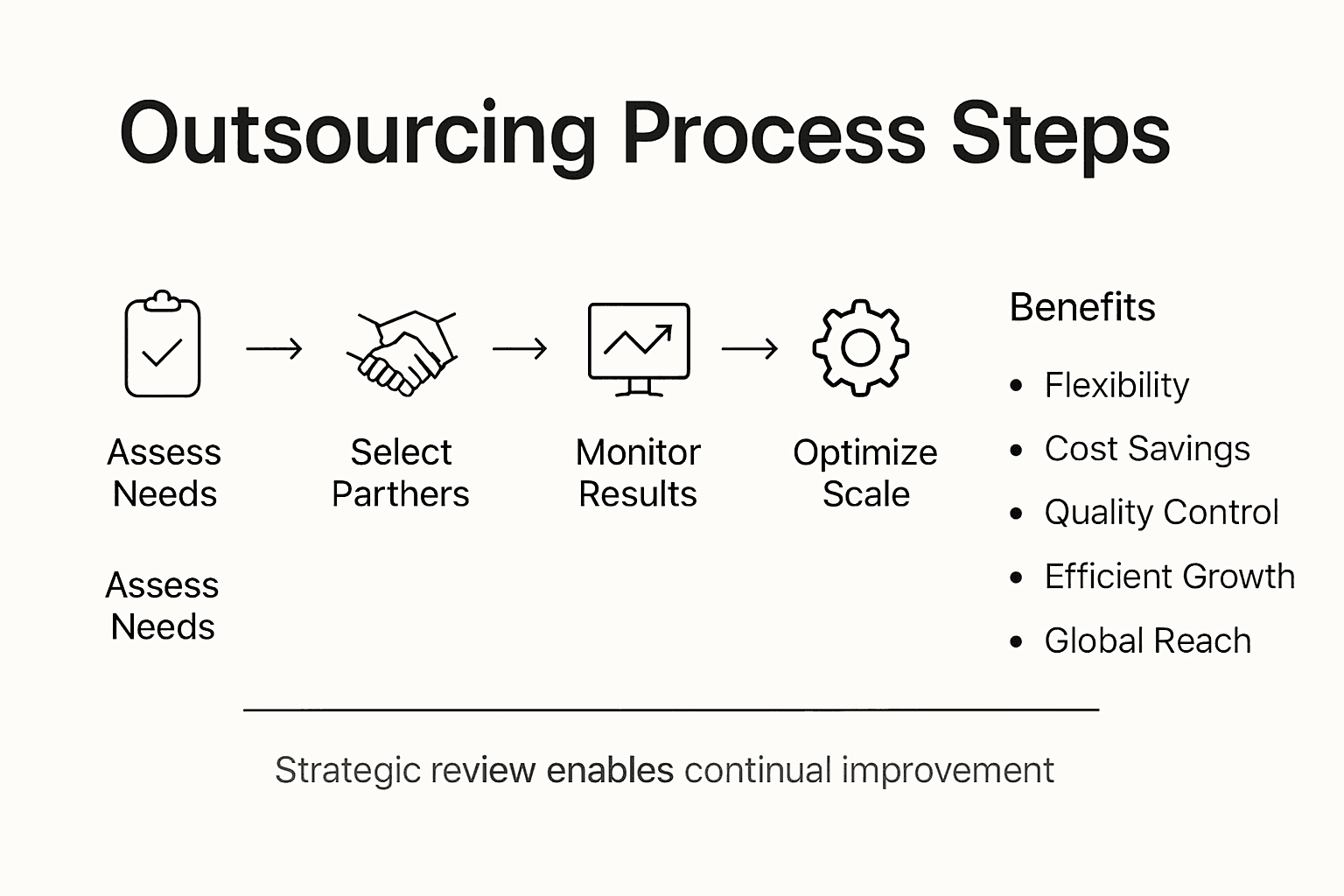
More than 50 percent of European tech firms now rely on outsourcing to drive growth and control costs. For C-suite executives and procurement managers, choosing the right American or European partners can determine whether operational improvements translate into lasting competitive advantage. This guide lays out clear, actionable strategies to assess business needs, structure agile agreements, and create scalable frameworks that support rapid expansion without compromising quality.
Table of Contents
- Step 1: Assess Business Needs And Define Outsourcing Objectives
- Step 2: Select Outsourcing Partners And Structure Scalable Agreements
- Step 3: Implement Tailored Onboarding And Communication Protocols
- Step 4: Monitor Performance And Integrate Feedback Loops
- Step 5: Verify Scalability And Optimize Ongoing Operations
Key Insights Summary
| Key Insight | Explanation |
|---|---|
| 1. Assess Business Needs | Conduct an internal audit to identify outsourcing opportunities that align with strategic goals. |
| 2. Strategic Partner Selection | Evaluate potential outsourcing partners on expertise, cultural compatibility, and scalability. |
| 3. Tailored Onboarding Process | Implement personalized onboarding for outsourced team members to ensure seamless integration. |
| 4. Performance Monitoring Framework | Establish a robust system for tracking performance metrics and integrating feedback for continuous improvement. |
| 5. Plan for Scalability | Develop flexible infrastructure and contingency plans to effectively handle growth challenges. |
Step 1: Assess business needs and define outsourcing objectives
Successfully scaling your global outsourcing strategy starts with a precise assessment of your current business infrastructure and strategic goals. This foundational step determines whether outsourcing will genuinely optimize your operational capabilities.
Begin by conducting a comprehensive internal audit that examines your current operational workflows, technological capabilities, and performance bottlenecks. Companies need to critically analyze their existing business processes to identify areas most suitable for outsourcing. Look for repetitive tasks, resource-intensive functions, or departments where specialized external expertise could provide significant performance improvements.
Evaluate your objectives through a strategic lens by mapping specific outcomes you want to achieve. Are you seeking cost reduction, accessing specialized talent, increasing scalability, or improving operational efficiency? Each objective requires a nuanced approach. For instance, cost reduction might prioritize regions with lower labor expenses, while talent acquisition could focus on technical expertise concentration. Establishing clear strategic objectives is critical in determining what functions to outsource and how success will be measured.
Align your outsourcing strategy with your broader organizational goals, ensuring that external partnerships complement your internal capabilities. This means considering technological compatibility, cultural alignment, and long term strategic fit.
Here’s a summary of strategic objectives and how outsourcing addresses each one:
| Strategic Objective | Outsourcing Approach | Business Impact |
|---|---|---|
| Cost Reduction | Use lower-cost regions | Improved profit margins |
| Access Specialized Talent | Target regions with expertise | Enhanced innovation & quality |
| Increased Scalability | Flexible resource allocation | Rapid business expansion |
| Operational Efficiency | Outsource repetitive tasks | Streamlined workflows |
Pro tip: Create a detailed scorecard that objectively ranks potential outsourcing opportunities based on strategic value, cost efficiency, and operational impact.
Step 2: Select outsourcing partners and structure scalable agreements
Selecting the right outsourcing partners requires a strategic approach that goes far beyond simple cost comparisons. Your goal is to identify global partners who can seamlessly integrate with your organizational culture and deliver exceptional operational performance.
Managing complex outsourcing relationships demands robust partner selection and coordination mechanisms that balance multiple critical factors. Start by developing a comprehensive evaluation framework that assesses potential partners across several key dimensions. Look beyond basic cost metrics to examine technical expertise, innovation capabilities, communication protocols, and cultural compatibility. Pay close attention to their track record of scaling services for similar businesses in your industry.
Structure agreements that provide maximum flexibility and clear performance expectations. Effective outsourcing partner selection involves defining specific business outcomes and evaluating providers holistically. This means creating contracts with scalable terms that allow for adjustments as your business needs evolve. Include specific key performance indicators (KPIs), service level agreements (SLAs), and mechanisms for periodic performance reviews.

Consider potential risks and build mitigation strategies into your partnership framework. This includes establishing clear communication channels, defining dispute resolution processes, and creating exit strategies that protect your business interests while maintaining operational continuity.
Pro tip: Develop a weighted scoring matrix that objectively evaluates potential outsourcing partners across multiple dimensions including cost, expertise, cultural fit, and scalability.
Step 3: Implement tailored onboarding and communication protocols
Successfully integrating outsourced team members requires a strategic and personalized approach that goes beyond traditional onboarding methods. Your goal is to create a comprehensive system that quickly transforms external talent into seamless organizational contributors.
Effective onboarding integrates new employees into organizational culture through tailored checklists and manager engagement. Develop a multi-stage onboarding process that addresses both technical skills and cultural assimilation. This means creating role specific welcome packages, establishing clear communication channels, and designing interactive training modules that help new team members understand your company’s unique workflow and expectations.
A competency-based onboarding program that employs e-learning and mentor engagement supports successful integration across global teams. Implement communication protocols that include regular check-ins, transparent performance expectations, and structured feedback mechanisms. Consider establishing a buddy system that pairs new outsourced team members with experienced internal staff who can provide real-time guidance and cultural context.
Ensure your communication infrastructure supports seamless collaboration across different time zones and cultural backgrounds. This includes selecting robust digital collaboration tools, establishing clear communication norms, and creating flexible interaction frameworks that respect diverse working styles while maintaining organizational consistency.
Pro tip: Create a comprehensive digital onboarding portal with interactive modules, role-specific resources, and real-time communication channels to streamline the integration process.
Step 4: Monitor performance and integrate feedback loops
Establishing a robust performance monitoring system is critical for maintaining the effectiveness and continuous improvement of your global outsourcing strategy. Your primary objective is to create a dynamic evaluation framework that allows real-time insights and proactive adjustments.
Establishing monitoring and evaluation feedback loops enables organizations to dynamically assess outsourced service performance through precise metrics and indicators. Develop a comprehensive performance tracking system that includes both quantitative and qualitative measurements. This means creating key performance indicators (KPIs) that capture productivity, quality, cost efficiency, and alignment with strategic objectives. Implement advanced analytics tools that provide granular visibility into team performance across different operational dimensions.
Design a multilayered feedback mechanism that encourages transparent communication and continuous improvement. Schedule regular performance review sessions that involve both internal stakeholders and outsourcing partners. These reviews should go beyond traditional reporting by facilitating open discussions about challenges, opportunities, and potential process enhancements. Use these interactions to refine communication protocols, address skill gaps, and align outsourced teams more closely with your organizational culture and goals.
Ensure your monitoring approach remains flexible and adaptive. This means regularly reassessing your evaluation metrics, staying responsive to changing business needs, and maintaining a forward looking perspective that views performance monitoring as a collaborative growth opportunity rather than a punitive exercise.
Below is a comparison of key performance monitoring metrics for outsourced teams:
| Metric | Quantitative Example | Qualitative Example | Business Benefit |
|---|---|---|---|
| Productivity | Project completion rate | Team collaboration effectiveness | Higher deliverable output |
| Quality | Defect rate | Customer satisfaction feedback | Improved service standards |
| Cost Efficiency | Operating cost per task | Budget adherence discussions | Controlled expenditures |
| Strategic Alignment | KPI achievement | Stakeholder satisfaction reviews | Consistency with goals |
Pro tip: Implement a weighted scoring system that balances objective performance metrics with qualitative feedback to create a more holistic evaluation framework.
Step 5: Verify scalability and optimize ongoing operations
Successfully scaling your global outsourcing operations requires a strategic approach that anticipates growth challenges and proactively designs flexible infrastructure. Your mission is to create an adaptive operational framework that can seamlessly expand without compromising performance or quality.
Scalability in operations is achieved through enhancing operational efficiency by leveraging technology and implementing data-driven decision-making. Develop robust technological infrastructure that supports modular growth, including cloud-based systems, scalable communication platforms, and integrated management tools. These technologies should allow you to quickly adjust resource allocation, add team members, and modify workflows without significant operational disruption.
Companies must assess and optimize processes regularly to maintain efficient operations at scale, especially in global outsourcing environments. Conduct periodic comprehensive reviews that examine team performance, technological capabilities, and alignment with evolving business objectives. Build flexibility into your contracts and operational agreements that allow for rapid recalibration of team structures, skill sets, and delivery mechanisms.
Create contingency planning that anticipates potential scaling challenges. This includes developing backup talent pools, cross training team members, and establishing clear protocols for rapid skill integration and knowledge transfer. Maintain a forward looking perspective that views scalability as a continuous process of adaptation and strategic refinement.
Pro tip: Implement quarterly scalability audits that systematically evaluate your operational infrastructure against projected growth metrics and emerging technological capabilities.
Unlock Scalable Global Outsourcing with StorsenDigital
Scaling global teams seamlessly requires more than just finding low-cost labor. The article highlights the challenges of selecting the right partners, structuring flexible agreements, and implementing tailored onboarding to achieve operational efficiency and long-term strategic alignment. If your business faces complexity in managing outsourced workflows, ensuring cultural fit, or monitoring performance effectively, you need a trusted partner who understands these critical pain points.
At StorsenDigital, we specialize in delivering comprehensive nearshoring and Business Process Outsourcing (BPO) services across Europe that address these exact challenges. From talent recruitment to managed BPO in HR, IT, finance, and customer support, our tailored solutions empower your company to reduce costs while enhancing quality and scalability. We integrate advanced communication protocols and digital onboarding tools that transform external teams into cohesive contributors aligned with your business goals.
Take the next step to master scalable outsourcing now! Discover how our strategic consulting and flexible operational models can accelerate your growth and optimize resource allocation. Visit our contact page to connect with our experts and start building your scalable global team.

Ready to turn outsourcing complexity into your competitive advantage? Explore how StorsenDigital’s trusted solutions deliver cost efficiency and operational excellence for medium to large enterprises aiming to expand through nearshoring. Reach out today and let us help you unlock your global potential.
Frequently Asked Questions
How can I assess my business needs before outsourcing?
To effectively assess your business needs, conduct a comprehensive internal audit of your existing workflows, technological capabilities, and any performance bottlenecks. Identify repetitive tasks or areas that would benefit most from external expertise, then rank these opportunities based on strategic value and operational impact.
What should I consider when selecting outsourcing partners?
When selecting outsourcing partners, evaluate them based on technical expertise, communication protocols, and cultural compatibility, in addition to cost. Develop a scoring matrix that objectively weighs these factors, ensuring your chosen partner can effectively scale services for your specific industry.
How do I create an effective onboarding process for outsourced team members?
To create an effective onboarding process, develop a multi-stage system that includes role-specific training modules and clear communication channels for new team members. Consider establishing a buddy system to help new hires integrate into your company culture and ensure they understand workflow expectations within the first month.
What metrics should I use to monitor outsourced team performance?
Use a balanced set of metrics that includes both quantitative indicators, like project completion rates, and qualitative measures, such as customer satisfaction feedback. Schedule regular review sessions to transparently discuss these metrics and make adjustments to improve performance.
How can I ensure my outsourcing operations are scalable?
To ensure scalability, implement a robust technological infrastructure that allows for flexible resource allocation and quick adjustments to team structures. Conduct quarterly scalability audits to evaluate your operational framework against projected growth metrics and address any potential challenges proactively.
What are some best practices for maintaining effective communication with global teams?
Establish clear communication protocols that include regular check-ins and the use of digital collaboration tools to facilitate seamless interaction. Consider designing flexible meeting schedules that accommodate different time zones, helping to maintain alignment and collaboration across your global teams.


